A quick overview of the Sunshine State's fascinating past, with photos and illustrations included.
In 1513, Spanish explorer Juan Ponce de León first set foot on Florida's east coast. The land he discovered was a geographic anomaly so distinctive that one day, centuries later, astronaut Neil Armstrong would say that Florida was the first shape on earth he recognized on his return from a visit to the moon.
This unique state has witnessed such momentous events as the 1959 arrival of the first Cuban exiles under Fidel Castro and the 1981 launch of the
Columbia—the first space shuttle. Join historian James C. Clark as he chronicles the surprising history of the Sunshine State in this concise and captivating book.
- 256 pages
- English
- ePUB (mobile friendly)
- Available on iOS & Android
eBook - ePub
A Concise History of Florida
About this book
Information
1
SETTLING FLORIDA
More than ten thousand years ago, as the great glaciers began to melt, Florida began to take shape. It had the same general shape as it has today, only it was twice as wide. St. Petersburg would have been one hundred miles inland during this period. As the glaciers melted, the sea level rose, and the peninsula of Florida was reduced to its present size. (The Florida peninsula is so distinctive that astronaut Neil Armstrong said Florida was the first shape on earth he recognized as he returned from his walk on the moon.)
Four thousand miles away, ice created a bridge from Siberia to Alaska, allowing people to enter North America. They scattered across the continent and reached Florida nearly sixteen thousand years ago.
The first Floridians hunted animals far different from those found today. They hunted bison, camels, mastodons and mammoths, but when hunting wiped those creatures out, the people turned to more traditional game such as rabbits and deer. Florida’s first settlements formed around springs, such as Warm Mineral Springs in present-day Sarasota.
The people who settled along the coastline moved farther inland as the sea level rose. By 5,000 BC, the Florida climate had become what it is today.
The population increased, and the native tribes built villages. Archaeologists have found that around 2,000 BC, the tribes made fired-clay pottery.
By 500 BC, there were established tribes throughout the peninsula, including the Timucuan, Calusa and Apalachee, with smaller tribes in more far-flung locations. The Ais lived near the Indian River, Creeks and Choctaws in the panhandle, the Matacumbes in the Florida Keys and the Tequestas in southeast Florida.
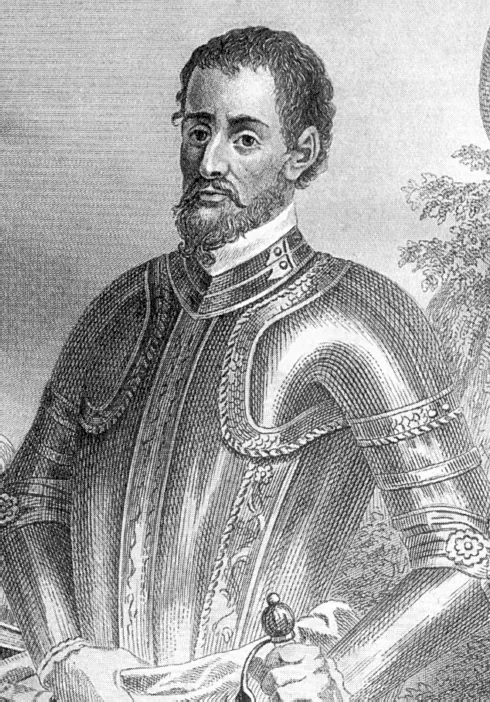
Hernando de Soto led an expedition through Florida and what is now the southeastern United States. Florida Archives Photographic Collection.
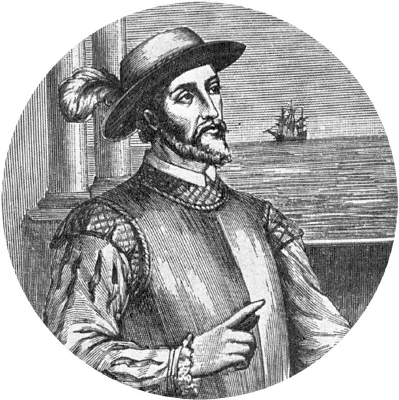
Credited with the European discovery of Florida, Ponce de León named it after the “Feast of Flowers.” Florida Archives Photographic Collection.
The Timucuans established a number of villages in north-central Florida. They grew corn and gathered fruits and berries. The Timucuan villages featured a cluster of small huts surrounded by a circular twelve-foot-high wall of tree trunks. They had a rigid feudal system with a chief and council.
The Calusa Indians in the southern half of the peninsula lived in nearly fifty villages.
The population estimates vary widely; however, by the time the Europeans arrived, there were between 100,000 and 300,000 people in Florida.
There was one tribe that would become synonymous with Florida that was not present—the Seminoles. They were late arrivals, not moving into Florida until the 1700s.
Although Juan Ponce de León gets the credit for the “discovery” of Florida, there are indications that the peoples of the Caribbean islands, such as Cuba, moved between the islands and Florida much earlier. The people who came might have been looking for slaves and avoided publicizing their voyages. Crude forms of Florida first appear on maps around 1500. One sign that the Spanish had come before is seen in the hostile reaction Ponce de León and other explorers received. The Indians had apparently encountered the outsiders before, and the experience was negative.
TIMELINE 14,000 BC–AD 700
14,000 BC: The first people arrive in Florida.
9,000 BC: Glaciers melt, and Florida shrinks. The peninsula was once twice as wide.
7,500 BC: People hunted, gathered and started settlements during the Archaic period.
5,000 BC: First semipermanent settlements in Florida.
4,000 BC: Settlements are established along the St. Johns River and near present-day Tampa.
3,000 BC: The late Archaic period sees settlements on the coasts and along riverbanks.
2,000 BC: First fired-clay pottery comes into use.
500 BC: Mound building takes place along the Crystal River.
AD 700: Indian tribes, including the Timucuan, Apalachee, Calusa and Tequesta, are formed.
The Columbus expedition in 1492 set off waves of Spanish exploration that stretched from Hispaniola to Peru. Florida was a late addition to the Spanish Empire.
The knowledge that there was gold in the New World led to a gold rush by the Spanish. The search for wealth drew people of various backgrounds. Thousands of poor Spaniards enlisted in the military for a chance to claim a share of the wealth. The Spanish practiced a system called primogeniture, which meant that the eldest son inherited the vast majority of the father’s wealth, leaving younger sons to fend for themselves and causing many of them to seek fame and fortune in the New World. After Spain’s wars with the Moors ended, soldiers sought new adventures.
The adventurers, known as conquistadors, came to conquer the Indians and make their fortune.
Conquistador Ponce de León originally came with the second voyage of Christopher Columbus and was later named governor of Puerto Rico. The son of Christopher Columbus challenged Ponce de León’s position as governor, and as a consolation, the king of Spain granted Ponce de León a charter to go look for new lands. On March 3, 1513, his three ships sailed north, and on April 2, they sighted land. He named the cape he rounded “Cape Canaveral,” the first European name for a point in North America.
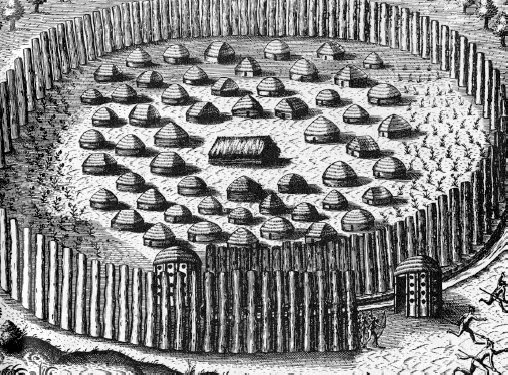
French artist Jacques Le Moyne drew this rendering of a Timucuan village. The chief lived in the larger structure in the middle of the compound. Florida Archives Photographic Collection.
He named the territory La Florida, or “feast of flowers,” because it was the Easter season, and he claimed it for the king of Spain.
No one is sure where he landed, the original North American mystery. It was probably near present-day Melbourne, although there are many claims and no proof.
Wherever he landed, the reception was probably not what he expected. The natives attacked and injured three of his crewmen. Ponce de León fought back just enough to get his men to safety. The attack was unprovoked; perhaps the natives had encountered other Europeans who sought to enslave them. When he reached his second landing site at Jupiter Inlet, Ponce de León was attacked again. Then, while sailing around the keys and up the west coast, he was attacked twice more.
For three weeks, he wandered along the coast and then returned to Puerto Rico. It was seven years before he returned. He planned to come back sooner; however, his wife died, and he needed to care for his daughters.
When he did come back, it was to establish a settlement. He brought two hundred settlers—men and women—along with farming implements, plants and animals. Where he landed is unknown, but it was on the southwest coast near Port Charlotte.
The natives there were no friendlier than the ones he had encountered on his voyage seven years earlier. As the Spanish left the ships, the attacks began. There were three attacks, and Ponce de León himself was shot with an arrow in his thigh.
He ordered a withdrawal to Cuba, where he died of infection—perhaps from a poisonous arrow.
There was another expedition in 1528, this one led by Pánfilo de Narváez, whose luck was no better than Ponce de León’s. Narváez was a classic conquistador, seeking plunder but finding only misery and death waiting for his three hundred men. Only a handful of the members of the expedition survived.
Hernando de Soto came in 1539 with a royal contract that gave him the power to explore and govern Florida and spread the Catholic faith. He came with 537 men and landed on the west coast of the peninsula.
After landing, he found Juan Ortiz, a survivor of the Narváez expedition who had been living with the natives. They walked and rode their horses for three long years, wandering through what is now the southeastern United States, although their exact route is uncertain. The Spanish claim ran to what is now Washington, D.C., and west to the Mississippi—if they could hold it.
The De Soto expedition spread European diseases throughout the region, wiping out large numbers of natives. Among the dead was De Soto, who died of disease on the banks of the Mississippi and was buried in the river. His men—their number reduced by two hundred—made their way to Mexico.
Luis Cancer arrived in 1549, sent by the viceroy of Mexico with three other missionaries to Tampa Bay. As he went ashore, he was clubbed to death by the natives. The survivors returned to Mexico.
Tristán de Luna arrived a decade later, sent from Mexico with 1,500 settlers and soldiers to the Gulf Coast. He proved to be a terrible leader, and the expedition failed.
The Spanish were ready to give up on La Florida as not worth the money and lives. On September 23, 1561, King Philip II announced that Spain no longer had an interest in settling Florida.
Between 1513 and 1560, not a single Spanish settlement was built.
2
THE FRENCH CHALLENGE
King Philip II’s decision to abandon Florida might have stood if not for the French. Like children who express interest in a toy only when another child wants to play with it, Florida recaptured the Spanish imagination only when France wanted it.
In France, the Protestants—known as Huguenots—sought religious freedom from the government, which often persecuted them. The Huguenots fled to nations throughout Europe and to North America.
In 1562, Jean Ribault was selected to lead an expedition to North America, accompanied by his aide, René de Laudonnière. He landed near Cape Canaveral and then sailed north to the mouth of the river the Spanish called the St. Johns, which Ribault renamed River of May, after the month he arrived.
He and the Timucuan Indians became friends, regularly exchanging gifts and food. When Ribault returned to Europe, he made a brief detour along the way to establish a colony in present-day South Carolina.
The British jailed Ribault briefly, and Laudonnière took over the French mission. For centuries, it was thought that the French built Fort Caroline at present-day Jacksonville, but no trace of the fort has ever been found. Recent research suggests that the three-sided fort was located in present-day Georgia, not Florida. The colony had several hundred residents but not enough soldiers. Laudonnière was a weak leader, and his colony was plagued with problems. After being released from jail, Ribault returned to try to salvage the French settlement.
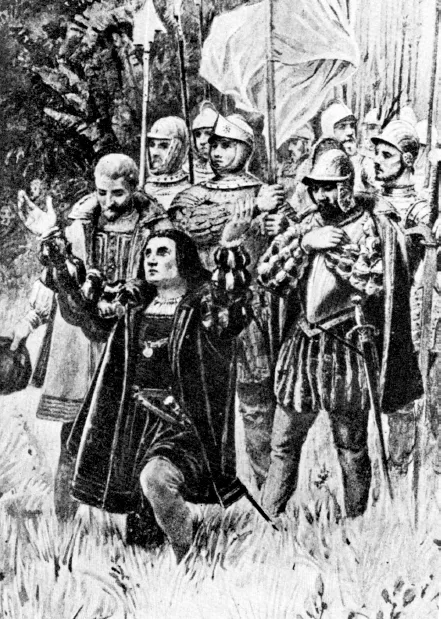
Jean Ribault claimed Florida for France in 1562, leading the Spanish to settle the territory they had originally decided to ignore. Florida Archives Photographic Collection.
The Spanish were alarmed by the French presence, which was along the Gulf Stream, the route for Spanish ships laden with gold. The Catholic Church also was concerned that the French Protestants would convert the Indians to the Protestant faith.
THE ST. JOHNS RIVER
For centuries, the St. Johns River was the lifeblood of Florida, bringing tourists and industry to the state.
The Indians called it the “River of Lakes,” and the Spaniards initially called it “River of Currents.” Sailing along the east coast of Florida, the Spanish saw streams empty into the Atlantic and named each of them. They had no idea where they led, and overeager mapmakers often filled in the details, showing nonexistent waterways that reached the Gulf of Mexico.
The river is unusual because its waters flow north. The first Spaniard to see the river was Juan Bono Quexo in 1520. However, it was the French who first tried to settle the area. In 1564, the French erected Fort Carolina where the river reaches the Atlantic Ocean. Jean Ribault renamed it the River of May, but the French settlement lasted only a year, and the Spanish renamed it River of St. Matthew.
The mission of St. John w...
Table of contents
- Front Cover
- Title Page
- Copyright
- Dedication
- Contents
- Acknowledgements
- 1. Settling Florida
- 2. The French Challenge
- 3. Spanish Rule
- 4. The British Period
- 5. The American Revolution
- 6. Spain Returns
- 7. The First African Americans
- 8. The Territory of Florida
- 9. The State of Florida
- 10. Establishing Education
- 11. The Seminole Wars
- 12. The Civil War
- 13. Reconstruction
- 14. The Early Tourists
- 15. The Everglades
- 16. Presidents and Florida
- 17. Bourbon Florida
- 18. The Spanish-American War
- 19. Sports in Florida
- 20. The New Tourists
- 21. Florida Governors 1868–1950
- 22. Florida Immigrants
- 23. Oranges
- 24. Florida Colleges
- 25. Making Music
- 26. Space Age Florida
- 27. The 1920s
- 28. Florida Writers
- 29. Florida in the Movies
- 30. The Great Depression
- 31. World War II
- 32. Modern Tourism
- 33. Florida Politics 1948–2014
- 34. Hurricanes
- 35. Air Conditioning
- 36. Civil Rights in Florida
- 37. Modern Florida
- Appendix I: Florida’s Counties and Admission Dates
- Appendix II: Florida Governors
- Bibliography
- About the Author
Trusted by 375,005 students
Access to over 1.5 million titles for a fair monthly price.
Study more efficiently using our study tools.
Frequently asked questions
Yes, you can cancel anytime from the Subscription tab in your account settings on the Perlego website. Your subscription will stay active until the end of your current billing period. Learn how to cancel your subscription
No, books cannot be downloaded as external files, such as PDFs, for use outside of Perlego. However, you can download books within the Perlego app for offline reading on mobile or tablet. Learn how to download books offline
Perlego offers two plans: Essential and Complete
- Essential is ideal for learners and professionals who enjoy exploring a wide range of subjects. Access the Essential Library with 800,000+ trusted titles and best-sellers across business, personal growth, and the humanities. Includes unlimited reading time and Standard Read Aloud voice.
- Complete: Perfect for advanced learners and researchers needing full, unrestricted access. Unlock 1.5M+ books across hundreds of subjects, including academic and specialized titles. The Complete Plan also includes advanced features like Premium Read Aloud and Research Assistant.
We are an online textbook subscription service, where you can get access to an entire online library for less than the price of a single book per month. With over 1.5 million books across 990+ topics, we’ve got you covered! Learn about our mission
Look out for the read-aloud symbol on your next book to see if you can listen to it. The read-aloud tool reads text aloud for you, highlighting the text as it is being read. You can pause it, speed it up and slow it down. Learn more about Read Aloud
Yes! You can use the Perlego app on both iOS and Android devices to read anytime, anywhere — even offline. Perfect for commutes or when you’re on the go.
Please note we cannot support devices running on iOS 13 and Android 7 or earlier. Learn more about using the app
Please note we cannot support devices running on iOS 13 and Android 7 or earlier. Learn more about using the app
Yes, you can access A Concise History of Florida by James C. Clark in PDF and/or ePUB format, as well as other popular books in History & North American History. We have over 1.5 million books available in our catalogue for you to explore.