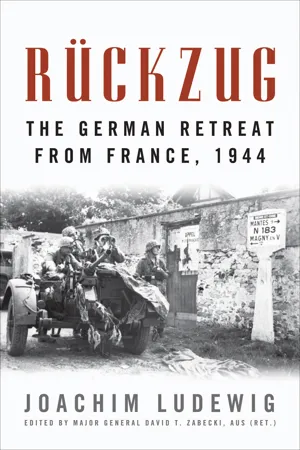
A German historian's account of the Nazi retreat from France in the summer of 1944: "An important book [about] a surprisingly under-examined phase of WWII" (Anthony Beevor,
Wall Street Journal).
The Allied invasion of Normandy on June 6, 1944, marked a critical turning point in the European theater of World War II. The massive landing on France's coast had been meticulously planned for three years, and the Allies anticipated a quick and decisive defeat of the German forces. Many of the planners were surprised, however, by the length of time it ultimately took to defeat the Germans.
While much has been written about D-Day, very little has been written about the crucial period from August to September, immediately after the invasion. In
Rückzug, Joachim Ludewig draws on military records from both sides to show that a quick defeat of the Germans was hindered by excessive caution and a lack of strategic boldness on the part of the Allies, as well as by the Germans' tactical skill and energy. This intriguing study, translated from German, not only examines a significant and often overlooked phase of the war, but also offers a valuable account of the conflict from the perspective of the German forces.
- 504 pages
- English
- ePUB (mobile friendly)
- Available on iOS & Android
eBook - ePub
About this book
Information
Part 1
The Initial Situation
Facing OB West in the
Middle of August 1944
The Situation in Northern France
and the Allied Landings along
the Mediterranean Coast
and the Allied Landings along
the Mediterranean Coast
Chapter 1
The German Reich's Military-Political Situation
Development of the General Conditions up to the Summer of 1944
Operation BARBAROSSA had failed. Its operational timing was thrown off when the German offensive ground to a halt in front of Moscow at the end of 1941. But it also was a failure in terms of Hitler's vision of worldwide Blitzkrieg. When it still looked like the Soviet Union would be defeated, it was hard to foresee that the war could not be continued on Hitler's terms, with Germany in a consolidated European world power position. But the end of 1942 and the start of 1943 brought the final turning point in the war, both against the German Reich (with the landings of the Allies in French northwest Africa, the British offensive against German Army Group Africa, and the German failure at Stalingrad) and against Japan in the Pacific (at the battles at Midway and Guadalcanal). The military initiative had shifted to the side of the anti-Hitler coalition, and the German war-fighting machine was increasingly forced on the defensive. By the time Grand Admiral Karl Dönitz was forced to recall his submarines from the mission of attacking Allied convoys in the North Atlantic in the spring of 1943, the Allies had secured the lifelines between the Old and New Worlds. Their certain victory in the Battle of the Atlantic also set one of the key conditions for large-scale operations against German-occupied Europe. Hitler was forced to drop the overseas phase of his program, a phase that had envisioned colonies and systems of bases to support an international policy reaching beyond Europe. All efforts on the German side now concentrated on holding onto what was called Fortress Europe. Germany's central geographic position had always exposed it to the danger of a two-front war, but now in July 1943 that threat had a direct effect on military operations for the first time. The Germans were forced to break off their limited offensive against the Kursk salient in reaction to the Allied landings on Sicily. The Allied penetration into the southern periphery of Fortress Europe allowed them to establish strategic air bases, which further contributed to the increasing of Allied air superiority starting in the summer of 1943. Fortress Europe had no overhead cover, no roof, which meant that the traditional advantage of interior lines was of much less value to the defender. Through naval and air superiority the Allies had established decisive prerequisites for the success of their planned invasion of France in 1944. The German shift to the defensive resulted in the implementation of a rigid hold-the-line strategy that was diametrically opposed to Clausewitz's teachings. By November 1943 Hitler concluded that the point of main effort now had to be shifted once again to the west to defeat the anticipated landings. A successful invasion in the west would threaten the vital core of the German armament capacities faster than any Soviet offensive from the east, because of the short distance between the point of the invasion and the center of Germany's heavy industry. Additionally, Germany with its remaining resources was capable of achieving a decisive military victory only in the west. In Hitler's view, such a military success could still offer possibilities for overall strategic exploitation. In contrast to what would happen in the east, any developing western invasion front would cover at least initially a geographically relatively limited combat area, and the Germans would not immediately have to face an overwhelming enemy force-ratio superiority. According to Führer Directive 51 of November 3, 1943,1 the Allied invasion was to be repelled through “decisive battle on the landing beaches.” Failing that, and after any initial enemy successes, the objective then would be “to throw the enemy back into the sea by means of a counterattack.” The success of either course of action would support Hitler's evergrowing hopeful conviction that he could trigger the collapse of the Allied coalition and then implement his basic alliance-policy idea of an accommodation with Great Britain, or at least the British withdrawal from the war. The “long-range struggle against England,” emphasized in Directive 51, and the means with which the British were to be worn down by the vengeance weapons—the V-1 Buzz Bomb and V-2 Missile—to the point where they would at last be bombed into pacification, was a rather absurd notion, considering that the Allied bombing raids on Germany's large cities had so far produced little success.
Hitler believed that a military success in the west was the last chance to bring about a turning point in the war. If nothing else, he hoped to gain some maneuver room for the Reich, which since early 1943 had been faced with the Allied demand for unconditional surrender that was now the only basis for any negotiations. The underlying intent of Führer Directive 51 can be seen in the continuity of its systematic and racial-ideological concepts. The idea was to maintain or restore the situation of a secure continental back door that had been achieved in 1940, and therefore lay the foundation for a renewed offensive toward the east. Thus, this final major phase of Hitler's military thinking was characterized by a strategic concept that merely echoed the period before the earlier victory over France. But the decisive factor in this case was the fact that this concept retained its validity even as the Reich's overall situation deteriorated so rapidly throughout the year 1944 that, compared to 1940, there was an almost immeasurable gap between idea and reality.2 Apart from the events in France, the overall situation in the summer of 1944 looked just about hopeless. It was marked by the constant retreat of the German front lines and the gradual defection of the allies of the Third Reich, starting with Italy in September 1943. The situation in the Italian theater of war, of course, had essentially stabilized. The units of OB Südwest (Supreme Command Southwest) gradually withdrew to the Apennines position until September 1944. But on the Eastern Front the Wehrmacht suffered its most serious setbacks to date in the fight against the Soviet Union.
Because a center of gravity was forming in the west, the Eastern Front was weakened correspondingly and it no longer received the forces it might have expected otherwise.3 Just as the center of gravity was being shifted, the German Eastern Front was severely disrupted by the large-scale offensives mounted by the Soviets during the summer months. The Soviet pincer offensive launched on June 22, 1944, triggered the collapse of German Army Group Center and resulted in the decisive defeat of the German army during the war in the east. Along with the tremendous manpower losses of twentyeight divisions and 350,000 men, the Soviet offensive also meant that by the end of July Germany's eastern boundaries were now directly threatened. During the next several weeks this disastrous situation spread to the frontline sectors of German Army Groups North, North Ukraine, and South Ukraine. The resulting German defeats and retreats also made the positions of Germany's allies untenable. Between August and September, Romania, Bulgaria, and Finland broke with the Reich, leaving Germany completely isolated in the foreign policy arena. Hungary, which only barely hung on to the German side, and Japan, with which there had never been any meaningful coordination of military operations, remained the last major allies of the Reich. Raw material shortages kept spreading throughout Germany's armament industries, along with the progressive shrinkage of the German-controlled “defensive regions” that supplied the Reich's war-fighting capabilities with material resources and labor. More than anyone else, it was Albert Speer4 who in 1942 reorganized Germany's defense industry along the basic lines of decentralized economic management to the maximum extent possible. Because of his efforts, Germany's war industry did not collapse during this period of attritional warfare. In the summer of 1944, many branches of the armament industry were still able to achieve peak production, but the bottlenecks in the petroleum sector alone indicated clearly that the end of all modern military mobility was coming sooner than later. The end seemed to be just around the corner following the Allied bombing raids on the synthetic fuel processing plants starting on May 12, 1944, and certainly with the capture of the Romanian oil fields around Ploesti on August 30, which for the armaments industry meant the loss of the war.
As long as Hitler clung to his fixed idea that the enemy coalition was bound to fall apart, he did not come to terms with the real situation in the summer of 1944. But the conclusions that could be drawn from the disastrous development of the situation in the west and the establishment of the second front in France were only too clear. In his book, Mein Kampf, Hitler had written: “Germany will either be a world power or it will not exist at all.”5 In his mind the war had to be fought to the complete exhaustion of all available potential. Fully following his maxim of all or nothing, Hitler therefore never considered capitulation, especially since he desperately clung to the conviction that he could turn the situation around in the end with a powerful thrust in the west. Considering this course of action, any potential maneuver room for seeking a political solution was extremely restricted at best. But any maneuver room had already ceased to exist in practice because of the Allies’ announced demand of unconditional surrender,6 which amounted to a total governmental and political capitulation based on the standards of international law.7 This Allied policy made it quite clear that either discontinuation of the war or defeat would result in not only the downfall of Hitler's empire but also the end of Germany's status as a major power. The result was a confirmation of at least a partial intersection of the vital interests between Hitler's regime and Germany's old leadership groups in the government bureaucracy, in industry, in the military establishment, and in diplomacy.8 These circumstances certainly contributed to the steadfastness of German defensive fighting on all fronts, even after the final outcome had largely been decided.
The German propaganda effort was made easier not only by the unconditional surrender policy, but also by the subsequently publicized Allied plans for postwar Germany. Those plans, announced at the Teheran Conference at the end of 1943, included dismemberment of Germany, occupation zones—designated in the spring of 1944—and finally the Morgenthau Plan of September 1944. German propaganda, of course, was directed by Dr. Josef Goebbels, who on July 25, 1944, was also appointed Reich Plenipotentiary for the Total War Effort.
The majority of the German population found itself chained to a regime whose propaganda skillfully stirred up anxiety about an uncertain future, fear of the Red Army in the east, and the militarily senseless bombing raids against Germany's large cities. German propaganda thus exploited the impotent rage of the population for its own purposes and fed the flames of resistance based on the hopes for a final, ultimate victory that, in retrospect, appears completely irrational.
Like propaganda, governmental power springing from Nazi terror directed against the population and which had been increasing since 1943 prolonged the war to an extent that should not be underestimated.9 Once the war had clearly turned, ideology pervaded almost all aspects of German life. Visible symbols of the effect of this process on the Wehrmacht can be seen in the December 22, 1943, introduction of the National Socialist Guidance Officer and the so-called German salute on July 23, 1944. The spreading influence of the Nazi Party and the SS also resulted in the party's provincial gauleiters (regional leaders) being appointed to the office of Reich defense commissar, effective November 16, 1942. Reichsführer-SS Heinrich Himmler, who already had been the Reich interior minister since 1943, also became the commanding general of the Replacement Army after the attempt on Hitler's life on July 20, 1944.
The German population, which during the second half of 1944 was more firmly than ever before under the control of the National Socialist leadership, nonetheless remained largely uninformed of the racial policy crimes of...
Table of contents
- Cover
- Title
- Copyright
- Contents
- World War II German Military Ranks
- Foreword
- Author's Acknowledgments
- A Note on the English Edition
- List of Abbreviations
- Introduction
- Part 1. The Initial Situation Facing OB West in the Middle of August 1944: The Situation in Northern France and the Allied Landings along the Mediterranean Coast
- Part 2. From the Retreat of the German Army in the West to the Climax of the Crisis: Combat Operations from August 20 to September 4, 1944
- Part 3. Developments from the Climax of the Crisis until the Transition to Positional Warfare in the West: Combat Operations in September 1944
- Conclusion
- Notes
- Bibliography
- Index
Trusted by 375,005 students
Access to over 1.5 million titles for a fair monthly price.
Study more efficiently using our study tools.
Frequently asked questions
Yes, you can cancel anytime from the Subscription tab in your account settings on the Perlego website. Your subscription will stay active until the end of your current billing period. Learn how to cancel your subscription
No, books cannot be downloaded as external files, such as PDFs, for use outside of Perlego. However, you can download books within the Perlego app for offline reading on mobile or tablet. Learn how to download books offline
Perlego offers two plans: Essential and Complete
- Essential is ideal for learners and professionals who enjoy exploring a wide range of subjects. Access the Essential Library with 800,000+ trusted titles and best-sellers across business, personal growth, and the humanities. Includes unlimited reading time and Standard Read Aloud voice.
- Complete: Perfect for advanced learners and researchers needing full, unrestricted access. Unlock 1.5M+ books across hundreds of subjects, including academic and specialized titles. The Complete Plan also includes advanced features like Premium Read Aloud and Research Assistant.
We are an online textbook subscription service, where you can get access to an entire online library for less than the price of a single book per month. With over 1.5 million books across 990+ topics, we’ve got you covered! Learn about our mission
Look out for the read-aloud symbol on your next book to see if you can listen to it. The read-aloud tool reads text aloud for you, highlighting the text as it is being read. You can pause it, speed it up and slow it down. Learn more about Read Aloud
Yes! You can use the Perlego app on both iOS and Android devices to read anytime, anywhere — even offline. Perfect for commutes or when you’re on the go.
Please note we cannot support devices running on iOS 13 and Android 7 or earlier. Learn more about using the app
Please note we cannot support devices running on iOS 13 and Android 7 or earlier. Learn more about using the app
Yes, you can access Rückzug by Joachim Ludewig, David T. Zabecki in PDF and/or ePUB format, as well as other popular books in History & European History. We have over 1.5 million books available in our catalogue for you to explore.