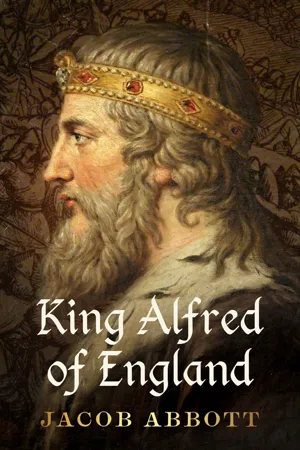
The biography of Alfred the Great, the ninth-century king who fended off the Vikings and converted their leader to Christianity.
King of Wessex from 871 to 886 AD, and king of the Anglo-Saxons until 899 AD, the man who would later be known as Alfred the Great saved his realm from the Vikings even as surrounding kingdoms fell to them. He then made the conversion of the Vikings' leader, Guthrum, to Christianity a condition of their peace treaty—and eventually became renowned for his beneficent rule, sharp intellect, and reforms in the areas of education, law, and the military.
This biography, richly detailed and with a distinctly witty touch, brings Alfred and his world to vivid life.
- 157 pages
- English
- ePUB (mobile friendly)
- Available on iOS & Android
eBook - ePub
King Alfred of England
About this book
Information
Topic
HistoireSubtopic
Biographies historiquesThe Sequel
The romantic story of Godwin forms the sequel to the history of Alfred, leading us onward, as it does, toward the next great era in English history, that of William the Conqueror.
Although, as we have seen in the last chapter, the immediate effects of Alfred’s measures was to re-establish peace and order in his kingdom, and although the institutions which he founded have continued to expand and develop themselves down to the present day, still it must not be supposed that the power and prosperity of his kingdom and of the Saxon dynasty continued wholly uninterrupted after his death. Contentions and struggles between the two great races of Saxons and Danes continued for some centuries to agitate the island. The particular details of these contentions have in these days, in a great measure, lost their interest for all but professed historical scholars. It is only the history of great leading events and the lives of really extraordinary men, in the annals of early ages, which can now attract the general attention even of cultivated minds. The vast movements which have occurred and are occurring in the history of mankind in the present century, throw every thing except what is really striking and important in early history into the shade.
The era which comes next in the order of time to that of Alfred in the course of English history, as worthy to arrest general attention, is, as we have already said, that of William the Conqueror. The life of this sovereign forms the subject of a separate volume of this series. He lived two centuries after Alfred’s day; and although, for the reasons above given, a full chronological narration of the contentions between the Saxon and Danish lines of kings which took place during this interval would be of little interest or value, some general knowledge of the state of the kingdom at this time is important, and may best be communicated in connection with the story of Godwin.
Godwin was by birth a Saxon peasant, of Warwickshire. At the time when he arrived at manhood, and was tending his father’s flocks and herds like other peasants’ sons, the Saxons and the Danes were at war. It seems that one of Alfred’s descendants, named Ethelred, displeased his people by his misgovernment, and was obliged to retire from England. He went across the Channel, and married there the sister of a Norman chief named Richard. Her name was Emma. Ethelred hoped by this alliance to obtain Richard’s assistance in enabling him to recover his kingdom. The Danish population, however, took advantage of his absence to put one of their own princes upon the throne. His name was Canute. He figures in English history, accordingly, among the other Eng- lish kings, as Canute the Dane, that appellation being given him to mark the distinction of his origin in respect to the kings who pre- ceded and followed him, as they were generally of the Saxon line.
It was this Canute of whom the famous story is told that, in order to rebuke his flatterers, who, in extolling his grandeur and power, had represented to him that even the elements were sub- servient to his will, he took his stand upon the sea-shore when the tide was coming in, with his flatterers by his side, and command- ed the rising waves not to approach his royal feet. He kept his sycophantic courtiers in this ridiculous position until the en- croaching waters drove them away, and then dismissed them overwhelmed with confusion. The story is told in a thousand dif- ferent ways, and with a great variety of different embellishments, according to the fancy of the several narrators; all that there is now any positive evidence for believing, however, is, that probably some simple incident of the kind occurred, out of which the stories have grown.
Canute did not hold his kingdom in peace. Ethelred sent his son across the Channel into England to negotiate with the Anglo-Saxon powers for his own restoration to the throne. An arrangement was accordingly made with them, and Ethelred returned, and a violent civil war immediately ensued between Ethelred and the Anglo-Saxons on the one hand, and Canute and the Danes on the other. At length Ethelred fell, and his son Edmund, who was at the time of his death one of his generals, succeeded him. Emma and his two other sons had been left in Normandy. Edmund carried on the war against Canute with great energy. One of his battles was fought in the county of Warwick, in the heart of England, where the peasant Godwin lived. In this battle the Danes were defeated, and the discomfited generals fled in all directions from the field wherever they saw the readiest hope of concealment or safety. One of them, named Ulf,12 took a by-way, which led him in the direction of Godwin’s father’s farm.
Night came on, and he lost his way in a wood. Men, when flying under such circumstances from a field of battle, avoid always the public roads, and seek concealment in unfrequented paths, where they easily get bewildered and lost. Ulf wandered about all night in the forest, and when the morning came he found himself exhausted with fatigue, anxiety, and hunger, certain to perish unless he could find some succor, and yet dreading the danger of being recognized as a Danish fugitive if he were to be discovered by any of the Saxon inhabitants of the land. At length he heard the shouts of a peasant who was coming along a solitary pathway through the wood, driving a herd to their pasture. Ulf would glad-ly have avoided him if he could have gone on without succor or help. His plan was to find his way to the Severn, where some Danish ships were lying, in hopes of a refuge on board of them. But he was exhausted with hunger and fatigue, and utterly bewildered and lost; so he was compelled to go forward, and take the risk of accosting the Saxon stranger.
He accordingly went up to him, and asked him his name. Godwin told him his name, and the name of his father, who lived, he said, at a little distance in the wood. While he was answering the question, he gazed very earnestly at the stranger, and then told him that he perceived that he was a Dane—a fugitive, he supposed, from the battle. Ulf, thus finding that he could not be concealed, begged Godwin not to betray him. He acknowledged that he was a Dane, and that he had made his escape from the battle, and he wished, he said, to find his way to the Danish ships in the Severn. He begged Godwin to conduct him there. Godwin replied by saying that it was unreasonable and absurd for a Dane to expect guidance and protection from a Saxon.
Ulf offered Godwin all sorts of rewards if he would leave his herd and conduct him to a place of safety. Godwin said that the attempt, were he to make it, would endanger his own life without saving that of the fugitive. The country, he said, was all in arms. The peasantry, emboldened by the late victory obtained by the Saxon army, were every where rising; and although it was not far to the Severn, yet to attempt to reach the river while the country was in such a state of excitement would be a desper ate undertaking. They would almost certainly be intercepted; and, if intercepted, their exasperated captors would show no mercy, Godwin said, either to him or to his guide.
Among the other inducements which Ulf offered to Godwin was a valuable gold ring, which he took from his finger, and which, he said, should be his if he would consent to be his guide.
Godwin took the ring into his hand, examined it with much apparent curiosity, and seemed to hesitate. At length he yielded; though he seems to have been induced to yield, not by the value of the offered gift, but by compassion for the urgency of the distress which the offer of it indicated, for he put the ring back into Ulf’s hand, saying that he would not take any thing from him, but he would try to save him.
Instead, however, of undertaking the apparently hopeless enterprise of conducting Ulf to the Severn, he took him to his father’s cottage and concealed him there. During the day they formed plans for journeying together, not to the ships in the Severn, but to the Danish camp. They were to set forth as soon as it was dark. When the evening came and all was ready, and they were about to commence their dangerous journey, the old peasant, Godwin’s father, with an anxious countenance and manner, gave Ulf this solemn charge:
"This is my only son. In going forth to guide you under these circumstances, he puts his life at stake, trusting to your honor. He can not return to me again, as there will be no more safety for him among his own countrymen after having once been a guide for you. When, therefore, you reach the camp, present my son to your king, and ask him to receive him into his service. He can not come again to me." Ulf promised very earnestly to do all this and much more for his protector; and then bidding the father farewell, and leaving him in his solitude, the two adventurers sallied forth into the dark forest and went their way.
After various adventures, they reached the camp of the Danes in safety. Ulf faithfully fulfilled the promises that he had made. He introduced Godwin to the king, and the king was so much pleased with the story of his general’s escape, and so impressed with the marks of capacity and talent which the young Saxon manifested, that he gave Godwin immediately a military command in his army. In fact, a young man who could leave his home and his father, and abandon the cause of his countrymen forever under such circumstances, must have had something besides gen- erosity toward a fugitive enemy to impel him. Godwin was soon found to possess a large portion of that peculiar spirit which con- stitutes a soldier. He was ambitious, stern, energetic, and always successful. He rose rapidly in influence and rank, and in the course of a few years, during which King Canute triumphed whol- ly over his Saxon enemies, and established his dominion over al- most the whole realm, he was promoted to the rank of a king, and ruled, second only to Canute himself, over the kingdom of Wes- sex, one of the most important divisions of Canute’s empire. Here he lived and reigned in peace and prosperity for many years. He was married, and he had a daughter named Edith, who was as gentle and lovely as her father was terrible and stern. They said that Edith sprung from Godwin like a rose from its stem of thorns.
A writer who lived in those days, and recorded the occurrences of the times, says that, when he was a boy, his father was employed in some way in Godwin’s palace, and that in going to and from school he was often met by Edith, who was walking, attended by her maid. On such occasions Edith would stop him, he said, and question him about his studies, his grammar, his logic, and his verses; and she would often draw him into an argument on those subtle points of disputation which attracted so much attention in those days. Then she would commend him for his attention and progress, and order her woman to make him a present of some money. In a word, Edith was so gentle and kind, and took so cordial an interest in whatever concerned the welfare and happiness of those around her, that she was universally beloved. She became in the end, as we shall see in due time, the English queen.
In the mean time, while Godwin was governing, as vicegerent, the province which Canute had assigned him, Canute himself extended his own dominion far and wide, reducing first all England under his sway, and then extending his conquests to the Continent. Edmund, the Saxon king, was dead. His brothers Edward and Alfred, the two remaining sons of Ethelred, were with their mother in Normandy. They, of course, represented the Saxon line. The Saxon portion of Canute’s kingdom would of course look to them as their future leaders. Under these circumstances, Canute conceived the idea of propitiating the Saxon portion of the population, and combining, so far as was possible, the claims of the two lines, by making the widow Emma his own wife. He made the proposal to her, and she accepted it, pleased with the idea of being once more a queen. She came to England, and they were married. In process of time they had a son, who was named Hardicanute, which means Canute the strong.
Canute now felt that his kingdom was secure; and he hoped, by making Hardicanute his heir, to perpetuate the dominion in his own family. It is true that he had older children, whom the Danes might look upon as more properly his heirs; and Emma had also two older children, the sons of Ethelred, in Normandy. These the Saxons would be likely to consider as the rightful heirs to the throne. There was danger, therefore, that at his death parties would again be formed, and the civil wars break out anew. Canute and Emma therefore seem to have acted wisely, and to have done all that the nature of the case admitted to prevent a renewal of these dreadful struggles, by concentrating their combined influence in favor of Hardicanute, who, though not absolutely the heir to either line, still combined, in some degree, the claims of both of them. Canute also did all in his power to propitiate his Anglo-Saxon subjects. He devoted himself to promoting the welfare of the kingdom in every way. He built towns, he constructed roads, he repaired and endowed the churches. He became a very zealous Christian, evincing the ardor of his piety, whether real or pretended, by all the forms and indications common in those days. Finally, to crown all, he went on a pilgrimage to Rome. He set out on this journey with great pomp and parade, and attended by a large retinue, and yet still strictly like a pilgrim. He walked, and carried a wallet on his back, and a long pilgrim’s staff in his hand. This pilgrimage, at the time when it occurred, filled the world with its fame.
At length King Canute died, and then, unfortunately, it proved that all his seemingly wise precautions against the recurrence of civil wars were taken in vain. It happened that Hardicanute, whom he had intended should succeed him, was in Denmark at the time of his father’s death. Godwin, however, proclaimed him king, and attempted to establish his authority, and to make Emma a sort of regent, to govern in his name until he could be brought home. The Danish chieftains, on the other hand, elected and proclaimed one of Canute’s older sons, whose name was Harold;13 and they succeeded in carrying a large part of the country in his favor. Godwin then summoned Emma to join him in the west with such forces as she could command, and both parties prepared for war.
Then ensued one of those scenes of terror and suffering which war, and sometimes the mere fear of war, brings often in its train. It was expected that the first outbreak of hostilities would be in the interior of England, near the banks of the Thames, and the inhabitants of the whole region were seized with apprehensions and fears, which spread rapidly, increased by the influence of sympathy, and excited more and more every day by a thousand groundless rumors, until the whole region was thrown into a state of uncontrollable panic and confusion. The inhabitants abandoned their dwellings, and fled in dismay into the eastern part of the island, to seek refuge among the fens and marshes of Lincolnshire, and of the other counties around. Here, as has been already stated in a previous chapter when describing the Abbey of Croyland, were a great many monasteries, and convents, and hermitages, and other religious establishments, filled with monks and nuns. The wretched fugitives from the expected scene of war crowded into this region, besieging the doors of the abbeys and monasteries to beg for shelter, or food, or protection. Some built huts among the willow woods which grew in the fens; others encamped at the road-sides, or under the monastery walls, wherever they could find the semblance of shelter. They presented, of course, a piteous spectacle—men infirm with sickness or age, or exhausted with anxiety and fatigue; children harassed and way-worn; and helpless mothers, with still more helpless babes at their breasts. The monks, instead of being moved to compassion by the sight of these unhappy sufferers, were only alarmed on their own account at such an inundation of misery. They feared that they should be overwhelmed themselves. Those whose establishments were large and strong, barred their doors against the suppliants, and the hermits, who lived alone in detached and separate solitudes, abandoned their osier huts, and fled themselves to seek some place more safe from such intrusions.
And yet, after all, the whole scene was only a false alarm. Men acting in a panic are almost always running into the ills which they think they shun. The war did not break out on the banks of the Thames at all. Hardicanute, deterred, perhaps, by the extent of the support which the claims of Harold were receiving, did not venture to come to England, and Emma and Godwin, and those who would have taken their side, having no royal head to lead them, gave up their opposition, and acquiesced in Harold’s reign. The fugitives in the marshes and fens returned to their homes; the country became tranquil; Godwin held his province as a sort of lieutenant general of Harold’s kingdom, and Emma herself joined his court in London, where she lived with him ostensibly on very friendly terms.
Still, her mind was ill at ease. Harold, though the son of her husband, was not her own son, and the ambitious spirit which led her to marry for her second husband her first husband’s rival and enemy, that she might be a second time a queen, naturally made her desire that one of her own offspring, either on the Danish or the Saxon side, should inherit the kingdom; for the reader must not forget that Emma, besides being the mother of Hardicanute by her second husband Canute, the Danish sovereign, was also the mother of Edward and Alfred by her first husband Ethelred, of the Anglo-Saxon line, and that these two sons were in Normandy now. The family connecti...
Table of contents
- Cover
- Title
- Contents
- Illustrations
- The Britons
- The Anglo-Saxons
- The Danes
- Alfred’s Early Years
- The State of England
- Alfred’s Accession to the Throne
- Reverses
- The Seclusion
- Reassembling of the Army
- The Victory Over the Danes
- Character of Alfred’s Reign
- The Close of Life
- The Sequel
- Copyright
Trusted by 375,005 students
Access to over 1.5 million titles for a fair monthly price.
Study more efficiently using our study tools.
Frequently asked questions
Yes, you can cancel anytime from the Subscription tab in your account settings on the Perlego website. Your subscription will stay active until the end of your current billing period. Learn how to cancel your subscription
No, books cannot be downloaded as external files, such as PDFs, for use outside of Perlego. However, you can download books within the Perlego app for offline reading on mobile or tablet. Learn how to download books offline
Perlego offers two plans: Essential and Complete
- Essential is ideal for learners and professionals who enjoy exploring a wide range of subjects. Access the Essential Library with 800,000+ trusted titles and best-sellers across business, personal growth, and the humanities. Includes unlimited reading time and Standard Read Aloud voice.
- Complete: Perfect for advanced learners and researchers needing full, unrestricted access. Unlock 1.5M+ books across hundreds of subjects, including academic and specialized titles. The Complete Plan also includes advanced features like Premium Read Aloud and Research Assistant.
We are an online textbook subscription service, where you can get access to an entire online library for less than the price of a single book per month. With over 1.5 million books across 990+ topics, we’ve got you covered! Learn about our mission
Look out for the read-aloud symbol on your next book to see if you can listen to it. The read-aloud tool reads text aloud for you, highlighting the text as it is being read. You can pause it, speed it up and slow it down. Learn more about Read Aloud
Yes! You can use the Perlego app on both iOS and Android devices to read anytime, anywhere — even offline. Perfect for commutes or when you’re on the go.
Please note we cannot support devices running on iOS 13 and Android 7 or earlier. Learn more about using the app
Please note we cannot support devices running on iOS 13 and Android 7 or earlier. Learn more about using the app
Yes, you can access King Alfred of England by Jacob Abbott in PDF and/or ePUB format, as well as other popular books in Histoire & Biographies historiques. We have over 1.5 million books available in our catalogue for you to explore.