The former Apple CEO "delivers a clear message to individuals, entrepreneurs, and corporations: change . . . or wither" (
Booklist).
The future belongs to those who see the possibilities before they become obvious. This is the most exciting time ever to be part of the business world.
Throughout history, there are some events that stand out as so groundbreaking that they completely change life as we know it. The Apollo moon landing of 1961 was one of those events—the invention of the Apple personal computer was another.
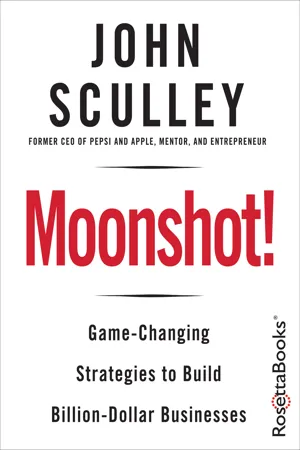
In this book, John Sculley, former CEO of both Pepsi and Apple, discusses an era that is giving birth to numerous groundbreaking events and inventions—moonshots—that will change the way we live and work for generations to come. He offers wisdom for a new breed of innovative entrepreneurs to build businesses across industries that will bring in billions of dollars—while changing people's lives for the better.
Moonshot! lays out a roadmap for building a truly transformative business, beginning with a can't-fail concept and drawing on clear examples from companies who've done innovation right.
- 191 pages
- English
- ePUB (mobile friendly)
- Available on iOS & Android
eBook - ePub
About this book
Information
Subtopic
EntrepreneurshipIndex
BusinessPART I
Moonshot!
1.
MOONSHOT!
I actually think every individual is now an entrepreneur, whether they recognize it or not.
—Reid Hoffman, cofounder and executive chairman of LinkedIn
In November 1982, few people outside of the Bay Area had ever heard of Silicon Valley, so I was very curious about what my day ahead would be like. At the time, as president of Pepsi-Cola Company, I had been invited to Apple, which then had just $500 million in revenues and was looking for a CEO. As I drove from my hotel, Rickey’s Hyatt House in Palo Alto, to Cupertino, I looked around expecting to see some glass-walled, modern buildings peppering the landscape similar to the ones I had become accustomed to seeing on Route 128 surrounding Boston. But this was Silicon Valley, and I was soon to discover that this foreign (to me) world beat to a very different drum. Driving up to Bandley Drive in Cupertino, I thought I must be at the wrong address for Apple Computers’ headquarters: It was just five small, one- and two-floor, tilt-up-wall-construction buildings tucked into a residential area.
This was the first time that I met Steve Jobs. After an hour with the then Apple CEO, Mike Markkula, Steve joined us, and shortly afterward he and I split off. Steve and I spent the next hour sizing each other up. I was immediately struck by how self-confident and articulate he was, with his sweeping description of how personal computers were going to be the most important educational tool ever in mankind’s history. In those days Steve—at twenty-seven—was healthy, strikingly handsome with thick black hair and dark, penetrating eyes. I had arrived in my business casual khaki pants, open-collar blue shirt, and blue blazer. I immediately felt out of place as Steve, along with everyone else I was to meet, wore blue jeans and T-shirts.
Steve took me across Bandley Drive to a one-story building called Bandley II. I couldn’t help but notice a black-and-white Jolly Roger pirate flag flapping from a flagpole atop the building. Once inside, I followed Steve to a small lab with an engineer’s bench jammed with lots of test equipment. My eyes quickly focused on a bright ten-inch display and, next to it, a slight, young engineer with a beaming smile named Andy Hertzfeld.
Steve suddenly got very serious. “Nobody outside Apple has ever before seen what you are about to see,” he said with gravity. “We are creating the world’s first personal media computer that is designed to be incredibly easy for nontechnical people to use and it will be affordably priced. This prototype will become the Mac… and it’s going to change the world.”
On a nearby keyboard, Andy started typing quickly, and suddenly five animated little Pepsi cans danced across the screen. “This is just the beginning of a revolution where people will be able to publish their own content, combining beautiful fonts, graphics, and even animations like this. It’s going to be insanely great!” Steve added with a flourish.
When Gutenberg invented the printing press in Mainz, Rhineland, in 1436, it later enabled Aldus in Venice to print books and sell them from town to town. Nothing like that had ever been possible before, and its effect was to open the minds of anyone who could read to provocative ideas. History, science, poetry, and theology suddenly spread across Europe. This Renaissance was the cultural awakening from the Dark Ages and a thousand years of feudal society to a new world-changing era for mankind.
Steve Jobs had created a cover story for my visit in order to explain to the young Mac development team why I was there and why he was showing me, an outsider, Apple’s most secret project. Steve had told them that I was the CEO of Pepsi-Cola Company and that I was potentially the first big corporate customer for the Mac. “So, we should impress him…,” he directed. At the time, I didn’t fully appreciate how technically advanced and challenging it had been just to make those black-and-white Pepsi cans dance on that small ten-inch display.
This moment was my introduction to the creation of a Moonshot. I had first heard the term in 1961 when then President John F. Kennedy uplifted a still-in-shock American public from the Soviet’s successful 1957 launch of Sputnik, the first satellite, into space. JFK had eloquently proclaimed that, before that decade was over, we would send a man to the moon and safely bring him back. It was inspiring… it was maybe possible… but it would be incredibly hard.
Years later, on July 20, 1969, I remember standing on the Sheep Meadow in Manhattan’s Central Park with 20,000 other people, watching man’s first landing on the moon on a huge screen. The crowd was hushed as the lunar vehicle module, the Eagle, made numerous attempts to land. When it finally came to rest and the hatch opened, astronauts Neil Armstrong and Buzz Aldrin descended the ladder. At exactly 4:18 p.m. Eastern time, Neil Armstrong became the first man ever to step onto the surface of the moon, uttering those famous words: “One small step for man, one giant leap for mankind.” At this moment, a deafening cheer erupted and everyone in the crowd hugged one another in celebration. This was the granddaddy of all Moonshots, and it was amazing.
The first man to step onto the moon in 1969 never would have been able to make that journey if the U.S. had not paved the way with a “tubes-to-transistor” moment. The telemetry required to navigate the Apollo 11 rocket ship to the moon would never have fit into the spacecraft if lightweight, miniaturized transistors had not been commercially developed and adapted for this purpose. NASA underwrote this critical tubes-to-transistors research, which led to the founding of Intel by Gordon Moore and Bob Noyce, among other significant high-technology firms. I realized only years later that Neil Armstrong’s success inspired many students to take up science, math, and engineering because it was now cool. And some of these students later used their technical skills and creativity to launch the personal computer era—a breakthrough I witnessed firsthand with Steve Jobs.
Larry Page is a business leader who is changing the world by using his exceptional talent and Google’s success to continue to make creative leaps. Moonshot is now part of the Silicon Valley lexicon, a designation reserved for only the most game-changing disruptive innovations. Steven Levy’s book In the Plex talks admiringly about Google and Larry Page’s “healthy disrespect for the impossible.” Larry Page is indeed leading the way today with amazing Moonshots like driverless cars. No one has been more inspiring about the possibilities of Moonshots than Google with their creation of an annual Silicon Valley event dubbed “Solve for ×.” Astro Teller, Google’s captain of Moonshots, calls this, “10× thinking that doesn’t break the laws of physics about clearly defined problems.”1 He goes on to say that 10× thinking with a low probability of success is a more inspiring and passionate goal than making the bottom line ten percent better with a high probability of success. One of the most talented individuals who worked with me at Apple is Megan Smith, VP of Google Labs’ Solve for ×, further illustrating that Google is committing their best people to 10× innovation. Big corporations aren’t usually wired to think this way. Google is.
THE PERSONAL COMPUTER MOONSHOT: WOZ, THE GENIUS INVENTOR
Steve Wozniak invented the first really useful personal computer. He is a rare breed, a “disruptive innovator” genius like Thomas Edison. “So, Woz what did you want to be?” I recently asked him when we were sitting around and chatting. “Well, I never really cared about starting a company,” he answered, “that was all Steve Jobs’ idea. We actually started five companies, but the one that survived was Apple. Before Apple, I was perfectly happy working at Hewlett-Packard and being an engineer, but I wanted to be the best engineer in the entire world. So I had to figure out how to design things with pen and paper and I would design minicomputers because I didn’t have any money. But then HP had this wonderful program, where engineers, if they were working on something that interested them, would let them take parts home for free.” He said: “I used to do that and build things. So I would build things with one-dollar chips using some hacker approaches that were being built by other people for thousands of dollars. Why? Because I was a natural hacker and I wanted things for myself and I really wanted to build a computer.”
What drove Woz to invent the personal computer? I think it was the passion that emerged when this shy but gifted eleven-year-old realized that he was just naturally brilliant at mathematics. He can still solve any kind of math problem in his head. Woz realized that so much of computing is about math: when to load registers, what you load into each register, when you execute commands, all those kinds of things.
Woz would go to the library and look up technical papers on signal processing of various minicomputers being sold back in the early 1970s. From this research, he just kept increasing his domain expertise about computers. In short order, he learned an incredible amount about computers as they existed at that time.
At the same time, he was a hacker, and so he figured out novel ways of hacking, solving problems cheaply that others solved expensively. So that was a different domain. He coupled the hacker’s domain with the traditional computer science domain. All self-taught.
When it came to designing the Apple I board, he solved a problem that hadn’t been solved before, in a very inexpensive hacker’s way. Woz’s first computer, the Apple I, was for hobbyists. The second computer he developed, the Apple II, was for the rest of us. Steve Jobs had declared an incredible vision: “Hey, why don’t we build a computer that isn’t just a kit with a circuit board connected to a TV, but a complete, easy-to-use, all-in-one device?” And guided by Steve’s vision, Woz built the Apple II.
Woz recently told me one of my now favorite stories about him. Back in the late ’70s, he’d never been to Las Vegas but had always wanted to go there. Apple was taking the Apple II to the Las Vegas CES, Consumer Electronics Show, for the first time. Because Apple had almost no money, only three people were going to make the trip: Mike Markkula, who was cofounder and head of marketing; Apple’s CEO at the time, Mike Scott; and Steve Jobs. But Woz wanted to go and made a proposition to the three: “If I can design a floppy disk drive, would I be allowed to go on the trip to Las Vegas with you?” This was like less than a month away. They said, “Yes,” because there was no such thing as a floppy disk drive in the market at that time.
Woz told me that he stayed up night after night with no sleep. He worked around the clock for over a week, churning calculations in his head, figuring out ways to hack it and build it. He did get to go to Las Vegas for the first time, and he brought the first floppy disk drive for the Apple II computer. No one in the world had ever seen a floppy disk drive for a personal computer before. There were disk drives for big minis and mainframe computers, but these things cost thousands of dollars. The idea that you could have an affordable floppy disk for a personal computer didn’t seem possible then. Up until this point, an Apple II used a tiny tape recorder to archive its programming code. Inspired by the lure of a first trip to Vegas, Woz invented the first floppy disk drive.
Back in the 1970s, other highly talented disruptive innovators like Bill Gates, Steve Jobs, and Larry Ellison also dropped out of college, as Woz had done, to become entrepreneurs. Why? Computer science programs just weren’t teaching the new technologies needed to reinvent the computer industry around the microprocessor and the new kinds of software it required.
Many times, my wife, Diane, and I have watched Woz create seemingly impossible math puzzles and then somehow do massive calculations in his head, no paper required, to solve the puzzle. Truly magical moments, and I have no idea how he does it. But his knack paid off big-time. Woz first created the Apple I, a circuit board with chips and DRAM memory. He and Steve Jobs sold it through Paul Terrell’s first Byte Shop for $666.66. Later, Woz invented the Apple II, which included a never-before-seen way to display fonts and graphics on a color TV monitor, a feat no one previously thought was possible.
THE DERIVATIVE EFFECTS OF WOZ’S INVENTION
It was Steve Jobs who saw the promise in Woz’s computer inventions and came up with the idea to create the Apple II, an all-in-one-box solution that was easy to learn how to use. One didn’t have to program the Apple II as you did with the earlier hobbyist computers, you just inserted a software application into it, and it did useful things like create a spreadsheet, write a letter, or store some data you could retrieve later. Steve Jobs designed the Apple II to have a beautiful ABS plastic case with a built-in keyboard. So began the first computer industry Moonshot of a truly personal computer that was affordable for the average person. Steve Jobs was a different kind of genius from Woz. Steve was not an engineer, but a visionary with a noble cause and an instinctive designer’s talent for envisioning end-to-end systems. Steve Jobs was a systemic designer who could not only zoom out and connect the dots, but could zoom in and simplify computers in a way that made them both incredibly easy to use and consistently beautiful machines.
Steve Jobs had a genius ability to see the future possibility of other genius inventions and how to turn these inventions into products that would actually change the world. Steve Jobs likened computers to “bicycles for the mind.” Give people computer tools, he believed, and let them change the world one person at a time. He saw that his machines had to be really easy to use and inexpensive enough that most people could buy one. Steve sweated every detail. He had the charisma and focused determination to drive the success of first the Apple II and then the Mac.
Bill Gates is also a true genius. He is very technical and is a self-taught computer scientist who is quite different from Steve Jobs and Woz. Bill Gates is an adaptive innovator who saw that the future of personal computing was going to be about software licensing and creating software applications that could be sold on a disk in a box on a retail store shelf. He had the most amazing focus. The combination of these qualities made him the best business competitor I ever knew. Everyone in the industry was gunning for Bill, but he never lost his focus or his optimism. He was relentless in building Microsoft into the overwhelmingly dominant force in software.
Steve Jobs, in the early days when I arrived, was the visionary, but he was inflexible and trusted only his own instincts. He had to make every important decision in the Mac group. So in those days, Steve Jobs was not yet an adaptive innovator like Bill Gates, because Steve Jobs was not pragmatic, as Bill Gates was. Even after he left Apple in 1985 and founded NeXT and acquired a small media animation technology company, PIXAR, from George Lucas, Steve was still unwilling to compromise on anything. NeXT and PIXAR both almost went bankrupt. Despite this, Steve’s genius as a “systemic designer” was important to both of these companies’ eventually becoming extremely important to the future of Silicon Valley. While NeXT failed as a computer company, Steve Jobs later sold it to Apple for $400 million in 1996, and the NeXT operating system became the Mac operating system (OS). By the mid-1990s, the ever-improving computational performance predicted by Moore’s Law made it possible to make computer-generated animated movies, and PIXAR switched from being a computer company into a creative animated film company—later sold to Disney for more than $7 billion.
By the time Steve Jobs returned to Apple, twelve years after leaving in 1985, he had matured as an executive. He was still Steve Jobs the brilliant systemic designer, but he was now also an adaptive innovator. He adapted the then failing Mac into the successful iMac as the easy-to-use portal device for the recently introduced World Wide Web, using the Netscape browser invented by Jim Clark and Marc Andreessen. It was the perfect adaptive-innovator product at exactly the right time, and it also was the perfect systemic designer product. The gumdrop design of the iMac at that time and its bright attractive colors became the wake-up call for high technology that the consumer electronics digital era had begun. The world loved the concept and the iMac design. By then, Steve Jobs’ first decision on returning to Apple as CEO was to cancel the disastrous policy of licensing the Mac OS; a decision made after I had left Apple and a policy that almost bankrupted the company. Later, Steve followed up with another product, the iPod, which combined both his end-to-end systems genius and his love for technology and music. The iPod also demonstrated that Steve Jobs had evolved into an adaptive innovator. By 1997, Steve had expanded his domain expertise to include a new domain for him of consumer entertainment. While it seems obvious today that high tech and entertainment are domains that have converged, it wasn’t obvious before Steve had his success in the mid-1990s with both PIXAR’s animated movies and the iMac, iPod, and iTunes. His multiple-domain expertise combined computing with recorded music in the beautiful, easy-to-use device and end-to-end system of iPod to iTunes. He redefined the recording industry with the iTunes store, which allowed consumers to buy songs individually for ninety-nine cents, rather than buy the entire album. And Silicon Valley was amazed that Steve made the iPod fully compatible with Windows computers—something the Steve Jobs I knew in the 1980s never would have done.
Unquestionably, the iPhone was Steve Jobs’ greatest Moonshot ever. It is the perfect example of brilliant adaptive innovation. It again converged expertise in multiple domains: Low-cost, miniaturized consumer electronic components, able to run a long time on a single battery charge, converged with mobile wireless technology. Timing is everything in the high-tech world, and it would have been impossible for the iPhone to do what it does so well until wireless providers like AT&T made the shift from a slower 2G to enhanced-speed 3G, with expanded services like GPS and faster photo and video transfers. The total end-to-end solution was presented in Steve’s handsome systems design of the smartphone, coupled with his brilliant concept of the App Store. The iPhone was a masterpiece, and, through it, the smartphone became the world’s most indispensable cultural instrument. Google engineer Andy Rubin was an incredibly smart “fast follower” of the iPhone, with the creation of the open source and free Android platform, while Microsoft found itself completely left out! We will talk later in the book about how mobile devices are changing the world. And the revolution all started with Steve Jobs’ iPhone!
THE TSUNAMI OF TECHNOLOGY
Today there is a tsunami that involves four exponential technologies converging at such speeds that they are ushering in a second digital age. Peter Diamandis, in his book Abundance, was the first to explain that, in this new digital era, there is no scarcity of resources. In fact, he points out the most important digital technologies are actually growing exponentially.
The first leg of this technology tsunami is cloud computing. Operational only in ...
Table of contents
- Cover
- Title Page
- Copyright
- Dedication
- Contents
- Introduction and Highlights by John Sculley
- Part I Moonshot!
- Part II Huge Changes to the Middle Class
- Part III How to Create a Billion-Dollar Business Concept
- Part IV Powerful Tools for Success
- Part V Moonshot: A Summary and Concluding Remarks
- Notes
Trusted by 375,005 students
Access to over 1.5 million titles for a fair monthly price.
Study more efficiently using our study tools.
Frequently asked questions
Yes, you can cancel anytime from the Subscription tab in your account settings on the Perlego website. Your subscription will stay active until the end of your current billing period. Learn how to cancel your subscription
No, books cannot be downloaded as external files, such as PDFs, for use outside of Perlego. However, you can download books within the Perlego app for offline reading on mobile or tablet. Learn how to download books offline
Perlego offers two plans: Essential and Complete
- Essential is ideal for learners and professionals who enjoy exploring a wide range of subjects. Access the Essential Library with 800,000+ trusted titles and best-sellers across business, personal growth, and the humanities. Includes unlimited reading time and Standard Read Aloud voice.
- Complete: Perfect for advanced learners and researchers needing full, unrestricted access. Unlock 1.5M+ books across hundreds of subjects, including academic and specialized titles. The Complete Plan also includes advanced features like Premium Read Aloud and Research Assistant.
We are an online textbook subscription service, where you can get access to an entire online library for less than the price of a single book per month. With over 1.5 million books across 990+ topics, we’ve got you covered! Learn about our mission
Look out for the read-aloud symbol on your next book to see if you can listen to it. The read-aloud tool reads text aloud for you, highlighting the text as it is being read. You can pause it, speed it up and slow it down. Learn more about Read Aloud
Yes! You can use the Perlego app on both iOS and Android devices to read anytime, anywhere — even offline. Perfect for commutes or when you’re on the go.
Please note we cannot support devices running on iOS 13 and Android 7 or earlier. Learn more about using the app
Please note we cannot support devices running on iOS 13 and Android 7 or earlier. Learn more about using the app
Yes, you can access Moonshot! by John Sculley in PDF and/or ePUB format, as well as other popular books in Business & Entrepreneurship. We have over 1.5 million books available in our catalogue for you to explore.