Iconic Cars 5-Book Bundle
eBook - ePub

Iconic Cars 5-Book Bundle

Mustang, Camaro, Corvette, Porsche, BMW M Series

  1. 921 pages
  2. English
  3. ePUB (mobile friendly)
  4. Available on iOS & Android
eBook - ePub

Iconic Cars 5-Book Bundle

Mustang, Camaro, Corvette, Porsche, BMW M Series

About this book

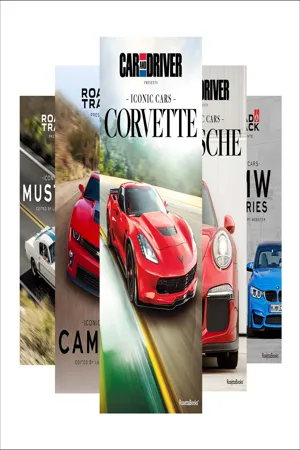
These 5 volumes collect decades of expert coverage from Car and Driver and Road & Track to explore some of the world's finest automobiles. Corvette
Car and Driver has tested nearly every version of the Chevrolet Corvette. Here, they compile and curate more than 50 years of articles, reviews, and news about this classic sports car from the first 'Vettes of the 1950s to the new Corvette Stingray. Porsche
Car and Driver has chronicled this high-end German brand from its first commercial automobile, the 356 Roadster, to its modern lineup of supercars, super sedans, and even super SUVs. This volume presents its most informative and entertaining articles from 1975 to today. Camaro
Withmore than 30 years of Camaro articles and reviews from the experts at Road & Track, this volumecovers the launch, the racers, the duds, and, of course, the Camaro's triumphant return. You'll find road tests, reviews, and comparisons, along with interviews with the folks behind the scenes and columns from Matt DeLorenzo and Peter Egan. Mustang
The original pony car, the Ford Mustang is a beloved American icon. Culled from 50 years of Road & Track coverage, this volume presents road tests, reviews and articles on everything from Ford's game-changing win at Le Mans in 1966 to the dark years of the Mustang II. BMW M Series
This eBook collects Road & Track 's coverage of the acclaimed BMW M Series from 1985 to 2014, including features, reviews, comparison tests, and interviews on everything from the M3 and M5 to the short-lived M1 supercar, and even today's M-badged SUVs.

Frequently asked questions

Yes, you can cancel anytime from the Subscription tab in your account settings on the Perlego website. Your subscription will stay active until the end of your current billing period. Learn how to cancel your subscription.
No, books cannot be downloaded as external files, such as PDFs, for use outside of Perlego. However, you can download books within the Perlego app for offline reading on mobile or tablet. Learn more here.
Perlego offers two plans: Essential and Complete
  • Essential is ideal for learners and professionals who enjoy exploring a wide range of subjects. Access the Essential Library with 800,000+ trusted titles and best-sellers across business, personal growth, and the humanities. Includes unlimited reading time and Standard Read Aloud voice.
  • Complete: Perfect for advanced learners and researchers needing full, unrestricted access. Unlock 1.4M+ books across hundreds of subjects, including academic and specialized titles. The Complete Plan also includes advanced features like Premium Read Aloud and Research Assistant.
Both plans are available with monthly, semester, or annual billing cycles.
We are an online textbook subscription service, where you can get access to an entire online library for less than the price of a single book per month. With over 1 million books across 1000+ topics, we’ve got you covered! Learn more here.
Look out for the read-aloud symbol on your next book to see if you can listen to it. The read-aloud tool reads text aloud for you, highlighting the text as it is being read. You can pause it, speed it up and slow it down. Learn more here.
Yes! You can use the Perlego app on both iOS or Android devices to read anytime, anywhere — even offline. Perfect for commutes or when you’re on the go.
Please note we cannot support devices running on iOS 13 and Android 7 or earlier. Learn more about using the app.
Yes, you can access Iconic Cars 5-Book Bundle by Road & Track, Larry Webster in PDF and/or ePUB format, as well as other popular books in Technology & Engineering & Automotive Transportation & Engineering. We have over one million books available in our catalogue for you to explore.

CAMARO Z-28

As near as Chevrolet can come to being in racing without being in racing
GORDON CHITTENDEN PHOTOS
Road Test
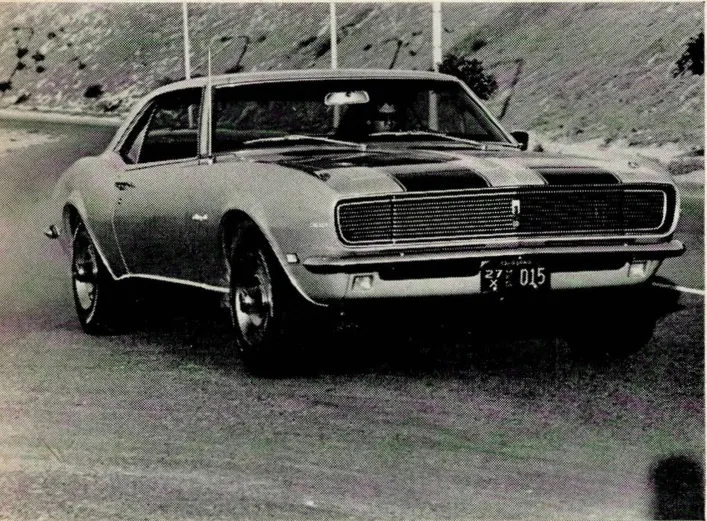
Who says GM isn’t racing? If the Z-28 isn’t a bona fide racing car—in street clothing for this test—then we’ve never seen one. Chapter IV, Touring Cars, Group 2, Appendix J, FIA International Sporting Code requires that 1000 of the Group 2 sedans (more popularly known in this country as Trans-Am sedans) be series produced and that’s the reason for the Z-28’s being. No question that the Z-28 is doing its stuff either: two of them followed two Porsche Group 6 prototypes home at Sebring to finish third and fourth overall and win the Trans-Am category of Sebring’s 12 hours.
Z-28 is a typical Chevrolet code designation for a performance package which adds $400.25 to the basic Camaro 6-cyl coupe price of $2694 and includes a 5-liter (302-cu-in.) V-8, slightly modified spring rates, quicker steering and identification trim. To that $400 is added $100.10 for power-assisted disc front brakes and $184.35 for 4-speed manual transmission. Our test car was equipped with still-quicker (17:1 overall) steering at $15.80, limited-slip differential ($42.15), power steering ($84.30) and a host of such items as interior trim packages, custom steering wheel, deluxe seat belts (!) and a tack-on fiberglass “spoiler” for a total price of $4435. To the basic Z-28 package can be added a whole range of racing parts, available from Chevrolet dealers.
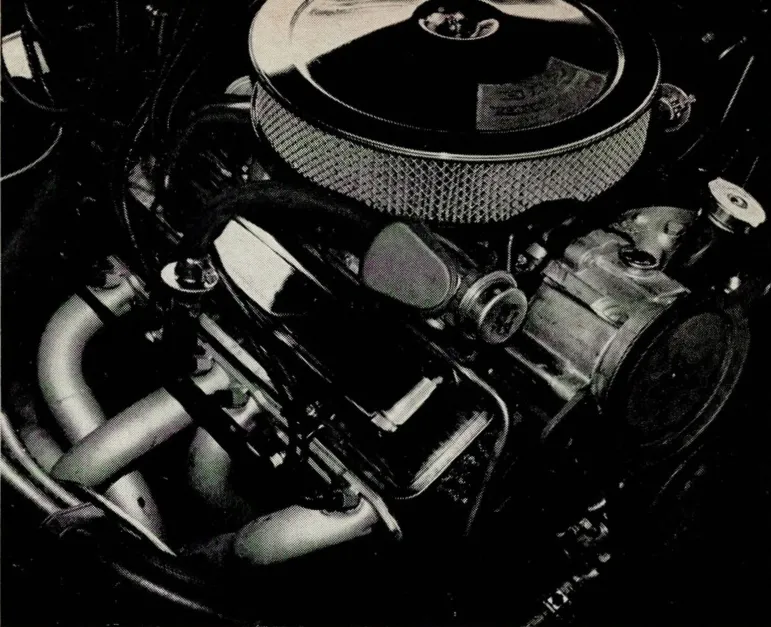
The chrome-trimmed 302 engine is a combination of the 327 block (4.00-in. bore) and the 283 crankshaft design (3.00-in. stroke)—but with a stronger, forged steel crank instead of the cast nodular iron one of the 283 and other “mild” Chevrolet engines. The 302 comes in a rather wild state of tune: its standard camshaft gives 346° duration for both intake and exhaust valves—118° of overlap. Mechanical lifters and 1.50:1 rockers give a valve lift of 0.485 in; an optional cam provides equivalent overlap with greater lift, but our test car had the standard one. Compression ratio is 11.0:1 and carburetion is by a single Holley 4-barrel rated at 800 cu ft/min. Our test car also had, as its only item from the “dealer” list, a set of tuned headers (installed by Bill Thomas Race Cars, as these are never installed at the factory anyway) which add another $200.
CAMARO Z-28
AT A GLANCE
Price as tested$4435
EngineV-8, ohv, 4949 cc, 350 bhp
Curb weight, lb3355
Top speed, mph132
Acceleration, 0-Âź mi, sec14.9
Average fuel consumption, mpg11.0
Summary: Street version of race-winning Trans-Am sedan… sparkling performance from 5-liter pushrod engine but tractability lacking… brakes not up to performance… rather heavy and bulky.
The engine makes no bones about its character. It idles lumpily at 900 rpm and has very little torque below 4000 rpm, considering the car’s great weight (3355 lb). It does start easily from cold, however, the automatic choke putting idle speed up to something like 1500 rpm; very little mechanical noise is heard from under the hood though the headers give it a nice tingly sound. Getting off the line in acceleration tests the car slews smoothly to the right but, even with the clutch dropped at 4500-rpm, it gets off to a relatively leisurely start until the engine can get up over the 4000 hump. Then, hold on! From there it revs so freely that it seems it could go on forever. We found 7500 to be a good shift point as far as the engine was concerned, but above 7000 (63, 85 and 113 mph in 1st, 2nd, 3rd resp.) the diaphragm-spring clutch became reluctant to re-engage after our rather unmerciful shifts—so we were forced to use 7000. Chevrolet rates this engine at 290 bhp @ 5800 rpm, which may be true as far as it goes, but we think the curve keeps climbing to something more like 350 bhp @ 6200. We even think the torque rating of 290 lb-ft @ 4200 is conservative.

Light monitor under rear window checks on license, stop and taillight functioning.
Flow-through ventilation system exits stale air through trunk and then out doorjambs.
The Z-28 can be had with a range of final-drive ratios from 3.55 to 4.88:1. The standard 3.73:1 would seem best for road use, if anyone seriously contemplates using the car for such; our car had a 4.10:1, probably good for road racing but getting the engine into much noise and vibration at freeway speeds. Fuel economy? Who cares?—but 11-mpg average, if you must know.
The 4-speed gearbox is the familiar and beloved Muncie unit with the not-so-beloved Muncie shift linkage. This example wasn’t as bad as some we’ve tried, but the linkage is stiff and notchy, characteristics aggravated by Chevrolet’s dumb sliding-plate shift lever seal. Fortunately the latter comes only with the optional console, a conventional rubber boot doing the job when no console is ordered. Our test car had the optional close-ratio (2.20:1 1st) box, appropriate for the high numerical final drive. An 11.0-in. clutch with 2450-2750-lb spring pressure (larger and stronger than that supplied with the 396 engine) is still sufficiently light for the average male to operate easily, though as mentioned earlier it does have some trouble at high engine revs.
Though the FIA regulations allow the use of any springs and shocks in racing, the road Z-28 sticks surprisingly close to stock Camaro suspension. The front coil springs (112 lb/in. at the wheel) and 11⁄16-in. anti-roll bar are left unchanged from everyday Camaro 327s. At the rear spring rates are considerably stiffened: 25% more than for the 396 model, or 131 lb/in. at the wheel. Like the 396, 350 and the 4-speed 327 Camaros (and all Firebirds) the Z-28 uses multi-leaf rear springs instead of the standard Camaro single-leaf ones; this is a necessary move for any engine-transmission combination likely to be delivering great shock loads to the rear axle as the single-leaf jobs don’t do much in the way of controlling axle motion about its own horizontal centerline.
With its E70-15 wide tires the Z-28 is a stable, near-neutral car that has no trouble setting excellent lap times around any reasonably smooth course. The trick with a car like this, with all that torque available in the right gear, is to find that point where you’re using just enough throttle to get it around a turn neutrally rather than plowing or spinning out. Our test car had power steering, which would be a must with all the weight and the 17:1 ratio, but this is so lacking in feel that one has to learn to drive without the help of feedback from the tires… and that’s not much fun.
Lining material for the Z-28 brakes, otherwise no different from the normal power disc/drum Camaro option, is harder and thus eliminates any trace of fade in our usual fade test as well as putting the pedal efforts up—to the benefit of pedal feel—a bit. Proportioning isn’t good for panic stops in the unladen car: we got only 19 ft/sec/sec or 0.59-g by jamming on the brakes at 80 mph. By controlling them carefully we got up to 24 ft/sec/sec. Again, FIA rules allow changes that will make the brakes more satisfactory, and special parts are on the dealer option list.
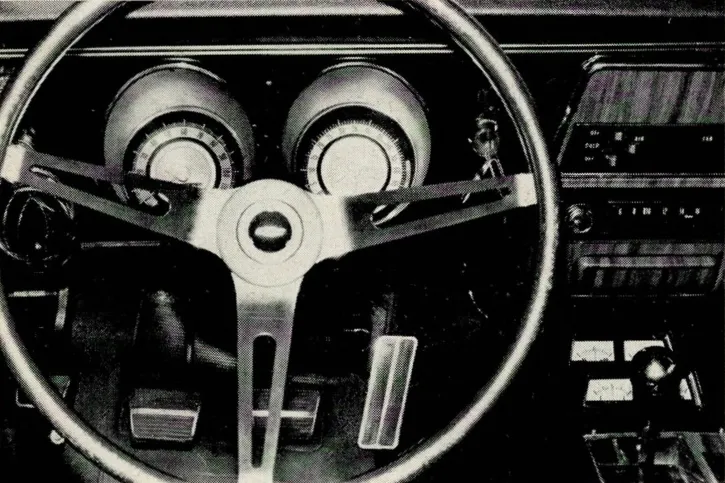
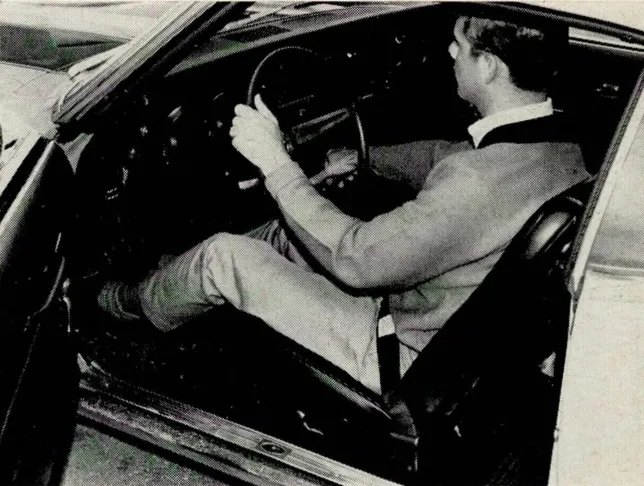
The stiffer rear springs (which also add frictional harshness over single-leafs) and the tighter shocks that come with the package do give the Z-28 the general sort of “clumpity-clump” ride we’ve come to expect of Ponycars with handling packages, and the unit body of the Camaro isn’t as resistant to rattles and squeaks as its weight would indicate. But the ride isn’t super-stiff either and we found it to be generally acceptable. We can say little about the driving position or comfort that we haven’t said over and over about Ponycars; the steering wheel is close, the seats mediocre and not adjustable for back angle, vision to the front excellent (except for a too-high, too-long hood) and to the rear poor; the minor instruments, add-on options, not well placed for reading; excellent heating and ventilation, aided here by air exits in the doorjambs. The separate lap and diagonal seat belts generally adopted by Detroit this year (including this Camaro) are bothersome to use and messy to not use; we presume this will be taken care of in a year or so when the designers get around to putting a little ingenuity to the problem of passenger restraint.
Surprisingly enough, the usual Chevrolet warranty—2 years or 24,000 miles on the car in general and 5 years/50,000 on the drivetrain—applies to the Z-28. Servicing is needed only every 6000 miles, and there’s enough room around the compact engine that the enthusiastic owner won’t be discouraged from a little tuning on his own. The car is straightforward throughout.
The Z-28 offers a lot of performance for the money; how many 4-seat cars can you name that will do the ¼ mile in 14.9 sec, hit 142 mph and cost just $4435? On the other hand, it’s not what we’d call “tractable” and, despite its stability and performance, it’s pretty clumsy to drive. However, Chevrolet obviously achieved what they set out to do—namely, build a race-winning Trans-Am sedan.

1970 CHEVROLET CAMARO

A tremendous improvement—puts the Pony car in a new class… but the brakes aren’t up to the weight or performance
GORDON CHITTENDEN PHOTOS
Road Test
The new Camaro is, except for its engine and drivetrain, an entirely new car and represents what we think is the first serious effort since the 1963 Corvette to create a real American GT. Substantial and meaningful changes have been wrought on the Camaro’s chassis—greatly improved suspension, front disc brakes as standard equipment—and though the stylists have continued to reign supreme in the body layout, the new model is esthetically successful and clearly more comfortable than the old.
We got our test car about a week before public introduction and greatly enjoyed the reactions of people on the streets to it. Some practically crashed into trees gawking at its European snout and graceful lines, but we got the feeling several times that drivers of older Camaros were purposely ignoring it. Did they feel abandoned, or did they simply not realize it was a Camaro?
The choice of options on our test car was quite important, as it always is on American cars. We shied away from the striped, spoilered, race-geared Z-28 after trying one: a Z-28 may be a great thing to be se...

Table of contents

  1. Title Page
  2. Copyright
  3. Corvette SS
  4. The Corvette Test
  5. America’s Best Sports Car: Bricklin or Corvette?
  6. The Lost Corvettes
  7. Northwest Passage
  8. Northwest Passage Part II
  9. Building the Yukon Corvette
  10. Duntov Turbo Corvette
  11. The Marque of Zora
  12. Chevrolet Corvette
  13. Happy Birthday to Us
  14. Corvette vs. Corvette
  15. The Road to Remorses, The Road to Divorces
  16. Weapons Grade
  17. More Iconic Cars Books
  18. Porsche Power
  19. Danny Ongais and the Ultimate Turbo Showdown
  20. Kremer Porsche 935K3
  21. Porsche 944 Turbo
  22. Porsche 959
  23. Catching Cold
  24. Porsche 928GT
  25. Ruf 993BTR
  26. Janis Joplin’s 1964 Porsche 356 Cabrio
  27. Rohr Porsche 911GT1
  28. Fear of Flying?
  29. Godzilla, Captain America, and the Neunelfer
  30. More Books
  31. Cover
  32. Title Page
  33. Copyright
  34. Contents
  35. 1. Camaro Z-28 (June 1968)
  36. 2. 1970 Chevrolet Camaro (May 1970)
  37. 3. Camaros for Everything (April 1972)
  38. 4. Trans-Am Ponycars (March 1977)
  39. 5. IROC Camaro vs. Z-28 (October 1978)
  40. 6. All-new Firebird & Camaro: A Tradition Modernized (January 1982)
  41. 7. Chevrolet Camaro Z-28 vs. Ford Mustang GT (June 1982)
  42. 8. Camaro IROC-Z vs. Mustang GT (December 1984)
  43. 9. Ford Mustang GT vs. Chevrolet Camaro IROC-Z (October 1986)
  44. 10. Old and New: Camaro vs. Mustang (December 1991)
  45. 11. Ford SVT Mustang Cobra vs. Chevrolet Camaro Z28 (November 1997)
  46. 12. Chevrolet Camaro SS (July 1998)
  47. 13. Grudge Match: Chevrolet Camaro SS vs. Ford SVT Mustang Cobra (April 1999)
  48. 14. Chevrolet Camaro SS vs. Corvette Z06 (January 2001)
  49. More Books from Road & Track
  50. Cover
  51. Title Page
  52. Copyright
  53. Contents
  54. 1. Meet the Mustang (May 1964)
  55. 2. Ford Mustang (August 1964)
  56. 3. Mustang GT-350 (May 1965)
  57. 4. Ecco la Moostang! (August 1965)
  58. 5. Shelby American Mustangs for 1967 (January 1967)
  59. 6. Mustang, Barracuda, & Camaro (March 1967)
  60. 7. Mustang II Mach 1 (January 1974)
  61. 8. Ford’s New Mustang & Capri (August 1978)
  62. 9. Ford Mustang Turbo (January 1979)
  63. 10. Ford Mustang GT vs. Chevrolet Camaro IROC-Z (October 1986)
  64. 11. Ford Probe vs. Ford Mustang (March 1988)
  65. 12. Old and New: Camaro vs. Mustang (December 1991)
  66. 13. Sun and Fast Fun: Ford Mustang Cobra Convertible vs. Pontiac Firebird Formula Convertible (June 1994)
  67. 14. Saleen Solution: Saleen Mustang S-351 (June 1994)
  68. 15. Ford Mustang Bullitt GT (August 2001)
  69. 16. 2003 Ford SVT Mustang Cobra (August 2002)
  70. 17. Muscle Car of the Moment: Ford SVT Mustang Cobra vs. Pontiac GTO (July 2004)
  71. 18. Horse, Back: 2015 Ford Mustang (February 2014)
  72. 19. The 5 Mustang Race Cars That Matter Most (May 2014)
  73. More Books from Road & Track
  74. Cover
  75. Title Page
  76. Copyright
  77. Contents
  78. 1. Munich Muscle (May 1985)
  79. 2. H&B BMW M635CSi (May 1985)
  80. 3. BMW M3 (August 1994)
  81. 4. Postcards to the Ed. (July 1996)
  82. 5. BMW M3 IMSA Racer (July 1997)
  83. 6. Street Civil, Track Worthy (July 1997)
  84. 7. 2000 BMW M5 (December 1999)
  85. 8. BMW M Roadster vs Z8 (January 2001)
  86. 9. BMW M3 (February 2001)
  87. 10. Brothers in Arms—BMW M3 & M3 GTR (May 2002)
  88. 11. Triple Threat: Audi S4 vs BMW M3 vs Mercedes-Benz C32 AMG (December 2003)
  89. 12. The Ultimate NĂźrburgring Experience (June 2004)
  90. 13. BMW M1: The “Ultimate” Exotic (February 2006)
  91. 14. BMW M5 & M6: Bavarian Brothers (February 2006)
  92. 15. Trackcation (October 2013)
  93. 16. BMW M1 Procar (June 2014)
  94. 17. Power Trio (November 2014)
  95. 18. 2015 Performance Car of the Year (Dec 2014 / Jan 2015)
  96. 19. Shadow Boxing (September 2014)
  97. More Books from Road & Track