"A complete operational history of the
Bismarck . . . with period photos [and] underwater photography of the wreck, allowing a forensic analysis of the damage." —
Seapower
This new book offers a forensic analysis of the design, operation, and loss of Germany's greatest battleship, drawing on survivors' accounts and the authors' combined decades of experience in naval architecture and command at sea. Their investigation into every aspect of this battleship is informed by painstaking research, including extensive interviews and correspondence with the ship's designers and the survivors of the battle of the Denmark Strait and
Bismarck's final battle.
Albert Schnarke, the former gunnery officer of
Tirpitz,
Bismarck's sister ship, aided the authors greatly by translating and supplying manuscript materials from those who participated in the design and operations. Survivors of
Bismarck's engagements contributed to this comprehensive study including D.B.H. Wildish, RN, damage control officer aboard HMS
Prince of Wales, who located photographs of battle damage to his ship. After the wreck was discovered in 1989, the authors served as technical consultants to Dr. Robert Ballard, who led three trips to the site. Filmmaker and explorer James Cameron has also contributed a chapter, giving a comprehensive overview of his deep-sea explorations on
Bismarck and sharing his team's remarkable photos of the wreck. The result of nearly six decades of research and collaboration, this is an "encyclopedic and engrossing" account (
Naval Historical Foundation) of the events surrounding one of the most epic naval battles of World War II. And
Battleship Bismarck finally resolves some of the major questions around her career, not least the most profound one of all: Who sank the
Bismarck, the British or the Germans?
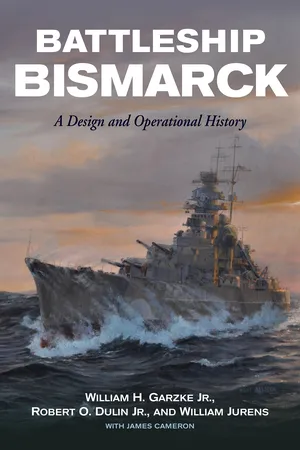
eBook - ePub
Battleship Bismarck
A Design and Operational History
- 624 pages
- English
- ePUB (mobile friendly)
- Available on iOS & Android
eBook - ePub
Battleship Bismarck
A Design and Operational History
About this book
Information
Subtopic
Military & Maritime HistoryIndex
History1
THE ORIGINS OF THE BATTLESHIP BISMARCK
For the first forty-two years of the twentieth century, battleships were acknowledged as the primary instruments of sea power. They were, therefore, the strategic naval weapons of choice for all the great naval powers.
Suffering defeat and the loss of its empire at the end of World War I, Germany was obliged to sign the Versailles Treaty, which placed crippling restrictions on its armed forces. Contrary to the terms of the 11 November 1918 armistice, which designated internment at a neutral port, the German fleet was to be interned in Scapa Flow, under control of the Royal Navy. On 21 November, units of the German High Sea Fleet under the command of Rear Admiral Ludwig von Reuter arrived at the Firth of Forth to surrender to the allied fleet under Admiral David Beatty. From there, the German ships were taken to Scapa Flow for internment until a peace treaty could be negotiated.
The Versailles Treaty was to have been signed at 1200 on 20 June 1919, but the event was postponed to 23 June while the victorious powers argued over the disposition of the German ships. France and Italy each wanted a quarter of the ships in the anchorage. Great Britain wanted all the ships scrapped or sunk, aware that any redistribution of them would be detrimental to the Royal Navy’s proportional advantage. Although clause XXXI of the armistice forbade Germany to scuttle its ships, Admiral von Reuter settled the issue by ordering the sinking of fifty-two of the seventy-four interned ships on 21 June 1919.
The Kaiserliche marine, second in size to the Royal Navy at the beginning of World War I, was reduced by the onerous treaty terms to six pre-dreadnought battleships and six obsolete cruisers that had been built between 1899 and 1906.1 Article 190 forbade the new Reichsmarine to construct or acquire any warships other than those intended to replace ships in commission.
French and British naval constructors decided on 10,000 long tons (2,240 pounds)—the light-ship displacement of the six pre-dreadnought battleships of 1902–6 vintage—as a limiting displacement for armored ships. After twenty years of service, these battleships could be replaced by a vessel of the same displacement, which was incapable of supporting battleship-scale armament or protection, and with a gun caliber limited to 280 millimeters (mm).
On 16 April 1919 the National Assembly of the Weimar Republic formally established the Reichsmarine, a development marked by strife and mutiny. By October 1922 the Reichsmarine had come to terms with its reduced status. The battleship would become the prime element when the decision was made to rebuild the fleet. However, doing so in compliance with the Versailles Treaty limitations would be difficult. The Germans interpreted the treaty displacement limitation terms in long tons, as had the French and English.2
The Versailles Treaty dictated some important changes in the Construction Office and shipyards controlled by the Reichsmarine. The long-established Wilhelmshaven Navy Yard and its veteran workforce were deemed essential to the construction needs of a postwar Reichsmarine, but the former navy yard at Kiel was taken over by the private shipyard Deutsche Werke Werft in 1925.3 Private shipyards, such as Blohm and Voss in Hamburg and Deschimag in Bremen, would meet most of the navy’s future needs. The Construction Office, which had produced the designs for German ships before and during World War I, was also affected. Funds were too severely limited for it to continue as it had under Kaiser Wilhelm II; many naval constructors had to be dismissed. These developments would lead to difficulties when naval construction began during the Adolf Hitler regime about a decade later.
War reparations devastated the German merchant marine, which had lost some of the world’s largest passenger ships. The incomplete passenger liner Bismarck, whose construction by Blohm and Voss had been suspended during World War I, was made a war reparation. Upon completion, Bismarck was to be handed over to Great Britain as compensation for the loss of the hospital ship Britannic. The workers at Blohm and Voss showed their disgust at this decision by causing innumerable delays and even painting Bismarck’s stacks in the colors of the Hamburg-American Line before she left Germany under the British flag; she became Majestic, operated by the White Star Line. The passenger ship Vaterland, interned in the port of New York during the war, was assigned to the United States, becoming Leviathan. The liner Imperator would become Berengeria, operated by the Cunard Line, in compensation for the loss of Lusitania.
Admiral Erich Raeder would rise to a position of leadership in the Reichsmarine by 1928. Although convinced of the primacy of the battleship, Raeder understood that as a markedly inferior naval power, the Reichsmarine also would have to rely heavily on the submarine—of which it had none, by terms of the Versailles Treaty. Admiral Raeder believed that the loyalty of the navy and its personnel—the true core of the fighting force—was achieved through discipline and training. During the last months of World War I, some German naval officers and petty officers had become actively involved in political action, contributing to the eventual abdication of Kaiser Wilhelm. Admiral Raeder was convinced that the only proper path for a career naval officer was complete abstinence from politics and absolute loyalty to the state.
From 1920 to 1923 Raeder immersed himself in compiling a study of Kaiserliche marine operations in World War I that became the basis of a two-volume book, Kreuzerkrieg. The concept of “cruiser warfare” would manifest itself (and be fully supported by Adolf Hitler) when Raeder’s unprepared navy was thrust into war on 3 September 1939.
The Washington Naval Treaty and the Postwar Battleship
Even after World War I ended, the victorious naval powers continued to design and construct new and more powerful battleships and battle cruisers armed with 406- to 460-mm guns. Only Italy and France were unable to compete; the interned German ships they wanted under the Versailles Treaty had been scuttled by their crews, and they lacked the finances to build their own capital ships. The financial burdens associated with naval construction programs were overwhelming, especially following a ruinously expensive and destructive world war. These programs also increased tensions among the leading naval powers.
The United States already had eleven battleships under construction in 1921, along with five battle cruisers of the Lexington class. Faced with the possibility that these new ships could be outclassed by Japanese and British battleships armed with 457-mm guns, the U.S. Navy also began developing a 457-mm/48-caliber gun. In tests at the naval proving grounds at Dahlgren, Virginia, this gun fired a shell farther than any other gun thus far tested. Mounting nine of these guns with the requisite protection and a speed of 25.2 knots, however, would have required a battleship of 80,000 tons. Additional complications for American designers were the restrictions imposed by the Panama Canal and by harbor depths that collectively limited designs to a beam of less than 33.5 meters and a draft of 10.5 meters.
The Imperial Japanese Navy had started an ambitious “8–8 program,” which called for eight battle cruisers and eight battleships to be completed by 1927. Construction of the first two battleships, Nagato and Mutsu, was well under way by the time of the armistice. These ships were well protected, had 406-mm guns, and were capable of 26.5 knots. The Japanese also began the construction of two similar but larger battleships in 1920 and four more in 1921. Designs were being prepared for four additional ships. All were to be ships of thirty knots and armed with 406-mm guns. In late 1921 the Japanese had prepared the design for four super battleships, to be armed with eight 457-mm guns in twin turrets and having a speed of thirty knots. This ambitious naval program threatened the balance of power in the Far East, where the United Kingdom had a number of possessions, as did the United States (including the Hawaiian Islands, Guam, American Samoa, and the Philippines). In addition, Japan had gained control of many former German possessions in the Pacific. The British could not ignore these developments. The Royal Navy ordered the construction of four large battle cruisers armed with nine 406-mm/45-caliber guns in triple turrets. Heavily protected and capable of more than thirty knots, these ships were to be larger than HMS Hood, currently the largest ship of her type.
Public opinion in Japan, the United States, and the United Kingdom began to turn against their countries’ contest for naval supremacy, which promised to be disastrously expensive. Battleship competition between the United States and Great Britain was regarded on both sides of the Atlantic as senseless. Foreseeing that the naval race would cause economic instability, the U.S. government proposed a naval disarmament treaty. Early in 1921 Congress passed a joint resolution favoring a conference to achieve such a treaty. The British foreign office indicated a willingness to follow the Americans in this effort; the two countries felt that if the Japanese could be persuaded to curb their naval program, the race would end. The Japanese government, facing social unrest and economic bankruptcy from the large naval expenditu...
Table of contents
- Cover
- Title
- Copyright
- Contents
- Foreword
- Acknowledgments
- Prologue
- 1 The Origins of the Battleship Bismarck
- 2 Bismarck Joins the Kriegsmarine
- 3 German Naval Developments
- 4 Prelude to Operation Rheiniibung
- 5 The Royal Navy in 1941
- 6 Operation Rheiniibung Commences
- 7 Bismarck’s Norwegian Interlude and the British Reaction
- 8 Prelude to Battle
- 9 Contact!
- 10 The Destruction of HMS Hood
- 11 Aftermath
- 12 Decisions
- 13 Torpedo Attack by Victorious Aircraft
- 14 Bismarck Strives to Escape
- 15 Discovery
- 16 The Fateful Torpedo Attack
- 17 Crippled
- 18 The British Destroyers Attack
- 19 The Final Batde: Prelude
- 20 The Final Batde: 0847-0930
- 21 The Final Batde: 0930-1021
- 22 The Final Batde: Commentary
- 23 Survival and Aftermath
- 24 The Wreck
- 25 Reflections
- 26 Research
- APPENDIXES
- Notes
- Selected Bibliography
Trusted by 375,005 students
Access to over 1.5 million titles for a fair monthly price.
Study more efficiently using our study tools.
Frequently asked questions
Yes, you can cancel anytime from the Subscription tab in your account settings on the Perlego website. Your subscription will stay active until the end of your current billing period. Learn how to cancel your subscription
No, books cannot be downloaded as external files, such as PDFs, for use outside of Perlego. However, you can download books within the Perlego app for offline reading on mobile or tablet. Learn how to download books offline
Perlego offers two plans: Essential and Complete
- Essential is ideal for learners and professionals who enjoy exploring a wide range of subjects. Access the Essential Library with 800,000+ trusted titles and best-sellers across business, personal growth, and the humanities. Includes unlimited reading time and Standard Read Aloud voice.
- Complete: Perfect for advanced learners and researchers needing full, unrestricted access. Unlock 1.5M+ books across hundreds of subjects, including academic and specialized titles. The Complete Plan also includes advanced features like Premium Read Aloud and Research Assistant.
We are an online textbook subscription service, where you can get access to an entire online library for less than the price of a single book per month. With over 1.5 million books across 990+ topics, we’ve got you covered! Learn about our mission
Look out for the read-aloud symbol on your next book to see if you can listen to it. The read-aloud tool reads text aloud for you, highlighting the text as it is being read. You can pause it, speed it up and slow it down. Learn more about Read Aloud
Yes! You can use the Perlego app on both iOS and Android devices to read anytime, anywhere — even offline. Perfect for commutes or when you’re on the go.
Please note we cannot support devices running on iOS 13 and Android 7 or earlier. Learn more about using the app
Please note we cannot support devices running on iOS 13 and Android 7 or earlier. Learn more about using the app
Yes, you can access Battleship Bismarck by William H. Garzke,Robert O. Dulin,William Jurens,James Cameron in PDF and/or ePUB format, as well as other popular books in History & Military & Maritime History. We have over 1.5 million books available in our catalogue for you to explore.