"An outstanding contribution to the historiography of the Second World War at sea . . . . an excellent book." —The Australian Naval Institute
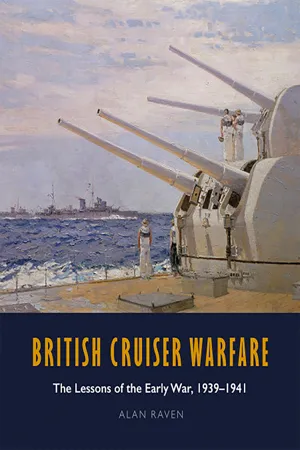
Cruisers were the Navy's maids-of-all-work, employed in a greater variety of roles than any other warship type. Smaller, faster, and far more numerous than battleships, they could be risked in situations where capital ships were too vulnerable, while still providing heavy gunfire support for smaller ships or anti-aircraft cover for the fleet. As such, they were in the frontline of the naval war from the outset—and from its first days, the fighting provided unexpected challenges and some very unpleasant surprises, not least the efficacy of air power.
Cruisers learned to deal with these new realities in the Norway campaign and later in the Mediterranean, partly through the introduction of new technology—notably radar—but also by codifying the hard-won experience of those involved. This highly original book analyses the first years of the war when the sharpest lessons were learned, initially describing every action and its results, and then summarizing in individual chapters the conclusions that could be drawn for the many aspects of a cruiser's duties. These include the main roles like surface gunnery, shore bombardment, anti-aircraft tactics, and fighter direction, but also encompass technology like radar, ASDIC, and shipborne aircraft, and even tackle more human issues such as shipboard organization, damage control, the impact of weather, and the morale factor. It also attempts to evaluate the importance of electronic warfare, intelligence and code-breaking, and concludes with a comparison between the performance of British cruisers and their Italian and German opponents.
Thought-provoking and sometimes controversial, this is a book that should be read by everyone interested in the Second World War at sea.
Includes maps and photos
- 320 pages
- English
- ePUB (mobile friendly)
- Available on iOS & Android
eBook - ePub
About this book
Information
Subtopic
Military & Maritime HistoryIndex
HistoryTable of contents
- Cover
- Title
- Copyright
- Contents
- Introduction
- Sources
- Acknowledgements
- Abbreviations
- CHRONOLOGY OF EVENTS FROM SEPTEMBER 1939 TO DECEMBER 1941
- SUMMARIES
- Bibliography
- Plate section
Trusted by 375,005 students
Access to over 1.5 million titles for a fair monthly price.
Study more efficiently using our study tools.
Frequently asked questions
Yes, you can cancel anytime from the Subscription tab in your account settings on the Perlego website. Your subscription will stay active until the end of your current billing period. Learn how to cancel your subscription
No, books cannot be downloaded as external files, such as PDFs, for use outside of Perlego. However, you can download books within the Perlego app for offline reading on mobile or tablet. Learn how to download books offline
Perlego offers two plans: Essential and Complete
- Essential is ideal for learners and professionals who enjoy exploring a wide range of subjects. Access the Essential Library with 800,000+ trusted titles and best-sellers across business, personal growth, and the humanities. Includes unlimited reading time and Standard Read Aloud voice.
- Complete: Perfect for advanced learners and researchers needing full, unrestricted access. Unlock 1.5M+ books across hundreds of subjects, including academic and specialized titles. The Complete Plan also includes advanced features like Premium Read Aloud and Research Assistant.
We are an online textbook subscription service, where you can get access to an entire online library for less than the price of a single book per month. With over 1.5 million books across 990+ topics, we’ve got you covered! Learn about our mission
Look out for the read-aloud symbol on your next book to see if you can listen to it. The read-aloud tool reads text aloud for you, highlighting the text as it is being read. You can pause it, speed it up and slow it down. Learn more about Read Aloud
Yes! You can use the Perlego app on both iOS and Android devices to read anytime, anywhere — even offline. Perfect for commutes or when you’re on the go.
Please note we cannot support devices running on iOS 13 and Android 7 or earlier. Learn more about using the app
Please note we cannot support devices running on iOS 13 and Android 7 or earlier. Learn more about using the app
Yes, you can access British Cruiser Warfare by Alan Raven in PDF and/or ePUB format, as well as other popular books in History & Military & Maritime History. We have over 1.5 million books available in our catalogue for you to explore.