A study of how the Royal Navy defended the British Empire's far-flung bases, from Bermuda to Hong Kong and beyond. Includes maps and photos.
During the nineteenth century, the Royal Navy played a key role in defending the expanding British Empire. As sail gave way to steam power, there was a pressing requirement for coaling stations and dock facilities across the world's oceans. These strategic bases needed fixed defenses.
In
Britain's Island Fortresses, historian Bill Clements describes in detail, with the aid of historic photographs, maps and plans, the defenses of the most important islands, Bermuda, Ceylon, Hong Kong, Jamaica and Singapore, and a number of lesser ones including Antigua, Ascension, Mauritius, St. Helena, and St. Lucia. He describes how the defenses were modified over the years in order to meet the changing strategic needs of the Empire, and the technological changes brought about by the Industrial Revolution. Only three of these bases had to defend themselves in war—Hong Kong, Singapore and Ceylon—and the author relates the battles for these bases. This is a fascinating read for anyone interested in the maritime history of the British Empire.
- 304 pages
- English
- ePUB (mobile friendly)
- Available on iOS & Android
eBook - ePub
About this book
Information
Topic
StoriaSubtopic
Storia militare e marittimaChapter One
Bermuda
The Bermudas, or the Somers Islands as they have been called, are a group of extinct volcanoes lying some 665 miles (1,070 kms) east-south-east of Cape Hatteras in North Carolina. The islands were first discovered by a Spaniard, Juan de Bermudez, in 1505, but the Spanish did not establish a permanent settlement on the islands. It was not until 1609 when Sir George Somers, with a fleet of vessels belonging to the Virginia Company carrying settlers for the new colony of Jamestown, was caught in a storm and his flagship, the Sea Venture, was wrecked on the reef, so providing the first settlers. The crew and passengers of the Sea Venture were subsequently saved and the island was claimed for the Virginia Company and England, making Bermuda one of the earliest British colonies.
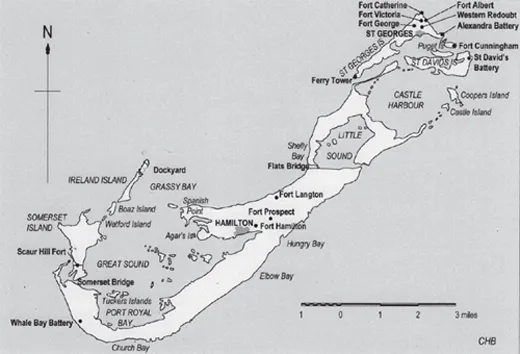
Map of Bermuda. (Charles Blackwood)
The Bermudas comprise between 150 and 180 islands, many of which are mere rocks, and the territory has a total area of 20 square miles (53 sq kms). The largest island is Main Island, more commonly referred to as Bermuda. Eight of the largest islands, including Ireland Island on which the old Royal Navy dockyard was situated, are connected by bridges. Bermuda has two main centres of population, the capital is the city of Hamilton on Bermuda itself, and the town of St George’s, the old capital, on St George’s Island.
The islands are surrounded by a reef of rocks extending in parts on the north side more than 9 miles (14 kms) from the shore. Until 1795 the only practical harbours were St George’s Harbour and Castle Harbour, the latter being the only one that the frigates of that period could enter.
Prior to 1775 Bermuda had little strategic significance as far as the British Government was concerned. However, with the outbreak of the War of American Independence in that year, followed by the loss of the American colonies in 1783, Bermuda became an important base for ships of the Royal Navy and continued to be such until the end of the Second World War in 1945.
The Colonial Fortifications
With the settlement of Bermuda in the early seventeenth century there was a requirement to fortify St George’s Harbour against any attack from the potential enemies, the French and the Spanish. The Virginia/Bermuda Company initially constructed a total of ten towers and forts to defend the approaches to St George’s Harbour and Castle Harbour. The first fort to be built was Paget’s Fort, built in 1612 on Paget’s Island and mounting eight guns. Paget’s Fort was followed by five hexagonal-shaped towers known respectively as Charles Fort, Peniston’s Redoubt, Pembroke Fort, St Catherine’s Fort and Warwick Castle. The other four fortifications were Smith’s Fort on Governor’s Island and Devonshire Redoubt and King’s Castle on Castle Island, with Southampton Fort nearby, all completed by 1622. The largest of these forts was Devonshire Redoubt with a hexagonal tower as a keep and mounting twenty-three guns. The next largest were King’s Castle with twelve guns and Paget’s Fort with eight guns.
Between 1685 and 1782 almost the entire length of the south and west coasts was fortified by the colonial government with some forty or so forts and batteries. The majority of these works were small two- or three-gun batteries, usually mounting small 6-pdr or 4-pdr smooth-bore guns. Most were roughly constructed with D-shaped emplacements sunk into the rock, with low parapets and platforms of stone. Most of the platforms were made of soft Bermuda limestone which was an unsuitable medium on which to mount guns.
Almost without exception these batteries lacked magazines and many of the guns were provided with only half a dozen or so charges and round shot. Only five of these batteries were large enough to be considered forts and these were Maria Hill Fort (9 guns) on Ireland Island; Fort Popple (8 guns) on St David’s Island; West Side Fort (6 guns) opposite the entrance to Hog Fish Cut Channel; Landward Fort (6 guns) on Castle Island; and Burnt Point Fort (5 guns) at the western extremity of St George’s Island.
In 1783, as the war with the American colonies ended, Sub-Engineer and Lieutenant Andrew Durnford RE was sent to Bermuda to report on the state of the defences in view of the fact that the newly independent United States could now be a potential enemy, thus increasing the strategic importance of the colony dramatically. Durnford’s comprehensive report made it clear that the existing defences were in a poor state of repair, many having been hastily thrown up during the late war. Durnford made numerous recommendations for the improvement of the defences and on completing his report he returned to England.
Five years later, now a captain, Andrew Durnford returned to Bermuda as the Commanding Royal Engineer with instructions to improve the island’s defences, and he was to spend ten years on the island until his death in 1798 in the rank of major. In his ten years as Commanding Royal Engineer, Durnford renovated or rebuilt many of the old fortifications including King’s Castle, Devonshire Redoubt and Southampton Fort.
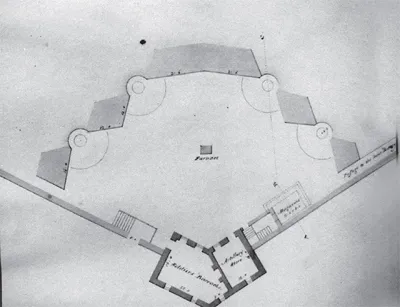
Plan of proposed works for Fort St Catherine 1798. (TNA WO 55/1551/2)
In 1791 Paget Fort was repaired, Town Cut Battery in the town of St George’s was rebuilt and the ‘Great Battery’ at Devonshire Redoubt on Castle Island was completed, together with a redan. Burnt Point Fort was rebuilt in 1794 and a new work, Upper Fort Paget was built to support the old Smith’s Fort on Governor’s Island. New works were also begun on Coney Island to the west of the Ferry and four new redoubts were built to defend St George’s.
In 1792 the Royal Navy, appreciating the potential value of Bermuda as a major naval base, gave instructions for a survey of the reefs around the island to be carried out in the hope that a channel could be found that would lead to the expanse of water between Ireland Island and Spanish Point known as the Great Sound. Lieutenant Thomas Hurd RN, a hydrographer, discovered a channel 2 miles (3.2 kms) long on the north-eastern side of St George’s Island. The channel was deep enough to permit Royal Navy line-of-battle ships to enter Great Sound and was named ‘The Narrows’. A large anchorage north of St George’s Island was named ‘Murray’s Anchorage’ in honour of Admiral Murray RN, whose flagship, HMS Resolution, was the first line-of-battle ship to moor there.
Construction of the Dockyard and the re-fortification of Bermuda
The outbreak of war with Revolutionary France did not, however, lead immediately to the construction of a major naval base on the island. Indeed, although the Admiralty decided in 1795 to purchase land on Ireland Island on the north-west tip of Bermuda on which to build the dockyard, it was not until 1809 that work began. Starting construction in that year proved to be a fortuitous decision as it enabled the Royal Navy to use Bermuda as a base in the war against the United States between 1812 and 1815.
In the period between 1798 and 1809 three officers, Captain Debutts RE (1798)1, Lieutenant Phillip Sherwin RA (1806)2 and Captain Thomas Cunningham RE (1811)3, all reported on the state of the island’s fortifications. Almost without exception the fortifications were found to be in a poor state. Indeed, it was not just the physical aspects of the forts and batteries that were in need of repair, for Captain Fraser, as the senior Royal Artillery officer on Bermuda, believed that the Artillery men under his command were in little better state. In his report on the Artillery doing duty on the island, comprising detachments from the 1st, 2nd and Invalid Battalions RA, the men of the Invalid Battalion:
‘are entirely worn out (the Drummer excepted) the others are like all draughts [sic] the worst men, for there are none of them but have some defects, as ulcered legs, the remains of Venereal Taints, and from their great propensity to drinking rum renders a cure impossible. The whole including the Officers are thirty in number, and there are not three sober men amongst them, or men on whom any reliance could be placed.’4
Captain Thomas Cunningham made a thorough inspection of the island’s batteries recommending that a number should be abandoned and others replaced by towers. Most of the large forts and batteries he found to be still in need of repair with many guns and carriages unserviceable. He therefore made a number of recommendations which included the rebuilding of Upper Fort Paget, and so removing the necessity of maintaining Smith’s Fort, Town Cut Battery and Fort Popple, together with plans for a new work in place of the old Fort St Catherine. These included a new lower battery to command the eastern channel into Murray’s Anchorage. He also reviewed the defences of the Ferry and recommended that only one Martello tower rather than the two recommended by Debutts should be built there.
Cunningham’s recommendations for the defence of the naval establishment on Ireland Island were for a tower on the north-western point of the island and a second tower on a hill 750 yards (692m) from the first, in conjunction with a ditch across the island aligned with the second tower. The tower on the point was to be a large three-gun tower similar to those being built on the English east coast, admitting that ‘These towers I know only by description, having never seen a plan.’5
Major Cunningham, as he had now become, left Bermuda in 1816 without seeing his recommendations implemented. However, work was subsequently started on the new fort on Paget’s Island, to be named Fort Cunningham on the orders of the governor; on the new Fort St Catherine and on the Martello tower planned for Ferry Point.
It was only with the arrival of Major Thomas Blanshard in 1822 that work on the defences of the Royal Navy dockyard commenced. He was to stay in Bermuda for some eight years, but his initial task was to prepare a report on the state of the existing fortifications and to recommend new works for the defence of the island.
By 1823 Hamilton was the principal trading port on the island, and Murray’s Anchorage and the Great Sound were the principal anchorages, with the only entrance through The Narrows. The critical areas of the island to be defended were the entrance to The Narrows, Hamilton itself and Ireland Island, with the strategic importance of St George’s now much reduced.
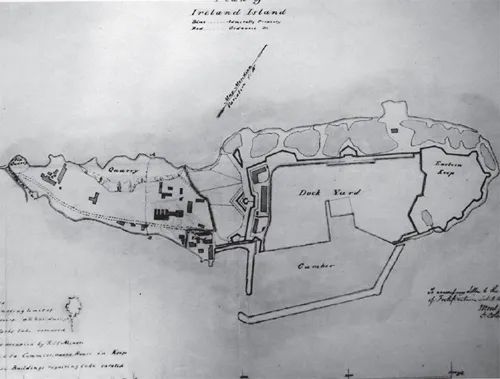
Plan of Ireland Island in 1855. The plan shows the bastioned keep, dockyard area and fortified land front. (TNA MPHH 1/683)
Blanshard reported that Fort Cunningham, the pentagonal redoubt on Paget Island mounting ten 24-pdr SB guns on traversing platforms, was now completed, but Fort St Catherine which, in his words ‘has been constructed on a more expensive scale than was at first intended’, was still in the course of construction, as was the Martello tower at Ferry Point. At the dockyard the ditch for the Entrenched Line across the island was under construction.6
Captain Blanshard’s report was completed in 1823 and, apart from the defences of the dockyard, his main recommendations for new works were:
a. Completion of Fort St Catherine for seven 24-pdr SB guns in two batteries.
b. Completion of the Martello tower at Ferry Point.
c. Construction of a permanent work for five guns on traversing platforms on Retreat Hill, a hill 160 feet (50m) high in the rear of Fort St Catherin...
Table of contents
- Cover
- Title
- Copyright
- Contents
- Preface
- Introduction
- Chapter 1 Bermuda
- Chapter 2 Jamaica
- Chapter 3 St Helena
- Chapter 4 Antigua and St Lucia
- Chapter 5 Ceylon
- Chapter 6 Mauritius
- Chapter 7 Ascension Island
- Chapter 8 Singapore
- Chapter 9 Hong Kong
- Appendix: Artillery Guns and Mortars
- Notes
- Glossary
- Bibliography
Trusted by 375,005 students
Access to over 1.5 million titles for a fair monthly price.
Study more efficiently using our study tools.
Frequently asked questions
Yes, you can cancel anytime from the Subscription tab in your account settings on the Perlego website. Your subscription will stay active until the end of your current billing period. Learn how to cancel your subscription
No, books cannot be downloaded as external files, such as PDFs, for use outside of Perlego. However, you can download books within the Perlego app for offline reading on mobile or tablet. Learn how to download books offline
Perlego offers two plans: Essential and Complete
- Essential is ideal for learners and professionals who enjoy exploring a wide range of subjects. Access the Essential Library with 800,000+ trusted titles and best-sellers across business, personal growth, and the humanities. Includes unlimited reading time and Standard Read Aloud voice.
- Complete: Perfect for advanced learners and researchers needing full, unrestricted access. Unlock 1.5M+ books across hundreds of subjects, including academic and specialized titles. The Complete Plan also includes advanced features like Premium Read Aloud and Research Assistant.
We are an online textbook subscription service, where you can get access to an entire online library for less than the price of a single book per month. With over 1.5 million books across 990+ topics, we’ve got you covered! Learn about our mission
Look out for the read-aloud symbol on your next book to see if you can listen to it. The read-aloud tool reads text aloud for you, highlighting the text as it is being read. You can pause it, speed it up and slow it down. Learn more about Read Aloud
Yes! You can use the Perlego app on both iOS and Android devices to read anytime, anywhere — even offline. Perfect for commutes or when you’re on the go.
Please note we cannot support devices running on iOS 13 and Android 7 or earlier. Learn more about using the app
Please note we cannot support devices running on iOS 13 and Android 7 or earlier. Learn more about using the app
Yes, you can access Britain's Island Fortresses by Bill Clements in PDF and/or ePUB format, as well as other popular books in Storia & Storia militare e marittima. We have over 1.5 million books available in our catalogue for you to explore.