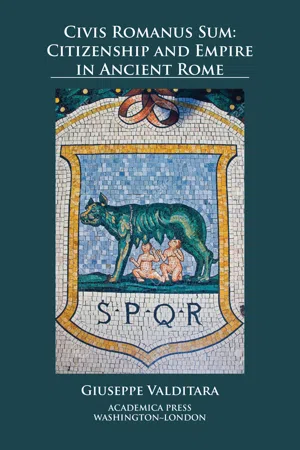
The story of Rome and its people draws on ancient legends passed down from generation to generation. Circulating throughout the Mediterranean world in the centuries after Rome's legendary founding, they were later enshrined in the words of the poets and historians of the great Augustan age and have been studied ever since. Before it was a mighty empire, Rome was born as a Latin settlement on the Palatine Hill and from the beginning showed an inclination to integrating different peoples through a federation. The early legends, born out in fact and in Rome's later history, offered an element of mixed ethnic identity. As Rome expanded its rule across Italy and over the world, adherence to Roman identity and values stood as the main qualifications for "becoming Roman" and enjoying all the privileges of Rome's civilization. As migrant populations traverse today's world, assimilation remains a crucial issue of debate in managing borders and defining societies. As the eminent Italian jurist and educator Giuseppe Valditara shows in this exceptional new book, Rome was born by uniting different peoples all on equal terms and without discrimination and relying on a strong collective identity. To defend this identity and the security of its citizens, not coincidentally, the walls were the first public building. Rome was never racist: people could become citizens and achieve important positions without distinctions of race, religion, or nationality. Rome was a meritocratic society that put state interest first. Its whole politics of citizenship and immigration revolved around this concept. The assimilation of foreigners willing to assimilate. A strong pride in belonging to the community arose at the base of society, through sharing the values ??and destiny of citizenship.
- English
- ePUB (mobile friendly)
- Available on iOS & Android
eBook - ePub
About this book
Information
1.
The Legendary Origins of Rome: A Melting-Pot
The history of the Roman people drew on ancient legends that were passed down from generation to generation for centuries, already well known in the Greek world from the fifth century BC, and enshrined in the words of the poets and historians of the Augustan age. Rome, in its historical reality, was born in a Latin settlement on the Palatine1 and an inclination toward integrating various peoples in a federation. The two leagues of the Triginta populi Albenses2 and of the Septimontium,3 which included the inhabitants of the Palatine4 in a wider dynamic of relationships and alliances, are exemplarily meaningful.
If we look at the legends, one element characterizing early Roman identity is the ethnically mixed aspect of its society.5 The story that we will recall here through the words of Titus Livius and Dionysius of Halicarnassus is well known. The Latin people derived from a fusion of the aboriginal population with the Trojans.6 Ascanius, son of the Trojan hero Aeneas,7 founded Alba Longa (whose population was to be deported from Rome and to become a part of its citizenry), together with some expatriates from Lavinium, a town whose ethnic origin likewise derived from the aboriginals and Trojans.8 Eventually, the legendary Romulus descended, on his mother’ side, from Ascanius or from his brother-in-law Silvius,9 and thus from the “foreigner” (advena)10 Aeneas.
The tradition identifying the foundation of Rome with Trojan ancestry seems multifarious and very ancient at the same time, as it was already recorded at around the half of the sixth century BC in Tarquinia, where, in the “bulls’ grave,” the fight between Etruscans and Romans is metaphorically represented by Achilles assaulting Troilus.11 But, in the ancient age, such Greek historians as Dionysus of Calcides, in the fifth century BC;12 Hellanicus, who wrote in the last quarter of the fifth century BC;13 Callias of Syracuse, who worked in the last decades of the fourth century BC;14 Timaeus of Tauromenium, belonging to the second half of the fourth century BC;15 Xenagora, belonging to the third century BC;16 and Cephalon of Gergis, also from the third century BC,17 also mention this tradition.
The tradition that connects Latium with the ancient Greek world, implying a mixing of varied elements, is even more ancient. Hesiod in the Theogony, recalls Agrios and Latinos, sons of Ulysses and the sorceress Circe, who reigned over all the Tyrrhenians. According to Aristotle,18 Achaean warriors, returning from Troy together with their Trojan concubines, founded a place called Latinion.19 As though the memory of this ancient mixing of ethnicity as the fundament of Rome was not enough, the origin of Roman people is also connected to another fusion of different populations: Latin men, companions of Romulus, and the Sabine women.20 We do not need to summarize this well known story, but it can be helpful to remember that, according to Livy, a relevant immigration of the “parents” and of the “relatives” of the Sabine women followed the “rape” of the women themselves.21
The origin and the meaning of these legends is not relevant here.22 It is a fact that they were known to “all Romans,”23 mentioned in the libri sibillini,24 and possibly included in some fragment of the Annales Maximi,25 well known by the Roman annalists,26 and thus wholly and sincerely felt as a part of Rome’s identity and cultural heritage.
The idea that peoples have of themselves is certainly important to determine their spirit and cultural traits.27 Rome was a basically open, ethnically mixed community born from the mixing of different peoples.28 The definition that Quintus Cicero gives of Rome in his Commentariolum petitionis, addressed to his brother Marcus in 64 BC, is exemplarily meaningful: civitas ex nationum conventu constituta, i.e. a town constituted because of the coming together of different nations, which refers very probably to the Italic nations.29
Considered from this perspective, the difference with the feeling that other ancient peoples have about their origins - firstly, with what the Greeks thought of themselves - appears very clear. Such differences can be immediately perceived if we just consider three famous texts from Herodotus, Isocrates, and Thucydides:
Such was their answer to Alexander; but to the Spartan envoys they said, ‘It was most human that the Lacedaemonians should fear our making an agreement with the foreigner; but we think you do basely to be afraid, knowing the Athenian temper to be such that there is nowhere on earth such store of gold or such territory of surpassing fairness and excellence that the gift of it should win us to take the Persian part and enslave Hellas. For there are many great reasons why we should not do this, even if we so desired; first and chiefest, the burning and destruction of the adornments and temples of our gods, whom we are constrained to avenge to the uttermost rather than make covenants with the doer of these things, and next the kinship of all Greeks in blood and speech, and the shrines of gods and the sacrifices that we have in common, and the likeness of our way of life, to all which it would ill beseem Athenians to be false. Know this now, if you knew it not before, that as long as one Athenian is left alive, we will make no agreement with Xerxes. Neverless we thank you for your forethought concerning us, in that you have so provided for our wasted state that you offer to nourish our households. For your part, you have given us full measure of kindness; yet for ourselves, we will make shift to endure as best we may, and not be burdensome to you. But now, seeing that this is so, send your army with all speed; for as we guess, the foreigner will be upon us and invading our country in no long time, but as soon as ever the message comes to him that we will do knothing that he requires of us; wherefore, ere he comes into Attica, now is the time for us to march first into Boeotia.’ At this reply of the Athenians the envoys returned back to Sparta.30 (Herodotus)… for we did not become dwellers in this land by driving others out of it, nor by finding it uninhabited, nor by coming together here a motley horde composed of many races; but we are of a lineage so noble and so pure that throughout our history we have continued in possession of the very land which gave us birth, since we are sprung from its very soil and are able to address our city by the very names which we apply to our nearest kin31 (Isocrates)Firstly, I shall speak first of our ancestors […]. For this land of ours, in which the same people have never ceased to dwell in an unbroken line of successive generations, they by their value transmitted to our times a free state.32 (Thucydides)
The question asked to the young Athenians before including them in a demos is well known: “Who is your father and to what deme does he belong, and who is your father’s father, and who your mother, and who her father and what his deme?”33
The principle of inheritance by which citizenship passed down was not casual.34
Dionysus of Halicarnassus (2.17.1-2) correspondingly concluded: “if I compare the Greek usages with the Roman ones, I really cannot praise them, not the Spartans’ ones, nor the Thebans’ ones, nor the usages of the Athenians, who are so highly proud of their wisdom. These who gave their citizenship to none or few (and it is better not to talk about some of them who drive foreigners off) to save the nobility of their origins, did not obtain anything good from such boastfulness, suffering a worst damage from it instead.” The issue was clear also to the Emperor Claudius and to the historian Tacitus: quid aliu...
Table of contents
- Cover
- Title Page
- Copyright
- Contents
- 1. The Legendary Origins of Rome: A Melting-Pot
- 2. The Openness of Roman Society
- 3. Archaic Juridical Institutes and Forms of Integration
- 4. Annexing Defeated Populations, a Logic of Power
- 5. Citizenship and Worth: An Utilitarian View of Citizenship
- 6. The Edict of Caracalla and the Utilitarian View of Citizenship
- 7. Citizenship and utilitas publica
- 8. The Prohibition of Dual Citizenship: A Question of Public Interest
- 9. Roman Law and Foreigners in Rome: A Question of “Sovereignty on the Territory”
- 10. Losing Citizenship
- 11. Citizenship: The Change of the Fourth Century BC
- 12. Expelling Immigrants
- 13. No More Masters in Their Own Houses: The Romans and Their Policies on Foreigners
- 14. Citizenship by Birth and by Manumission: Change in the First Century BC
- 15. Citizenship and the Principate: The Restrictive Policy Going on
- 16. Defending publica utilitas and Combating Invasions
- 17. Granting Citizenship and Popular Support: A Matter of “Sovereignty”
- 18. Conquered Territories: Between Defending the National Interest and Assimilation
- 19. A Birthrate Policy to Rule the Empire
- 20. Rome Was Born by Building A Wall: At the Origins of the Roman Identity
- 21. Mos, an Identitarian Law
- 22. Roman Memory, Roots, and Identity
- 23. The Importance of the Identitarian Principle
- Index
Trusted by 375,005 students
Access to over 1.5 million titles for a fair monthly price.
Study more efficiently using our study tools.
Frequently asked questions
Yes, you can cancel anytime from the Subscription tab in your account settings on the Perlego website. Your subscription will stay active until the end of your current billing period. Learn how to cancel your subscription
No, books cannot be downloaded as external files, such as PDFs, for use outside of Perlego. However, you can download books within the Perlego app for offline reading on mobile or tablet. Learn how to download books offline
Perlego offers two plans: Essential and Complete
- Essential is ideal for learners and professionals who enjoy exploring a wide range of subjects. Access the Essential Library with 800,000+ trusted titles and best-sellers across business, personal growth, and the humanities. Includes unlimited reading time and Standard Read Aloud voice.
- Complete: Perfect for advanced learners and researchers needing full, unrestricted access. Unlock 1.5M+ books across hundreds of subjects, including academic and specialized titles. The Complete Plan also includes advanced features like Premium Read Aloud and Research Assistant.
We are an online textbook subscription service, where you can get access to an entire online library for less than the price of a single book per month. With over 1.5 million books across 990+ topics, we’ve got you covered! Learn about our mission
Look out for the read-aloud symbol on your next book to see if you can listen to it. The read-aloud tool reads text aloud for you, highlighting the text as it is being read. You can pause it, speed it up and slow it down. Learn more about Read Aloud
Yes! You can use the Perlego app on both iOS and Android devices to read anytime, anywhere — even offline. Perfect for commutes or when you’re on the go.
Please note we cannot support devices running on iOS 13 and Android 7 or earlier. Learn more about using the app
Please note we cannot support devices running on iOS 13 and Android 7 or earlier. Learn more about using the app
Yes, you can access Civis romanus sum by Giuseppe Valditara in PDF and/or ePUB format, as well as other popular books in Politica e relazioni internazionali & Relazioni internazionali. We have over 1.5 million books available in our catalogue for you to explore.