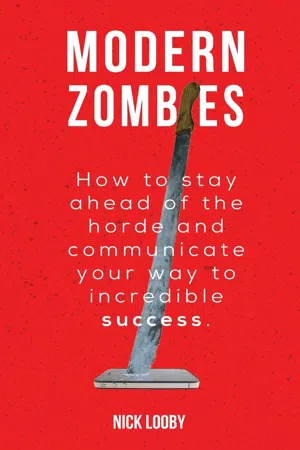
eBook - ePub
Modern Zombies
How to Stay Ahead of the Horde and Communicate Your Way to Incredible Success
- English
- ePUB (mobile friendly)
- Available on iOS & Android
eBook - ePub
Modern Zombies
How to Stay Ahead of the Horde and Communicate Your Way to Incredible Success
Information
2 > 1+1
“Coming together is a beginning, staying together is progress, and working together is success.” — Henry Ford
Enabling each member of your meeting to excel at their role, to allow their talents to flourish with the end game in mind will revolutionise your team. To harness the power of many is a potent opportunity indeed.
If you are holding the get-together, you are in a superb position to enable the brevity revolution and remove the virus from your team.
Part of your role as organiser and guide during a meeting or group discussion will involve the facilitation of input from each participant. Active listening, accurate observation, and powerful use of body language will enable you to direct the audience and keep them on the brevity line. Keep them on message, apply clarity to the desired outcomes, and prevent ineffective deviation. You are in charge of surfing the communication waves and making sure none of your team slide into the perilous waters of the horde.
Old-School
As technology develops, the communication waters continue to rise with incredible speed. The flood of unproductive messaging will potentially devastate the majority of businesses, and if we’re not careful, our relationships will be overcome too.
As mobile devices become more and more a part of who we are (I bet yours is within reach right now), the deluge will continue to adversely affect how well our communication lands and gets through.
Simply having your mobile device within view during a meeting will send a subliminal message to the rest of your group that they are not as important as your phone. If this thing needs me, I will respond. Even if you turn it so the face of your phone is hidden, the same rules apply — the zombie device rules.
I met with my financial advisor recently, and his phone stole the show. We met in my kitchen as I like to work from home and often have meetings over a cup of coffee. We sat and begun digging into the detail of some critical financial decisions. He placed his phone facedown on the table in front of him. Interesting.
It wasn’t long (it never is) before it rang. He picked it up and had the decency to put it on silent. Down it went again, facedown. Now it’s even worse. Someone has called, they have not been answered, and the phone is sitting there silent. The desire to pick it up and check who was calling is lingering in the air, and you can sense the pressure.
Crazy stuff really. How are we supposed to concentrate and focus on the task at hand if we voluntarily place an amazing distraction within arm’s reach? Try to lose weight when an opened bag of crisps is sitting on your lap. Try to cut down on alcohol when your fridge is full to bursting with ice-cold, refreshing brews. It’s not going to happen.
My advisor couldn’t resist. At the first break in conversation, his hand darted to his phone to check who needed him. Disappointing.
Do not allow distraction to cloud your vision. Suggest that your meetings are mobile device free and see how that feels. I would expect resistance and more than a little grumbling. That will be the virus raising its head in concern. It’s not as though we are asking our team to take any risks or put themselves in harm’s way. We’re simply removing the distractions. You will find that the improved focus, the added activity, and the dynamic results will be well worth the initial zombie groans.
We are always on. With such choice and variety for communicating, there is no surprise that taking a step back has an interesting impact.
Using the phone to make a voice call instead of an email, for example, will deliver a powerful impression that others are choosing not to make. Sounds daft, and it is, but a phone call has never been so powerful. Try it and see. Have voice to voice, human interactions, and make great things happen.
Pick up your phone and give someone a call. Right now. Scroll through your address book and select someone you are likely to email in the next day or so. Say hi and check in to see how they are. Let them know you are calling instead of pinging them an email as it has been a while since you’ve had a chat. How are the kids? What plans do they have for the weekend? How are they getting on with their business challenges? Where could you be of most help?
I suggested this to a group of university students at a recent talk, and you should have seen their faces. I find the younger generation extremely resistant to picking up the phone to make a voice call. It is not surprising; they have been brought up in a world that communicates in multiple ways, none of which require voice-to-voice contact. It is an unknown to many of that age group. How we encourage them to try this alternative option is quite a challenge.
One attractive reason to give a voice call a go is that it would definitely freak out the person on the other end of the call. How many of us are expecting the phone to ring and be greeted by a millennial? I am generalising here, but the trend is most definitely anti-voice. Even though there is superb value in hearing the tone of the conversation, and you can cover huge amounts of ground with ease, it is still the last option on many people’s communication list. Voice is part of the cure. If we are concerned by the raging virus, we should all be making this a habit.
The go-to defence against picking up the phone tends to be based on a lack of trust. If I email you, I will have a record of what was said, and there can be no confusion as to who is at fault if things don’t go according to plan. Just in case, to cover my back even more, I will cc everyone in too. Is this what it has come to? Trust is in such short supply that we daren’t have a human conversation. Have the zombies taken over already?
Some interactions require evidence, are formal and legally binding, but not all of them. If we can’t trust the people we are communicating with, what has happened to our business relationships? If it has to be recorded, then so be it. If not, we have a world of options.
The irony of our modern communication ocean is that it has never been easier to ‘talk’ to the world and share our ideas. We are only a few clicks away from global conversations, but global conversations are extremely noisy, and your voice will struggle to be heard.
There is no need to shout, but there is every need to get through.
Take your meetings by the balls and crank up the tempo, the passion, and the zeal. Chase the zombies out of the room and get stuff done! Stop adding to the ocean of noise that threatens to drown us all, and rely on email only when it is the best option, and even then, keep it focused. Have conversations that are rewarding as well as fun. Make progress and slay the horde as it attempts to drag you down into its meaningless noise.

Section 4
Becoming the Cure and Communicating with Your Audience
“…I don’t just wish you rain, Beloved — I wish you the beauty of storms…” — John Geddes, A Familiar Rain
From time to time we will have the privilege to communicate with a group. These opportunities are growing in our digital world with the list of conferencing options growing week on week. At the time of writing, webinars, Google Hangouts, and Facebook Live are in fashion, but by the time of reading these could easily have been surpassed by the rising stars of online mass communication. There is a question about attention and focus that many of these formats do not address, however. To dominate your audience’s attention and draw them from their zombie slumbers in our connected age is a serious challenge; one which we must explore.
The corporate market still favours the good old presentation, although there should be nothing old about the presentations you make. The digital market has yet to match the power and connection that is possible during a live event, but it is getting closer. We don’t need to attend an event to take away the key learning points any more. A digital version of the content is likely to be available s...
Table of contents
- Acknowledgements
- About the Author
- Modern Zombies
- Self-Talk
- Self-Belief
- Invisible Coach
- Zombie or Survivor?
- Habits and Challenges
- Networking vs the Zombies
- Pitch Your Opening Conversation to Wake the Undead
- Presence is Your Gift
- Open for Business and More
- Paying Attention? Name Your Rewards
- Reading the Signals
- Building Relationships — Phone Call Fridays
- Ownership!
- Working an Exhibition
- Compliment Day
- Motivating and Influence
- One-to-One — Conversations Worth Having
- Listening — Through the Zombie Groans and Beyond
- Zombie Home
- Tough Stuff
- Surfing Above the Horde
- 2 > 1+1
- Preparation
- Goals Worth Scoring
- Knowing Your Horde
- Zombies Are Only Hungry for Brains
- Opportunities
- On Stage
- Risk vs Reward
- Don’t Expect to Get it Right All the Time
- Instant Audit
- Virus Symptoms
- Zombie Slayer
- Adventures in Zombieland
- There Are No Shortcuts
Trusted by 375,005 students
Access to over 1.5 million titles for a fair monthly price.
Study more efficiently using our study tools.
Frequently asked questions
Yes, you can cancel anytime from the Subscription tab in your account settings on the Perlego website. Your subscription will stay active until the end of your current billing period. Learn how to cancel your subscription
No, books cannot be downloaded as external files, such as PDFs, for use outside of Perlego. However, you can download books within the Perlego app for offline reading on mobile or tablet. Learn how to download books offline
Perlego offers two plans: Essential and Complete
- Essential is ideal for learners and professionals who enjoy exploring a wide range of subjects. Access the Essential Library with 800,000+ trusted titles and best-sellers across business, personal growth, and the humanities. Includes unlimited reading time and Standard Read Aloud voice.
- Complete: Perfect for advanced learners and researchers needing full, unrestricted access. Unlock 1.5M+ books across hundreds of subjects, including academic and specialized titles. The Complete Plan also includes advanced features like Premium Read Aloud and Research Assistant.
We are an online textbook subscription service, where you can get access to an entire online library for less than the price of a single book per month. With over 1.5 million books across 990+ topics, we’ve got you covered! Learn about our mission
Look out for the read-aloud symbol on your next book to see if you can listen to it. The read-aloud tool reads text aloud for you, highlighting the text as it is being read. You can pause it, speed it up and slow it down. Learn more about Read Aloud
Yes! You can use the Perlego app on both iOS and Android devices to read anytime, anywhere — even offline. Perfect for commutes or when you’re on the go.
Please note we cannot support devices running on iOS 13 and Android 7 or earlier. Learn more about using the app
Please note we cannot support devices running on iOS 13 and Android 7 or earlier. Learn more about using the app
Yes, you can access Modern Zombies by Nick Looby in PDF and/or ePUB format, as well as other popular books in Business & Business General. We have over 1.5 million books available in our catalogue for you to explore.