eBook - ePub
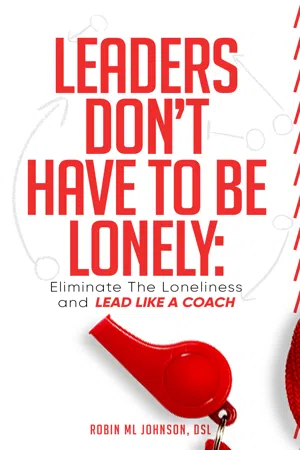
Leaders Don't Have to Be Lonely
Eliminate the loneliness and lead like a coach
- English
- ePUB (mobile friendly)
- Available on iOS & Android
eBook - ePub
INTRODUCTION
Employees don’t talk to you? You can’t understand why you are always the last one to find out what’s happening in your department? Employees stop talking when you enter the room? There is simile between your department and a revolving door?
Leaders Don’t Have to Be Lonely will help new managers understand the distinct difference between being a manager and being a leader. While managers concentrate on budgets, metrics, marketing, and customers, leaders also manage those things while developing and maintaining relationships with their employees. When managers choose not to lead, and dismiss the idea of developing relationships with their employees, they lose because they eventually experience what we call, “Leadership Loneliness.”
Leadership loneliness is a phenomenon felt by many leaders both in the boardroom and on the front line. Although, many leaders think experiencing loneliness is inevitable, it can be avoided. Leaders can do something about it. In part one of the book, managers will learn the three most common reasons why they are likely to experience loneliness and isolation. They will also learn that loneliness and isolation, if it persists, can impact their mental and physical health, which can ultimately affect how they lead.
In part two, the discussion changes and managers learn how they can chart a new course to eliminate the loneliness and isolation they experience. Of course, eliminating loneliness and isolation implies something will have to be done entirely different than what was done before. The difference suggested here is in the manager becoming a coaching-leader.
Because coaching-leadership is a relationship-based leadership style, there is no possible way to discuss the matter without delving into the architect of relationships. Good working relationships are the outcome of establishing trust, and managers who work to bring life to relationships with their employees experience twofold benefits; 1) when employees feel listened to (an element of relationship building) their stress is reduced and business performance improves; and 2) the leader feels a sense of purpose and satisfaction knowing they made a difference in someone else’s life.
Finally, the story would not be complete without sharing ways in which to carry out the coaching-leadership responsibility. If there is a desire to make the transformation from manager to coaching-leader, then leaders will find a coaching model and coaching forms to help get them started.
CHAPTER ONE

LEADERSHIP & LONELINESS
Manager vs. Leader
Being promoted into a management position does not make one a leader automatically. Many new managers think they are leaders, and wish to be, because of the prestige, benefits and the influence it affords them. However, what business school professors and leadership pundits fail to mention is this: as a new leader, one is in a minority group with responsibilities and pressures likely to exceed their capabilities and capacity.1 Being a leader is far harder than it looks because not only are they responsible for all that goes into producing, marketing and selling goods, but they are also accountable for people2 - the most challenging of all variables to manage.
Leadership is about having the ability to influence others. There is often confusion about what leadership really is because the word has become almost ubiquitous and synonymous with what usually occurs in the workplace by those in authority: management.
Management is defined by the actions of a group of people who achieve orderly results by controlling schedules, policies, procedures and budgets.3 Yet leadership is a process grounded in relationship and is based on the ability to influence followers to create change and attain their goals.4 It is critical in the new manager’s role to understand what it takes to lead. A lack of healthy leadership will restrict organizational growth and success. Let’s be clear, managers are greatly needed. They are well adept at managing budgets, policies and procedures, and can even maneuver through and manipulate office politics. But what is missing, most often, is the innovation and encouragement to change and grow, which comes with leadership skills.5
Managers in the educational arena are evaluated on their students’ reading and math scores. Those in manufacturing management are judged on the number of cases, which can be produced by shift’s end. And sales managers will be seen as a value-add if they consistently make their quarterly sales number. However, regardless of their product (good scores, cases, or sales, respectively), the ability to make product successfully is predicated upon the manager’s ability to influence their employees. Therefore, managers must learn how to engage an employee’s knowledge, skills and abilities and find creative ways to release their energies to fulfill the organization’s mission and vision.6 Managers who can successfully accomplish this are on their way to becoming leaders, and more specifically, coaching-leaders. How the manager engages their employees’ knowledge, skills and abilities will be the key to their own success, and in large part, will determine their ability to make evolutionary steps from manager to coaching-leader.7
Managers who wish to become leaders are responsible for those whom they lead: employees, who reinforce their decisions, assume responsibility, serve, challenge the status quo, and participate in transformations.8 It is imperative for new managers to recognize both they, and those who follow, together play a critical role in the rise or the fall of the organization. And though they each play a different role, they complement one another, and therefore should not be in competition with each other.9 They are each two sides of the same coin, with no means of operating an organization independent of one another.
A Leader’s Influence
New managers might feel like targets with darts being hurled at them from every direction. Yet, successfully navigating their way around those darts, in order to accomplish their goals, will mean learning that the key to leadership is gaining the ability to influence not only their workforce, but also their boss and every other stakeholder to whom the organization is responsible (e.g. customers, shareholders, executive board, parents, and the community).10
Influence comes from the leader
- Being a good listener
- Remembering names
- Being genuinely interested in others
- Letting others talk
- Showing respect for others’ opinions, and
- Admitting when they are wrong or have made a mistake11
These habits are essential for any manager seeking to transition into a coaching-leader function. And, in fact, the authors of Leadership Mystique argue, if a leader gets derailed, it is more likely to be caused by a lack of interpersonal skills rather than by an insufficient knowledge of the latest techniques in education, marketing, finance or production.12 So a manager must take the responsibility to influence earnestly, as it may be the most significant part of the leadership process.13
Leadership Loneliness and Isolation
We started by introducing the idea that leaders are in a minority group with responsibilities and pressures that, at least in the beginning, are likely to exceed their capabilities and capacity. Unfortunately, being in the minority often leads to isolation and loneliness. Many leaders feel loneliness or isolation at some point during their tenure, as taking on the new role often means separating from friends and having to make tough decisions on their own.14
In speaking with a number of middle managers while researching for this book, it is noteworthy, they all said loneliness was a struggle when they were first promoted into the managerial role, especially when they found themselves managing their peers. One common reason for this loneliness is the push and pull effect, which happens when peers begin to slowly push away as they deal with their own mixed feelings of happiness, envy, abandonment or being overlooked, while at the same time the manager’s new colleagues pull them into the realm of scheduling, budgeting, head counts and strategy.15 Some new managers find this tension a bit disconcerting, as all these people make relentless, and perhaps even, conflicting demands on them.16 They are not alone if they do. In fact, half of all CEOs report feelings of loneliness, with nearly 70% of first time CEOs experiencing this phenomenon.17 Their level of responsibility virtually invites it. For them, there is the onus of being forced to make the tough decisions alone, without supporters, mentors, or true corporate friends, which creates a sense of loneliness few people experience.18
Loneliness - a sadness felt from having a lack of camaraderie, and isolation - a phenomenon felt when loneliness persists, should be seen as a warning sign that something is not right. Loneliness causes people to feel empty, alone and unwanted, and people who are lonely often crave human contact, but their state of mind makes it more difficult to form connections with other people.19 If managers are feeling lonely and isolated, they should take it as a sign that they should take more interest in their relationships. They should make the time to reach out and interact with others, whether the interaction is of a working or personal nature.
Loneliness is a “dangerous byproduct of leadership.”20 Not only are there emotional implications, but suffering through loneliness and isolation can also lead to health issues. In their book, Loneliness, Cacioppo and Patrick say, an individual who experiences isolation has health issues comparable to those who have high blood pressure, lack of exercise, are obese and who smoke.21 Likewise, if an individual experiences isolation for too long, those physical ailments can begin to accelerate the aging process.22 Although I have yet to meet a leader who is experiencing chronic feelings of isolation, the bottom line stands. Loneliness and isolation, if not treated, can lead to an early grave.
What leads to this loneliness and isolation?
As I hope it’s becoming clear, leadership can be a tempestuous position. If a manager finds him or herself in this space of loneliness and isolation, they should realize it is quite prevalent and, in some respects, unavoidable. Even the greatest of leaders have all experienced this deep sense of separation from others. Consider the lives of such biblical leaders as: David, the king of Israel, known for leading the people of Israel into victory during times of war; Paul, the converted Jew responsible for influencing Christianity by evangelizing throughout the Roman Empire; and Jesus. Or we can consider the likes of America’s leaders, such as Harry Truman,23 George W. Bush,24 and Martin Luther King.25 These men each had to deal with their own bouts of loneliness and isolation, in the midst of being physically surrounded by others. They were unable to escape these feelings of isolation, and new managers are just as unlikely to escape it if th...
Table of contents
- Title Page
- Copyright
- Table Of Contents
- PART I: LEADERSHIP LONELINESS
- PART II: BECOMING A COACHING-LEADER
Trusted by 375,005 students
Access to over 1.5 million titles for a fair monthly price.
Study more efficiently using our study tools.
Frequently asked questions
Yes, you can cancel anytime from the Subscription tab in your account settings on the Perlego website. Your subscription will stay active until the end of your current billing period. Learn how to cancel your subscription
No, books cannot be downloaded as external files, such as PDFs, for use outside of Perlego. However, you can download books within the Perlego app for offline reading on mobile or tablet. Learn how to download books offline
Perlego offers two plans: Essential and Complete
- Essential is ideal for learners and professionals who enjoy exploring a wide range of subjects. Access the Essential Library with 800,000+ trusted titles and best-sellers across business, personal growth, and the humanities. Includes unlimited reading time and Standard Read Aloud voice.
- Complete: Perfect for advanced learners and researchers needing full, unrestricted access. Unlock 1.5M+ books across hundreds of subjects, including academic and specialized titles. The Complete Plan also includes advanced features like Premium Read Aloud and Research Assistant.
We are an online textbook subscription service, where you can get access to an entire online library for less than the price of a single book per month. With over 1.5 million books across 990+ topics, we’ve got you covered! Learn about our mission
Look out for the read-aloud symbol on your next book to see if you can listen to it. The read-aloud tool reads text aloud for you, highlighting the text as it is being read. You can pause it, speed it up and slow it down. Learn more about Read Aloud
Yes! You can use the Perlego app on both iOS and Android devices to read anytime, anywhere — even offline. Perfect for commutes or when you’re on the go.
Please note we cannot support devices running on iOS 13 and Android 7 or earlier. Learn more about using the app
Please note we cannot support devices running on iOS 13 and Android 7 or earlier. Learn more about using the app
Yes, you can access Leaders Don't Have to Be Lonely by Robin ML Johnson in PDF and/or ePUB format, as well as other popular books in Business & Human Resource Management. We have over 1.5 million books available in our catalogue for you to explore.