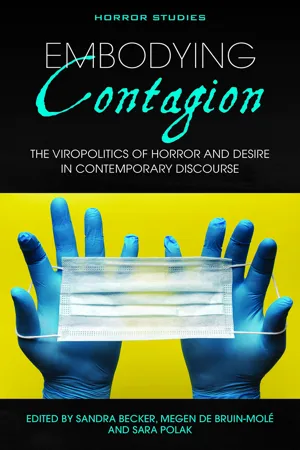
eBook - ePub
Embodying Contagion
The Viropolitics of Horror and Desire in Contemporary Discourse
- 288 pages
- English
- ePUB (mobile friendly)
- Available on iOS & Android
eBook - ePub
Embodying Contagion
The Viropolitics of Horror and Desire in Contemporary Discourse
About this book
From Outbreak to The Walking Dead, apocalyptic narratives of infection, contagion and global pandemic are an inescapable part of twenty-first-century popular culture. Yet these fears and fantasies are too virulent to be simply quarantined within fictional texts; vocabulary and metaphors from outbreak narratives have now infiltrated how news media, policymakers, and the general public view the real world and the people within it. In an age where fact and fiction seem increasingly difficult to separate, contagious bodies (and the discourses that contain them) continually blur established boundaries between real and unreal, legitimacy and frivolity, science and the supernatural. Where previous scholarly work has examined the spread of epidemic realities in horror fiction, the essays in this collection also consider how epidemic fantasies and fears influence reality. Bringing scholarship from cultural and media studies into conversation with scholarship from the medical humanities and social sciences, this collection aims to give readers a fuller picture of the viropolitics of contagious bodies in contemporary global culture.
Information
Print ISBN
9781786836908
Subtopic
Literary Criticism
1

The Krokodil Drug Menace, Cross-Genre Body Horror and the Zombie Apocalypse
Peter Burger
IN 2011, ALARMING stories about the new drug krokodil started to appear in Western European and American news media. Originating in Russia and neighbouring countries, krokodil is a home-brewed desomorphine-based opiate, associated with horrific images of decaying limbs. For drug chemistry cognoscenti, its name echoes that of alpha-chlorocodide, an intermediate product in the process that turns codeine into desomorphine.1 The name is more popularly understood, however, as reflecting the fact that it turns the addicts’ skin scaly and green, or, alternatively, makes them look as if they have been ravaged by a crocodile’s jaws. Gruesome images of krokodil’s alleged effects proliferate on news sites, in medical journals, and in YouTube videos, generating thousands of comments. A critique of krokodil discourse in these diverse sites and genres warrants an approach that merges the sociology of social problems with folklore studies.
The krokodil menace is the latest example of society’s penchant to construct drug users as monsters. A dominant trope in recent drug discourse is that of the zombie, that is, not the original living dead of Haitian folklore, but the pop culture and Western contemporary folklore zombies that take their cue from George Romero’s cannibalistic ghouls. Contaminated and contagious, present-day ‘drug zombies’ may be black or white, but they are invariably represented as poor and marginalised, even among drug users. The stories told about krokodil and its users – whether vernacular, tabloid, educational or academic – display a strong cross-genre similarity, and ultimately feed the hegemonic narrative that dehumanises drug addicts of low socio-economic status. Merging global news and amusement media discourse and imagery with vernacular discourse, they also exemplify the interconnected and hybrid nature of present-day folklore.
Krokodil is Coming
Known in Russia since 2003, krokodil appeared on the radar of Western European and American news media, medical researchers and drug counsellors in 2011.2 The latest drug menace was said to be more lethal than any of its predecessors – and it was rapidly moving westwards. I will have occasion to reappraise these claims in subsequent paragraphs, but for the moment I shall stick with the story as it can be traced in news coverage and in the majority of papers in medical journals.
Although news media and medical authorities alike classified krokodil as the latest designer drug, this label, connoting style and affluence, belies its underclass nature. ‘Home-brewed’, another common epithet, comes closer: krokodil is described as a toxic concoction of codeine, matchstick heads, gasoline, iodine, bathroom cleaner, paint thinner and hydrochloric acid – practices and accounts may vary.3 Cooked up in kitchen labs, it is injected intravenously by Russian drug addicts too poor to afford heroin. Its effects are understood to be more vicious than those of other drugs. Krokodil is said to be instantly addictive and infallibly lethal. According to a 2011 feature in Pravda’s English-language edition, ‘Some may take it for five years, but many people die after taking their first dose of this drug’.4 Users are said to have a one-to-two-year life expectancy, during which time their bodies are eaten away from the inside. News media display, with varying degrees of restraint, their gangrenous limbs and mutilated bodies.
Originally confined to Russia, Ukraine, Georgia and other former Soviet republics, in 2011 krokodil was observed migrating westwards. According to a paper published in the American Journal of Medicine, krokodil use ‘has been spreading rapidly across Europe’.5 European news media sounded the alarm: ‘“Krokodil” killer drug sweeps through Europe’, ran a headline on Belgian news site Het Laatste Nieuws in October 2011. Employing a striking metaphor that plays on xenophobia and nationalism, the article claimed, ‘Already the krokodil rubs its body against the Belgian and Dutch borders’. In the accompanying picture a woman holds up her mutilated forearm, allowing an unimpeded view of its bones and tendons.
Individual cases in Western Europe were first spotted in Germany (October 2011), Norway (August 2012), the Netherlands (March 2013) and the UK (October 2013).6 Across the Atlantic, unconfirmed reports from Canada (November 2013) were followed by the first ‘official’ US case in December 2013, a Missouri patient who lost a finger to the drug.7 In December 2013, too, news media drew attention to the first patient in Mexico, a 17-year-old girl, highlighting the lurid detail that she had injected the drug in her genitals.8
In spite of headlines like ‘Doctors confirm: Use of flesh-eating opioid drug krokodil is spreading in U.S.’, these are, without exception, scattered, individual cases, often unconfirmed or eventually labelled as false alarms by law enforcement and medical authorities.9 News media initially downplayed this uncertainty, dwelling on the alarmist claims and largely ignoring the retractions. Eventually though, in October and November 2013, the lack of evidence sparked a backlash. Pointing out that the horrific skin lesions found with American patients were probably MRSA infections or other known sequelae of ‘ordinary’ heroin use, a growing number of US news media slammed the krokodil threat as mere media hype: ‘Krokodil concerns lack teeth’ (Newsweek, 28 October 2013).10 After 2015, news coverage of krokodil use and dire warnings by health authorities subsided in the US, but they made a fresh resurgence in the UK in 2018, with headlines such as ‘Flesh-rotting “zombie” drug Krokodil “has arrived in the UK” – and it’s 10 times stronger than heroin’ (The Mirror, 1 November 2018).11
Using material from varied and at first sight disparate media worlds – news sites, medical journals, and YouTube videos and user comments – I will examine the way this purported drug epidemic and its victims were discursively constructed in institutional and vernacular (or ‘folk’) venues.
The Vernacular Public Sphere
Novelty drug panics have frequently been analysed from a constructionist perspective on social problems.12 Regardless of their grounding in real-life conditions, these need to be recognised and promoted by claims makers. The sociology of social problems leads us to expect a mostly top-down process, in which experts, policymakers and other high-status claims makers strive for the acceptance of their claims about the nature and proposed solutions to the new threat.13 News media usually do not act as claims makers in their own right, but rather transmit the claims of others, adapted to news media formats. Eventually, at the very bottom of this trickle-down model, the claims reach the public.
But this drug epidemic is different. With the coming of Web 2.0, the vernacular public sphere has grown more prominent. In the words of folklorist Robert G. Howard, the vernacular exists ‘alongside but apart from institutions’, for example in user comments on news sites or in more elaborate forms such as sick jokes and Photoshop humour in response to shocking news.14 English and communication studies scholar Trevor J. Blank reads these intentionally tasteless responses to death, disaster and scandal as counter-hegemonic: they voice vernacular criticism of the official perspective on these topics, as expounded by mainstream news media.15 Rather than the deaths themselves, the jokes target the emotionally stifling media coverage. Following Michael Jackson’s death, for example, jokes mercilessly spotlighted aspects of his life that news media necrologies piously glossed over: ‘Like Michael Jackson always said: Live fast, die young, leave a vaguely Vietnamese looking woman’s corpse’.16
Despite its subversive potential, Howard cautions that ‘it is important to recognize that the vernacular can act to support or contest the institutional, and often it does a little of both’.17 Most studies of the vernacular web, however, focus on its power to subvert and disrupt, for example fuelling the allegedly social media driven Arab Spring or fostering vaccination conspiracy theories.
The second major characteristic of the vernacular web is its hybridity.18 Its very existence is vouchsafed by the infrastructure provided by institutions, for example Facebook, YouTube, Twitter, and comments sections on news sites. Expressing its own alternative authority, the vernacular necessarily invokes institutional authority. Institutions, in turn, avail themselves of blogs, Twitter accounts and Facebook pages to project an ethos-boosting grass-roots image. In the case of the alleged krokodil epidemic, I argue, the vernacular and the institutional are meshed to the point where it becomes difficult to say who is taking his cue from whom. Scholarly journals present images borrowed from YouTube videos as medical evidence and zombie metaphors pervade news discourse and users’ comments as well as medical discourse. In this collusion, the vernacular web’s counter-hegemonic potential is not realised. As I start to try and unpick this tangle, the first thread I will follow is that of drug scare rhetoric.
Drug Scare Rhetoric
Time and again, news media, policymakers and law enforcement personnel discover a drug that is worse than all previous ones. The rhetoric they employ to sell the public on this new menace has been analysed by the American historian of social problems Philip Jenkins. In his book Synthetic Panics (1999), Jenkins predicts that each fresh threat will be given a ‘catchy label that would lend itself to imaginative permutations in news headlines’.19 In this respect, krokodil was a journalist’s dream come true. A small sample of headlines: ‘The drug that eats junkies’; ‘The drug that eats you alive’; ‘Flesh-eating drug krokodil “could sink its teeth into British addicts”, health workers warned’.20
The new drug, Jenkins says, will be depicted as more addictive, toxic and harmful than all its predecessors. Numbers are provided to substantiate the claim that we have an ‘epidemic’ on our hands. The numbers are personified through stories about individuals who suddenly turn extremely violent, or completely ruin themselves. The threat’s urgency is enhanced by implicating the new drug in current social problems such as illegal immigration. And, finally: claims makers demonise the new drug’s users by comparing them to zombies and other monsters.
A recent US instance of drug scare rhetoric is the prominent 2012 news story of Rudy Eugene (31), a black Haitian-American who was killed by a police officer when he was caught in the act of biting a 65-year-old homeless man’s face. He was, according to the Miami police, under the influence of ‘bath salts’ – like krokodil, a DIY designer drug. In epithets evocative of George Romero-style cannibal zombies, Eugene was labelled the ‘Miami Zombie’ and the ‘Causeway Cannibal’ by news media. As it turned out later, Eugene was neither a cannibal (no human flesh was found in his digestive tract) nor a bath salts addict – only marijuana could be detected in his system. Both allegations were used to exonerate the policeman who had shot a frenzied, but naked and unarmed suspect.21
Like the paddo and bath salts incidents, cautionary stories about krokodil can be, and have been, employed to support a political agenda. In March 2013, Belgian minister for Social Affairs and Public Health, Laurette Onkelinx, referred to krokodil when she announced a bill to ban legal highs.22 The extreme case of the monster drug is used to prop up anti-drug policies meant to combat more mundane substances. In a more general sense, monsters, and zombies in particular, are a rhetorical staple of public policy discourse – the institutional as well as the vernacular.
Public Policy Discourse – and Zombies
The Miami police force did not need to invent the zombie label for Rudy Eugene, since this was already firmly established as an explanation for bizarre and violent behaviour. In fact, a study of three major Miami area newspapers reveals that reporters consistently ignored interpretations of Eugene’s behaviour in terms of mental illness, focusing instead on influences from outside that carried more cultural resonance.23 Law enforcement sources favoured craze-inducing narcotics, the explanation that carried most weight among officials. Eugene’s girlfriend claimed that he may have been a victim of drink spiking.24 Her attorney, however, pointed the finger at cannibalism, ‘a serious issue . . . very dangerous to the health and well-being of both the cannibal and the victim.’25 Eugene’s Haitian background cued explanations in terms of zombies. Exactly what had turned him into a zombie remained a matter of debate. The US Centers for Disease Control and Prevention (CDC) felt it necessary to publicly deny the existence of a zombie virus.26
A year earlier, however, the CDC itself had jumped on the zombie bandwagon, utilising the imaginary threat of a zombie apocalypse to urge citizens to prepare for real-life disasters.27 Zombie talk also crops up in drug prevention programmes.28 In 2011, the US Navy issued anti-bath salts posters in which a service member’s face appears as a zombie in the mirror (‘It’s not a fad . . . It’s a nightmare’). The Washington D.C. Department of Health ran series of ads showing decomposing teenagers who supposedly used synthetic marijuana or Spice: ‘No one wants to take a zombie to the prom’.29
This use of zombie...
Table of contents
- Cover
- Title
- Copyright
- Contents
- Acknowledgements
- Notes on Contributors
- Preface Priscilla Wald
- Embodying the Fantasies and Realities of Contagion Megen de Bruin-Molé and Sara Polak
- Part One: Epidemic Fantasies in Reality
- Part Two: Epidemic Realities in Fantasy
- Epilogue
- Bibliography
Trusted by 375,005 students
Access to over 1.5 million titles for a fair monthly price.
Study more efficiently using our study tools.
Frequently asked questions
Yes, you can cancel anytime from the Subscription tab in your account settings on the Perlego website. Your subscription will stay active until the end of your current billing period. Learn how to cancel your subscription
No, books cannot be downloaded as external files, such as PDFs, for use outside of Perlego. However, you can download books within the Perlego app for offline reading on mobile or tablet. Learn how to download books offline
Perlego offers two plans: Essential and Complete
- Essential is ideal for learners and professionals who enjoy exploring a wide range of subjects. Access the Essential Library with 800,000+ trusted titles and best-sellers across business, personal growth, and the humanities. Includes unlimited reading time and Standard Read Aloud voice.
- Complete: Perfect for advanced learners and researchers needing full, unrestricted access. Unlock 1.5M+ books across hundreds of subjects, including academic and specialized titles. The Complete Plan also includes advanced features like Premium Read Aloud and Research Assistant.
We are an online textbook subscription service, where you can get access to an entire online library for less than the price of a single book per month. With over 1.5 million books across 990+ topics, we’ve got you covered! Learn about our mission
Look out for the read-aloud symbol on your next book to see if you can listen to it. The read-aloud tool reads text aloud for you, highlighting the text as it is being read. You can pause it, speed it up and slow it down. Learn more about Read Aloud
Yes! You can use the Perlego app on both iOS and Android devices to read anytime, anywhere — even offline. Perfect for commutes or when you’re on the go.
Please note we cannot support devices running on iOS 13 and Android 7 or earlier. Learn more about using the app
Please note we cannot support devices running on iOS 13 and Android 7 or earlier. Learn more about using the app
Yes, you can access Embodying Contagion by Sandra Becker,Megen de Bruin-Molé,Sara Polak in PDF and/or ePUB format. We have over 1.5 million books available in our catalogue for you to explore.