Good water, sanitation, and hygiene (WASH) services protect health and the environment. Such services are particularly important in schools to instill lifelong proper hygiene habits in children and provide them access to the requisite facilities. Many schools in Mongolia face significant challenges in improving WASH due to physical and demographic conditions. The country's harsh winters require sustainable WASH facilities that can withstand extended periods of below-freezing temperatures. This publication provides essential information for national and local administrators, engineers, field practitioners, and policy makers to plan, implement, and manage improved WASH in schools, particularly in small and isolated rural settlements. It covers WASH standards and norms, design and technology options, operation and maintenance, hygiene education approaches, and cost estimation.
eBook - ePub
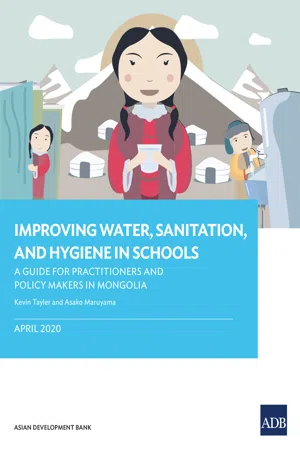
Improving Water, Sanitation, and Hygiene in Schools
A Guide for Practitioners and Policy Makers in Mongolia
- 148 pages
- English
- ePUB (mobile friendly)
- Available on iOS & Android
eBook - ePub
Improving Water, Sanitation, and Hygiene in Schools
A Guide for Practitioners and Policy Makers in Mongolia
About this book
Information
Subtopic
Studi sullo sviluppo globaleAPPENDIX 1
Physical Context of Mongolia
Section I introduced the challenges confronting many schools in rural Mongolia when improving water, sanitation, and hygiene (WASH) facilities. Among those challenges, physical conditions, particularly, climate, and the availability of water, often limit the options available for many rural schools to devise improved WASH schemes. Appendix 1 seeks to facilitate the understanding of the physical conditions essential to improve WASH services in schools.
Climate
The provision of water and sanitation services in Mongolia is influenced by its climate, in particular, its harsh winters and low rainfall.
Typical monthly temperatures range from 15°C to 25°C in July to –20°C to –30°C in January, depending on location. The lowest winter temperatures occur in the mountainous areas, particularly in the valleys between the Altai, Khangai, Khentii, and Khuvsgul ranges, where average January temperatures can range from –30°C to –35°C. The diurnal temperature variation is typically between 12°C and 18°C. Temperatures can fall to around –50°C in winter and reach almost 40°C in summer.
Some parts of the country experience permafrost conditions. Even where this is not the case, the ground freezes to a depth of several meters in winter. Figure A1.1 provides an overview of permafrost conditions in the country. The terms used in Figure 1 to describe permafrost have the following meanings:
(i) | Continuous permafrost occurs where all ground remains frozen to a considerable depth throughout the year. |
(ii) | Permafrost is discontinuous where the ground thaws completely in some places during the summer. |
(iii) | Insular permafrost occurs where permanently frozen areas are surrounded by areas that thaw completely in the summer. |
(iv) | Sporadic permafrost exists where isolated areas of permafrost remain, although most of the ground thaws completely during the summer. |
Figure A1.1: Extent of Permafrost Conditions in Mongolia

Source: National Snow and Ice Data Center. https://nsidc.org/sites/nsidc.org/files/images/data/ggd/geocryo_regions.png.
Permafrost conditions occur mainly in the north of Mongolia and in mountainous areas. The depth of permafrost can reach 100 meters (m) or more while the ground may thaw to a depth of 1.0 meter (m) to 4.5 m during the summer, depending on location. In areas with seasonally frozen ground, the ground may freeze to a depth of 1.6 m to 5.0 m, contingent on the severity of the winter and the location.
The extreme winter temperatures have important implications for the design of water supply and sanitation systems. In permafrost areas, deep groundwater is only available below the permafrost. Water may exist at shallow depths above the permafrost during summer. However, water available at shallow depths has a high probability of contamination by pathogens and chemicals leaching from pit latrines, leaking sewers, and other sources of contamination. Overall, accessing clean water in permafrost areas is normally both difficult and expensive. Moreover, in both permafrost areas and those with seasonally frozen ground, measures to prevent pipes and tanks from freezing in winter are required. Many water and sanitation facilities in locations across Mongolia have failed because the designs did not adequately consider the effects of extreme cold on their performance.
Rainfall amounts in Mongolia are generally low. Ulaanbaatar’s average annual rainfall is about 380 millimeters (mm). Monthly precipitation peaks in July at almost 80 mm and falls below 5 mm from October to April. Rainfall patterns are generally similar in other parts of the country, although total rainfall in the north and east exceeds that in Ulaanbaatar, while total rainfall in the dry southwest is much lower.
The following general points on water supply should be noted, all of which have an impact on the availability of water to supply schools:
(i) | long dry periods rule out rainwater harvesting as a water supply option, |
(ii) | low overall rainfall amounts mean that there are few surface water sources other than along main rivers, and |
(iii) | low rainfall amounts reduce recharge of aquifers. |
Mongolia is a predominantly sunny country, on average experiencing around 250 sunny days each year. The possibility of solar energy should be investigated when considering options for powering pumps in settlements without an electricity grid connection. Average wind speeds in some areas are high enough to suggest that wind could also be a possible power source.
Water Availability
Water availability should be a central concern in planning for improved WASH in schools, because every water supply system requires a source that is both adequate and reliable. Many washrooms and toilets in schools are not in use simply because there is no adequate source of water to supply them. Box A1.1 summarizes the general situation surrounding water availability in Mongolia.
Box A1.1: Water Availability in Mongolia
The main sources of water in Mongolia are rivers, streams, lakes, springs and groundwater.
There are over 4,000 rivers, of which around 20 rivers are large, mostly flowing north flowing north toward the Arctic Ocean. Few rivers and streams exist in the drier south of the country. Rivers in the west and southwest of Mongolia flow south into the desert, where some feed lakes or systems of lakes. In such cases, the final lake in the system is normally saline. All rivers freeze completely during winter, except for a few large ones.
A 2004 study (Altanzagas 2006) identified around 9,600 springs in the country, of which 1,484 were dry at the time of the study. The study also estimated that around 10% of Mongolia’s population were using spring water.
Groundwater accounted for 80% of all Mongolia’s freshwater consumption in 2010 (ADB 2014). In areas with limited rainfall, groundwater may be fossil water, which receives little or no recharge from the surface.
Sources: B. Altanzagas (2006) and ADB (2014).
Water Quality
Two aspects of water quality impact upon the choice of source for school and settlement-wide water supply systems: microbiological quality, in particular, the likelihood that pathogens are present; and physical and chemical quality. The microbiological quality of deep groundwater is usually better than that of shallow groundwater, including springs and surface water. The physical and chemical quality of groundwater can affect both the safety and the palatability of water.
The water quality issues in Mongolia relate to the following:
(i) | Arsenic. This occurs in groundwater in the southern Gobi region and may be an issue in adjacent regions. |
(ii) | Fluoride. High levels have been recorded in many wells in the southern Gobi region, especially in the northeastern part of Omnogovi Aimag and in Dundgovi and Dornogovi Aimag. |
(iii) | High total dissolved solids concentrations. These are usually associated with salinity. High total dissolved solids (TDS) concentrations affect the palatability of water, at worst making it undrinkable, particularly in southern and southwestern Mongolia, including parts of the southern Gobi region. Further information on acceptable TDS levels is given in section II. |
(iv) | Hardness. This is mainly caused by calcium and magnesium carbonate. Most of Mongolia’s groundwater is hard to a greater or lesser extent. At extreme levels, this may influence palatability and make groundwater unsuitable as a drinking water source. At lower levels, hardness causes scaling on utensils and pipes. |
High levels of arsenic and fluoride can both adversely affect health, as explained in section V.
APPENDIX 2
Assessing Water, Sanitation, and Hygiene Needs
Section III outlined the process and priorities in planning for improved water, sanitation, and hygiene (WASH) in schools, based on assessments of school WASH needs, resource availability, and constraints. Appendix 2 provides guidance on information collection and analysis for the assessments, especially for school management, aimags, and Ulaanbaatar education departments. This appendix covers information collection needs and procedures relating to
(i) | the school and the number of students, teachers, and staff to be served; |
(ii) | existing and planned WASH facilities; |
(iii) | standards and regulations; |
(iv) | climatic conditions; |
(v) | institutional responsibilities and capabilities; |
(vi) | water availability; |
(vii) | power availability; and |
(viii) | hygiene knowledge and practice. |
Information Type 1: School, Students, Teachers, and Staff
To estimate the demand for WASH services, information is required on (i) the total number of students and students living in dormitories, teachers, and school staff; (ii) the location and uses of existing and planned school buildings; and (iii) the layout of existing buildings.
1. Student, Teacher, and Staff Numbers
Information on student, teacher, and staff numbers is needed to determine how much water should be supplied to the school; and how many toil...
Table of contents
- Front Cover
- Title Page
- Copyright Page
- Contents
- Tables, Figures, and Boxes
- Acknowledgments
- Abbreviations
- Weights and Measures
- Executive Summary
- I. Introduction
- II. Legislation, Standards, and Norms on Water, Sanitation, and Hygiene in Schools
- III. Planning for Improved Water, Sanitation, and Hygiene in Schools
- IV. Improving and Managing Water, Sanitation, and Hygiene in Schools
- V. Promoting Hygiene Education
- VI. Conclusion and Recommendations
- Appendixes
- Glossary
- References
- Footnotes
- Back Cover
Trusted by 375,005 students
Access to over 1.5 million titles for a fair monthly price.
Study more efficiently using our study tools.
Frequently asked questions
Yes, you can cancel anytime from the Subscription tab in your account settings on the Perlego website. Your subscription will stay active until the end of your current billing period. Learn how to cancel your subscription
No, books cannot be downloaded as external files, such as PDFs, for use outside of Perlego. However, you can download books within the Perlego app for offline reading on mobile or tablet. Learn how to download books offline
Perlego offers two plans: Essential and Complete
- Essential is ideal for learners and professionals who enjoy exploring a wide range of subjects. Access the Essential Library with 800,000+ trusted titles and best-sellers across business, personal growth, and the humanities. Includes unlimited reading time and Standard Read Aloud voice.
- Complete: Perfect for advanced learners and researchers needing full, unrestricted access. Unlock 1.5M+ books across hundreds of subjects, including academic and specialized titles. The Complete Plan also includes advanced features like Premium Read Aloud and Research Assistant.
We are an online textbook subscription service, where you can get access to an entire online library for less than the price of a single book per month. With over 1.5 million books across 990+ topics, we’ve got you covered! Learn about our mission
Look out for the read-aloud symbol on your next book to see if you can listen to it. The read-aloud tool reads text aloud for you, highlighting the text as it is being read. You can pause it, speed it up and slow it down. Learn more about Read Aloud
Yes! You can use the Perlego app on both iOS and Android devices to read anytime, anywhere — even offline. Perfect for commutes or when you’re on the go.
Please note we cannot support devices running on iOS 13 and Android 7 or earlier. Learn more about using the app
Please note we cannot support devices running on iOS 13 and Android 7 or earlier. Learn more about using the app
Yes, you can access Improving Water, Sanitation, and Hygiene in Schools by Kevin Tayler,Asako Maruyama in PDF and/or ePUB format, as well as other popular books in Tecnologia e ingegneria & Studi sullo sviluppo globale. We have over 1.5 million books available in our catalogue for you to explore.