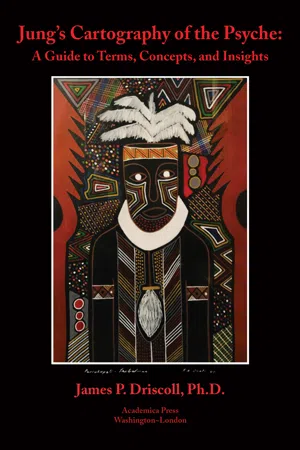
eBook - ePub
Jung’s cartography of the psyche
A Guide To Terms, Concepts, And Insights
- English
- ePUB (mobile friendly)
- Available on iOS & Android
eBook - ePub
About this book
Carl Jung was a great explorer and mapper of the unconscious realm that Sigmund Freud had discovered. Jung created a copious vocabulary of psychological terms and concepts that help us understand features of the psyche that were previously overlooked or difficult to define. Taken together, his terms and concepts offer a basic cartography of the human psyche. In contrast to clinically oriented Jungian glossaries, this work delineates the complex interrelationships of his ideas showing how they intermesh within a coherent system. It carries Jung's seminal insights to an array of subjects that have unfolded in surprising directions, including, for example, revolutionary ideas on the self, time, and the Godhead. The commentaries James P. Driscoll offers in Jung's Cartography of the Psyche are helpful for applying Jung to literature, philosophy, religion, the political domain, and other aspects of the human experience. They comprise an introduction and guide that demonstrates Jung's scope and depth as well as the rewards of studying him further.
Information
JUNG’S TERMS, CONCEPTS, AND PERSPECTIVES
ACTIVE IMAGINATION is a process of dreaming, or spontaneous fantasizing with open eyes, that can become a powerful tool for dealing with the archetypes, and a means of dialoguing with archetypal figures arising from the personal and collective unconscious. This technique concentrates on an image, event, picture or mood, allowing a complex of associated fantasies to develop into a dramatic context from which the images gain a life of their own and can interact with us and each other as entities. The independent life of the entities distinguishes active imagination from directed fantasy. Active imagination creates a situation where the transcendent function comes into play allowing partnership and teamwork with the archetypes that can facilitate assimilation of unconscious contents and give independent voice to major personality functions, such as the shadow or anima, that may be suffering from unhealthy repression.
This method of therapy reflects Jung’s belief that individuation results from bringing unconscious elements into consciousness. It requires a significant degree of isolation so that the resulting drama may precede without distraction, and it is most appropriate for an advanced stage of analysis. There is a danger that it will arouse complexes so powerful that they take possession of the person who is left to wrestle with his demons. Jung himself created his Red Book from his experiences with active imagination; the book illustrates the potential dangers along with the promise of the method.
Artistic creation, particularly drama and dramatic narratives, including novels and epics, can be a natural expression and instance of active imagination. It can explain cases where a character takes possession of events in the writer’s story, leading his narrative into the unknown. This is especially evident with powerful and memorable characters, and common for those writers who are notable for creating characters so extraordinary that they become like real people for the readers and viewers. Shakespeare is the example par excellent. His greatest characters, like Falstaff, Hamlet, Shylock, Iago, Rosalind, Cleopatra, Lear, and Prospero, take possession of their drama and lead it and the reader/audience where these characters want to go. The same holds with other powerful writers, especially those whose work is marked by visionary elements. With artists, active imagination often proceeds through amplification, conscious or largely unconscious, of traditional myths, motifs, and characters who manifest powerful archetypes.
Such natural or spontaneous active imagination brings art close to magic where the artist becomes conjurer and his art a form of conjuration. Natural active imagination also appears to have major impact in the realm of religion where it may explain many religious visions and presumed direct communications, or revelations, from saints and gods. It may be argued that religious myth germinates in the active imagination of seers, then becomes collectivized among the faithful. Thereby the deities would become collective unconscious complexes that can be further dealt with through active imagination just as we deal with our personal unconscious complexes.
ACTUAL GOD. Jung uses the term to refer to God as a metaphysical entity or God as noumena, as distinct from culture specific god images and concepts or from powerful psychic phenomena, such as numinous emergents from the self that are seen as manifestations of divinity. This usage reflects Jung’s Kantianism, especially Kant’s belief that the noumena is, in its particulars, unknowable. Assuming that attempts to define or describe Actual God are blind allies, Jung did little beyond distinguishing this unknowable entity from personal god images which are knowable. The Jungians have largely ignored Actual God or mistakenly conflated it with the deity of Western monotheism.
Jung never explicitly discussed time being the supreme creative and ordering force, in effect time as Actual God. Although his interest in synchronicity pointed down that metaphysical path, it remained a road glimpsed but not taken. The universe is indisputably ordered by time, thus making Actual God as time irrefutably real, a view that accords with Whitehead and is dramatized implicitly by the supreme poet of the West, William Shakespeare. In his Red Book Jung gives Abraxas a position like Actual God and later refers to Abraxas, the Gnostic supreme deity, as a “Time God.” Not being a Kantian, I am at liberty to venture to discuss and attempt to define Actual God. Indeed, I find the concept of crucial importance as a prelude or groundwork for defining all ideas of God and the nature of the universe.
Here is my definition of Actual God: the dynamism of change that is and moves through time and by that means creates the temporal universe. Actual God sustains the life, structure, and implicit, unfolding intelligence of the temporal process, which is the creative continua that forms the universe we know. Actual God entails, generates, and sustains the dynamic interconnectedness and interdependence of everything in time, and thereby integrates the universe, making it a universe rather than a chaotic multiverse, and maintaining it in homeostasis or dynamic stability. In coalescing the unus mundus, and through Time’s irreversibility, Actual God gives order, value, and meaning to all things within time and the universe, and thus it acts as a metaphysical guarantor of the meaning of life, order in nature and the universe, and the possibility of valid spiritual and religious experience.
Actual God is inherent in the fundamental character/principle of time: irreversibility and its corollaries order, adventure, novelty, responsibility, universal interdependence and creative coalescence toward greater order and enhanced complexity in the universe. The irreversibility of time and the interconnectedness and interdependence of everything in time create value and thereby give Actual God moral qualities that provide a universal ground for ethics.
For Jung, and for this work, Actual God must not to be confused with civilizational gods such as Allah, Brahman, Yahweh, and the Christian Trinity. Actual God is a universal force not particularized for any civilization, species, or planet, but abides and prevails as a regulator acting throughout the entire universe and that moves the whole system toward higher levels of order and complexity. The tendency of formal religions to see God as an ego rather than as like a self, the homeostatic regulator of the psyche, inhibits their recognition and understanding of Actual God.
ADAPTATION. To survive and thrive man, like every other living thing, must adapt. Adaptation is the first law of life and the prime driver of biological and cultural evolution. For humanity adaptation involves coming to terms with the challenges of the external world and one’s circumstances in it, but also with the dominant archetypes of the human psyche. The goal and final objective of psychic adaptation is, for Jung, individuation. His introversion, extraversion, and the four psychic functions are primary modes of adaptation for human consciousness Like individuation, adaptation is an ongoing temporal process that is never achieved once and for all. Failure of adaptation can lead to neurosis and is, according to Jung, one definition of neurosis.
Adaptation can be authentic, which requires an honest assessment of the one’s self and a realistic assessment of the world. Or it can be inauthentic which usually entails unthinking conformity to collective values. Authentic adaptation requires humility, courage, consciousness, honesty, creativity, imagination, resourcefulness, and in the heroic mode a willingness to undertake adventure, where, as Shakespeare put it, to succeed one must give and hazard all. We need humility and courage to admit that our beliefs or practices have proved morally wrong, dysfunctional, or outdated. We need consciousness and honesty to see and acknowledge things as they are. We are above all else beings who must adapt consciously, who can freely choose what we become from the options that our nature and place in time afford. To freely chose, we must exercise honesty in respect to ourselves and others, along with the creativity and imagination to perceive and assess our full range of options in life. Finally, without adventure and the hazards adventure brings, novel options and solutions are neither discovered nor created.
Adaptation, as Darwin learned, is the great driver of species evolution. Failure to adapt when the psyche faces intolerable suffering or injustice can lead to tragedy, and it inevitably raises the problem of evil. In Shakespeare, King Lear’s madness when he flees onto the heath in the storm has its roots in his initial failure to adapt. His Fool, as his most trusted advisor, cannot save Lear from his initial acts of folly, yet acting as his analyst, the Fool leads him toward the heroic adaptation that is the tragic insight which comes when we finally grasp a problem we have lost the chance to solve.
ADVENTURE is a key concept for Whitehead that can help illumine Jung’s views of the psyche and individuation. We grow, learn, and advance through adventure. Every true adventure encounters the unexpected and often the extraordinary, a truth dramatized repeatedly in Western literature’s foremost adventure story, Homer’s Odyssey. Creativity is a necessary response and adaptation to the unexpected. Creativity, which requires resourcefulness and works chiefly through imagination, is Time’s gift to adventurous spirits. Creativity furthers individuation and sustains the self, but without adventure creativity atrophies along with the self. Scientific, technological, economic, and artistic innovation are powered by imagination, and they begin with and require fertilization through continued adventure. Higher animals are adventurous, and man is by far the most adventurous of the all.
ALCHEMY. Jung believed that alchemists projected psychic contents into matter. Thereby, they employed alchemy to work indirectly, through symbols, on the psyche which made alchemy a precursor of modern psychology. Hence, alchemy forms a repository of evidence about and insight into psychic processes, particularly individuation. Like the fine arts and analytic psychology, according to Jung alchemy tends to be compensatory toward the cultural canon. Like them also it was repeatedly attacked as subversive. Alchemy’s attempts to transform base metal into precious metals correspond to Jungian psychology’s prime goal of transforming the ego through individuation.
The alchemists arranged the elements used in their experiments in pairs of opposites, their objective being to make from the conjunction of opposites new elements, the most fundamental opposites being the male and female who in the conjunctio form a new element, the child. Just as alchemy sought to differentiate the elements through work with opposites, so Jung’s psychotherapy seeks to differentiate parts or chief archetypes of the psyche through work with opposites. The goal of alchemy, the philosopher’s stone, symbolizes the ultimate goal of therapy, wholeness. Art, especially painting and literature, has an alchemy all its own, and the greatest art instinctively seeks the alchemists goal of wholeness.
Jung turned to alchemy because he believed it expressed the Western collective unconscious in purer form, less adulterated by orthodox Christian biases. He found in alchemical terms, such as separatio, mortificatio, and dissolutio, ways of discussing various aspects of the individuation process that avoided the confusing connotations of terms from the mainstream. The bizarre imagery, occultism. and arcane ideas of alchemy make Jung’s alchemical studies exceptionally difficult. However, Jung did not intend these studies to lead up into the sunlight, but down into depth of the ocean of the Western unconscious. The alchemical works that Jung chose to investigate constituted, he believed, an arcane exercise in active imagination conducted on the collective psyche of Western civilization.
ALIENATION. While currently associated more with Marxist than Jungian thought, this fundamental concept goes back to Augustine and Greek tragedy and is critical in Shakespeare, Milton, and many modern greats, for example Melville, Dostoevsky, and Kafka. As a common reality of the human condition, the roots of alienation extend to the dawn of history and likely before. Alienation, dependence, and interdependence define the spectrum of possible relationships of individual to God and of ego to self, as well as of person to person. In traditional views that render God wholly other, sin is a metaphor for the alienation from God that pervades the cosmos since the fall of man. In Marxian ideologies, alienation from historical necessity and the collective will give rise to betrayal or bad faith, a Marxian equivalent of sin. Alienation of the workers by the conditions of their work under capitalism takes the place of alienation from God.
For Jung initial alienation of ego from unconscious oneness is a necessary first step in the individuation process, but permanent alienation of ego from self and unus mundus generates a sickness of soul whose symptoms are malaise, despair, and meaninglessness. Alienation and inflation, as the internal and external facets of uroboric regression, are symbiotic evils. Alienation feeds inflation, especially in the forms of pride, scorn and envy, and inflation always alienates. The presence of alienation and inflation ever stifles understanding and love between individuals. The remedy to alienation and inflation is communication and then love bringing interdependence with others, the self, and finally the unus mundus.
AMPLIFICATION is a method of interpreting symbols, dreams, archetypes, synchronicities, and myths that clarifies and expands their meaning by drawing upon the cultural, historic, and mythological contexts and then relating them to a specific, often personal, context. Its aim is to manifest more fully the meanings, the linked personal and universal significance, revealed in symbols, myths, dreams etc. It allows us to create multiple perspectives to grasp the object holistically and thereby facilitates a metastance and activates the transcendent function. While amplification and active imagination are different tools, they serve similar ends by complementing each other.
Consider how details from Greek culture and mythology can amplify the Oedipus myth. The gods, who embody the enduring qualities and universal aspects of human life, are the driving forces of myths. Jung tells us that gods represent archetypes; and the gods in each myth reveal which archetypes are active. The active god-archetype driving the Oedipus myth is Poseidon. Poseidon carries archetypal masculine feeling, as his brother Zeus carries archetypal thinking. The Oedipus myth began not with Oedipus’s crime but earlier with Poseidon acting as erastes to mortal Pelops’ eremenos. Afterwards, when the mature Pelops needed help securing a bride, Poseidon, remembering his joy in Pelops, came to the man’s aid: thus Poseidon and Pelops established an ideal erastes-eremenos relationship. The offspring of Pelops’s marriage was Chrysipus. Laius, visiting Pelops, lusted for Chrysipus, stole the boy by force, and violated him, causing his death. By disregard of feeling, Laius became a destructive erastes contrasted against Poseidon’s beneficial erastes. The disasters that befell the house of Laius through his offspring Oedipus, who embodies thought divorced from feeling, were retribution of Poseidon (feeling) against Laius’s crude, insensitive violence. This amplification yields significant meanings in the Oedipus story beyond what Freud found: the rivalry of father and son for the mother becomes a destructive effect of the damage to the feeling function that results when erastes-eremenos male bonding is violated.
Such amplification can be applied usefully to other important literary works, among them John Milton’s major poems, and many of Shakespeare’s plays. In King Lear amplification of the stages Lear passes through and of the role of Cordelia reveal the archetypes of the Quaternal Christian Godhead. Although King Lear deals fundamentally with an archetypal situation, misguided critics tend to search for psychological realism. Amplification avoids loggerheads that result when we seek a realistic explanation of Lear’s initial unconscious, his irrational and tyrannical behavior with his daughters, by showing that the early Lear is driven by a psychologically incestuous Yahweh, or father archetype, which is sharply at odds with his anima. Betrayed by the daughters he trusted and losing all, Lear on the heath in the storm embodies the unjust suffering the Job archetype symbolizes, and by extension he exemplifies the crucified Christ. His final defiance manifests the Promethean (and Satan) archetype. While Cordelia, epitomizing the interdependence of truth and love, manifests the Paraclete or wisewoman archetype. Amplifying the archetypes shows Lear’s story to be Shakespeare’s dramatization of the structure and character of the Judeo-Christian Godhead. Just as the meanings of Oedipus story are enriched and deepened by amplifying its archetypes, amplification can be used to expand the richness and depth of meaning of King Lear and many other great literary works.
ANDROGYNE is a symbol, often present in alchemical texts, of the male and female held in conscious balance without merger of the contrasexual features. Its psychological significance lies chiefly in relation to the anima and animus and their roles in individuation. Individuation works to achieve the psychic androgyny wholeness requires. Jung sometimes cited Jesus as an example of psychological androgynous wholeness and sexual complementarity. Shakespeare liked to play with the androgyne, a practice facilitated by the pervasive use of transvestite actors in the Elizabethan theater. His magnificent female characters, such as Portia, Rosalind, Cleopatra, and Viola, as well as his grand fools played by Robert Armin, like Feste and Lear’s fool, have distinct androgynous features. Shakespeare’s most fully androgynous character is the sprite Ariel who also represents Mercurius.
ANIMA. In Jungian psychology the term has two distinct meanings. First, anima refers to the contrasexual element in the male psyche that, appearing as a single figure, plays mediatrix between ego and the unconscious, thereby facilitating understanding of both its personal and collective aspects. Originally identified with the mother, in male adolescence anima starts to be projected on other women and to appear in dreams as a supportive companion. Countless stories in literature show a female figure helping the hero achieve his goal. In life as in art, every beloved or admired female carries the projection of the anima. Anima is the great teacher, seductress, illusionist, and guide that draws the male into the active life. Like the shadow, it is opposed to the persona. Those qualities that are repressed from persona become lodged in the shadow and the anima. Jung distinguished four general categories or stages of anima which he identified with Eve, He...
Table of contents
- Cover
- Title Page
- Copyright
- Contents
- Introduction
- Jung’s Terms, Concepts, and Perspectives
- Epilogue
- Bibliography
- Index
Trusted by 375,005 students
Access to over 1.5 million titles for a fair monthly price.
Study more efficiently using our study tools.
Frequently asked questions
Yes, you can cancel anytime from the Subscription tab in your account settings on the Perlego website. Your subscription will stay active until the end of your current billing period. Learn how to cancel your subscription
No, books cannot be downloaded as external files, such as PDFs, for use outside of Perlego. However, you can download books within the Perlego app for offline reading on mobile or tablet. Learn how to download books offline
Perlego offers two plans: Essential and Complete
- Essential is ideal for learners and professionals who enjoy exploring a wide range of subjects. Access the Essential Library with 800,000+ trusted titles and best-sellers across business, personal growth, and the humanities. Includes unlimited reading time and Standard Read Aloud voice.
- Complete: Perfect for advanced learners and researchers needing full, unrestricted access. Unlock 1.5M+ books across hundreds of subjects, including academic and specialized titles. The Complete Plan also includes advanced features like Premium Read Aloud and Research Assistant.
We are an online textbook subscription service, where you can get access to an entire online library for less than the price of a single book per month. With over 1.5 million books across 990+ topics, we’ve got you covered! Learn about our mission
Look out for the read-aloud symbol on your next book to see if you can listen to it. The read-aloud tool reads text aloud for you, highlighting the text as it is being read. You can pause it, speed it up and slow it down. Learn more about Read Aloud
Yes! You can use the Perlego app on both iOS and Android devices to read anytime, anywhere — even offline. Perfect for commutes or when you’re on the go.
Please note we cannot support devices running on iOS 13 and Android 7 or earlier. Learn more about using the app
Please note we cannot support devices running on iOS 13 and Android 7 or earlier. Learn more about using the app
Yes, you can access Jung’s cartography of the psyche by James P. Driscoll in PDF and/or ePUB format, as well as other popular books in Politics & International Relations & Politics. We have over 1.5 million books available in our catalogue for you to explore.