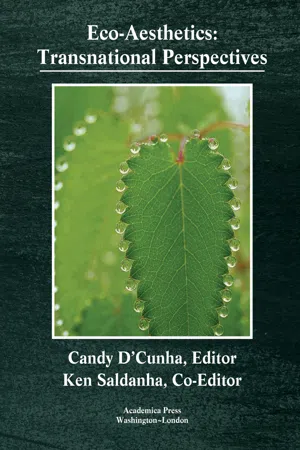
Eco-criticism, as explored in this volume edited by Sr. Candy D'Cunha, and co-edited by Ken Saldanha, begins with the concept of imagination, in other words, eco-aesthetics through which the power of words, stories, images, essence, and meaning are directly applied to environmental problems that afflict planet earth today. On the other hand, eco-criticism also concurs with the other branches of environmental humanities in the realm of history, ethics, anthropology, religious studies, and humanistic geography, among others. Arising from developing world perspectives, these fields harmonize environmental phenomena to comprehend the array of environmental concerns through a transnational perspective. In addition to these, the honest depiction of the harm done to the environment is to enable human to rethink and reorient themselves for radically transforming the present eco-system.
- English
- ePUB (mobile friendly)
- Available on iOS & Android
eBook - ePub
About this book
Information
Topic
Scienze biologicheSubtopic
EcologiaChapter 1
Naturescapes in Indian Women’s Poetry in English
Nature has been pivotal in all the continental literatures. The tradition of nature writing in English is a mere depiction or description, and hence may be considered a kind of monologue. Umpteen poets in all languages in the past as well as in the present, have either adored and deified the beauty of nature or used her as a symbol in their poetry. The English Romantics especially celebrated the element of beauty in their own inimitable manner. John Keats celebrated beauty as truth, truth beauty, Shelley simply saw revolutionary spirit in her, William Blake divinised her beauty, Wordsworth realized the Spirit of Wisdom pervading her, and Coleridge idealized her as real and realized her as ideal.
The present paper examines how Indian Women Poets writing in English have used and reflected Nature in their poetry. No specific theory has been employed here to study various poets’ responses to Nature. As the scope of the study is large, it has been confined to the select six women poets representing four phases of Indian English Poetry as schematised by Makrand Paranjape. Nature was a dominant theme in the early Colonial phase of Indian Poetry in English. It was one of the humble perspectives towards Nature. It was largely “pastoral” in spirit, to use Terry Gifford’s term1. Several poets expressed their profound love for nature and portrayed her in a sensuous and picturesque manner.
To begin with, Toru Dutt treated as the first woman poet writing in English in the “Phase of Colonialism,” (Paranjape, 7) had a great penchant for nature. She used nature as a symbol to convey a subtle philosophy. “Our Casuarina Tree” (Paranjape 42) is both tree and symbol, in it are implicated both time and eternity. In these eleven lines of five stanzas, she captures the beauty of the tree. In the first stanza, like the English Romantics, she says:
Like a huge Python, winding round and round
The rugged trunk, indented with deep scars
Upto its vey summit near the stars.
The “giant” tree, its flowers are hung “in crimson clusters” and the sweet song form the tree over flowing the silent dark night echoes Keats’s “Ode to a Nightingale.” One can see the echoes of Shelley, Collins and Gray. The poem on the whole has wonder, nostalgia, melancholy, love and hope – the dominant traits of the Romantics. “Lotus” is another sonnet which celebrates the principle of beauty as expressed in flowers. The poet imaginatively presents the superiority of lotus over the rose and the lilly, as it combines the subtleness of the lilly and the beauty of the rose.
Heavily influenced by John Milton, ‘The Tree of Life’ (Souza, 108) is a brilliant vivid description of images of nature and perhaps the best example of an account of those daylight visions which come to mortals, but rarely. Biographically, it is of interest as the last poem written by her. The opening line is vividly suggestive:
Broad Daylight, with a sense of weariness!
It describes how, as the invalid lay with her father’s hand in hers, in that intimate, voiceless communion which the two knew and loved so well,
Suddenly, there shone
A strange light and the scene as sudden changed.
In the midst of an illimitable plain stretched out before her eyes, the visionary saw
A tree with spreading branches and with leaves
Of diverse kinds, -- dead silver and live gold.
Beside the tree stood an angel, who plucked some of the leaves and bound them round the poetess’ brow, till its wild throbbing ceased. So wonderful was their effect that she pleaded for some to be bound round her father’s brow also.
One leaf the Angel took, and therewith touched
His forehead, and then gently whispered ‘Nay!’
After Toru had gazed awhile, she opened her “tear-dimmed eyes” upon the world again, to find the vision gone, and her father still sitting patiently beside her, with her hand held fast in his.
Sarojini Devi was a major potent voice in the phase of “Nationalism” (Paranjape 13) who presented her unerring sense of beauty and melody. Like the English Romantics, she loved the sights and sounds in nature with the wonder and excitement of a child. She often turned to her for relief form the humdrum of city life for repose and consolation. For her, nature was a sanctuary of peace. In “Summer Woods” she says:
O, I am tired of panted roofs, and soft and silken floors,
And long her wind-blown canopies of crimson gulmohars
O, I am tired of strife and song and festivals and fame
And long to fly where Cassia-woods are breaking into flame.
Her nature poems are coloured by psychedelic quality suggesting perhaps that the poet celebrates herself to a higher consciousness leading to transcendence and mystic elation.
In the following lines in the poem “The Magic of Spring,” she depicts the cheering sights and sounds of the spring season in the following landscape:
The kimshuks burst into dazzling flower,
The seemuls burgeoned in crimson pride,
The palm-groves shone with the oriole’s wing,
The koels began to sing
The soft clouds broke in a twinkling tide…
Her “Indian Dancers” is a fine example of images drawn from the world of nature:
The scents of red roses and sandalwood flutter
And die in the maze of their gem-tangled hair,
And smiles are entwining like magical serpents
The poppies of lips that are opiate-sweet,
Their glittering garments of purple are burning
Like tremulous dawn in the quivering air,
And exquisite, subtle and slow are the tinkle
And tread of their rhythmical, slumber soft feet
Both Toru and Sarojini were lyricists instinctively. Toru’s career was purely artistic, while that of Sarojini, her girlish ecstasy ended when she plunged into politics. She however lifted politics to artistic sphere. K.K. Mehrotra commented thus, “there is no deep emotional conflict or spiritual upheaval” (88). She was moved by the scenes and sounds around her which she turned into lovely lyrics. Unlike Toru, she is very subjective:
Hide me in a shine of roses
Drown me in a wine of roses
Drawn from every fragrant grove!
Bind me on a pyre of roses,
Burn me in a fire of roses,
Crown me with the rose of Love! (“The Time of Roses”)
Thus, in the first two phases of pre-independence, women poets treated nature in a profoundly ideal-romantic vein, as a sacred and solitary retreat, not only for meditation and mystic communion with the imprint, but also as an escape from the “strife and song and festivals and fame” and from “the toil and weariness, the praise and prayers of men.” Nature emerges as a symbol of delight in the human consciousness which seeks everywhere evidences of beauty, love, harmony and radiance.
By contrast, the post-independence Indian women poets are not particularly fascinated by nature for its own sake. Nature is not their primary subject. They have dismissed such poetry as purely romantic and ideal which is not an answer to their own plight and many social problems. They have responded to nature in different ways. According to Singh (114), the male poets have employed various objects of nature as images and symbols to signify social and cultural contexts. Their depiction of nature is relatively more distanced from personal emotion. On the other hand, he says, “The female poets’ nature imagery and symbolism are more drenched in subjective emotion, pathetic fallacy and empathy than the male poets are” (114). Many of these women poets have urban sensibility.
Unlike the women poets of the pre-independence, women poets of the post-independence have used nature in a limited sense as vehicles of expression of human experience. But unlike their male counterparts such as Nissim Ezekiel, A.K. Ramanujan, R. Parthasarathy, K.N. Daruwalla, and Jayantha Mahopatra who have extensively used things and objects in Nature as symbols to articulate the complexity of human life in a far objective way, the post-independence women poets are comparatively less objective. Their poetry is full of pathetic fallacy2. They have used nature as vehicles for their personal conditions and contexts, thoughts and feelings.
Among the women poets in the “Modernism” phase (14), Kamala Das has used things and objects in nature in several of her poems to convey her condition. “The Suicide” recapitulates how she revelled in her childhood days in an environment blessed with nature’s bounties. It is a poem about the loss of the simplicity of life and the depravity of love in life.
In the bright summer months
I swam about and floated
I lay speckled and gold
In all the hours of the sun
In the poem “Rain,” the poet uses nature as a cause for leak in the new house only to show that human condition is the same despite the differences in places and times. In another poem, “There Will Come Soft Rain,” Das simply captures her beauty in the beginning in pure romantic spirit:
There will come soft rain and the smell of the ground
And swallows circling with their shimmering sound;
And frogs in the pools singing at night,
And wild plum trees in tremulous white,
Robins will wear their feathery fire,
Whistling their whims on a low fence-wire;
And this beauty is contrasted to human condition
And not one will know of the war, not one
Will care at last when it is done.
“In Love” poem “the luring month/of sun, luring in today’s/sky” is contrasted to her “unending lust” and “the need for love.” In “Forest Fire,” hunger is compared with “forest fire that consumes and with each killing gains a wilder,/brighter charm, all that comes my way.”
Kamala Das does not approach nature like a romantic or a pantheist. Nature is an organic presence in her poems, interacting with people and interfering in their lives. The poem “For Cleo Pascal” is a striking example:
Only the trees seen glad to see me
As if I were their kith and kin
I take on their characteristics
As the days one after another pass by
While I wear this land as an over coat
W...
Table of contents
- Cover
- Title Page
- Copyright
- Contents
- Introduction
- Foreword
- Preface
- Chapter 1: Naturescapes in Indian Women’s Poetry in English
- Chapter 2: The Politics of Climate Crisis: A Critical Study of Amitav Ghosh’s The Great Derangement Climate Change and the Unthinkable
- Chapter 3: Australian Aborigines and Eco-spirituality
- Chapter 4: Eco-consciousness in Mahasweta Devi’s Short Fiction
- Chapter 5: Eco-critical Perspectives in Chinua Achebe’s Things Fall Apart
- Contributors
Trusted by 375,005 students
Access to over 1.5 million titles for a fair monthly price.
Study more efficiently using our study tools.
Frequently asked questions
Yes, you can cancel anytime from the Subscription tab in your account settings on the Perlego website. Your subscription will stay active until the end of your current billing period. Learn how to cancel your subscription
No, books cannot be downloaded as external files, such as PDFs, for use outside of Perlego. However, you can download books within the Perlego app for offline reading on mobile or tablet. Learn how to download books offline
Perlego offers two plans: Essential and Complete
- Essential is ideal for learners and professionals who enjoy exploring a wide range of subjects. Access the Essential Library with 800,000+ trusted titles and best-sellers across business, personal growth, and the humanities. Includes unlimited reading time and Standard Read Aloud voice.
- Complete: Perfect for advanced learners and researchers needing full, unrestricted access. Unlock 1.5M+ books across hundreds of subjects, including academic and specialized titles. The Complete Plan also includes advanced features like Premium Read Aloud and Research Assistant.
We are an online textbook subscription service, where you can get access to an entire online library for less than the price of a single book per month. With over 1.5 million books across 990+ topics, we’ve got you covered! Learn about our mission
Look out for the read-aloud symbol on your next book to see if you can listen to it. The read-aloud tool reads text aloud for you, highlighting the text as it is being read. You can pause it, speed it up and slow it down. Learn more about Read Aloud
Yes! You can use the Perlego app on both iOS and Android devices to read anytime, anywhere — even offline. Perfect for commutes or when you’re on the go.
Please note we cannot support devices running on iOS 13 and Android 7 or earlier. Learn more about using the app
Please note we cannot support devices running on iOS 13 and Android 7 or earlier. Learn more about using the app
Yes, you can access Eco-Aesthetics by Sr. Candy D'Cunha, in PDF and/or ePUB format, as well as other popular books in Scienze biologiche & Ecologia. We have over 1.5 million books available in our catalogue for you to explore.