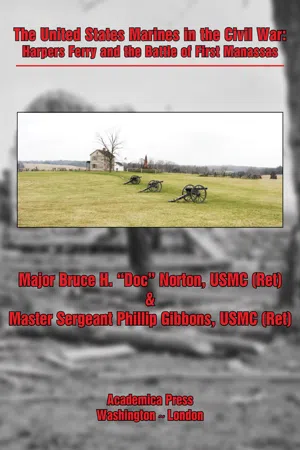
This book presents the most accurate picture of the United States Marine Corps at the onset of the American Civil War and describes the actions of the Marines at the Battle of First Manassas, or as the Union called it, Bull Run. To tell the story of the actions of the U.S. Marines in the Manassas Campaign, distinguished Marine Corps historians Bruce H. Norton and Phillip Gibbons begin with Marine actions in October 1859 at Harpers Ferry, where they were instrumental in suppressing John Brown's raid on the town's Federal Armory and attempted slave insurrection. The Marines were the only professional fi ghting force that could respond immediately when the call for assistance came to retake the Armory, which Brown's men had seized. The Marines were led by highly professional and well-trained offi cers and noncommissioned officers who represented a decades-old standard of excellence well established by the eve of the Civil War. The book then discusses Marine actions at the Battle of First Manassas, the Civil War's fi rst battle, on July 21, 1861, a story that has never been adequately or accurately told. In both engagements, the Marines proved that they were "at all times ready, " as the Corps remains to this very day.
eBook - ePub
The United States Marines in the Civil War
Harpers Ferry and The Battle of First Manassas
- English
- ePUB (mobile friendly)
- Available on iOS & Android
eBook - ePub
The United States Marines in the Civil War
Harpers Ferry and The Battle of First Manassas
About this book
Information
CHAPTER 1
The United States Marines and John Brown’s Raid
On July 3, 1859, John Brown arrived in Harpers Ferry, 61 miles northwest of Washington, DC, in what was then the Commonwealth of Virginia (now, West Virginia), accompanied by his two sons, Oliver and Owen, and Jeremiah Anderson. In the preceding months, he had raised money from other abolitionists and ordered pikes, guns, and other weapons to be used in his war against slavery. Using the alias Isaac Smith, Brown rented the Kennedy Farm, located about five miles from the Federal Armory, on the Maryland side of the Potomac River.
Throughout the summer Brown’s Army gathered at the farmhouse. Numbering 21 at the time of the raid, these men stayed hidden in the attic by day, reading, writing letters, polishing their rifles, and playing checkers. To avoid being seen by curious neighbors, they would only come out at night.
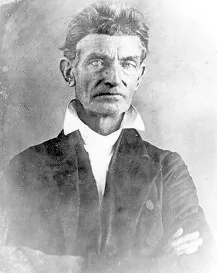
(John Brown – 1859)
To keep up the appearance of a normal household, Brown sent for his daughter, 15-year-old Annie, and Oliver’s wife, 17-year-old Martha. The girls prepared meals, washed clothes, and kept nosy neighbors at a distance. Brown studied maps and conferred with John Cook, his advance man in the Ferry, about the town, armory operations, train schedules, and other information deemed valuable to his plan. On September 30, Brown sent Martha and Annie home to New York. The time was near.
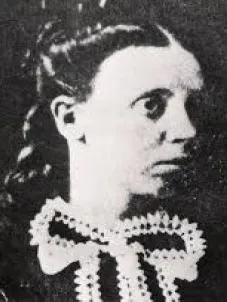
(Annie Brown - John Brown’s Daughter)
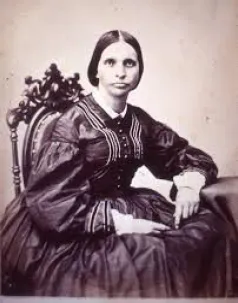
(Martha Brown, John Brown’s Daughter-in-Law)
On Sunday, October 16, Brown called his men together. Following a prayer, he outlined his battle plans and instructed them, “Men, get your arms; we will proceed to the Ferry.”
“Harpers Ferry was the site of a major federal armory, including a musket factory and rifle works, an arsenal, several large mills and an important railroad junction and was one of the most heavily industrialized towns south of the Mason-Dixon line,” said Dennis Frye, the National Park Service’s Chief Historian at Harpers Ferry. “It was also a cosmopolitan town, with a lot of Irish and German immigrants, and even Yankees who worked in the industrial facilities.” The town and its environs’ population of 3,000 included about 300 African Americans evenly divided between slave and free. But more than 18,000 slaves – the “bees” Brown expected to swarm – lived in the surrounding counties.
The Military Responds
In 1859, James Ewell Brown Stuart, was a 1st Lieutenant in the U.S. Cavalry, enjoying six months’ leave from his frontier post at Fort Riley, Kansas Territory. Yet the joys of coming home to Virginia had not made him forget he was a cavalryman by profession. On the rainy morning of October 17, he had ridden over the muddy streets of Washington to the offices of the War Department, and now sat waiting to speak with the Secretary of War, John B. Floyd.
J. E. B. Stuart had invented and patented an improved device that attached a cavalryman’s sabre to his belt, and he was attempting to sell the patent to the War Department. On that Monday morning, he was waiting for an interview in the anteroom of the Secretary.1 While the young lieutenant was rehearsing in his mind for the coming interview, the Secretary himself was face to face with the specter of a slave insurrection.
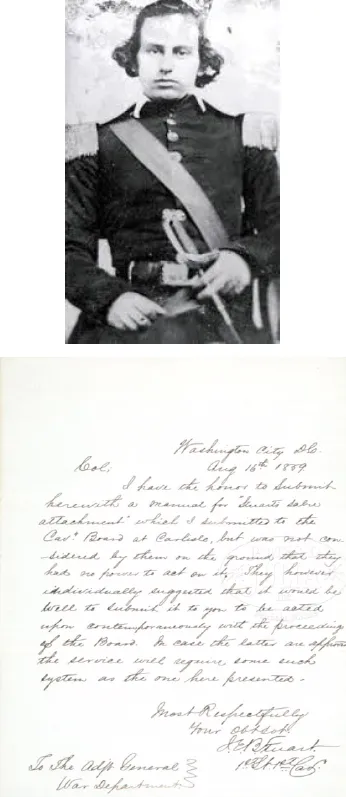
((Top)1st Lieutenant J. E. B. Stuart, U.S. Army Cavalry – (Bottom) Stuart’s letter to the Adjutant General, War Department referencing the “Stuarts’ Sabre Attachment”)
John B. Floyd was a poor administrator, a failing which almost resulted in his removal from office; but on this day there was no time for paper shuffling. Word had come by way of Baltimore that “an insurrection had broken out at Harpers Ferry and a band of armed men had captured the United States arsenal there and was forming a slave rebellion.” A native of Virginia, the Secretary must have heard of the often-told tales of the Haitians’ revolt against their French masters with all its barbarism. Nor had any son of the Old Dominion forgotten Nat Turner’s Rebellion, a slave uprising which occurred a generation before and claimed the lives of 55 whites in a single bloody night.
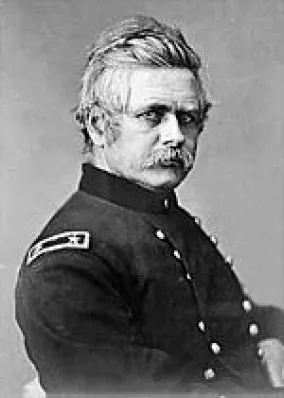
(Captain Edward O. C. Ord, U.S. Army)
Swinging into action, Floyd fired off a telegram to Fort Monroe; by noon Captain Edward O. C. Ord and 150 artillerymen were on their way toward Baltimore on the first leg of the journey to Harpers Ferry. There was no question as to who would command operations against the insurgents. Floyd called for his chief clerk and set him to writing orders summoning to the War Department Brevet Colonel Robert E. Lee, then on leave at his estate, Arlington, just across the Potomac River from the capital.
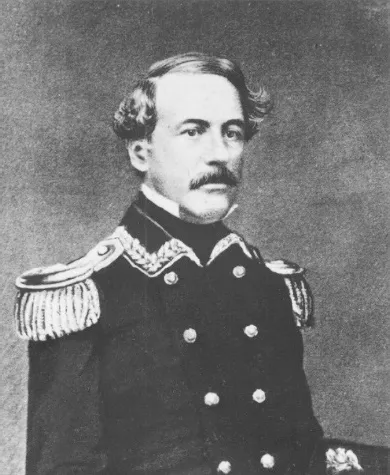
(Brevet Colonel Robert E, Lee, U.S. Army – 1859)
Message in hand, the harassed aide came dashing out of the office, only to halt when he spied the forgotten cavalry officer. J. E. B. Stuart, by now thoroughly bored, and had easily persuaded him to deliver the sealed envelope. Even as this message was speeding toward its destination, President James Buchanan called Secretary Floyd to move even faster, a demand which was to bring the Marine Corps into the picture.
Since there were no troops nearer the scene of the uprising than those en route from Fort Monroe, Floyd was powerless to comply; but Secretary of the Navy Isaac Toucey quickly offered a solution to the dilemma. About noon, Charles W. Welsh, chief clerk of the Navy Department, came riding through the main gate of the Washington Navy Yard. He sought out First Lieutenant Israel Greene, the Officer-of-the Day, and temporarily in command of Marine Barracks, Washington, and asked how many leathernecks were available for duty.
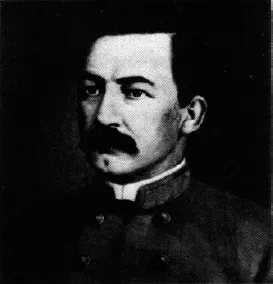
(Ist Lieutenant Israel Greene – 1859)
Lieutenant Greene estimated that he could round up some 86 men from both his barracks and the small Navy yard detachment. He then asked Welsh what was wrong. The civilian told him all he knew – that the armory at Harpers Ferry had been seized by a group of abolitionists, and that state and federal troops were already on the march. As a “line officer,” 1st Lieutenant Greene was allowed by law to lead Marines in combat.
As the senior line officer on duty at the Navy Yard, 1st Lieutenant Greene assumed the burden of organizing the expedition. Major William W. Russell, Paymaster of the Corps, was detailed to assist him; but Russell, a staff officer, could not exercise command over the force. Major Russell was an experienced line officer from his time fighting in the Mexican War and his expertise could be depended upon if necessary. Colonel John Harris, Commandant of the Marine Corps, also felt the presence of a more mature person was required. Greene, after all had only a dozen years’ service to his credit, and Russell’s presence might prevent unnecessary bloodshed. Working with the major, Greene, saw to it that each of his six sergeants and 80 other Marines had drawn muskets, ball cartridges, and rations.
Since no one knew for certain the strength or exact position of the insurgent force, two 12-pound Dahlgren heavy boat howitzers and several shrapnel shells were made ready. At 15:30, the Leathernecks clambered aboard a Baltimore and Ohio train and rattled off toward Harpers Ferry.
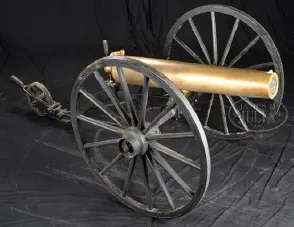
(12-Pound Dahlgren Howitzer – 1858)
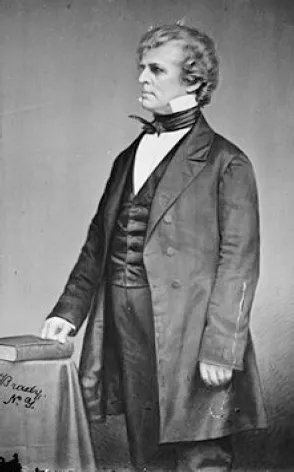
(Secretary of the Navy Isaac Toucey – 1859)
Mr. Welsh reported back to the Navy Department and Secretary Toucey and at once began drafting an order to Colonel Harris. “Send all the available Marines at Headquarters,” he wrote, “under charge of suitable officers by this evening’s train of cars to Harpers Ferry to protect the public property at that place, which is endangered by a riotous outbreak.” Once they arrive at their destination, the Leathernecks would be under the command of the senior U.S. Army officer present, in this case Colonel Robert E. Lee.
While Secretary Toucey was busy alerting the Marines, J. E. B. Stuart had returned from Arlington with Colonel Lee. Once again, the lieutenant waited in the Secretary’s anteroom as Floyd outlined the crisis to Lee. There was no need to stress the savage implications of a slave uprising, for the colonel had been stationed at Fort Monroe when Nat Turner had put aside his plough to take up the sword, and he well remembered the terror that followed. He recalled, too, how militia, regulars, and Marines from Norfolk had scoured the Virginia countryside before bringing Nat Turner to bay deep in the vastness of Dismal Swamp. After receiving the latest intelligence from western Virginia, Lee was handed orders placing him in overall command of the effort to suppress the insurrection.
Accompanied by Stuart, Floyd and Lee hurried to the White House, where the colonel was given a proclamation of martial law to issue if he should see fit. In addition to the proclamation, Lee acquired an aide. Certain that a fight of some sort was at hand, Stuart volunteered to accompany him to Harpers Ferry, and Lee accepted. Still in civilian clothes the colonel hurried to the railroad station, but the Marines had already left.
The next train to leave the National Capital was the Baltimore Express. At 17:00, Lee and Stuart boarded the train in the hope of catching up with the column at Relay House, a railroad station near Baltimore where the Marines had to change trains. They were, again, too late, and the expedition rolled off toward its goal without its commanding officer. Lee then wired the stationmaster at Sandy Hook, Maryland, to hold the trainload of Leathernecks until he and his aide arrived. For the time being, all the two officers could do was wait. Fortunately, they were not delayed for long. John W. Garrett, president of the Baltimore and Ohio Railroad, learned of Lee’s plight and ordered a locomotive to Relay House. Aware that a few moments wasted might cost him his job, the engineer opened wide the throttle. At 22:00, Lee arrived at Sandy Hook on the Maryland side of the Potomac River across the bridge from Harpers Ferry. Major Russell and Lieutenant Greene were waiting as the Army officers descended from the cab. Lee now learned the details of the insurrection.
It had happened so quickly. On the night of October 17, at about 22:30, eighteen armed men were led by a farmer who called himself Isaac Smith. (Some said he was called “Old Osawatomie”). John Brown of Kansas padded across the covered, wooden railroad trestle leading into the town and made a prisoner of one of the bridge tenders. Next, the raiders strolled through the darkness and up to the gates of the United States armory. They leveled their pistols at a startled watchman and quickly gained access to the buildings.
The leader of the band then sent out patrols to take hostages. Most prominent among the captives was Lewis W. Washington, a colonel on the staff of Governor Henry A. Wise of Virginia and a great-grandnephew of George Washington. His captors forced him to hand over a sword given to the first President of the United States by Frederick the Great of Prussia, and a pistol given to the President by the Marquis de Lafayette in 1778. During the nightmare that followed, this sword and pistol hung at the side of the man who called himself Smith. (See Appendix 1)
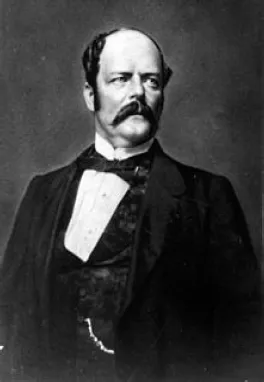
(Lewis W. Washington – 1858)
While the prisoners were being rounded up, the second bridge tender, Mr. Patrick Higgins, wandered out onto the span in search of his partner. In the darkness, he collided with two of the raiders who had been posted as guards. A single punch floored one of them, and as the other fired wildly Higgins sprinted back to the town. The angry, red crease etched lightly across his scalp by a rifle bullet was proof enough that Harpers Ferry was under attack....
Table of contents
- Cover
- Title Page
- Copyright
- Acknowledgments
- Contents
- Introduction
- Chapter 1: The United States Marines and John Brown’s Raid
- Chapter 2: “The Marines of 1861”
- Chapter 3: “Their Backs to the Enemy” - The Marine Battalion at Bull Run
- Chapter 4: The Battle of 1st Manassas Staff Ride of the Marine Battalion
- Questions for Critical Thought on the Battle of 1st Manassas
- Appendix A: A Letter from a Marine who was at Bull’s Run
- Appendix B: Report of Major John G. Reynolds
- Appendix C: Report of Col. Andrew Porter
- Appendix D: Report of Major George Sykes
- Appendix E: Casualties at First Manassas
- Appendix F: Uniforms and equipment of the Marine Battalion, July 1861
- Notes
- Bibliography
- Index
Trusted by 375,005 students
Access to over 1.5 million titles for a fair monthly price.
Study more efficiently using our study tools.
Frequently asked questions
Yes, you can cancel anytime from the Subscription tab in your account settings on the Perlego website. Your subscription will stay active until the end of your current billing period. Learn how to cancel your subscription
No, books cannot be downloaded as external files, such as PDFs, for use outside of Perlego. However, you can download books within the Perlego app for offline reading on mobile or tablet. Learn how to download books offline
Perlego offers two plans: Essential and Complete
- Essential is ideal for learners and professionals who enjoy exploring a wide range of subjects. Access the Essential Library with 800,000+ trusted titles and best-sellers across business, personal growth, and the humanities. Includes unlimited reading time and Standard Read Aloud voice.
- Complete: Perfect for advanced learners and researchers needing full, unrestricted access. Unlock 1.5M+ books across hundreds of subjects, including academic and specialized titles. The Complete Plan also includes advanced features like Premium Read Aloud and Research Assistant.
We are an online textbook subscription service, where you can get access to an entire online library for less than the price of a single book per month. With over 1.5 million books across 990+ topics, we’ve got you covered! Learn about our mission
Look out for the read-aloud symbol on your next book to see if you can listen to it. The read-aloud tool reads text aloud for you, highlighting the text as it is being read. You can pause it, speed it up and slow it down. Learn more about Read Aloud
Yes! You can use the Perlego app on both iOS and Android devices to read anytime, anywhere — even offline. Perfect for commutes or when you’re on the go.
Please note we cannot support devices running on iOS 13 and Android 7 or earlier. Learn more about using the app
Please note we cannot support devices running on iOS 13 and Android 7 or earlier. Learn more about using the app
Yes, you can access The United States Marines in the Civil War by Major Bruce H. Norton in PDF and/or ePUB format, as well as other popular books in Politics & International Relations & American Government. We have over 1.5 million books available in our catalogue for you to explore.