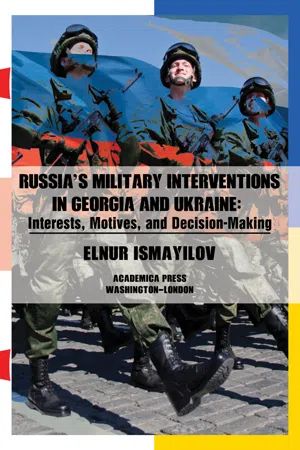
In Russia's Military Interventions, Elnur Ismayilov analyzes Russia's recent military interventions in Georgia and Ukraine by assessing the driving factors – the interests fueling Russian involvement and the decisions that fostered the resulting wars. Ismayilov covers the creation and transformation behind Russia's post-Soviet perspectives on Ukraine and Georgia and explores the panorama of post-Soviet Russia's foreign policy from the 1990s up to the turbulent present, in which Ukraine and Georgia's pro-Western orientations have remained a core concern of the Kremlin. Thoughtfully, Russia is fighting against being rated as a declining regional power and confronts a palpable clash of Russian nationalism and Western liberal democracy.
eBook - ePub
Russia's military interventions in Georgia and Ukraine
interests, motives, and decision-making
- English
- ePUB (mobile friendly)
- Available on iOS & Android
eBook - ePub
Russia's military interventions in Georgia and Ukraine
interests, motives, and decision-making
About this book
Information
Subtopic
Russian PoliticsChapter I
Introduction
The new Russia is not the Soviet Union … nor is she the old Russian Empire. Russia’s new borders, possibilities, culture, civilization, and inner development have all contributed to making Russia a new state, one that has not previously existed on the global political or geographic map.
(Sergey V. Kortunov, Chief of Staff, Council of Russian Defense)
1.1 Background
The international system under which we live is between two eras: the post-Cold War era and the new Cold War era. The world is in a transitional stage, from international cooperation and hope for a new era of peace to the menace of new global military confrontations. The end of the Cold War, which was the turning point in international politics that led to the creation of the new world order, was characterized mainly as a blossoming of relations between global powers. The new world order was described as “an order in which no nation must surrender one iota of its own sovereignty; an order characterized by the rule of law rather than the resort to force; the cooperative settlement of disputes, rather than anarchy and bloodshed, and an unstinting belief in human rights.”1 Optimistic expectations for the new world order changed with the political, military, economic, and ideological developments in the last decade of the 20th century and in the beginning of the 21st century, especially with the expansion of the militarist, interventionist policies of global and regional powers. Hope for the settlement of conflicts that remained from the Cold War years through dialogue and other non-military tools in the new international system was replaced with the rise of armed conflicts, regional wars, and crises.
In the last two decades, the disintegration of several states and armed violence within them has burdened the security of the whole world. As a result of these developments, not only were new, previously unrecognized states internationally recognized, but the amount of unresolved frozen conflicts increased. The present period is reminiscent of the Cold War period; but there are important differences between these two periods. The Cold War competition was not just a competition between the Great Powers over territory and influence; it focused mainly on ideological competition between communism and liberal democracy. If the Cold War was an anti-system competition against a new system; then the new Cold War is closer to the nation states and imperial rivalries of previous centuries, except with powerful and fast-acting weapons.
It is unquestionable that one of the most controversial issues in the contemporary debate among politicians, lawyers, and academicians is the concept of intervention.2 Intervening in another country without the United Nations Security Council’s (UNSC) permission is prohibited under the UN Charter. Only the UN, which is accepted as the world’s legitimizing source, has the right to authorize the use of force. However, what we are witnessing since the end of the bipolar world order is that there are many cases in which global and regional powers’ unilateral use of force against a sovereign state was realized without UN authorization. Therefore, the concept of non-interference in international affairs has already lost its significance, while interference is widely acknowledged in the modern-day international system.3
There are wider definitions of intervention. Historically, in its classical meaning the concept of intervention was understood as a synonym for coercive activities, such as the use of armed forces or threats, taken by a state without the assent of the target state. In addition to military interventions, today, economic activities and foreign direct investments are acknowledged as the main forms of intervention. Intervention is mainly acknowledged as a tool for the protection of the vital interests of the intervening state, independent of whether the intervening state perceives its action as legitimate or illegitimate. According to Adam Robert, intervention is defined as “coercive action (using its armed forces) by state(s) involving in another state without the consent of its authorities” and with the aim of “preventing suffering and death among [its] population.”4
The concept of intervention and its interpretation in Russia’s political discourse is not congruent with the principles of international law. Russia uses its own interpretation of military interventions in its near abroad to justify its actions – as the U.S. did in the cases of Iraq and Libya.5 The main reason is undoubtedly the geopolitical and ideological developments in the international environment. With its interventions in Georgia and Ukraine, the Kremlin has been pursuing several different goals. Unlike in the 1990s, when Russia lost its superpower status with the collapse of the Soviet Union, the Kremlin’s foreign policy in the 21st century is inherently linked, again, to international politics. During Vladimir Putin’s presidency Russia has returned to the world scene, and its foreign policy decisions and actions have impacted global politics. In regional politics, Russia sees itself as having special privileges in the post-Soviet space.6
After the dissolution of the Soviet Union, the post-Soviet space remained one of the most important geostrategic areas for Russia. In comparison to other regional and non-regional powers, Russia had a distinctive influence on its neighborhood, especially in the South Caucasus and in Eastern European countries such as Ukraine, Belarus, and Moldova. The reason for Russia’s distinctive influence can be explained through the Kremlin’s legacy in these regions over the past two centuries, including regional countries’ economic dependence on the Kremlin and Russia’s political and military influence on these countries, as well.
As Henry Kissinger argued, the dissolution of empires gives cause to two contradictory notions.7 If, according to the first notion, the periphery states try to take advantage of the weakened imperial power, then, according to the second notion, the imperial power attempts to reestablish its political authority in its former imperial territories. The second trend has been seen in the Kremlin’s aggressive behavior toward the aforementioned regions. According to Garnett, during the last decade of the 20th century, in these regions, characterized as a “belt of weak states,”8 Russia continuously appeared to realize its political, economic, and military policies.9 Although there have been many regional conflicts in the post-Soviet geography since the collapse of the Soviet Union in which Russia’s military has been involved directly or indirectly, this book focuses solely on Russia’s military interventions in Georgia in 2008 and Ukraine in 2014. Both countries, Georgia and Ukraine, share many similarities, mainly in their pro-Western foreign policy orientations and in their cold relations with the Kremlin.
Since the end of the Cold War, Russia has pursued different tactics and strategies in these regions. In the beginning of the 1990s, when new nationalist elites agreed on secession from the Kremlin by declaring their independence, Russia blackmailed these countries by threatening them with internal problems in the autonomous regions on their territory. At the same time, the Kremlin provided military support to separatist movements in their wars against the central authorities. The Kremlin tried to disassociate the autonomous regions of South Ossetia and Abkhazia from Georgia. In this way, Russia forced the central authorities to accept the Kremlin’s role as mediator in the negotiations between the conflicting parties. When Putin took power, Russia followed the same policy and continued its influence in these regions, which was not costly for the Kremlin economically, militarily, and politically.10
Russia’s role as a “mediator” in the Georgia crisis in 2008 was perceived as an offensive military action carried out by Moscow against a sovereign state rather than as an involvement in a civil conflict.11 Indicatively, legitimate explanations, political rhetoric, and humanitarian claims geared toward justifying this incursion fail to reliably depict the main motivations pertinent to Russia’s leadership in utilizing military force, especially in this case. Nevertheless, inferring Russian officials’ and leaders’ justification of the campaign for military involvement on normative, political, and legal grounds offers substantial insights into Russia’s current thinking about the legality of using coercion beyond Russia’s borders. Further, the allusion insinuated by Russia regarding the standoff with Georgia as well as Moscow’s acknowledgement of Abkhazia and South Ossetia had particular implications for the region. Ideally, the insinuations raised fears of the efficiency of Russia’s past arrangements of conflict management in other areas. However, the Kremlin has steadily fought to cushion the blow in the cases of Trans-Dniester in Moldova and Nagorno-Karabakh between Armenia and Azerbaijan, with or without Russia’s intervention, in case these conflicts might reignite. Basically, where there is wider competition between the West and Russia over sovereignty and international norms, there is greater chance for systematic and regional-level antagonisms such as those observed in Ukraine.12
Firstly, before delving into the dimensions of Russia’s interventions, it is imperative to ascertain that Russian officials do not see their military involvement as a Russian “military intervention,” particularly in Georgia. Russian officials refute this argument and claim that the fight on Georgian territory in 2008 was a Georgian-Russian war. Notably, as implied by Cheterian, they claim that it was the Georgian invasion of South Ossetia that invoked Russia’s national and necessary peacekeeping response.13 In essence, this stance is similar to previous Soviet practices that were seen as interventions overseas. Soviet intervention practices violated international law that undermine state sovereignty. Although the Soviet Union formally upheld the rule of state sovereignty, the Brezhnev Doctrine clearly depicted Eastern Europe as having limited sovereignty. In this case, Moscow provided political justifications for using the Red Army in Hungary, Czechoslovakia, and Afghanistan in 1956, 1968, and 1979, respectively. In these instances, Moscow never relied on legal claims, like the Soviet Union forces being invited to undertake the interventions; however, the Soviet Union’s political and the self-interested strategic goals bolstered the superpower toward practicing intervention. The current study is aimed at exploring Russia’s military interventions in 2008 and 2014 while explicating the factors, the interests, and the way the decisions to invade were made in the Kremlin.14
This book analyzes Russia’s military interventions in Georgia and Ukraine by assessing the driving factors, the interests fueling Russian involvement, and the decisions that fostered the resulting wars. This s...
Table of contents
- Cover
- Title Page
- Copyright
- Contents
- List of Maps
- List of Abbreviations
- Acknowledgements
- Chapter I Introduction
- Chapter II Research Design, Theoretical Overview and Methodological Assumptions
- Chapter III Russia’s Foreign Policy Strategies
- Chapter IV Analysis of Russia’s Military Intervention in Georgia
- Chapter V Analysis of Russia’s Military Intervention in Ukraine
- Chapter VI Conclusion
- Bibliography
- Index
Trusted by 375,005 students
Access to over 1.5 million titles for a fair monthly price.
Study more efficiently using our study tools.
Frequently asked questions
Yes, you can cancel anytime from the Subscription tab in your account settings on the Perlego website. Your subscription will stay active until the end of your current billing period. Learn how to cancel your subscription
No, books cannot be downloaded as external files, such as PDFs, for use outside of Perlego. However, you can download books within the Perlego app for offline reading on mobile or tablet. Learn how to download books offline
Perlego offers two plans: Essential and Complete
- Essential is ideal for learners and professionals who enjoy exploring a wide range of subjects. Access the Essential Library with 800,000+ trusted titles and best-sellers across business, personal growth, and the humanities. Includes unlimited reading time and Standard Read Aloud voice.
- Complete: Perfect for advanced learners and researchers needing full, unrestricted access. Unlock 1.5M+ books across hundreds of subjects, including academic and specialized titles. The Complete Plan also includes advanced features like Premium Read Aloud and Research Assistant.
We are an online textbook subscription service, where you can get access to an entire online library for less than the price of a single book per month. With over 1.5 million books across 990+ topics, we’ve got you covered! Learn about our mission
Look out for the read-aloud symbol on your next book to see if you can listen to it. The read-aloud tool reads text aloud for you, highlighting the text as it is being read. You can pause it, speed it up and slow it down. Learn more about Read Aloud
Yes! You can use the Perlego app on both iOS and Android devices to read anytime, anywhere — even offline. Perfect for commutes or when you’re on the go.
Please note we cannot support devices running on iOS 13 and Android 7 or earlier. Learn more about using the app
Please note we cannot support devices running on iOS 13 and Android 7 or earlier. Learn more about using the app
Yes, you can access Russia's military interventions in Georgia and Ukraine by Elnur Ismayilov in PDF and/or ePUB format, as well as other popular books in Politics & International Relations & Russian Politics. We have over 1.5 million books available in our catalogue for you to explore.