This book is available to read until 23rd December, 2025
- 192 pages
- English
- ePUB (mobile friendly)
- Available on iOS & Android
eBook - ePub
Available until 23 Dec |Learn more
About this book
Real conversations about racism need to start now
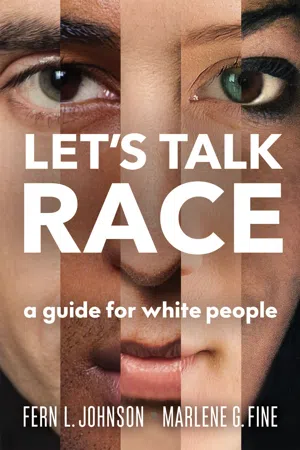
Let's Talk Race confronts why white people struggle to talk about race, why we need to own this problem, and how we can learn to do the work ourselves and stop expecting Black people to do it for us.
Written by two specialists in race relations and parents of two adopted African American sons, the book provides unique insights and practical guidance, richly illustrated with personal examples, anecdotes, research findings, and prompts for personal reflection and conversations about race.
Coverage includes:
- Seeing the varied forms of racism
- How we normalize and privilege whiteness
- Essential and often unknown elements of Black history that inform the present
- Racial disparities in education, health, criminal justice, and wealth
- Understanding racially-linked cultural differences
- How to find conversational partners and create safe spaces for conversations
- Conversational do's and don'ts.
Let's Talk Race is for all white people who want to face the challenges of talking about race and working towards justice and equity.
Frequently asked questions
Yes, you can cancel anytime from the Subscription tab in your account settings on the Perlego website. Your subscription will stay active until the end of your current billing period. Learn how to cancel your subscription.
At the moment all of our mobile-responsive ePub books are available to download via the app. Most of our PDFs are also available to download and we're working on making the final remaining ones downloadable now. Learn more here.
Perlego offers two plans: Essential and Complete
- Essential is ideal for learners and professionals who enjoy exploring a wide range of subjects. Access the Essential Library with 800,000+ trusted titles and best-sellers across business, personal growth, and the humanities. Includes unlimited reading time and Standard Read Aloud voice.
- Complete: Perfect for advanced learners and researchers needing full, unrestricted access. Unlock 1.4M+ books across hundreds of subjects, including academic and specialized titles. The Complete Plan also includes advanced features like Premium Read Aloud and Research Assistant.
We are an online textbook subscription service, where you can get access to an entire online library for less than the price of a single book per month. With over 1 million books across 1000+ topics, we’ve got you covered! Learn more here.
Look out for the read-aloud symbol on your next book to see if you can listen to it. The read-aloud tool reads text aloud for you, highlighting the text as it is being read. You can pause it, speed it up and slow it down. Learn more here.
Yes! You can use the Perlego app on both iOS or Android devices to read anytime, anywhere — even offline. Perfect for commutes or when you’re on the go.
Please note we cannot support devices running on iOS 13 and Android 7 or earlier. Learn more about using the app.
Please note we cannot support devices running on iOS 13 and Android 7 or earlier. Learn more about using the app.
Yes, you can access Let's Talk Race by Fern L. Johnson,Marlene G. Fine in PDF and/or ePUB format, as well as other popular books in Politics & International Relations & Civil Rights in Politics. We have over one million books available in our catalogue for you to explore.
Information
Chapter 1
Bridging the Chasm
Starting the Conversation about Race
“Until we start talking about what we believe and why we believe it, we will continue to tiptoe around each other and get nowhere. We have seen what the silence does. We should give talking a chance.”—Claudia Rankine, discussing her play The White Card
RANKINE IS TALKING ABOUT THE SILENCE about race—a silence sustained by skillful evasion and indirection. She made these comments in an interview about her play The White Card. The play features four upper-class whites (a married couple and their college-age son, and a male friend of the couple) and a Black woman photographer whose work the couple is interested in purchasing. The play opens on a note of civility and devolves into racial animosity. After stilted back-and-forth interaction washed down with champagne, the veneer of civility cracks, exposing deep racial division. Rankine’s play is an invitation to talk and break the silence about race. That invitation is ever more urgent today as support for the Black Lives Matter movement grows.
Rankine titles her play to call out a hidden, yet powerful, story about race in America. We are familiar with the expression “playing the race card.” The phrase is most often used to disparage people of color or their advocates and to discredit claims of racism. When Rankine turns the expression toward whites, she exposes how some whites promote their “good” views on race without admitting their own white biases:
- “I support police reform.”
- “I work every day to do the right thing.”
- “I’m not a racist. I’m color blind.”
Rankine’s play puts a lens up to some of the ways white people don’t understand the implications of their comments, behaviors, and attitudes about race. As she says, it’s now time for “giving talking a chance.”1
This book takes up Rankine’s urgent message to give talk a chance, because if we don’t, we will never achieve social and economic justice. We address white people because, collectively, we have not dug deeply enough to get past our ignorance, embarrassment, and fears about race. We are writing from our perspective as two white women who are the mothers of two African American men who were adopted as infants.2 Throughout the years of parenting, we came to understand at least some of what it means to be Black in this country and some of what it means to be the parents of Black children. We learned from books, workshops, talking with Black friends and acquaintances, and the minutiae of everyday life. We learned from how our children were treated on playgrounds and at school, from what was said about our being “such good people” for adopting Black children, from suspicious glances at our family, from unexpected stereotypes directed at our children. A white woman at a concert we attended with the boys when they were in middle school asked if they were the Lost Boys of Sudan. We learned from Black friends that our children would be subjected to having their hair touched by white children and even adults without permission. That teachers would set low expectations for their academic performance and high ones for their athletic performance. That we would have to teach our boys how to behave when they were pulled over by the police when driving. And we learned that they would be pulled over by the police. We also learned over and over how much we did not and still do not understand, and how easy it was and continues to be surprised by our ignorance.
We believe that talking about race is imperative but requires commitment to listen, willingness to entertain new ideas, and openness to learning that one’s thinking about many aspects of race has been wrong—often harmfully wrong. If we do not talk about race, then our ideas remain private and passively influenced by media images and what we might read about race. If we do not talk about race for fear of saying the wrong thing, then the unsaid is allowed to speak for itself. Yet, before we can engage productively with one another, we need to examine why whites find it so hard to talk about race.
Racial barriers stand firm. We need to learn why those barriers exist and how we can diminish them to achieve racial justice and equity. We need to ask—and answer—why do we continue to exist in racial boxes, which set up boundaries and barriers that persist today? If I as a white person fear that I will say the wrong thing, how does that create a barrier? If I as a white person know little about the distribution of wealth among races in our country, how does that create a barrier? If I as a white person say that I do not see color, how does that create a barrier? Barriers in these examples are created by fear in the first case, ignorance in the second, and lack of empathy in the third.
The worst culprit is likely the physical barrier of separation in neighborhoods. We cannot know and understand other people if we do not have contact with them. The housing barrier creates divisions in education, occupation, lifestyle, and health. The United States continues to be residentially segregated, even though there has been slight progress in recent years. Federal, state, and local policies created a suburban-urban split, with people of color concentrated in urban areas. Large metropolitan areas in the North and Midwest, such as Milwaukee, New York, Chicago, Detroit, Cleveland, and Buffalo, have the highest levels of segregation. Within those areas, neighborhood boundaries function like signposts to show who lives where. Rural America, which accounts for slightly less than one-fifth of the US population, is close to 80% white.3 We will discuss this topic more in chapter 4, but for now, we want to stress that the barriers between races will not be brought down until and unless we acknowledge them, learn about them, discuss their existence, and willingly do something to diminish them.
Our book calls on white people to talk with one another and with people of color about race and to explore why whites have such a difficult time in conversations about race. If we can’t talk among ourselves, how will we ever be able to talk constructively across racial boundaries? We, as white people, need to talk frankly, respectfully, and without defensiveness. We view talk among white people as essential to gaining the courage and skill to talk across the racial divide. And we view talk across race as essential to building the trust, understanding, and relationships essential to achieving racial equity.
We imagine that some people will respond to this call by thinking that we’re already saturated with talk about race. It’s true that news, politics, social media, TV shows, and movies prominently focus on race, but that’s not the same as talking deeply about race. Researchers who explored race relations in office settings remarked that “Americans talk about race all the time but usually through code and allusion.”4 To talk about race means more than simply saying something about the topic, lumping everything together with blanket terms like “diversity” and “multicultural,” or alluding to “problems” that involve those who are somehow marked as different from whites. For us, talking about race means to engage, to probe, and to have respectful and sustained conversations that focus on what, why, and how we think about race and our experiences with it. Talk in this sense is a personal and social responsibility to probe questions such as: Why are we reluctant to get too deeply into race talk, or to even broach topics related to race? What are our personal and family histories with race? What is okay or not okay to say when talking about race to other white people and to people of other races? What don’t we know about race, and why don’t we know it?
The context for writing and talking about race is continuously reshaped by current events. President Bill Clinton, for instance, called in 1997 for Town Halls around the country to address issues of race and promote racial understanding. Over twenty years later, the national call remains, but in a different and ever more urgent context.
We are writing this book during Donald Trump’s presidency. Had we written about the difficulties that whites experience in broaching deep and sustained conversations about race after Barack Obama’s election in 2008, the context would have differed. Many held the then-popular belief that race was receding as a significant social problem, and that the election provided evidence of a “post-racial” society. (We never believed this to be the case.) The post-racial idea gave comfort to many whites and provided a kind of relief that the worst of racial injustice was history and a new era was beginning.
At the same time, however, Obama’s election unleashed virulent racism that many whites in the US thought no longer existed. Ugly cartoons of the president and first lady circulated on the internet, racist graffiti could be found in most cities and in many schools, and those who claimed the illegitimacy of Obama’s birthright as an American never ceased in their assertions. Racism, it seemed, became more rather than less prevalent in our society. Then the startling succession of Black men being shot by police officers galvanized national attention. These shootings, more than anything else, opened a wide chasm in white and Black viewpoints.
It’s impossible to pinpoint an exact starting date, but February 26, 2012, stands out. On that day, Trayvon Martin, a seventeen-year-old African American boy, was shot and killed in Florida by George Zimmerman, a mixed-race twenty-eight-year-old. The killing became a subject of controversy when it was reported that Trayvon Martin was unarmed, and George Zimmerman had a history of calling police to report suspicious activity in the gated community where he lived—increasingly identified by Zimmerman as the activity of Black persons. After Zimmerman was acquitted on all charges, protests occurred in many cities, and the racial chasm widened. The Washington Post concluded that “the verdict did little to close the stark divisions the case opened up among Americans along the jagged fissures of race and personal safety.”5 The Martin case firmly anchored what was to become all too common news of events in which Blacks were killed by police at the time of an incident or died while in police custody. A narrative of division in how Black people and white people viewed the role of race in the shootings also unfolded.
Signs of racial division intensified following the shooting of Michael Brown on August 9, 2014, in Ferguson, Missouri, and the riots that followed. Shortly after Brown’s death, the Pew Research Center released polling data that showed a sharp racial divide in views about what happened and its implications. One finding revealed that 80% of Blacks who were polled thought the shooting raised racial issues, while only 37% of whites held that opinion.6 The survey also found that more Blacks (76%) than whites (52%) had confidence in the investigations of the shooting. Three points about such survey data deserve comment. First, none of these statistics shows a complete dichotomy between races. Some whites express viewpoints similar to the majority of Blacks, just as some Blacks see things similarly to the majority of whites. Second, answers to any polling question reflect what people think in the particular moment that they answer a question. New events, interactions with others, and personal reflection might lead to a different viewpoint at a different time. Third, none of the statistics are conditioned by probing why a person believes one thing or another or if they hesitated about how to answer.
As news about the shootings exploded, the story of yet another divide emerged, this one of deepening animosity between police advocates and Black community members and their supporters. The deaths of Trayvon Marti...
Table of contents
- Cover
- Title Page
- Copyright
- Contents
- Dedication
- Acknowledgments
- Introduction
- Chapter 1. Bridging the Chasm—Starting the Conversation about Race
- Chapter 2. Identifying Racism—Where Fiction Becomes Reality
- Chapter 3. Erasing Our Race—Normalizing and Privileging Whiteness
- Chapter 4. Raising Your Racial IQ—What Whites Don’t Know about Living in a Racialized World
- Chapter 5. Recognizing Differences—Cultural Misunderstandings and Misinterpretations
- Chapter 6. Better Talk—Putting It All Together
- Endnotes
- Index
- About the Authors
- A Note about the Publisher