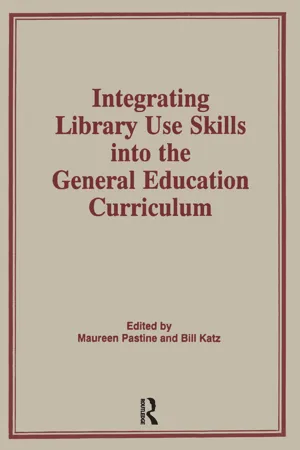
This provocative new book will help you design and implement the most effective library user education possible--one that builds on basic library use skills through a progressively sophisticated program that is fully integrated into course curriculum at all levels, from the freshman year to graduation and beyond. By exploring major issues underlying the integration of library use skills and research methodologies into the general education curriculum, contributors raise important questions, offer creative ideas, and provide insight into the many improvements made in library instruction in the past few years. Following an introduction by Patricia Breivik, a recognized national authority on libraries and general education, contributors representing two- and four-year institutions and research universities discuss such issues as the relationship between high school and college programs, research skills instruction in a remote access environment, the use of microcomputers and end user searching programs to promote critical thinking, and the improved relationship between librarians and faculty. In addition to articles on library instruction geared towards question analysis, information generation by field, structure of published knowledge and dissemination of a discipline's literature, chapters identify cooperative efforts needed among school, public, special, academic libraries and other information agencies, computer center personnel, and online database vendors. Bibliographic instruction librarians who are active participants in planning and administering library user education programs will find this volume to be essential for building and developing stronger, more integrated programs.
eBook - ePub
Integrating Library Use Skills Into the General Education Curriculum
- 334 pages
- English
- ePUB (mobile friendly)
- Available on iOS & Android
eBook - ePub
Integrating Library Use Skills Into the General Education Curriculum
About this book
Information
PART I: GENERAL
Politics for Closing the Gap
SUMMARY. Despite the realities of the Information Society, national concerns for quality education in America have largely ignored libraries. The major cause of this neglect is the lack of perception among most educational leaders that library personnel and resources both have something to offer in the search for excellence and that librarians are committed to serving their institutions’ learning priorities. To rectify this situation will require informed and aggressive leadership by librarians. Nonetheless, concerns raised by some educational leaders call for reforms that have strong implications for the instructional role of libraries. Resource-based learning can make a major contribution to preparing students for lifelong learning, active citizenship and risk taking. A number of recent, current and projected activities and publications are described. These can offer a good foundation for librarians wishing to promote information literacy and/or resource-based learning.
In 1983, the publishing of A Nation at Risk1 heralded the beginning of the current educational reform movement. In A Nation at Risk and in the reports which followed, one thing became clear: the educational establishment and its leaders saw no role for librarians or libraries in issues related to quality education. At best, a few made passing reference to libraries and laboratories as places other than classrooms where learning might take place. At worst, one questioned the ability and commitment of librarians to move beyond the owning, cataloging and lending of books.2
Patricia Senn Breivik is Director, Auraria Library, 11th at Lawrence Street, Denver, CO 80204.
© 1989 by The Haworth Press, Inc. All rights reserved.
This oversight is difficult to understand given the nature of some of the major concerns which have been raised. First, issues covered in many of the reports make it clear that the writers are not unaware, at least in some aspects, of the information society in which this and all future generations will exist. In particular there is a great deal of concern for the fragmentation of research and learning which is occurring due to the increasing abundance of information. It then seems ironic that libraries, which are the primary access point to information in all disciplines and which provide a framework for the interrelation of the literature of the diverse fields, should be so absent from their thinking.
Second, the nature of the learning reforms, which run as a thread through many of the reports, would seem — at least to librarians — to cry out for the involvement of librarians and learning resources. The reports call for active learning that prepares students for lifelong learning, active citizenship and risk taking. It would seem almost self-evident that one good way to accomplish this would be for classroom faculty to build their courses around the existing literature of their fields rather than on lectures and textbooks. A more active learning experience could be provided by placing students in the position of using the same books, journals, videotapes and online databases for their class assignments that will be available to them for learning after they graduate. Through resource-based learning, students could master the information retrieval and evaluation skills that will be useful for learning throughout their lives. They could become information literate.
The same skills are important for active citizenship. As U.S. Representative Major R. Owens wrote:
Information literacy is needed to guarantee the survival of democratic institutions. All men are created equal but voters with information resources are in a position to make more intelligent decisions than citizens who are information illiterates. The application of information resources to the process of decision-making to fulfill civic responsibilities is a vital necessity.3
Good information retrieval and evaluation skills also can facilitate the development of risk takers. The more pertinent information one has to factor into solving a particular problem, the greater the likelihood of the solution being an appropriate one. In this manner risk taking becomes less “risky” and therefore a less threatening endeavor for people to undertake.
Librarians are good at pointing out the reluctance of faculty to change their teaching styles, and it would be a nice “out” if librarians could be the good guys in white hats currently held back by the black-hatted classroom faculty. Faculty attitudes are important, but they cannot be blamed for the lack of attention given to libraries in the reports, because the authors of these reports are calling for changes in faculty attitudes and teaching styles. The problem is that, even among those educators committed to change, there is little or no understanding that libraries have any contribution to make to learning besides their traditional warehouse role.
Much of the blame for this lack of awareness must lie within our profession—indeed, with us as individual librarians. Despite all that we have to offer within the search for educational excellence, we seem to have successfully managed to keep it a secret. Certainly it is not our intent. The whole library instruction movement and even this volume of The Reference Librarian is dedicated to the concept of “selling” library instruction and getting it integrated into the mainstream of the educational experiences of students.
Perhaps librarians have been too isolated over the years. This is not the first time that educators have called for more active learning. For example, a study conducted by the Association of American Colleges published in 1940 discussed the criticisms of the traditional form of American college teaching and urged that, in place of specific assignments and set lectures, students should be directed to the literature of the subject with the professor becoming an aid in the acquiring and understanding of this knowledge rather than its source and final end.4 Within the literature of our field there is no indication that librarians responded to this report with any new initiatives. There was the library college movement, but its flavor was always more one of control by librarians than librarians seeking to support the educational agenda of others. Even our current terms of bibliographic and library instruction reinforce the perception of something which stands alone from the curriculum and that is useful only within libraries. Yet, for years our better programs have focused on search strategies which lead to needed information, whether housed in a library or elsewhere.
The result of this isolation—or self-centeredness—is manifested in another way, which has had an incalculable effect on the national visibility of libraries. The current rating system of libraries based on quantitative measures has produced an informally acknowledged academic library elite made up of a few directors of the very large Association of Research Libraries (ARL). These are the people most likely to be sought for insights into librarianship by people concerned with national academic issues, and there does not appear to be any equivalent elite for school or public libraries. The irony of this elite, which the profession has allowed to exist unchallenged, is that it is a most inappropriate representation for addressing the issues of concern to the writers of the reform reports.
Just as the largest and most prestigious universities are seldom known for innovation in instruction or quality undergraduate education, their libraries seldom provide models of innovative or even user friendly service and instructional support. This situation, in fact, should be expected, i.e., a library should reflect the personality and commitments of its institution. A problem only occurs when the interests and concerns of these very few, very large research libraries are represented as being those of academic libraries as a whole. When this happens, the overriding concerns for bibliographic control and preservation seem to be the preoccupation of all, and these concerns are far out of sync with national priorities, such as more active learning and the recruitment and retention of minorities.
In this mismatching of concerns, the impression has also been given that the priorities of libraries interfere with the ability of libraries to provide information systems that will meet users’ needs. The following statement appeared in the Carnegie Foundation Special Report, Higher Education and the American Resurgence.
Library personnel, while now fully competent to handle the library automation that has taken place, have neither the education nor the emotional commitment to prepare for the shift in outlook required to change from owning, cataloging, and lending, to becoming electronic data sleuths ready to link a student or faculty member to someone else’s data bank. Moreover, the time has come for information specialists to learn more about the needs of libraries.5
Frank Newman, President of the Education Commission of the States, authored the above. Since then he has considerably revised his assessment of libraries and librarians as evidenced by his editorial in the July/August issue of Change.6 The shame is that, when writing the above, he had believed that the agenda of a few research libraries was representative of all. On the other hand, Ernest L. Boyer’s report, College: The Undergraduate Experience in America, was based on the baccalaureate sector of higher education and included visits to twenty-nine colleges and universities. Boyer’s report states, “At a college of quality there is a wide range of learning resources that enrich and extend classroom instruction and encourage students to become independent, self-directed learners.”7 Boyer’s wider exposure to libraries provided a far more positive attitude toward libraries and their importance to education than Newman’s initial more narrow perspective. Somehow a new message must be consistently and effectively sent out from libraries of all sizes and types. Instead of placing the emphasis on library problems, librarians need to emphasize how they can help solve the problems of others. They need to make it clear that the agendas of school and academic libraries are the same as those of their institutions, that libraries do have much to offer in the addressing of identified educational priorities, and that library personnel and resources can be strong tools of empowerment for achieving those priorities.
Failure to effectively communicate such a message can be attributed in part to the reluctance of most librarians to be risk takers. Many are far too busy and comfortable within their library circles to venture far out into the wider seas of education and the professions. Few librarians become active in any professional organization that is not library related. Too few do research and publishing; the little that is done seldom focuses on issues of concern to educators; and libraries almost never publish in nonlibrary publications. Recently, for example, in the Library Instruction Round Table Newsletter there was a list of publications that would accept articles on library instruction in which only library publications were listed. The seeds for this problem are planted early in their careers, for most library schools focus on libraries in isolation rather than providing any serious consideration of the environments in which libraries exist.
If these comments seem too harsh a condemnation to those librarians reading this volume, they need to be weighed in terms of the problems confronting our country and the long term implication of our collective unwillingness to pay the price of leadership within the larger boundaries of education. Let me cite just two of the realities of concern to the reform writers by way of example.
Each generation of Americans has outstripped its parents in education, in literacy, and in economic attainment. For the first time in the history of our country, the educational skills of one generation will not surpass, will not equal, will not even approach, those of their parents.8
At stake is more than simply the issue of the health of the American economy. At stake is the fundamental issue of the place of the United States in the world, whether it will define itself as a country moving ahead or as a country drifting into a lesser role. We believe that the United States is gearing up for an economic renewal. Education at all levels is expected to play a role.9
To meet the challenges put forward in the reform reports, there have been many recommendations forthcoming about increasing teachers’ salaries and creating better working conditions for them. Unfortunately, however, few new solutions have been forthcoming regarding how learning experiences should be changed. Initial responses called for longer school days, longer school years and more homework, as if more of what has not been working would work. (Probably the most meaningful outcome to date has been the assessment movement which, while not offering a solution per se, is beginning to hold schools and academic institutions accountable for improvement in student performance. In other words, some governors and legislatures are insisting that schools and colleges be able to document student achievement.)
Given the paucity of possible solutions a...
Table of contents
- Cover
- Half Title
- Series Page
- Title Page
- Copyright Page
- Contents
- Introduction
- PART I: GENERAL
- PART II: BRIDGING THE GAP BETWEEN HIGH SCHOOL AND COLLEGE
- PART III: LIBRARY SKILLS IN A COMMUNITY COLLEGE
- PART IV: LIBRARY SKILLS IN COLLEGES AND UNIVERSITIES
- PART V: LIBRARY USE SKILLS FOR OFF CAMPUS PROGRAMS
- PART VI: LIBRARY USE SKILLS: ISSUES RELATED TO MICROCOMPUTERS AND END-USER ONLINE SEARCHING
- PART VII: OTHER CONSIDERATIONS FOR INTEGRATION OF LIBRARY USE SKILLS
- PART VIII: THE PAST AND THE FUTURE
Trusted by 375,005 students
Access to over 1.5 million titles for a fair monthly price.
Study more efficiently using our study tools.
Frequently asked questions
Yes, you can cancel anytime from the Subscription tab in your account settings on the Perlego website. Your subscription will stay active until the end of your current billing period. Learn how to cancel your subscription
No, books cannot be downloaded as external files, such as PDFs, for use outside of Perlego. However, you can download books within the Perlego app for offline reading on mobile or tablet. Learn how to download books offline
Perlego offers two plans: Essential and Complete
- Essential is ideal for learners and professionals who enjoy exploring a wide range of subjects. Access the Essential Library with 800,000+ trusted titles and best-sellers across business, personal growth, and the humanities. Includes unlimited reading time and Standard Read Aloud voice.
- Complete: Perfect for advanced learners and researchers needing full, unrestricted access. Unlock 1.5M+ books across hundreds of subjects, including academic and specialized titles. The Complete Plan also includes advanced features like Premium Read Aloud and Research Assistant.
We are an online textbook subscription service, where you can get access to an entire online library for less than the price of a single book per month. With over 1.5 million books across 990+ topics, we’ve got you covered! Learn about our mission
Look out for the read-aloud symbol on your next book to see if you can listen to it. The read-aloud tool reads text aloud for you, highlighting the text as it is being read. You can pause it, speed it up and slow it down. Learn more about Read Aloud
Yes! You can use the Perlego app on both iOS and Android devices to read anytime, anywhere — even offline. Perfect for commutes or when you’re on the go.
Please note we cannot support devices running on iOS 13 and Android 7 or earlier. Learn more about using the app
Please note we cannot support devices running on iOS 13 and Android 7 or earlier. Learn more about using the app
Yes, you can access Integrating Library Use Skills Into the General Education Curriculum by Linda S Katz,Maureen Pastine,Bill Katz in PDF and/or ePUB format, as well as other popular books in Education & Education General. We have over 1.5 million books available in our catalogue for you to explore.