- 238 pages
- English
- ePUB (mobile friendly)
- Available on iOS & Android
eBook - ePub
About this book
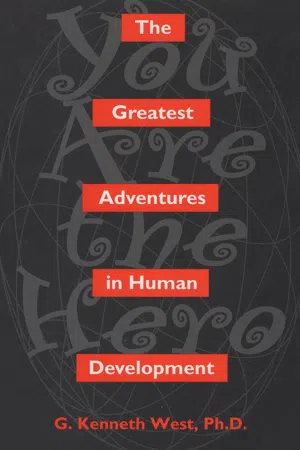
This undergraduate psychology text acknowledges the diverse backgrounds and learning styles of students by blending Adlerian "tasks of life" with the developmental psychology of Adler, Catalano, Dreikurs, Erikson, Fowler, Fromm, Gilligan, Hoffberger, Kierkegaard, Kohlberg, Levinson, Maslow, May, Piaget, Rogers, Sekkaran and Sternberg. Each chapter examines one of life's greatest adventures and offers the wisdom and advice of psychologists and counsellors most familiar with that aspect of life. Chapters cover adventures such as birth, loss, loving, leaving, growing up, growing old, children who succeed and fail, stagnant and fulfilling careers, faith, despair and crisis and transformation. Reflection questions precede each chapter to stimulate class discussion.
Information
Chapter 1
ADVENTURES AND DRAGONS
Far better it is to dare mighty things, to win glorious triumphs, even though checked by failure, than to take rank with those poor spirits who neither enjoy much nor suffer much, because they live in the gray twilight that knows not victory or defeat.
Theodore Roosevelt
Ponderings. What are the most important challenges in your life at this moment? What major opportunities do you see unfolding in the next five years? What are your dreams for these years? What events or forces could prevent you from realizing these dreams? As you consider the lives of others, what life events do you believe bring the most meaning to people’s lives? In modern society, what internal and external factors most frequently prevent people from reaching their dreams?
I first realized my life was a great adventure when my sixth-grade teacher, Mrs. Cross, read aloud The Odyssey to us. I knew then that these stories were not just about men and women who lived thousands of years ago; they were about me and about you. We are the Penelopes, the Telemachuses, and the Odysseuses of our own life adventures. We are also flawed characters like Icarus and Achilles.
Like Odysseus’s adventures, ours are filled with monsters, temptations, and twists of fate that can disrupt, sidetrack, and even end our voyages. But, like Odysseus and Penelope, we have within us the spirit and wits to persevere, to live vibrantly, and to take control of our lives.
This book is about the hero in each of us. It describes the “spirit within” that urges us to live passionately. It warns of dragons that may slay us and temptations that may seduce us into prematurely ending our voyages. We are the modern sojourners, though not unlike those who traveled before us—our own ancestors.
THE CALL TO ADVENTURE
A few men and women lead movements that liberate nations or oppressed people. The average person rarely knows them personally, but knows of them. They seem to respond without hesitation to inward and outward calls to free others from political or spiritual bondage. In doing so, they risk their lives and often die along the journey. Although more visible in their accomplishments and acclaim, world heroes are not greatly different from everyone else. Each person receives the call.
True, most people do not receive the summons to adventure in earth-shaking ways. In fact, we may wonder if we want to depart from the safety of our lives. Within each individual is a need for adventure but also the desire to keep everything the same. Predictability provides comfort; even when the ordinary falls short of our dreams, it is familiar and controllable.
Therefore, it is not surprising that personal calls for change and commitment are greeted with conflicting emotions. The invitation of the call may ask that we discover a mysterious part of ourselves that longs to be unleashed. Or it may require us to shed heavy psychological armor, carried from our pasts, that prevents us from facing important life challenges. We may be asked to leave familiar family patterns that are comfortable but are preventing us or our children from becoming full participants in the great adventures of life. The call will come often during our lifetimes.
No matter what the specific invitation of the call requires, it always demands that the well-known be abandoned and an odyssey into the unknown begun. There are no guarantees of safety or assurance. Of such risk taking heroes are made.
Many calls to adventure seem pleasant. They arrive when we believe we are ready for change. Sometimes we are ready, but at other times we are not. Therefore, these can be the most dangerous invitations, even though their arrival excites us. Often we are ill prepared for or even unaware of the dangers of the approaching journey. Such calls come with the advent of new love, new career possibilities, the birth of a child, or with various opportunities that present themselves during transitional periods. If we plunge headlong into an adventure that we are not prepared for, we may be overcome by the challenges that confront us. More difficult calls will follow.
More troublesome calls arrive with thunder; rarely are we ready for their force. They announce that we or those we love are not fulfilling their needs. Despite our intentions, something has gone awry in life. Such summonses occur at the most inopportune times when we feel consumed by life’s other tasks.
Because we do not welcome calls that disrupt the normal flow of life, we may not understand the miraculous nature of the invitation. The miracle is that we receive an opportunity to embark on a liberating adventure, to bring a new passion for life to us and those we love.
These disruptive calls, like the god Proteus, take many forms. Depression often is the disguise, announcing that we have inner gifts not being developed. Marital disharmony declares that marriage, the hoped-for union of two spirits, can be so much more than we are experiencing. A child’s psychological symptoms or school problems may set us on a quest for the liberation of our loved ones. Such calls may already be familiar to you.
These invitations frighten us. We know of the potential perils that await us, and we may even imagine disasters that will never evolve. We fear the abyss into which we must descend to meet and conquer the challenges that threaten us. Altering the course of life in midstream is no easy undertaking.
Supporters will be there to help. Teachers, therapists, friends, and spiritual mentors may direct us, but they can serve only as advisors. The future cannot be foretold, and we must frequently venture alone. Everyone has a unique voyage to undertake. The call will come. To hear it and respond requires the heart of a hero.
What is the call like? Think how on a long car trip you might drive for hours at night, and the broken lines pass by, again and again. Your mind wanders. You feel relaxed. Suddenly a thought startles you: I don’t remember driving this car! You panic. You cannot recall the curves, the hills, passing cars or any judgment you just made. How did you dodge disaster? In the moment of panic you break into a cold sweat. Immediately, you consciously takes control of the wheel. Now every decision seems crucial. You travel down the same highway, yet everything is different. You have heard one of life’s simpler calls.
Many who hear life’s challenging calls refuse to take charge of the wheel. They wish to pretend that they are not responsible for the journey. Their need for comfort and predictability outweighs their spirit for adventure. They let go of the passion in favor of false security. They fear their challenges will overcome them; therefore, they choose to drive unconsciously into the night.
The timid of the earth will not jump into life’s center ring where the action is. Instead, they remain satisfied with the sideshows. Nevertheless, most who fail to respond to the call will have full lives—lives that are filled with daily routines and pleasures, lives filled with events over which they feel little control, with criticism of those who take risks in life, with anger toward the fates whom they blame for their lot, with attempts to treat the hemorrhages of their lives with the small bandages offered by external sources.
Part of them still wishes to soar, however. They may become obsessed with lives of soap opera stars, so filled with emotion and change. Or, nurturing no passions of their own, they may vicariously feel the exhilaration of a basketball player who leaps above the rim to slam home a winning shot. Their addiction to the passion of others becomes a testimony to their own reluctance to live beyond the predictable. But also it gives hope that the gentle voice inside still beckons them. Some day they may take charge of the wheel.
But enough about those who ignore the call or who hearing it, fail to embark. This book is about heroes. This is a book about those who know the brevity of life and wish to experience their days to the fullest.
THE VOYAGES WE UNDERTAKE
The voyages undertaken in life are well-known. One’s parents embarked on them, and their parents before them. The adventures take place on at least four great seas: love (marriage and the raising of children), careers, religion, and friendship/community making (the creation of a better planet for the adventures of future generations).
Psychologists frequently discuss life’s greatest adventures. For example, Sigmund Freud wrote primarily of the first two opportunities, marriage and work. Alfred Adler and Rudolf Dreikurs recognized the additional searches. But despite the work of psychologists, the blessing and curse discovered by each sojourner is that no map or instructions dictate exactly which journeys to embark on or how to overcome the challenges to be faced.
For many, the entire life adventure can take place on a single sea. There are holy people, dedicated teachers, devoted spouses, caregivers, and noted humanitarians who concentrate on one life challenge. But most people travel all four. To balance these challenges in life calls for wisdom and courage. The challenges are different for each person; no two lives are the same.
Despite all the advice sought and received, voyagers must chart their own course, learn from their own meandering, and then frequently redirect their adventures. For each traveler the currents will change and the hazards may vary. Nevertheless, the opportunities presented by travel on the four seas fill life with the excitement and tragedy inherent in living.
One should not be frightened by the uncertainty of the odyssey. Most of the help one needs lies within.
THE INNER SPIRIT
I believe that man will not merely endure; he will prevail. He is immortal, not because he alone among creatures has an inexhaustible voice, but because he has a soul, a spirit capable of compassion and sacrifice and endurance.
William Faulkner
In his 1949 Nobel Prize acceptance speech, William Faulkner emphasized what humans for thousands of years have known: We each have a driving, inward spirit. This spirit is not a relic of superstition or a figment of literary imagination, but an inner force capable of guiding individuals to richer development.
Carl Rogers (1951, 1972; Figure 1.1) and Abraham Maslow (1968, 1971; Figure 1.2) built modern theories on their belief in the “self-actualizing tendency” that drives each human being toward greater development. As Rogers described, “This is the inherent tendency of the organism to develop all its capacities in ways which serve to maintain or enhance the organism” (Rogers, 1951, p. 196). Moreover, individuals have “an inherent capacity to move away from maladjustment and toward psychological health” (Corey, 1986, p. 102). When in harmony with this spirit, we live authentically, communicate clearly, know what is important, and resist goals and roles that violate our healthy growth. We can live in the present. And we can create relationships that enhance the inner growth of our loved ones.

Figure 1.1. Carl Rogers. Courtesy of The Center for Studies of the Person.

Figure 1.2. Abraham Maslow. Courtesy of Brandéis University.
Through the ages, people have attempted to understand and describe this spiritual drive. Each generation knows its presence and feels its power. Yet each finds different ways to discuss its magnificence. For the ancient Hebrews, the spirit was described as the “wind” within an individual. At religious celebrations the spiritual community exchanged the pax of peace by kissing one another. It was thought that their breath carried the spirit and a shared kiss allowed worshippers to celebrate the gift of the spirit. Today, this mystery of the inner life is still pondered.
This spirit or force within carries a small voice, a feeling that can direct a person. Yet its quiet instructions can also be ignored. Rogers’ works described, for example, how at an early age children begin to play roles that please others. They need to hear the applause of those they love. At their worst, they soon dance like puppets pulled by the strings of their loved ones and, later, by the expectations of society. As adults, they may frequently discover that they are out of touch with their own needs and desires. They are lived rather than living. They cannot distinguish between their dreams and the dreams others have for them.
Fortunately, the spirit within never dies or abandons us. When our behaviors conflict too violently with what our inner voice knows is best, we begin to develop symptoms, such as depression, insomnia, or disease. When forced to violate their inner voices, children begin to dysfunction as well. This is why family therapists consider most family crisis and symptomatic behavior to be a miracle. These knocks on the door signal that the spirit within begs to be heard. It is in crisis that human beings reach a crossroads, a second chance to be guided from within rather than from without.
In this age of science and technology, we may begin to doubt that we possess an inner spirit that is capable of directing us. Indeed, if you search for the words spirit, self-actualization or their equivalent in the index of most modern developmental psychology texts, you will be as unlikely to find it as you will the word God, religion or even love. What cannot be seen or measured is ignored.
By accepting this narrow understanding of life, humans are left at the mercy of outside forces. Soon they become convinced that the radical behaviorists are right, that people are no more than the combination of genetic material, their past training and current moods. People who ignore the spirit within them surrender their life travels to the expectations of society and to the authority of its guardians. Sadly, with surrender one abdicates the role of hero in one’s own adventure.
Highly developed, t...
Table of contents
- Cover
- Half Title
- Title Page
- Copyright Page
- Dedication Page
- Table of Contents
- List of Figures
- Preface
- Acknowledgements
- Chapter 1 Adventures and Dragons
- Chapter 2 The Miracle of Crisis: A Case Example
- Chapter 3 Love: The Greatest Adventure
- Chapter 4 The Parental Adventure: The Voyages of Future Heroes
- Chapter 5 Icarus and the Dragons: Teenagers, their Parents, and Beyond
- Chapter 6 The Inner Quest: Cognitive, Moral, and Religious Growth
- Chapter 7 Work and Careers: The Perilous Voyage
- Chapter 8 The Final Days of the Hero
- Chapter 9 Postscript: Heroes in our Past
- Bibliography
- References
- Index
- About the Author
Trusted by 375,005 students
Access to over 1.5 million titles for a fair monthly price.
Study more efficiently using our study tools.
Frequently asked questions
Yes, you can cancel anytime from the Subscription tab in your account settings on the Perlego website. Your subscription will stay active until the end of your current billing period. Learn how to cancel your subscription
No, books cannot be downloaded as external files, such as PDFs, for use outside of Perlego. However, you can download books within the Perlego app for offline reading on mobile or tablet. Learn how to download books offline
Perlego offers two plans: Essential and Complete
- Essential is ideal for learners and professionals who enjoy exploring a wide range of subjects. Access the Essential Library with 800,000+ trusted titles and best-sellers across business, personal growth, and the humanities. Includes unlimited reading time and Standard Read Aloud voice.
- Complete: Perfect for advanced learners and researchers needing full, unrestricted access. Unlock 1.5M+ books across hundreds of subjects, including academic and specialized titles. The Complete Plan also includes advanced features like Premium Read Aloud and Research Assistant.
We are an online textbook subscription service, where you can get access to an entire online library for less than the price of a single book per month. With over 1.5 million books across 990+ topics, we’ve got you covered! Learn about our mission
Look out for the read-aloud symbol on your next book to see if you can listen to it. The read-aloud tool reads text aloud for you, highlighting the text as it is being read. You can pause it, speed it up and slow it down. Learn more about Read Aloud
Yes! You can use the Perlego app on both iOS and Android devices to read anytime, anywhere — even offline. Perfect for commutes or when you’re on the go.
Please note we cannot support devices running on iOS 13 and Android 7 or earlier. Learn more about using the app
Please note we cannot support devices running on iOS 13 and Android 7 or earlier. Learn more about using the app
Yes, you can access The Greatest Adventures In Human Development by G. Kenneth West in PDF and/or ePUB format, as well as other popular books in Psicologia & Psicologia cognitiva e cognizione. We have over 1.5 million books available in our catalogue for you to explore.