- 404 pages
- English
- ePUB (mobile friendly)
- Available on iOS & Android
eBook - ePub
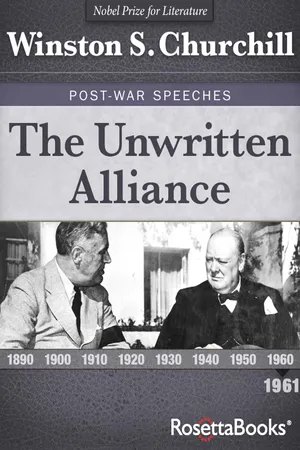
The Unwritten Alliance
About this book
The fifth and final volume in this collection of the British prime minister's oratory contains the final speeches and addresses of his life.
Legendary politician and military strategist Winston S. Churchill was a master not only of the battlefield, but of the page and the podium. Over the course of forty books and countless speeches, broadcasts, news items and more, he addressed a country at war and at peace, thrilling with victory but uneasy with its shifting role on the global stage. In 1953, he was awarded the Nobel Prize for Literature for "his mastery of historical and biographical description as well as for brilliant oratory in defending exalted human values." During his lifetime, he enthralled readers and brought crowds roaring to their feet; in the years since his death, his skilled writing has inspired generations of eager history buffs.
In the last years of Sir Winston Churchill's life, his health was failing—he had suffered several strokes—but his intellect and wit were as sharp as ever. This collection contains some of Churchill's more obscure works, including addresses at banquets, award ceremonies, and to the Primrose League—where he had given his first political speech many decades before, in 1897. In these speeches we see the continued force of his mental acuity, and of his love for the country he served every day of his adult life.
Information
Subtopic
British HistoryIndex
HistoryADOPTION OF A NEW ARMY RIFLE
A SPEECH TO THE HOUSE OF COMMONS
1 FEBRUARY 1954

| 1 | January—The first Sudanese Parliament opened. | |
| 13 | January—The Queen holds the first meeting of the Privy Council outside Great Britain at Government House, Wellington, New Zealand. | |
| 19 | January—The Prime Minister announces that the Belgian F.N. 30 rifle will be adopted by the British Army. | |
| 21 | January—The first ship propelled by atomic power, the U.S. submarine Nautilus, is launched. | |
| 28 | January—A baron of beef is cooked in the Mansion House kitchens for the first time since the war. | |
| 30 | January—The North German Lloyd Company re-enters the transatlantic shipping service after fourteen years’ absence. |
[1 February 1954
This is an interesting controversy and it is one which, I think, is very properly made a subject of debate. Certainly the dispute is not one about which there should be ideological cleavages, party feeling, bad temper, or even insulting language.
We have a common interest in taking the right decision. No party interest is involved in any way, and I really do not think that the hon. Member for Aston [Mr Wyatt] should assume that he is in the presence of a villainous plot when all that has happened is that the best focusing of the latest and best expert advice we can obtain has governed the decisions which have been taken. The hon. Gentleman was fairly moderate this afternoon in what he said, but a week ago in Reynolds News he used this sort of language:
Sir Winston Churchill announced the biggest betrayal of British designers and inventors in political history. It was also the shameful abandonment of the British soldier and of British interests.
The nearest he got to that to-day was to say that I was lacking in patriotism and guilty of dilatoriness.
I have only a fairly simple tale to tell this afternoon, but before I come to the tale I should like to make a few general observations arising out of what the hon. Gentleman said about the rapidity of fire. He said the new British rifle fired 80 shots as against 40 by the Belgian. As a matter of fact, these two rifles, if used on automatic gear, can fire at the rate of over 600 rounds a minute. Both can fire by semi-automatic gear, that is to say, self-loading but trigger-pulling for every shot, 50 or 60 rounds a minute. That is what I am advised is the case.
I doubt very much whether there is any real military advantage in these extraordinary rates. It seems to me incredible that a human being can give individual thought and aim to 50 or 60 decisions a minute. Even if a very highly trained expert soldier could achieve such a result in peace conditions, I am sure that the ordinary rank and file, especially in these short service days, would simply be wasting their ammunition if they tried to pull the trigger sixty times a minute. In the stress and excitement of battle, the soldier would be far more likely to fire away his limited amount of ammunition, the supply of which is always a main interest especially on the move in the front line.
It is remarkable and indeed odd that the more efficient fire-arms have become, the fewer people are killed by them. The explanation of this apparent paradox is simply that human beings are much more ingenious in getting out of the way of missiles which are fired at them than they are at improving the direction and guidance of these individual missiles. In fact, the semi-automatic and automatic rifles have already, in a certain sense, gained their triumph by largely putting an end to the very mass attacks they were originally devised to destroy.
But those are only general observations upon the point that it is, I think, an error to try to think only in purely technical terms, and that the practical usage and experience and qualities of the human being must be brought into all these questions of modern weapons with their ever-increasing improvements. One of the recurrent military problems of the last one hundred years has been the ever more rapid progress of scientific invention in all countries. In that condition the difficulty has been to choose the moment when to change from research and experiment in major weapons to what the French call production en série which, for the benefit of those who have studied ancient rather than modern languages, I will venture to translate as ‘mass production’.
The period of transition, perhaps ten years, in the rifle must be one of awkwardness and anxiety, but to have two different rifles in the Army at the same time is a serious disadvantage. To hold on to an obsolescent type too long may lead to disaster if war comes. On the other hand, to plunge into a new type too soon is to cut oneself off from the further improvements of invention which have now become perpetual.
I am not a technical expert, nor am I attempting to speak as one. I certainly should not have taken part in this discussion but for the fact that I was involved in it during the period when we sat on the other side of the House. I thought it was a mistake of the late Administration to take a plunge into the .280 rifle in April, 1951. That was not because it was not a very good one and a great advance on our well-proven but obsolete .303, but because we might find ourselves all alone with this new rifle for what at that time was mentioned to me as a ten-year transitional period at the very time when our supreme aim was the building up of a grand alliance and a common front between the nations of the free world.
Even if the .280 was the best rifle in the world, which we do not think it now is, I would rather that we were not the only country with it in a longer period of transition. When the various patterns of rifles are all so narrowly matched, it is wiser to keep company with the largest possible number of allies, but it would be a foolish boast to say that we had in fact complicated and confused the whole standardization of the allied arms on the common front, of which common front we form only about a quarter on the Rhine and about one-tenth on the whole N.A.T.O. front.
To simplify and unify ammunition supply on a common front must be held to rank very high in military policy. It has been said that the general wins who makes the fewest mistakes, and it is very tiresome when ammunition is brought with difficulty and suffering to troops in mortal peril and it turns out to be the wrong kind. Therefore, when competing types are neck and neck, it may well be that standardization claims priority.
MR WOODROW WYATT (Aston) rose.
THE PRIME MINISTER: The hon. Gentleman had better wait. He will get a chance later. Let me point out that when the decision to go into production with the E.M.2 in isolation was declared by the right hon. Gentleman the Member for Easington [Mr Shinwell] on 25 April 1951, at that time the problem of finding a common type of ammunition had not been solved and the British pattern rifle had not been devised, as it now has been, to take the .300 round. Therefore, I asserted—this is the only reason I am speaking in this debate—that such policy was a great mistake, but I do not impute any evil motives to the right hon. Gentleman, and I am glad to feel with Pope that: ‘To err is human; to forgive, divine.’
MR E. SHINWELL (Easington): Perhaps the right hon. Gentleman will forgive me instantaneously if I venture to interject and to remind him that, although provisionally a decision was taken on the date he mentioned, in April, 1951, we engaged in discussions at Washington with some of the other N.A.T.O. countries much later in the year and were prepared to consider any suggestions made by the other countries, and it was only because of the American intransigeance that we were unable to reach some agreement.
THE PRIME MINISTER: As I say, the fact remains that the right hon. Gentleman very authoritatively adhered to the .280 round at the time when no arrangements for production of a common round had been made.
The House might be interested to know how it came about that the .300 round was selected. In August, 1951, following an appeal by Canada, which was worried that Britain was what was called ‘going out on a limb’ with the .280 round, a Defence Ministers’ Conference took place in Washington between Great Britain, the United States, Canada, and France. At this conference the right hon. Gentleman, who was then Minister of Defence, offered to show the ammunition to N.A.T.O. on trial. This offer was accepted, and the trials of our .280 round with American .300 round took place in September, 1951. A vote was taken after the trials, at which the United States and France came down solidly for the .300 round, and Canada, while appreciating the efficiency of the .280 round, considered that the .300 round met all requirements.
MR SHINWELL: I am sorry to interrupt the right hon. Gentleman again, but we had better get the facts right. I was present at that Conference and took part in the negotiations. The position of the United States was as the right hon. Gentleman has stated, the position of France was that she had no opinion at all, and the position of Canada was as stated by the then, and, I think, present, Minister of Defence, Mr Brooke Claxton, that he was quite unconcerned about the size of the round or the type of rifle as long as Canada had the opportunity of producing whatever rifle or whatever round was decided upon.
THE PRIME MINISTER: All I say is that a vote was taken after the trials, and notwithstanding the vote, which I have described, the British representatives decided to adopt the .280 round and go ahead alone.
MR SHINWELL: Is the right hon. Gentleman suggesting that there was a vote of Ministers at the Conference?
THE PRIME MINISTER: No, Sir. Notwithstanding the fact that that was the opinion of the different countries at the Conference, it was decided to go on with the .280 round and to go ahead alone. This was a grave decision, and such was the position which we found when we came into office.
There is another aspect affecting the production of the rifle itself. Uniformity of type is not only important on the battlefield but the whole process of manufacture can be simplified and expedited if it is undertaken on a great scale by many allied countries at the same time. Above all, it was, and is, very important to us if possible to keep in step with the United States. Canada certainly never would have adopted a different round from that of the United States, but if both Canada and the United States were making the same rifle and round as Great Britain, that would be of enormous advantage. We should be in a really gigantic pool, meaning not only speed and ease of manufacture but vast reserves capable of transference between allies if the emergency of war rendered it necessary. It was these general reasons and not any claim to expert knowledge of the types involved that led me when in Opposition to intervene.
In October, 1951, when we became responsible, I, as the then Minister of Defence, reversed the right hon. Gentleman’s decision of 25 April of that year to proceed with the .280 round and rifle in isolation. I take full responsibility to-day for that.
In January, 1952, I visited Washington and conferred with President Truman on the whole subject. I should have been perfectly ready to go forward with the .280 E.M.2 rifle if he would have agreed to adopt it for the American Army. But the overpowering need was to find a common round between us both, or, better still, a common round for N.A.T.O. It was not until September, 1953, that the common round was achieved.
Now I come back to the rifle and the reasons why the Belgian was adopted instead of the British. The British and Belgian rifles (both then of .280 calibre) were first tested in the United States in 1950. British and Canadian representatives were present. The conclusion then reached was that the Belgian rifle showed most promise for development. They were tested again in America in 1952, when the Belgian rifle was considered preferable to the British.
Meanwhile, trials were also taking place in Great Britain. In 1951, the Belgian and British rifles were compared—I am giving the information which is given to me by the War Office, and which has been most carefully sifted and examined—and the conclusion reached by the British Trials Board was that the Belgian rifle F.N. (Fabrique Nationale) was technically the most efficient on the score of dependability, functioning, and accuracy. That was the view. I am not going into the specially technical aspects as to where they were almost neck and neck, but that was the view taken by the British Trials Board in 1951, and the right hon. Gentleman did say in one of his interventions this afternoon that he had begun to modify his views because of the later information which had reached him.
MR SHINWELL: I was at Washington and took part in the discussions about the rifle. We were not adamant about the round at Washington. We listened to the discussion, took part in it ourselves, and came away from Washington with an open mind about the possibility of making modifications in the round, just the same as other people. This is the point I want to take up with the right hon. Gentleman, because it seems to me to be the most important point in these discussions: Are we to understand, from what the right hon. Gentleman has just said, that the British Trials Board, only a few months after they had decided that both the round and the rifle were the best yet produced, actually changed their minds to decide in favour...
Table of contents
- Cover
- Title Page
- Copyright
- CONTENTS
- Introduction
- WESTMINSTER ABBEY APPEAL: A Speech in the Jerusalem Chamber, 30 January 1953
- EAST COAST FLOOD DISASTER: A Speech to the House of Commons, 2 February 1953
- THE AGRICULTURAL INDUSTRY: A Speech to the National Farmers’ Union at the Grosvenor House Hotel, London, 17 February 1953
- NORTH SEA FLOOD DISASTER: A Speech to the House of Commons, 19 February 1953
- DEFENCE: A Speech to the House of Commons, 5 March 1953
- THE DEATH OF QUEEN MARY: An Address of Sympathy from the House of Commons, 25 March 1953
- COMMONWEALTH PARLIAMENTARY ASSOCIATION LUNCHEON: A Speech before Her Majesty the Queen at St Stephen’s Hall, Westminster, 27 March 1953
- SCOTTISH UNIONIST ASSOCIATION ANNUAL MEETING: A Speech at Green’s Playhouse, Glasgow, 17 April 1953
- ST GEORGE’S DAY DINNER: A Speech to the Honourable Artillery Company, 23 April 1953
- ART: A Speech at the Royal Academy Banquet, 30 April 1953
- FOREIGN AFFAIRS: A Speech to the House of Commons, 11 May 1953
- THE CORONATION OF QUEEN ELIZABETH II: An Introduction to a Royal Broadcast, 2 June 1953
- THE CONSERVATIVE PARTY CONFERENCE: A Speech at Margate, 10 October 1953
- DEBATE ON THE ADDRESS: A Speech to the House of Commons, 3 November 1953
- FOREIGN AFFAIRS: A Speech at the Lord Mayor’s Guildhall Banquet, 9 November 1953
- NATIONAL SERVICE: A Speech to the House of Commons, 16 November 1953
- MR CLEMENT ATTLEE: A Speech after Presentation of the Freedom of the City of London to Mr Attlee, 20 November 1953
- FOREIGN AFFAIRS: A Speech to the House of Commons, 17 December 1953
- ADOPTION OF A NEW ARMY RIFLE: A Speech to the House of Commons, 1 February 1954
- THE BERLIN CONFERENCE: A Speech to the House of Commons, 25 February 1954
- DEFENCE (GERMAN REARMAMENT): A Speech to the House of Commons, 2 March 1954
- THE HYDROGEN BOMB: A Speech to the House of Commons, 5 April 1954
- DOCTORATE OF NEW YORK UNIVERSITY: A Speech at No. 10 Downing Street, on accepting, in absentia, a Doctorate of Law of the University of New York, 7 April 1954
- THE ROYAL ACADEMY BANQUET: A Speech at the Royal Academy, 28 April 1954
- GRAND HABITATION OF THE PRIMROSE LEAGUE: A Speech at the Royal Albert Hall, London, 30 April 1954
- WELCOMING THE QUEEN’S RETURN FROM A COMMONWEALTH TOUR: A Speech to the House of Commons, 17 May 1954
- THE CONSERVATIVES’ TASKS: A Speech in the Royal Albert Hall, London, to a Mass Meeting of Conservative Women, 27 May 1954
- ANGLO-AMERICAN FRIENDSHIP: A Speech at a Dinner of the English-Speaking Union in honour of General Gruenther, 8 June 1954
- THE DEATH OF MR ARTHUR GREENWOOD: A Speech to the House of Commons, 15 June 1954
- A VISIT TO THE UNITED STATES AND CANADA: A Speech to the House of Commons, 12 July 1954
- REVIEW OF FOREIGN AFFAIRS: A Speech to the House of Commons, 14 July 1954
- PRESENTATION OF THE ESHER TROPHY: A Speech to 615 Squadron at Biggin Hill Aerodrome, 5 September 1954
- THE CONSERVATIVE PARTY CONFERENCE: A Speech at Blackpool, 9 October 1954
- THE LORD MAYOR’S BANQUET: A Speech at the Guildhall, 9 November 1954
- PRESENTATION TO LADY CHURCHILL OF A PORTRAIT: A Speech at Woodford, 23 November 1954
- BRISTOL UNIVERSITY DEGREE CONFERMENT: A Speech at the Close of Conferment, 26 November 1954
- EIGHTIETH BIRTHDAY PRESENTATION: A Speech at Westminster Hall during a Presentation from both Houses of Parliament to mark Sir Winston Churchill’s Eightieth Birthday, 30 November 1954
- DEBATE ON THE ADDRESS (GERMAN REARMAMENT): A Speech to the House of Commons, 1 December 1954
- THE BUILDING INDUSTRY: A Speech at the Dorchester Hotel, 25 January 1955
- DEFENCE: A Speech to the House of Commons, 1 March 1955
- WORLD DISARMAMENT: A Speech to the House of Commons, 14 March 1955
- EARL LLOYD GEORGE MEMORIAL: A Speech to the House of Commons, 28 March 1955
- ELECTION ADDRESS: A Speech at Woodford, 16 May 1955
- ELECTION ADDRESS: A Speech at Bedford, 17 May 1955
- ELECTION ADDRESS: A Speech at Walthamstow and Chigwell, 19 May 1955
- THE GUILDHALL STATUE: A Speech at the Unveiling of a Statue, 21 June 1955
- THE BRITISH ASSOCIATION: A Message to the British Association Meeting at Bristol, 6 September 1955
- THE CINQUE PORTS: A Speech in Hastings on Presentation of a Portrait, 7 September 1955
- THE FREEDOM HOUSE AWARD: A Speech recorded for the Freedom House Dinner in New York, 9 October 1955
- CONSTITUENCY SPEECH: A Speech at the Monkhams Ward Dinner and Dance, 18 November 1955
- YOUNG CONSERVATIVES: A Speech to Woodford Young Conservatives, 5 December 1955
- THE WILLIAMSBURG AWARD: A Speech in Drapers’ Hall, London, 7 December 1955
- THE FREEDOM OF BELFAST AND LONDONDERRY: A Speech at the Mansion House, 16 December 1955
- THE PRIMROSE LEAGUE: A Speech at the Albert Hall, 13 April 1956
- LORD CAMROSE MEMORIAL: An Unveiling Speech at St Paul’s, 3 May 1956
- THE CHARLEMAGNE PRIZE: A Speech at Aachen on receiving the prize, 10 May 1956
- THE PRIMROSE LEAGUE: A Speech at the Albert Hall, 3 May 1957
- DAY AT A CONSTITUENCY FETE: A Speech at Royal Wanstead School, 6 July 1957
- A MESSAGE TO EUROPE: A Speech at the United Europe Meeting, Central Hall, Westminster, 9 July 1957
- LIBERTY AND THE LAW: A Speech at the Guildhall Dinner of the Law Society to the American Bar Association, 31 July 1957
- MESSAGE TO GENEVA: A Greeting to the Inter-Parliamentary Union Conference at Geneva, September 1957
- INVESTITURE IN PARIS: A Speech on receiving the Croix de la Libération from General de Gaulle, 6 November 1958
- A CONSTITUENCY EVENT: A Speech to Woodford Conservative Association at the Kensington Palace Hotel, 6 January 1959
- REVIEW AT WOODFORD: A Constituency Speech at Hawkey Hall, Woodford, 20 March 1959
- DINNER IN AMERICA: Remarks in response to a Toast at a Dinner in the White House, Washington, 6 May 1959
- ADOPTION MEETING: A Speech at Hawkey Hall, Woodford, 29 September 1959
- A GENERAL ELECTION SPEECH: A Speech at Hawkey Hall, Woodford, 29 September 1959
- CHURCHILL COLLEGE CEREMONY: A Speech at a Tree-Planting at Churchill College, Cambridge, 17 October 1959
- THE WOODFORD STATUE: A Speech at the Unveiling of a Statue at Woodford, 31 October 1959
- Endnotes
Trusted by 375,005 students
Access to over 1.5 million titles for a fair monthly price.
Study more efficiently using our study tools.
Frequently asked questions
Yes, you can cancel anytime from the Subscription tab in your account settings on the Perlego website. Your subscription will stay active until the end of your current billing period. Learn how to cancel your subscription
No, books cannot be downloaded as external files, such as PDFs, for use outside of Perlego. However, you can download books within the Perlego app for offline reading on mobile or tablet. Learn how to download books offline
Perlego offers two plans: Essential and Complete
- Essential is ideal for learners and professionals who enjoy exploring a wide range of subjects. Access the Essential Library with 800,000+ trusted titles and best-sellers across business, personal growth, and the humanities. Includes unlimited reading time and Standard Read Aloud voice.
- Complete: Perfect for advanced learners and researchers needing full, unrestricted access. Unlock 1.5M+ books across hundreds of subjects, including academic and specialized titles. The Complete Plan also includes advanced features like Premium Read Aloud and Research Assistant.
We are an online textbook subscription service, where you can get access to an entire online library for less than the price of a single book per month. With over 1.5 million books across 990+ topics, we’ve got you covered! Learn about our mission
Look out for the read-aloud symbol on your next book to see if you can listen to it. The read-aloud tool reads text aloud for you, highlighting the text as it is being read. You can pause it, speed it up and slow it down. Learn more about Read Aloud
Yes! You can use the Perlego app on both iOS and Android devices to read anytime, anywhere — even offline. Perfect for commutes or when you’re on the go.
Please note we cannot support devices running on iOS 13 and Android 7 or earlier. Learn more about using the app
Please note we cannot support devices running on iOS 13 and Android 7 or earlier. Learn more about using the app
Yes, you can access The Unwritten Alliance by Winston S. Churchill in PDF and/or ePUB format, as well as other popular books in History & British History. We have over 1.5 million books available in our catalogue for you to explore.