A look at the early years of the Pacific conflict in World War II, by the
New York Times–bestselling author of
The Rise and Fall of the Great Powers.
Japan had mighty ambitions: to control the Western Pacific. The attack on Pearl Harbor devastated their primary obstacle—the American Pacific fleet—and they swept across the region. What ensued was a bitter struggle in which many thousands of soldiers lost their lives on both sides.
This is the first book in Paul Kennedy's chronicle of the Pacific conflict in World War II, concluded in
Pacific Victory. Featuring a new introduction by the author, this book provides a close, step-by-step narrative of the Japanese expansion into the Western Pacific during some of the most brutal years of World War II. Offering contemporary analysis of war strategy, it includes a riveting look at Japan's tightening grip on Hong Kong, New Guinea, the Philippines, and other key strategic locations—and the Allies' inexorable struggle against it.
- 158 pages
- English
- ePUB (mobile friendly)
- Available on iOS & Android
eBook - ePub
About this book
Information
Subtopic
Japanese HistoryIndex
HistoryThe Tokyo raid and the Battle of the Coral Sea
The Japanese onslaught in the Far East was one of the most successfully swift and extensive campaigns in the history of warfare. Within four months they had captured Hong Kong, Malaya, Singapore, the Dutch East Indies, southern Burma and most of the Philippines; within another month Corregidor was to surrender and the British to be pushed out of Burma. And the cost to Japan of this great victory?—about 15,000 men, about 380 aircraft and 4 destroyers.
Having achieved so much at such little cost, the Japanese were naturally reluctant to halt their advance and to hand the initiative to their economically stronger opponents. Yamamoto in particular was most anxious to eliminate the American hold upon Hawaii in order to prevent any comeback by the United States in the central Pacific, while the Navy General Staff favoured operations to out the link between America and Australia by occupying New Guinea, the Bismarck Archipelago and the various island groups beyond. It even entertained the idea of invading Australia itself, but this was firmly rejected by the army, which still had its attention rivetted upon China and Manchuria and therefore opposed the use of so many troops for these distant campaigns. Nevertheless, certain operations were to be undertaken by the navy along the lines they had indicated, both for strategic reasons and for morale. The Navy General Staff’s plan was favoured, for it was already clear that the Americans were intending to build up Australia as a spring-board for counterattack and were strengthening the island chain across the South-West Pacific. Moreover, Japanese forces had already advanced to Rabaul in New Britain, and then to the New Guinea coast and the northern Solomons by March 1942. However, the influential Yamamoto repeated his case for a strike against the United States carrier fleet at Hawaii and his argument received a great boost when, on 18th April, the Americans launched a surprise bombing raid upon Tokyo itself.
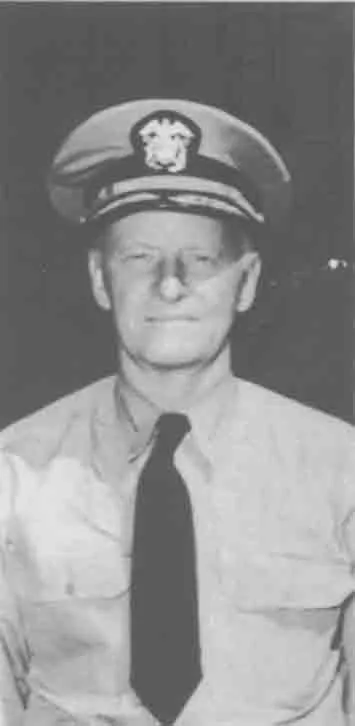
Admiral Nimitz, appointed C-in-C Pacific on 31st December 1941
Since the disaster at Pearl Harbor, the United States had been hastily reorganising its defence forces in the Pacific while the enemy was busy occupying South-East Asia. On 31st December 1941 Admiral King took control of the US Navy while Admiral Nimitz was appointed C-in-C Pacific. Both were vigorous men, eager for action, but they realised that at this stage in the conflict their prime duty was to conserve their limited forces and to strengthen the island link to Australia, which became essential after the fall of Java, In the early months of 1942, therefore, the American carriers were chiefly engaged in covering troop convoys to Australia and to Port Moresby, Fiji and New Caledonia, which were rapidly garrisoned and turned into island fortresses to check the expected Japanese push into the South-West Pacific. But the Americans were also acting aggressively wherever they could, and on 1st February their carrier aircraft attacked the Marshall Islands. Five weeks later, strikes from the Lexington and Yorktown against enemy forces on the north-west coast of New Guinea caused the Japanese commander to postpone his advance upon Port Moresby until Nagumo’s carrier force returned from its raid on Ceylon. Already, it was becoming clear that the aircraft carrier was the key weapon, both of attack and defence, in the wide expanses of the Pacific.
But King and Nimitz, together with Air Force General Arnold, had more daring schemes up their sleeve. They were keen to raise morale by striking Japanese soil itself, and with this object in mind Tokyo was the obvious target; by this, so they reasoned, Pearl Harbor would be in some way avenged. Obviously, carriers would have to be employed in this raid, for Japan was too far away from any US airbase. On the other hand, it was impossible to use carrier aircraft since they would have to be launched from a point outside the 500-mile picket boat patrol which the enemy operated, and the US navy possessed no plane which could fly the necessary 1,100 mile round trip. In any case, Nimitz did not wish to risk endangering his few precious carriers by having them wait around until the strike aircraft returned. The solution to the first problem was to use the Army Air Force B-25 Mitchell bomber, which could take off from a carrier if the pilots were given adequate training; the solution to the second problem was to instruct the bombers to fly on to the nearest Allied land base as soon as they had bombed Tokyo, which meant that the carriers could return as soon as the planes had taken off. Since the nearest base was in fact in eastern China, nearly 1,500 miles from Tokyo, the B-25 was an admirable choice; with extra fuel tanks fitted, it could carry a 2.000-lb bomb for almost 2,400 miles and would therefore be capable of this lengthy twin-leg journey. The pilots, led by Lieutenant-Colonel Doolittle, were ordered to practise short take-offs and long over-water flights as preparation for this venture. Only sixteen bombers could be used, though, because they were too large to go below deck and because of the space they required for taking off.
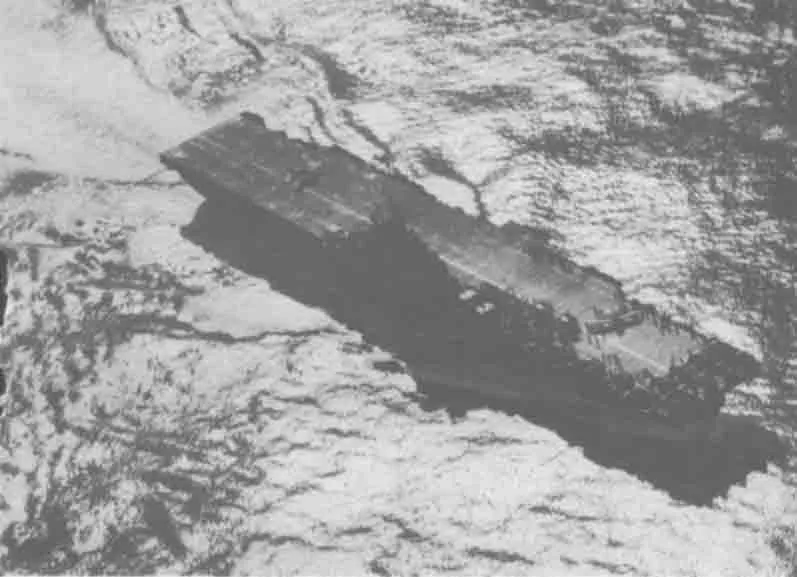
The carrier Yorktown, whose planes, together with those of the Lexington, struck at the Japanese on New Guinea
The carrier selected for this operation was the Hornet, which left San Francisco on 2nd April 1942 with its escort of cruisers and destroyers. Eleven days later, it rendezvoused with ‘Task Force 16’ (the carrier Enterprise and its escorts) which was to give aerial cover on the outward journey when the Hornet’s own fighters would naturally be kept below deck. The trip across the Pacific towards Japan went smoothly until the early morning of 18th April, when the force was sighted and reported by a patrol vessel while still over 700 miles from Tokyo. Anxiously Doolittle conferred with the naval commander, Vice-Admiral Halsey, and they agreed that it would be better to launch the planes, despite the fact that, because of the extra distance involved, there was now much less certainty of them reaching China afterwards. The B-25s therefore took off between 0825 and 0924, despite the heavy seas.
In the event, this proved to be a wise decision. The Japanese High Command was informed of the presence of the carriers by patrol boats, and appropriate defensive measures were ordered; these included the alerting of fighter squadrons and anti-aircraft batteries, and the despatch of Nagumo’s carrier force for a counterstrike against the raiders. Unfortunately for all these preparations, the Japanese expected that the American attack would not take place until the following day, when their homeland would be within range of the US navy carrier aircraft. Doolittle’s force thus achieved complete surprise when it reached Japan, four hours after setting off, and successfully dropped bombs and incendiaries upon Tokyo, Kobe and Nagoya. Aided by a tail wind, it then flew on to China but many planes ran out of fuel and, due to a misunderstanding, Chuchow airfield was not ready. The crews either dropped by parachute, or crash-landed their aircraft; but 71 of the 80 men involved survived. As for the carriers, they escaped unhurt and arrived back at Pearl Harbor on 25th April to a warm reception. As Nimitz and King had planned, the boost to American morale from the Tokyo raid was considerable.
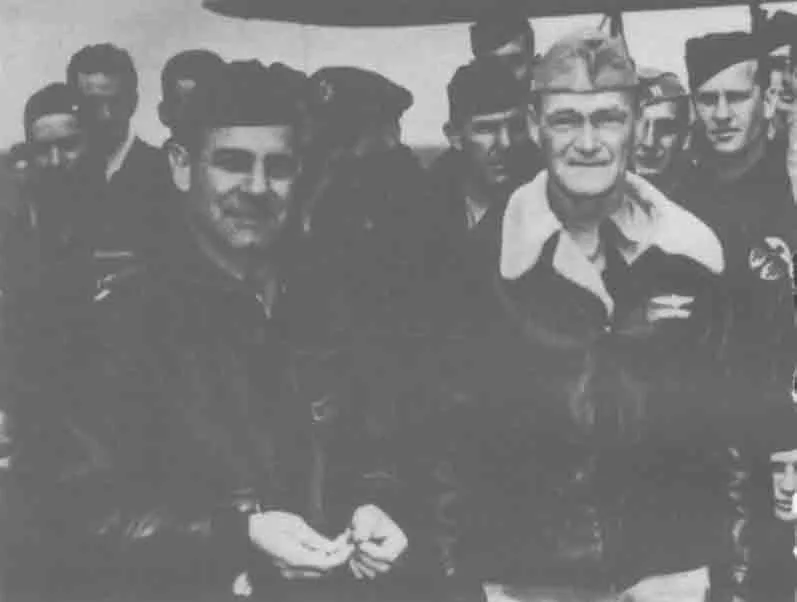
Doolittle accepts from Admiral Mitscher medals previously awarded to US Naval officers by Japan, to be tied to the bombs destined for the Tokyo raid

The carrier Shoho provides air support for the Japanese Tulagi landings
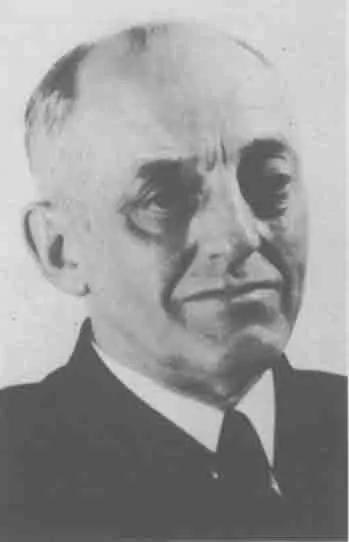
Admiral Robert L Ghormley, in charge of the South Pacific Area
On the Japanese side, there was considerable consternation at this attack, and especially at the idea that the Emperor’s residence had been exposed to the danger of enemy bombs. Consequently, it was decided to keep four army fighter groups at home for the defence of Tokyo and other cities whilst revising the patrol and reconnaissance services. At the same time, a large-scale punitive expedition was despatched by the Japanese army to Chekiang province, whose residents had received the American flyers. Most important of all, the Tokyo raid decided the priority of the Japanese strategic plans. The fear of further raids by American carrier forces upon Tokyo and perhaps upon the Imperial Palace caused the collapse of the Navy General Staff’s opposition to Yamamoto’s scheme for an advance into the central Pacific. This latter operation, which aimed at destroying the US Pacific Fleet and neutralising Hawaii as an enemy base, became much more important than efforts to cut the island chain between America and Australia. Therefore, on 5th May, Admiral Nagano, the Chief of Navy General Staff, issued Imperial General Headquarters Order No. 18 to Yamamoto, instructing him to ‘carry out the occupation of Midway Island and key points in the Western Aleutians in cooperation with the army’.
At the same time, the drive into the South-West Pacific was not going to be entirely halted. Having carried out the conquest of South-East Asia in a time which had astonished even the greatest optimists in Tokyo, the Japanese navy believed that it was capable of running two campaigns at once, even though their respective axes would be divergent. In any case, on 28th April Imperial General Headquarters had already ordered an advance to Tulagi in the southern Solomons, and to Port Moresby in southern Papua; the former would provide an advanced seaplane base to cover the next leap south, while the latter would bring Queensland within range of Japanese bombers. In addition, Nauru and Ocean Islands were to be seized, since Japanese agriculture would benefit from their important phosphate deposits. Since these steps had already been postponed once due to the activities of the US carriers, the Naval General Staff was determined that it should not happen again and confidently believed that they could be implemented in time to employ their own carrier force for the stroke against Midway in early June. Moreover, as soon as the US Pacific Fleet had been destroyed and Hawaii neutralised, the Japanese would then resume their advance to cut the link between Australia and America by operations to capture the New Hebrides, New Caledonia, Fiji and Samoa.
The thrust into the Coral Sea area was placed under the overall command of Vice-Admiral Inouye, C-in-C, Fourth Fleet, who would direct the operation from Rabaul. As soon as he had received his instructions of 28th April troops were made ready and various naval forces were ordered to assemble at Truk in the Carolines. Inouye and his staff, in consultation with Tokyo, then finalised their plan, which was very elaborate and complex. On 3rd May the Tulagi Invasion Group was to land at its objective, lying a little to the north of the large island of Guadalcanal in the Solomons. This landing force was escorted by destroyers and minesweepers, and was given more distant cover by the light carrier Shoho and four heavy cruisers under Rear-Admiral Goto, which would then assist the Port Moresby expedition also. Part of the Tulagi landing force would move on later to capture Nauru and Ocean Islands. On 4th May the Port Moresby invasion fleet, consisting of eleven transports with destroyer and minesweeper escorts, would set off from Rabaul for its destination, which would be reached six days later. It had a support group of two heavy cruisers and would also be covered by Goto’s ships. A subsidiary move of this operation would be the establishment by a seaplane carrier of a base at Deboyne Island in the Lousiade Archipelago, which lay off th...
Table of contents
- Cover
- Title Page
- Copyright
- Contents
- Introduction
- Origins of the Pacific war
- Pearl Harbor
- Hong Kong, Malaya and Singapore
- The Philippines and the Dutch East Indies
- Burma and the threat to India
- The Tokyo raid and the Battle of the Coral Sea
- Midway
- Guadalcanal
- New Guinea, Burma, China
- The strategic balance
- Bibliography
Trusted by 375,005 students
Access to over 1.5 million titles for a fair monthly price.
Study more efficiently using our study tools.
Frequently asked questions
Yes, you can cancel anytime from the Subscription tab in your account settings on the Perlego website. Your subscription will stay active until the end of your current billing period. Learn how to cancel your subscription
No, books cannot be downloaded as external files, such as PDFs, for use outside of Perlego. However, you can download books within the Perlego app for offline reading on mobile or tablet. Learn how to download books offline
We are an online textbook subscription service, where you can get access to an entire online library for less than the price of a single book per month. With over 1.5 million books across 990+ topics, we’ve got you covered! Learn about our mission
Look out for the read-aloud symbol on your next book to see if you can listen to it. The read-aloud tool reads text aloud for you, highlighting the text as it is being read. You can pause it, speed it up and slow it down. Learn more about Read Aloud
Yes! You can use the Perlego app on both iOS and Android devices to read anytime, anywhere — even offline. Perfect for commutes or when you’re on the go.
Please note we cannot support devices running on iOS 13 and Android 7 or earlier. Learn more about using the app
Please note we cannot support devices running on iOS 13 and Android 7 or earlier. Learn more about using the app
Yes, you can access Pacific Onslaught by Paul Kennedy in PDF and/or ePUB format, as well as other popular books in History & Japanese History. We have over 1.5 million books available in our catalogue for you to explore.