The sixth volume in the official biography: "A milestone, a monument, a magisterial achievement" (Andrew Roberts, author of
The Storm of War).
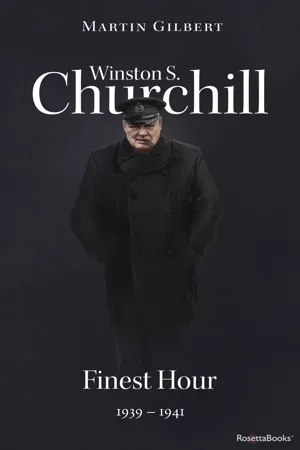
Starting with the outbreak of war in September 1939 and ending with the Japanese attack on Pearl Harbor in December 1941, this volume in the epic biography of Winston S. Churchill draws on remarkably diverse material: from the War Cabinet and other government records to Churchill's own archive and diaries and letters of his private secretariat to the recollections of those who worked most closely with him.
On the day Hitler invaded Poland, Churchill, aged sixty-four, had been out of office for ten years. Two days later, he became First Lord of the Admiralty, in charge of British naval policy and at the center of war direction. In May 1940 he became prime minister, leading his nation during a time of grave danger and setbacks. His first year and a half as prime minister included the Dunkirk evacuation, the fall of France, the Battle of Britain, the Blitz, the Battle of the Atlantic, the struggle in the Western Desert, and Hitler's invasion of Russia.
By the end of 1940, Britain under Churchill's leadership had survived the onslaught and was making plans to continue the war against an enemy of unlimited ambition and ferocious will. One of Churchill's inner circle said: "We who worked with Churchill every day of the war still saw at most a quarter of his daily tasks and worries." Martin Gilbert has pieced together the whole, setting in context much hitherto scattered and secret evidence, in order to give an intimate and fascinating account of the architect of Britain's "finest hour."
"The most scholarly study of Churchill in war and peace ever written." —Herbert Mitgang,
The New York Times
- 1,150 pages
- English
- ePUB (mobile friendly)
- Available on iOS & Android
eBook - ePub
Winston S. Churchill: Finest Hour, 1939–1941
About this book
Information
Topic
StoriaSubtopic
Biografie in ambito storicoPart One
At the Admiralty
1
The First Week of War: ‘I cannot doubt our victory’
At eleven o’clock on the morning of 3 September 1939, as German troops advanced through Poland for the third successive day, Britain declared war on Germany. Throughout the day, the fighting in Poland continued, intense but inconclusive. At five o’clock that afternoon, when the British War Cabinet held its first meeting of the war, there was some discussion as to who should be appointed Chief of the Imperial General Staff. The War Office favoured General Sir Edmund Ironside, whose name was pressed by the Secretary of State for War, Leslie Hore-Belisha.1 ‘There was some opposition to Ironside’s appointment,’ Hore-Belisha wrote in his diary that night, ‘but Winston came down on my side and strongly supported it; and that settled it.’2
As well as his support for Ironside, Churchill suggested to the War Cabinet that the War Office prepare a survey of current British gun production. Such a survey already existed, Hore-Belisha replied, and he would circulate it at once. While this discussion was in progress the latest air reconnaissance reports were brought in. These were then read out by the Secretary to the Committee of Imperial Defence, Major-General Ismay. Four or five German battleships, he reported, were putting out to sea, together with four cruisers and five destroyers.3
It was not known where these German warships were headed: Churchill thought it might be the Baltic. From the point of view of the Royal Air Force, commented the Secretary of State for Air, Sir Kingsley Wood, there could not be a ‘fairer target’.4
The War Cabinet thereupon authorized an air attack on the German Fleet. The attack itself, however, by 27 Blenheims and 9 Wellingtons, proved of importance not for what it achieved but for what it revealed. As one of the Secretaries present at that first War Cabinet later recalled, this air initiative ‘showed how ineffective and ill-designed our aircraft and bombs were against strong defences and well-armoured ships’.5
As soon as the War Cabinet of September 3 was over, Churchill walked at once across Horse Guards Parade to the Admiralty. ‘I met him at the private entrance,’ Captain Guy Grantham, the Naval Assistant to the First Sea Lord, later recalled, ‘and escorted him to the room he knew so well.’ As they entered the Admiralty building, Grantham wrote:
The first thing he said was ‘Where is the octagonal table?’ I got hold of the Office Keeper and said Winston wanted the table back—it was soon produced.
He also told me that on the back of the sofa there should be a chart box. It was there with charts in it, which I showed him. He said ‘I thought so. These are the same charts I used in this room in 1915!’6
Kathleen Hill, Churchill’s secretary since the summer of 1937, has also recalled that moment of Churchill’s return to the Admiralty. ‘He rushed up the steps and flung open the panelling. There were the charts. The ships were still there.’7
Churchill now began work again in the same room, and at the same desk, where he had worked as First Lord from October 1911 until the crisis at the Dardanelles of May 1915. Then, Prince Louis of Battenberg and Admiral of the Fleet Lord Fisher had been his senior advisers. Now it was Admiral of the Fleet Sir Dudley Pound, a former Assistant to Fisher, who was First Sea Lord; and it was with Pound that Churchill now discussed the disposition of the German Fleet, and Britain’s own naval preparations. In 1939, when Italy had invaded and occupied Albania, Pound had been in command of the Mediterranean Fleet, and Churchill had been a severe critic of that Fleet’s disposition. ‘Now,’ Churchill recalled, ‘we met as colleagues upon whose intimate relations and fundamental agreement the smooth-working of the vast Admiralty machine would depend,’ and he added: ‘We eyed each other doubtfully. But from the earliest days our friendship and mutual confidence ripened.’8
That evening, Pound introduced Churchill to the senior Admiralty officials with whom he would have to work from day to day, and hour to hour. Among those present was the Third Sea Lord and Controller, Rear-Admiral Bruce Fraser, who later recalled:
As he once again took the First Lord’s chair in the famous Board Room, Churchill was filled with emotion. To a few words of welcome from the First Sea Lord he replied by saying what a privilege and honour it was to be again in that chair, that there were many difficulties ahead but together we would overcome them.
He surveyed critically each one of us in turn and then, adding that he would see us all personally later on, he adjourned the meeting. ‘Gentlemen,’ he said, ‘to your tasks and duties.’9
***
On the morning of September 4, as German aeroplanes bombarded Warsaw, killing hundreds of civilians, and as German troops continued to advance across Polish soil, the British War Cabinet held its second meeting, with the Prime Minister, Neville Chamberlain, in the Chair. During the discussion Churchill, after noting that the ‘main German effort’ was concentrated on the Polish front, suggested that ‘every means possible should be employed to relieve the pressure’. His suggestion was an attack against the Siegfried Line, carried out jointly by the French Army and the Royal Air Force. The War Cabinet agreed that such a combined plan of action ‘was a vital necessity’.
Later in the same meeting, Churchill gave his War Cabinet colleagues an account of the sinking of the steamship Athenia by a German submarine, two hundred miles north-west of Ireland, on the previous afternoon. ‘It was understood,’ he said, ‘that the passengers and crew were in the ship’s boats. Two destroyers were hastening to the rescue and should be near the scene.’ Churchill added: ‘The occurrence should have a helpful effect as regards public opinion in the United States.’10 Later it was learnt that 112 passengers had been drowned, including twenty-eight Americans. The German Government at once announced that it was Churchill who had personally ordered a bomb to be placed on board. ‘This falsehood,’ he later wrote, ‘received some credence in unfriendly quarters.’11
At half past nine that evening, September 4, Churchill held a conference with Dudley Pound and several other senior Admiralty officials. According to the notes of the meeting, which he marked ‘Most Secret’, Churchill spoke of how, ‘with Japan placid, and Italy neutral though indeterminate’, the first phase of the naval war, and the ‘prime attack’, would be in the Atlantic approaches to Britain. A convoy system was being set up, to protect merchant shipping from submarine attack. For this purpose, Churchill noted, the First Sea Lord was examining whether as many as twelve destroyers and escort vessels could be ‘scraped’ from the Mediterranean and Eastern Theatres, until the completion, in about a month’s time, of special trawlers then being fitted with anti-submarine devices. Churchill wanted a statement prepared for him, to show the date of deliveries of these trawlers, expected in October, and he added: ‘It would seem well at any rate in the earliest deliveries, not to wait for the arming of them with guns, but to rely upon depth-charges. Gun-arming can be recommenced when the pressure eases.’
Churchill then proposed to the conference the immediate establishment of a scheme under which every captain or master of a merchant ship coming from the Atlantic would be visited ‘by a competent naval authority’, who would examine the records of his course, ‘including zig-zags’. Then, Churchill proposed, all ‘infractions or divergences from Admiralty instructions should be pointed out, and all serious departures should be punished, examples being made of dismissal’. The Admiralty had assumed responsibility for the safety of merchant shipping, Churchill commented, ‘and merchant-skippers must be made to obey’.
Discussing the diversion of merchant shipping from the Mediterranean to the Cape route, Churchill advised that this diversion, ordered automatically on September 3, should be maintained until Italy’s intentions become less obscure. But ‘no expectation’, he told his advisers, ‘can be based by us that the Italian uncertainty will be cleared up in the next six weeks’, though he felt that the Admiralty should ‘press’ the Government ‘to bring it to a head in a favourable sense as soon as possible’.
Churchill ended the conference by explaining that he wished his officials to treat his ideas as a basis for discussion, rather than the last word: ‘The First Lord,’ he ended, ‘submits these notes to his naval colleagues for consideration, for criticism and correction, and hopes to receive proposals for action in the sense desired.’12
From his first day at the Admiralty, Churchill instituted a method of work which was to be his hallmark throughout the war, and to be much misunderstood and even resented by some. This was the minute, a dictated note sent to one or more of his advisers, or even to Cabinet colleagues, containing a question, or a series of questions, some long and argumentative, others short and brisk.
These minutes, numbering several a day and several thousand a year, constituted the bulk of Churchill’s written output during the Second World War. They were intended, in the main, not as mere statements of fact, or exhortations, but as a means of entering into a dialogue with the recipient: they were instead of, or a supplement to, conversation; initiating or carrying on debate and enquiry into the myriad topics of the Navy, and of the nation at war.
More so than other Ministers and officials, Churchill used these minutes to acquire information, to initiate discussion, and to propose schemes and stratagems. Some contain words of rebuke, some words of encouragement; some are stern, some witty; some are weighty, some light. But from each of his minutes, Churchill expected to learn what was happening over the full range of his responsibilities, and to probe every area of potential war policy and action.
Three of Churchill’s minutes of September 3 showed his concern to equip himself with the facts needed to form a coherent picture of the naval situation. The first was addressed to the Director of Naval Intelligence, Rear-Admiral Godfrey, to whom he wrote: ‘Let me have a statement of the German U-boat force, actual and prospective, for the next few months. Please distinguish between ocean-going and small-size U-boats. Give the estimated radius of action in days and miles in each case.’ To the Fourth Sea Lord he minuted: ‘Please let me have a return showing the number of rifles in the possession of the Navy both afloat and ashore. Also return of the mines of different natures.’ And to the Deputy Chief of the Naval Staff, Rear-Admiral Tom Phillips, he minuted: ‘Kindly let me know the escorts which will be provided for the big convoy to the Mediterranean (a) from England to Gibraltar, and (b) through the Mediterranean. I understand these escorts are only against U-boat attack.’13
One of Churchill’s minutes on September 4 showed his concern for the well-being of those who worked under him. ‘You must be very uncomfortable,’ he minuted to Pound, ‘in that over-crowded, overheated small room, and the conditions there cannot be favourable to the important work that has to be conducted. I suggest that you should consider going back to the old war room at Admiralty House, where the last war was fought from, and only use the underground room after an air-raid warning has been received.’ Churchill ended this minute, as so many were to end, ‘Pray let me know your views.’14 Within the Admiralty these minutes quickly became known as ‘First Lord’s prayers’.
One such early ‘prayer’ concerned the setting up of a special Map Room at Admiralty House. The need for such a Room arose at once, as Churchill sought to grapple with the seriousness of the U-boat threat to Britain’s food and raw material life-lines. Seeking to follow from day to day the progress of hundreds of merchant ships and their destroyer escorts, as well as to keep track of unescorted ships, he asked on September 5 for ‘a room and additional staff’ to be established, to set up and display a chart ‘of large size’ on which, each morning, could be shown ‘all vessels within two, or better still, three days distance from our shores’.
The guidance or control of each of these vessels, Churchill minuted, ‘must be foreseen and prescribed so that there is not one whose case has not been individually dealt with, as far as our resources allow. Pray let me have proposals to implement this, which should come into being within twenty-four hours, and work up later.’15
The required Map Room, Captain Grantham later recalled, ‘I got organised in the Library of Admiralty House, where large-scale charts of the oceans of the world were mounted in wooden frames.’16
Looking back after the war on these early days, with their many War Cabinets, and Admiralty Conferences, Churchill wrote:
I do not recall any period when the weather was so hot—I had a black alpaca jacket made to wear over only a linen shirt. It was indeed just the weather that Hitler wanted for his invasion of Poland. The great rivers on which the Poles had counted in their defensive plan were nearly everywhere fordable, and the ground was hard and firm for the movement of tanks and vehicles of all kinds.
Each morning the CIGS, General Ironside, standing before the map, gave long reports and appreciations which very soon left no doubt in our minds that the resistance of Poland would speedily be crushed. Each day I reported to the Cabinet the Admiralty tale, which usually consisted of a list of British merchant ships sunk by the U-boats….17
When the War Cabinet met on the morning of September 5, Churchill warned of the danger of an incident arising in the Mediterranean, where there was ‘the risk that an Italian submarine would b...
Table of contents
- Cover
- Title Page
- Copyright
- Dedication
- Contents
- Illustrations
- Maps
- Preface
- Acknowledgements to the New Edition
- Part One: At the Admiralty
- Part Two: ‘Darkest Hour’
- Part Three: Britain Alone
- Part Four: World War
- Endnotes
Trusted by 375,005 students
Access to over 1.5 million titles for a fair monthly price.
Study more efficiently using our study tools.
Frequently asked questions
Yes, you can cancel anytime from the Subscription tab in your account settings on the Perlego website. Your subscription will stay active until the end of your current billing period. Learn how to cancel your subscription
No, books cannot be downloaded as external files, such as PDFs, for use outside of Perlego. However, you can download books within the Perlego app for offline reading on mobile or tablet. Learn how to download books offline
Perlego offers two plans: Essential and Complete
- Essential is ideal for learners and professionals who enjoy exploring a wide range of subjects. Access the Essential Library with 800,000+ trusted titles and best-sellers across business, personal growth, and the humanities. Includes unlimited reading time and Standard Read Aloud voice.
- Complete: Perfect for advanced learners and researchers needing full, unrestricted access. Unlock 1.5M+ books across hundreds of subjects, including academic and specialized titles. The Complete Plan also includes advanced features like Premium Read Aloud and Research Assistant.
We are an online textbook subscription service, where you can get access to an entire online library for less than the price of a single book per month. With over 1.5 million books across 990+ topics, we’ve got you covered! Learn about our mission
Look out for the read-aloud symbol on your next book to see if you can listen to it. The read-aloud tool reads text aloud for you, highlighting the text as it is being read. You can pause it, speed it up and slow it down. Learn more about Read Aloud
Yes! You can use the Perlego app on both iOS and Android devices to read anytime, anywhere — even offline. Perfect for commutes or when you’re on the go.
Please note we cannot support devices running on iOS 13 and Android 7 or earlier. Learn more about using the app
Please note we cannot support devices running on iOS 13 and Android 7 or earlier. Learn more about using the app
Yes, you can access Winston S. Churchill: Finest Hour, 1939–1941 by Martin Gilbert in PDF and/or ePUB format, as well as other popular books in Storia & Biografie in ambito storico. We have over 1.5 million books available in our catalogue for you to explore.