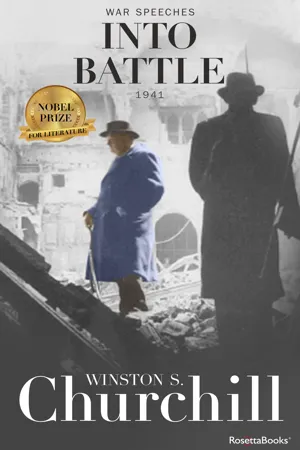
This first volume of collected essays and journalism from the Nobel Prize–winning prime minister includes some of his most important WWII speeches.
Legendary politician and military strategist Winston S. Churchill was a master not only of the battlefield, but of the page and the podium. Over the course of forty books and countless speeches, broadcasts, news items and more, he addressed a country at war and at peace, thrilling with victory but uneasy with its shifting role in global politics. In 1953, he was awarded the Nobel Prize for Literature for "his mastery of historical and biographical description as well as for brilliant oratory in defending exalted human values." During his lifetime, he enthralled readers and brought crowds roaring to their feet; in the years since his death, his skilled writing has inspired generations of eager history buffs.
Churchill was at his best when rallying Britons to the twin causes of war and justice, delivering inspiration and hope during the hard years of bombings, violence, sacrifice, and terror. This compilation, composed of speeches made in the early years of the war, contains some of his best. Profound words from famous speeches in this collection include: "This was their finest hour;" "Never in the field of human conflict was so much owed, by so many, to so few;" and "I have nothing to offer but blood, toil, tears and sweat."
Many decades after the end of the war, Churchill's words still have the power to stir the blood—and inspire the heart. A must-read for all WWII history fans.
- 320 pages
- English
- ePUB (mobile friendly)
- Available on iOS & Android
eBook - ePub
Into Battle
About this book
Information
Subtopic
British HistoryIndex
HistoryTHE FIRST MONTH OF WAR
AN ADDRESS BROADCAST
OCTOBER 1, 1939
OCTOBER 1, 1939
August 10. | Herr Foerster, speaking to Anti-Poland demonstrators at Danzig, says that Poland wants to annexe the whole of East Prussia, and “smash Germany in bloody war.” |
August 13. | Dr. Burckhardt, League of Nations Commissioner of Danzig, is invited by Herr Hitler to a conference at Berchtesgaden. |
August 13. | Mr. Churchill visits the Maginot Line at the invitation of the French General Staff. |
August 22. | Herr von Ribbentrop goes to Moscow to sign a Non-Aggression Pact between Germany and Soviet Russia. |
August 23. | King Leopold broadcasts an appeal for peace. |
August 24. | The Russo-German Pact is signed in Moscow by Herr von Ribbentrop and M. Molotoff. Parliament meets and passes the Emergency Powers Bill in one day. The Pope broadcasts a “paternal message to the world” appealing for peace. President Roosevelt appeals to the King of Italy to assist in maintaining peace. |
August 25. | The Anglo-Polish Treaty of Mutual Assistance is signed in London. President Roosevelt sends two appeals to Herr Hitler. Herr Hitler cancels the Tannenberg celebrations. |
August 27. | Herr Hitler refuses M. Daladier’s plea that there should be one more attempt at direct negotiation between Germany and Poland, and affirms that Danzig and the Corridor must return to the Reich. |
August 28. | Sir Nevile Henderson flies back to Berlin with the British Government’s reply. France closes the German frontier. |
August 29. | Queen Wilhelmina and King Leopold offer to mediate. Germany finally occupies Slovakia. |
August 30. | The British Government replies in uncompromising terms to Herr Hitler’s further note. |
August 31. | Germany broadcasts a 16-point plan for settlement with Poland. The Pope appeals for a truce. |
September 1. | Germany invades Poland without a declaration of War. Herr Foerster announces the return of Danzig to the Reich. Parliament votes an emergency grant of £500,000,000. The British and French Ambassadors are instructed to notify the German Government that unless German troops are immediately withdrawn from Poland, Britain and France will fulfil their treaty obligations. |
September 3. | Britain presents a two-hour ultimatum to Germany, expiring at 11 a.m. At 11.15 Great Britain declares war on Germany. France declares war at 5 p.m. The War Cabinet is appointed, with Mr. Churchill as First Lord of the Admiralty. Mr. Eden returns as Secretary of State for the Dominions. |
September 5. | The German Army cuts the Polish Corridor. |
September 7. | The Polish garrison at Westerplatte, outside Danzig, surrenders after heroic resistance. |
September 9. | The War Cabinet announces that its preparations will be based on the presumption of a three years’ war. Canada declares war. |
September 11. | It is announced that the B.E.F. has arrived in France. |
September 17. | Russia invades Poland. The Polish Army collapses. The Germans issue a 12-hour ultimatum to Warsaw. |
September 18. | H.M.S. Courageous, aircraft-carrier, is torpedoed and sunk. The German and Russian Armies meet at Brest Litovsk. The Polish Government enters Rumania. |
September 21. | General von Fritsch shot on the Polish front. |
September 22. | The partition of Poland announced by Germany and Russia. Warsaw still resists. |
September 27. | Warsaw surrenders. Sir John Simon introduces the first War Budget. |
[October 1, 1939.
The British Empire and the French Republic have been at war with Nazi Germany for a month to-night. We have not yet come at all to the severity of fighting which is to be expected; but three important things have happened.
First, Poland has been again overrun by two of the great Powers which held her in bondage for 150 years, but were unable to quench the spirit of the Polish nation. The heroic defence of Warsaw shows that the soul of Poland is indestructible, and that she will rise again like a rock, which may for a spell be submerged by a tidal wave, but which remains a rock.
What is the second event of this first month? It is, of course, the assertion of the power of Russia. Russia has pursued a cold policy of self-interest. We could have wished that the Russian armies should be standing on their present line as the friends and allies of Poland instead of as invaders. But that the Russian armies should stand on this line, was clearly necessary for the safety of Russia against the Nazi menace. At any rate, the line is there, and an Eastern Front has been created which Nazi Germany does not dare assail. When Herr von Ribbentrop was summoned to Moscow last week, it was to learn the fact, and to accept the fact, that the Nazi designs upon the Baltic States and upon the Ukraine must come to a dead stop.
I cannot forecast to you the action of Russia. It is a riddle wrapped in a mystery inside an enigma: but perhaps there is a key. That key is Russian national interest. It cannot be in accordance with the interest or the safety of Russia that Germany should plant itself upon the shores of the Black Sea, or that it should overrun the Balkan States and subjugate the Slavonic peoples of South-Eastern Europe. That would be contrary to the historic life-interests of Russia.
But in this quarter of the world—the South-East of Europe—these interests of Russia fall into the same channel as the interests of Britain and France. None of these three Powers can afford to see Rumania, Yugoslavia, Bulgaria, and above all Turkey, put under the German heel. Through the fog of confusion and uncertainty we may discern quite plainly the community of interests which exists between England, France and Russia—a community of interests to prevent the Nazis carrying the flames of war into the Balkans and Turkey. Thus, my friends, at some risk of being proved wrong by events, I will proclaim to-night my conviction that the second great fact of the first month of the war is that Hitler, and all that Hitler stands for, have been and are being warned off the East and the South-East of Europe.
What is the third event? Here I speak as First Lord of the Admiralty, with especial caution. It would seem that the U-boat attack upon the life of the British Isles has not so far proved successful. It is true that when they sprang out upon us and we were going about our ordinary business, with two thousand ships in constant movement every day upon the seas, they managed to do some serious damage. But the Royal Navy has immediately attacked the U-boats, and is hunting them night and day—I will not say without mercy, because God forbid we should ever part company with that, but at any rate with zeal and not altogether without relish. And it looks to-night very much as if it is the U-boats who are feeling the weather, and not the Royal Navy or the world-wide commerce of Britain. A week has passed since a British ship, alone or in convoy, has been sunk or even molested by a U-boat on the high seas; and during the first month of the war we have captured by our efficient contraband control 150,000 tons more German merchandise—food, oil, minerals and other commodities—for our own benefit than we have lost by all the U-boat sinkings put together. In fact, up to date—please observe I make no promises (we must deal in performance and not in promises)—up to date we have actually got 150,000 tons of very desirable supplies into this island more than we should have got if war had not been declared, and if no U-boat had ever cast sailormen to their fate upon the stormy seas. This seems to be a very solid, tangible fact which has emerged from the first month of the war against Nazidom.
Of course, we are told that all the U-boats have gone home just to tell their master about their exploits and their experiences. But that is not true, because every day we are attacking them upon the approaches to the British Isles. Some undoubtedly have preferred to go off and sink the unprotected neutral ships of Norway and Sweden. I hope the day will come when the Admiralty will be able to invite the ships of all nations to join the British convoys, and to insure them on their voyages at a reasonable rate. We must, of course, expect that the U-boat attack upon the seaborne commerce of the world will be renewed presently on a greater scale. We hope, however, that by the end of October we shall have three times as many hunting-craft at work as we had at the beginning of the war; and we hope that by the measures we have taken, our means of putting down this pest will grow continually. I can assure you we are taking great care about all that.
Therefore, to sum up the results of the first month, let us say that Poland has been overrun, but will rise again; that Russia has warned Hitler off his Eastern dreams; and that U-boats may be safely left to the care and constant attention of the British Navy.
Now I wish to speak about what is happening in our own island. When a peaceful democracy is suddenly made to fight for its life, there must be a lot of trouble and hardship in the process of turning over from peace to war. I feel very keenly for those thousands—scores of thousands of them—who wish to throw themselves into the fight at once, but for whom we cannot find full scope at the present time. All this will clear as we get into our stride. His Majesty’s Government is unitedly resolved to make the maximum effort of which the British nation is capable, and to persevere, whatever may happen, until decisive victory is gained. Meanwhile, patriotic men and women, especially those who understand the high causes in human fortunes which are now at stake, must not only rise above fear; they must also rise above inconvenience and, perhaps, most difficult of all, above boredom. Parliament will be kept in session, and all grievances or muddles or scandals, if such there be, can be freely ventilated or exposed there. In past times the House of Commons has proved itself an instrument of national will-power capable of waging stern wars. Parliament is the shield and expression of Democracy, and Ministers of the Crown base themselves upon the Parliamentary system. You have seen the power of Parliament manifested in the last week, when a Budget, gigantic in its burdens—a Budget which would have infuriated everybody a year ago—has been accepted with prompt and stolid resolve.
In other fields our work goes forward. A large army has already gone to France. British armies upon the scale of the effort of the Great War are in preparation. The British people are determined to stand in the line with the splendid army of the French Republic, and share with them, as fast and as early as we can, whatever may be coming towards us both. It may be that great ordeals are coming to us in this island from the air. We shall do our best to give a good account of ourselves; and we must always remember that the command of the seas will enable us to bring the immense resources of Canada and the New World into play as a decisive ultimate air factor, a factor beyond the reach of what we have to give and take over here.
Directions have been given by the Government to prepare for a war of at least three years. That does not mean that victory may not be gained in a shorter time. How soon it will be gained depends upon how long Herr Hitler and his group of wicked men, whose hands are stained with blood and soiled with corruption, can keep their grip upon the docile, unhappy German people. It was for Hitler to say when the war would begin; but it is not for him or for his successors to say when it will end. It began when he wanted it, and it will end only when we are convinced that he has had enough.
The Prime Minister has stated our war aims in terms which cannot be bettered, and which cannot be too often repeated. These are his words: “To redeem Europe fr...
Table of contents
- COVER
- TITLE PAGE
- COPYRIGHT
- CONTENTS
- EIRE BILL, House of Commons, May 5, 1938
- THE CHOICE FOR EUROPE, Free Trade Hall, Manchester, May 9, 1938
- THE AIR DEFENCES OF BRITAIN, House of Commons, May 25, 1938
- CIVILISATION, University of Bristol, July 2, 1938
- MANŒUVRES IN GERMANY, Theydon Bois, August 27, 1938
- THE MUNICH AGREEMENT, House of Commons, October 5, 1938
- THE DEFENCE OF FREEDOM AND PEACE, Address to the People of the United States of America, October 16, 1938
- THE CASE FOR A MINISTRY OF SUPPLY, House of Commons, November 17, 1938
- THE FRUITS OF MUNICH, Waltham Abbey, March 14, 1939
- THE STRENGTH OF THE NAVY, House of Commons, March 16, 1939
- THE INVASION OF ALBANIA, House of Commons, April 13, 1939
- THE KING’S DOMINIONS, Canada Club, London, April 20, 1939
- HITLER SPEAKS, Address Broadcast to the People of the United States of America, April 28, 1939
- THE NEW ARMY, Corn Exchange, Cambridge, May 19, 1939
- THREE MONTHS OF TENSION, City Carlton Club, London, June 28, 1939
- THE SUMMER ADJOURNMENT, House of Commons, August 2, 1939
- EUROPE IN SUSPENSE, Address Broadcast to the People of the United States of America, August 8, 1939
- THE FIRST MONTH OF WAR, Address Broadcast October 1, 1939
- THE LOSS OF THE Royal Oak AND THE WAR AT SEA, House of Commons, November 8, 1939
- TEN WEEKS OF WAR, Address Broadcast November 12, 1939
- TRAFFIC AT SEA, House of Commons, December 6, 1939
- THE BATTLE OF THE PLATE, Address Broadcast December 18, 1939
- A HOUSE OF MANY MANSIONS, Address Broadcast January 20, 1940
- A TIME TO DARE AND ENDURE, Free Trade Hall, Manchester, January 27, 1940
- THE NAVY IS HERE, Guildhall, London, at a lunch given to officers and men of the Exeter and Ajax, February 23, 1940
- THE NAVY ESTIMATES, House of Commons, February 27, 1940
- A STERNER WAR, Address Broadcast March 30, 1940
- NORWAY, House of Commons, April 11, 1940
- THE WITHDRAWAL FROM NORWAY, House of Commons, May 8, 1940
- PRIME MINISTER, House of Commons, May 13, 1940
- “BE YE MEN OF VALOUR,” Address Broadcast May 19, 1940
- THE CAPITULATION OF KING LEOPOLD, House of Commons, May 28, 1940
- DUNKIRK, House of Commons, June 4, 1940
- A MESSAGE TO THE PEOPLE, Broadcast June 17, 1940
- THEIR FINEST HOUR, House of Commons and Broadcast, June 18, 1940
- THE FALL OF FRANCE, House of Commons, June 25, 1940
- THE TRAGEDY OF THE FRENCH FLEET, House of Commons, July 4, 1940
- THE WAR OF THE UNKNOWN WARRIORS, Address Broadcast July 14, 1940
- THE WAR SITUATION, House of Commons, August 20, 1940
- THE WAR SITUATION, House of Commons, September 5, 1940
- EVERY MAN TO HIS POST, Address Broadcast September 11, 1940
- THE WAR SITUATION, House of Commons, September 17, 1940
- THE WAR SITUATION, House of Commons, October 8, 1940
- LEADERSHIP OF THE PARTY, Caxton Hall, London, October 9, 1940
- TO THE FRENCH PEOPLE, Address Broadcast to France in French and English, October 21, 1940
- THE WAR SITUATION, House of Commons, November 5, 1940
- “WE WILL NEVER CEASE TO STRIKE,” Mansion House, London, November 9, 1940
Trusted by 375,005 students
Access to over 1.5 million titles for a fair monthly price.
Study more efficiently using our study tools.
Frequently asked questions
Yes, you can cancel anytime from the Subscription tab in your account settings on the Perlego website. Your subscription will stay active until the end of your current billing period. Learn how to cancel your subscription
No, books cannot be downloaded as external files, such as PDFs, for use outside of Perlego. However, you can download books within the Perlego app for offline reading on mobile or tablet. Learn how to download books offline
We are an online textbook subscription service, where you can get access to an entire online library for less than the price of a single book per month. With over 1.5 million books across 990+ topics, we’ve got you covered! Learn about our mission
Look out for the read-aloud symbol on your next book to see if you can listen to it. The read-aloud tool reads text aloud for you, highlighting the text as it is being read. You can pause it, speed it up and slow it down. Learn more about Read Aloud
Yes! You can use the Perlego app on both iOS and Android devices to read anytime, anywhere — even offline. Perfect for commutes or when you’re on the go.
Please note we cannot support devices running on iOS 13 and Android 7 or earlier. Learn more about using the app
Please note we cannot support devices running on iOS 13 and Android 7 or earlier. Learn more about using the app
Yes, you can access Into Battle by Winston S. Churchill in PDF and/or ePUB format, as well as other popular books in History & British History. We have over 1.5 million books available in our catalogue for you to explore.