A vivid portrait of the final years of the civil war between the Chinese Nationalists and Communists, including many previously unpublished photos.
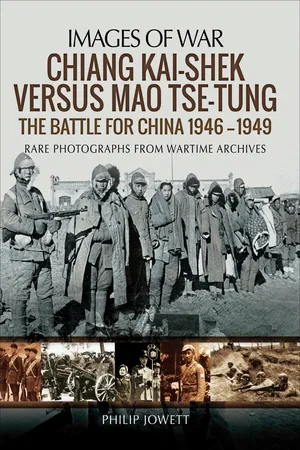
This volume in the Images of War series is the first photographic history of the Chinese Civil War, fought between Chiang Kai-shek's Nationalists and the Communists of Mao Tse-tung, which decided the future of modern China.
A selection of over two hundred archive photographs, many of which have not been published before, depict the battle for power that took place across the breadth of the country. The armies, air forces, and navies of the opposing sides are shown in a sequence of graphic images, as is the ordeal of the long-suffering Chinese civilians who were caught up in a conflict that cost millions of lives. Detailed accompanying text describes the make-up of the Nationalist and Communist forces, and their contrasting strategies, tactics, and leadership.
This is a visceral and concise introduction to a pivotal conflict that has left an indelible mark on the China of today—and on the rest of the world.
- 192 pages
- English
- ePUB (mobile friendly)
- Available on iOS & Android
eBook - ePub
About this book
Information
Chapter One
Unreal Peace, 1945–6
At the end of the war in China in August 1945 the two sides in the Civil War which had raged since 1927 were ready to renew hostilities. That same month Mao Tse-tung made a report to his party’s 7th Party Congress in which he emphasised the strong position of the Communists at the time. He told them that there were at least 95,500,000 people living in Communist controlled areas. In regard to the army of the Communists, he said that there were 910,000 men in the regular Red Army with an additional 2,200,000 militia. Although many of the militia were unarmed, they were able to support the regulars and be converted to regulars when arms were available. On the political front Mao said that the Communist Party had 1,100,000 members who would support the Red Army. This report was like a rallying cry to all Communists in China that battle would soon be joined with the Nationalists. However, this optimistic declaration by Mao disguised some of the weaknesses of the Communist armies at the start of the war. For instance, they were particularly short of heavy weaponry in the early days of the fighting. They had been handed large numbers of guns by the defeated Japanese in August 1945 but it was reported that they only had twenty-four batteries of artillery in the regular army.
On the Nationalist side Chiang Kai-shek was confident in August 1945 that his army would soon defeat the ‘disorganised’ Communists. Although, for economic reasons, he had been forced to cut the Nationalist Army from 3 million to 2.6 million, he thought that it was still large enough to defeat the Communists. Not without reason, Chiang Kai-shek believed that the USA would supply him with all the necessary weaponry to destroy his political enemies. Chiang was, however, a realist and knew that the Nationalist Army had many problems which affected its performance. In an often quoted statement Chiang said that the Nationalist Army officers ‘had a lack of professional skills’ and that they were ‘guilty of neglect and ill treatment of their men’. He bemoaned the high level of endemic corruption in the higher ranks and the lack of co-operation with other unit commanders in battle. Despite these weaknesses, the Nationalist Army in late 1945 had what appeared to be an overwhelming superiority. It was built around a thirty-nine-division-strong core of US-trained troops with several first-class formations such as the 1st and 6th New Armies. In total the army had a strength of 324 divisions and 60 or so brigades along with 89 guerrilla units of about 2,000 men each. In addition, there would soon be 1.5 million paramilitary Peace Preservation Corps recruited.
As Chiang tried to take advantage of this perceived superiority he decided, along with his US advisors, to move into Manchuria. With the assistance of the US Navy and Air Force the Nationalists had moved over 500,000 Nationalist troops into Northern China and Manchuria by October 1945. Although most were transported by ship, a large-scale air lift also moved significant numbers of troops. At the same time, 53,000 US Marines took control of the cities of Peking and Tientsin in Northern China and large parts of the province of Shantung. In the disorder in Manchuria the Communists had moved into areas previously occupied by the Japanese. To add to the confusion some towns were captured by forces described as ‘free-lance’ troops. These units were made up of men who it was reported had not made up their mind if they were pro-Chiang or pro-Mao.
Although officially the USA backed Chiang and his Nationalist Army, many in US government circles favoured a peaceful settlement in China. Ambassador Patrick Hurley persuaded Chiang Kai-shek to invite Mao to Chungking for talks in August. With assurances from Hurley, Mao agreed to attend the talks, which began on 28 August 1945. As the talks were underway Mao’s military commander, Lin Piao, was leading a large army of 130,000 Communists into Manchuria from their wartime bases in Jehol and northern Hopeh province. When Chiang found out about the Communists’ move the talks broke down and the Nationalists transferred additional troops into Manchuria. Meanwhile, Lin Piao’s forces were consolidating themselves in Western Manchuria in preparation for the battle for control of the region.
The breakdown of talks led to the resignation of Hurley, who was replaced as the peacemaker by US General Marshall. Marshall tried to arrange new talks but these would have to wait until the New Year as fighting intensified in many areas of China. By early December 1945 although officially there had been a peace of sorts in China, up to 80,000 Communists and Nationalists had been killed in clashes. According to statistics published at the time, 144 Nationalist divisions with a total of 1,200,000 troops were moving against their Communist enemies.
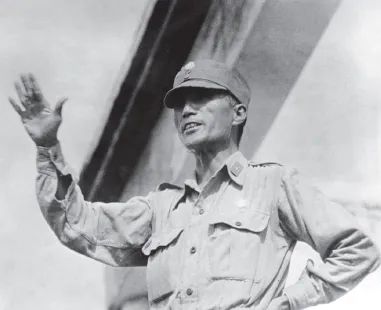
General Cheng Tung-kuo, the commander of the New 4th Army in Burma from 1943 until 1944. He was then given the title of Deputy Commander of the Chinese Army in Burma from 1944. During the coming Civil War he was to command the 1st Army in Manchuria made up of six elite divisions. He is seen here addressing some of his troops at a parade at Nanning on 17 August 1945. (US National Archives)
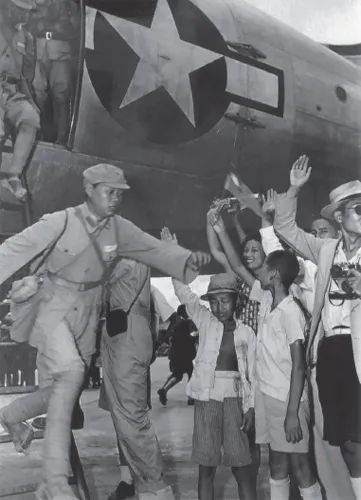
Chinese Nationalist soldiers disembark from a US transport plane in Northern China as large numbers of government troops are moved into the region in the autumn of 1945. They effectively flew ‘over the heads’ of Communist troops who controlled much of Northern China. When troops arrived in Peking they faced no opposition from the Communists who had retired into the countryside. In many cases they took over directly from Japanese troops, who had remained in control of their garrisons to keep the Communists out. Although these soldiers are being welcomed by the locals, there were many other civilians who did not see these ‘Southern’ troops as liberators. Some saw these ‘alien’ troops as just another occupying force and simply wanted to be left alone by the Chinese government. (Philip Jowett)
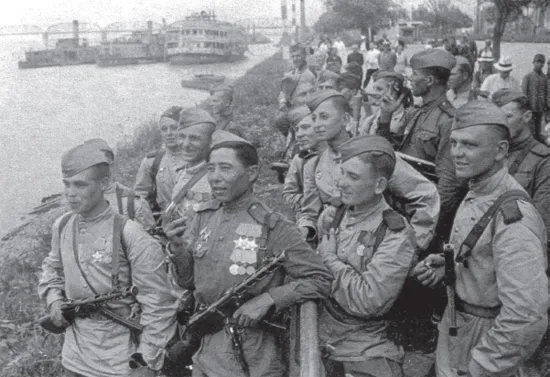
Soviet troops of the Far Eastern Army which conquered the puppet state of Manchuria are seen in Harbin on the banks of the Songhua River. The Soviet invasion of Manchuria in August 1945 led to a long occupation of the region by the Red Army. Although the Nationalist Chinese government officially protested about the occupation of Manchuria by the Soviets, in some ways it suited Chiang Kai-shek. By May 1946 the Soviet Army had totally withdrawn from Manchuria but not before taking much of the moveable infrastructure with it. (Philip Jowett)
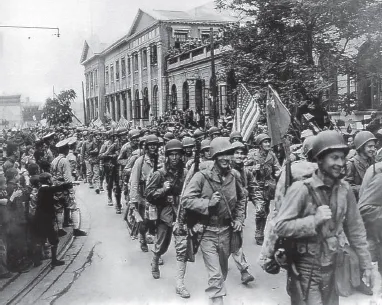
US Marines march through the streets of a South Manchurian city as they assist the Nationalists in taking control of parts of the region. They are greeted by happy Chinese civilians who were just relieved to be liberated from the hard Japanese occupation. The presence of US troops and Marines in China gave the Chinese false hope that they would bring stability to the country. In reality, the vast majority of the US troops would soon return home leaving the Communists and Nationalists to battle for control of China. (Philip Jowett)
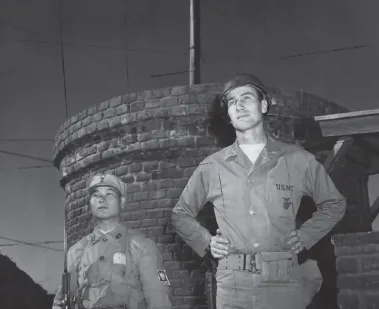
A US Marine who is part of the force sent to support the Nationalist return to occupied territory poses outside a base with a Chinese soldier. The US Marine force, which reached a total of 50,000 men, was sent to assist in the smooth takeover of cities in Northern China and Manchuria. By 1946 this force had been reduced to about 25,000 before the majority left China in 1947. (Philip Jowett)
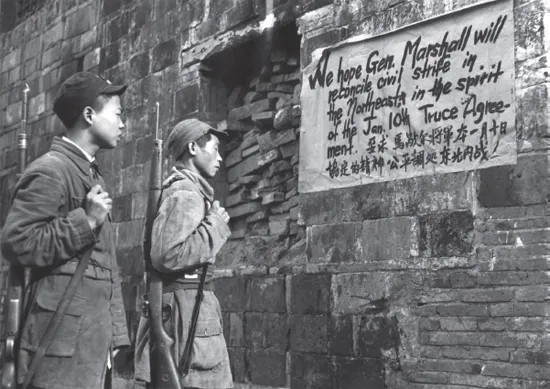
Two Communist fighters read a poster pasted to a wall in a Manchurian town held by the Red Army. The poster claims that the Communists support the attempts by General Marshall to broker a peace deal between them and the Nationalists. It says that the Communists will honour the 10 January 1946 truce, although the truth was that neither side was prepared to make peace. Fighting broke out in various parts of China in April 1946 and was followed by a temporary ceasefire in June. (Philip Jowett)
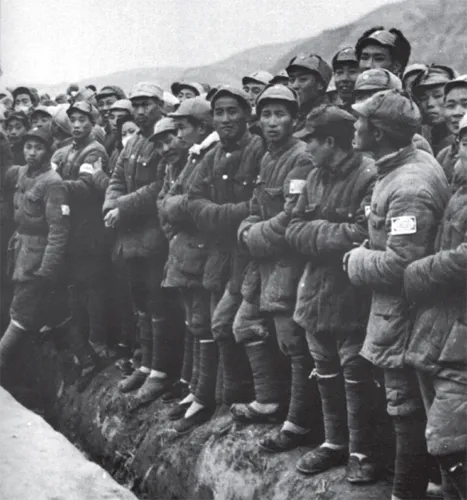
Communist troops wait at an airfield for the arrival of US General C. Marshall who had been tasked with the onerous job of brokering a peace between them and the Nationalists. Marshall was the former Commander-in-Chief of the US Forces in the Far East in the Second World War. It was thought that Marshall’s reputation would give him the authority to deal with the slippery characters, Mao and Chiang. Neither leader was really sincere about making peace and the astute General Marshall soon came to this conclusion after discussions with both factions. (Philip Jowett)
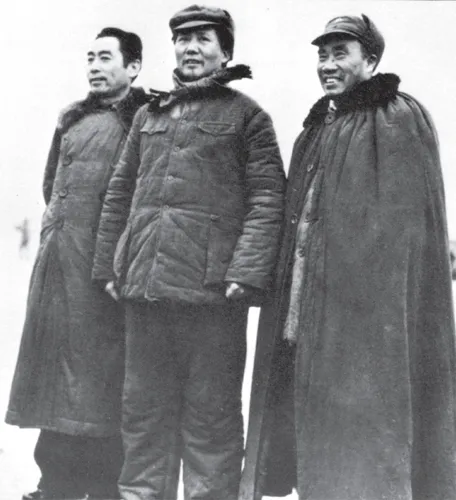
The three main leaders of the Chinese Communists, Chou En-lai, Mao Tse-tung and Chu Teh, wait at an airport for the arrival of General Marshall on 23 December 1945. Mao was the political leader of the Communists while Chou En-lai served as his deputy and as a military commander. Chu Teh had been a Red Army commander since the late 1920s and during the Civil War he maintained his long-time role as supreme commander of the army. (Philip Jowett)
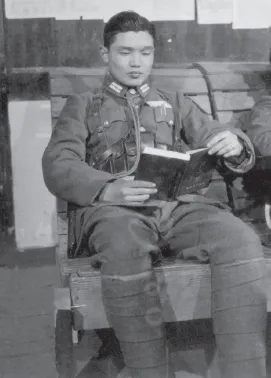
A Nationalist government Military Policeman relaxes with a book after patrolling a recently ‘liberated’ Northern Chinese city. The Nationalist Army and police had a difficult task in keeping law and order in cities and towns which had been occupied by the Japanese for up to eight years. In Northern China and Manchuria they were often faced by underground Communist forces who constantly challenged their authority. (US National Archives)
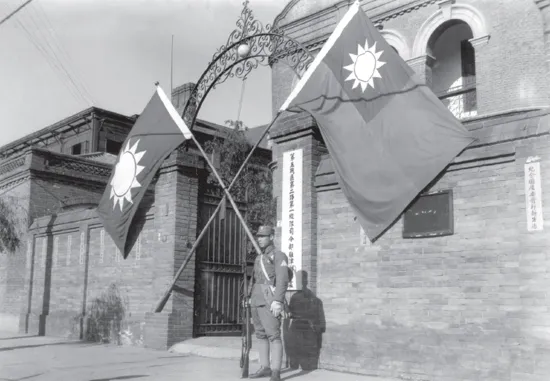
In the autumn of 1945 a Nationalist soldier guards a government building which flies the flags of China and the Kuomintang Party. Soldiers like this man often took over the control of Chinese cities from their enemies the Japanese Imperial Army. The Japanese had been allowed or even asked by the Nationalists to help them hold cities until they could get troops to relieve them. Even though the Nationalists and Japanese had been bitter rivals, the anti-Communist sympathies of the Imperial Army meant they would rather hand over power to Chiang Kai-shek than Mao. (Philip Jowett)
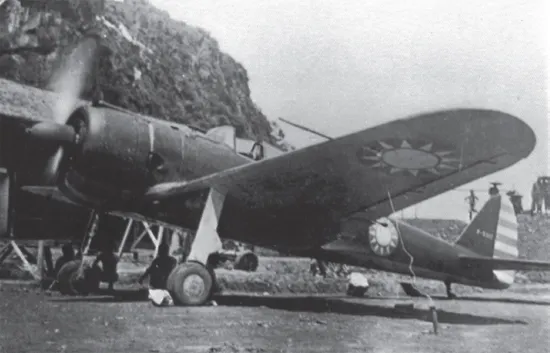
A Nakajima KI-84 ex-Japanese fighter has its engine fired up before going on a flight after its recent capture by the Nationalists. This was one of the most modern types in service with the Japanese and a few were used by the Nationalist Air Force in the early stages of the Civil War. It is probable that a few Japanese mercenary pilots were employed by the Nationalists during the Civil War. In March 1946 it was reported that a number of Japanese had also joined the Nationalist Army in various roles. (Philip Jowett)
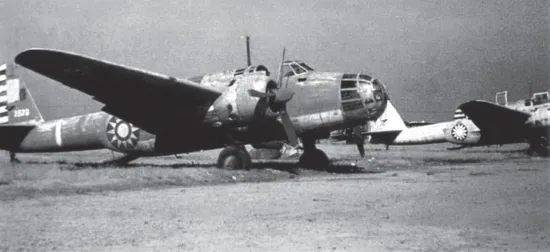
Two Kawasaki KI-48 bombers formerly in service with the Japanese Imperial Air Force are lined up at a Nationalist airfield at the start of the Civil War. The number of Japanese aircraft serving with the Nationalist Air Force was small but they were the main source of planes in 1945. It is not certain if Japanese air crew flew these planes but it would make sense when their compatriots often crewed ex-Imperial Army tanks. (Philip Jowett)
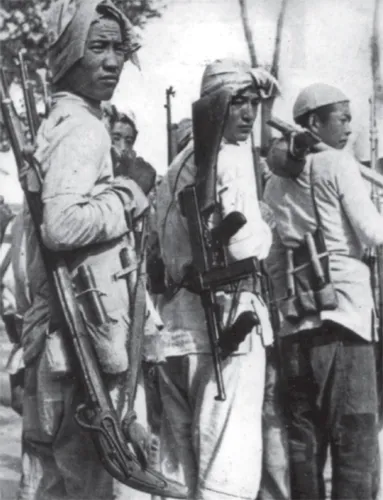
These militiamen photographed in 1945 were the backbone of the Communist forces in the e...
Table of contents
- Cover
- Title
- Copyright
- Contents
- Acknowledgements
- Introduction
- Chapter One: Unreal Peace, 1945–6
- Chapter Two: The Fighting Begins, 1946
- Chapter Three: Nationalist Accendancy, 1947
- Chapter Four: The Cockpit of Asia, Manchuria, 1947
- Chapter Five: The Nationalists Lose Manchuria, 1948
- Chapter Six: Nationalist Decline, January–October 1948
- Chapter Seven: The Huai-Hai Campaign, November 1948–January 1949
- Chapter Eight: Nationalists in Despair, December 1948–April 1949
- Chapter Nine: Fall Of The North – Nationalist Defeat in Northern China, 1948–9
- Chapter Ten: The Fall of Shanghai, 25 May 1949
- Chapter Eleven: The Long Retreat – Nationalist Defeats, 1949
- Chapter Twelve: Communist Victory – The Fall of the South, 1949
- Chapter Thirteen: The Aftermath, 1950–4
Trusted by 375,005 students
Access to over 1.5 million titles for a fair monthly price.
Study more efficiently using our study tools.
Frequently asked questions
Yes, you can cancel anytime from the Subscription tab in your account settings on the Perlego website. Your subscription will stay active until the end of your current billing period. Learn how to cancel your subscription
No, books cannot be downloaded as external files, such as PDFs, for use outside of Perlego. However, you can download books within the Perlego app for offline reading on mobile or tablet. Learn how to download books offline
Perlego offers two plans: Essential and Complete
- Essential is ideal for learners and professionals who enjoy exploring a wide range of subjects. Access the Essential Library with 800,000+ trusted titles and best-sellers across business, personal growth, and the humanities. Includes unlimited reading time and Standard Read Aloud voice.
- Complete: Perfect for advanced learners and researchers needing full, unrestricted access. Unlock 1.5M+ books across hundreds of subjects, including academic and specialized titles. The Complete Plan also includes advanced features like Premium Read Aloud and Research Assistant.
We are an online textbook subscription service, where you can get access to an entire online library for less than the price of a single book per month. With over 1.5 million books across 990+ topics, we’ve got you covered! Learn about our mission
Look out for the read-aloud symbol on your next book to see if you can listen to it. The read-aloud tool reads text aloud for you, highlighting the text as it is being read. You can pause it, speed it up and slow it down. Learn more about Read Aloud
Yes! You can use the Perlego app on both iOS and Android devices to read anytime, anywhere — even offline. Perfect for commutes or when you’re on the go.
Please note we cannot support devices running on iOS 13 and Android 7 or earlier. Learn more about using the app
Please note we cannot support devices running on iOS 13 and Android 7 or earlier. Learn more about using the app
Yes, you can access Chiang Kai-shek Versus Mao Tse-tung by Philip Jowett in PDF and/or ePUB format, as well as other popular books in History & Asian History. We have over 1.5 million books available in our catalogue for you to explore.