This royal historian's "lively study of the four Georges who sat on the English throne for over a century is a joy" (Jane Austen's Regency World).
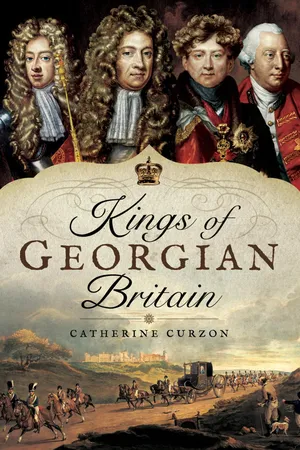
For over one hundred years of turmoil, upheaval, and scandal, Great Britain was a Georgian land. From the day the German-speaking George I stepped off the boat from Hanover to the night that George IV, bloated and diseased, breathed his last at Windsor, the four kings had presided over a changing nation.
Kings of Georgian Britain offers a fresh perspective on the lives of the four Georges and the events that shaped their characters and reigns. From love affairs to family feuds, political wrangling, and beyond, it is a chance to peer behind the pomp and follow these iconic figures from cradle to grave. After all, being a king isn't always about grand parties and jaw-dropping jewels, and sometimes following in a father's footsteps can be the hardest job around.
Take a step back in time and meet the wives, mistresses, friends, and foes of these remarkable kings who shaped the nation, and find out what really went on behind closed palace doors. Whether dodging assassins, marrying for money, digging up their ancestors, or sparking domestic disputes that echoed down the generations, the kings of Georgian Britain were never short on drama.
"[A] chronological series of amusing anecdotes. [Curzon is] often whimsical, has a good sense of pace and you can imagine her stifling a smirk while writing this unusual biography." —History of Royals
- 232 pages
- English
- ePUB (mobile friendly)
- Available on iOS & Android
eBook - ePub
Kings of Georgian Britain
About this book
Information
Topic
HistoireSubtopic
Biographies historiquesAct Four
George IV, King of the United Kingdom and Ireland
(London, England, 12 August 1762 – Windsor, England, 26 June 1830)
Ah, Prinny.
The first gentleman of England.
Prince of Wales, Prince Regent and King of the United Kingdom of Great Britain and Ireland, George IV was the punchline to a thousand jokes, the target of a hundred merciless cartoonist’s nibs, the price one paid for indulgence.
A man of taste in some things whilst in others he was hideously crass, his personal life is the stuff of tabloid legend with profligacy and widely scattered affections that knew no bounds. George’s considerable influence stretched to fashion, art and architecture and can still be felt today.
Still, whatever one may think of him, his eventful life was never short on entertainment.
The Son and Heir
‘We […] humbly beg Leave to present to your Majesty our sincerest Congratulations on the safe Delivery of the Queen, and Birth of his Royal Highness the Prince, and on the prosperous State of her Majesty’s Health since this happy Event.’1
The man who would one day reign as George IV started life as he meant to go on, as a right royal pain to his parents. His mother, Charlotte of Mecklenburg-Strelitz, underwent a difficult and prolonged labour, suffering through the delivery attended by the Dowager Princess of Wales, the Archbishop of Canterbury and her midwife, Mrs Draper. In the neighbouring room, members of the court waited with bated breath to hear the cries of a healthy and, they hoped, male newborn. The prince’s birth was announced to the people by the firing of the Tower cannon whilst the Earl of Huntingdon hastened to see the king and let him know that he was father to a healthy, robust baby girl. Or perhaps not.
It was an inauspicious start to the life of the boy who would become a notorious libertine. Rather ironically, given the love of spending he would later discover, right from the first second the baby cost his father money. George III had promised to pay the messenger who delivered news of the birth £500 should the newborn be a girl and double that amount if he brought word of a son. The king received Huntingdon with delight and, hearing that he was father to a healthy girl, paid the earl his £500 and set off to see the queen.
Whether Huntingdon ever received the additional £500 once George discovered that the child was a boy isn’t recorded. Eventually the confusion was ironed out and the court rejoiced in the birth of this child who had been born to a sure destiny: to one day rule as king.
Just as his life would be spent in the crucible of public opinion, within weeks of his debut, the newborn George Augustus, Prince of Wales, was baptized by the Archbishop of Canterbury and placed on public display in St James’s Palace. It was the perfect start for a prince who would grow to love drama and the thrill of the limelight and for little George Augustus, no expense was spared.
‘The ladies who went to see the young prince were admitted into the room, about forty at a time. The cradle in which the royal infant lay was placed on a small elevation, under a canopy of state. The head and the sides, which came no higher than the bed, were covered with crimson velvet, and lined with white satin. From the head rose an ornament of carved work, gilt, with a coronet in the middle. The upper sheet was covered with a very broad, beautiful Brussels lace, turning over at the top, upon a magnificent quilt of crimson velvet, and gold lace; the whole breadth of the Brussels lace appearing also along the sides, and hanging down from underneath. Near the cradle sat the nurse, with a small velvet cushion lying on her knee, for the babe to rest on; and on each side stood a fair mute, employed as occasion required, to rock the infant to sleep.’2
Charlotte, it seems, was particularly struck by the beauty of her son and sought some way to keep him like that forever, a newborn babe bedecked in velvet. Of course, being the queen can open all sorts of doors and she really went to town …
‘[…] her Majesty had a whole length portrait of his Royal Highness modelled in wax. He was represented naked. The figure was half a span long, lying upon a crimson cushion, and it was covered by a bellglass.’3
It sounds like a rather frightful bit of decoration but Charlotte treasured the model all her life, no doubt finding the memory of her perfect little boy rather comforting when the real thing began to grow, drink and wench! For now though, booze, women and gambling were a few years into the future and the young prince was instead living it up in the nursery. He revelled in public appearances in his early childhood and soon proved himself to be bright, intelligent and quick to learn. Indeed, one might conclude that the precocious George Augustus grew up too quickly in some ways whilst in others he never really grew up at all.
George Augustus was the son of George III, a pious man who enjoyed the simple things in life. Having watched his brothers live high on the hog, the king was determined that his own children, who would eventually number fifteen, would not fall prey to all the temptations the world would throw in their path. He did all he could to shield them from the vices of eighteenth century society, though as the years passed, it became increasingly apparent that his sons had no interest in being shielded from anything.
This loving yet protective father accordingly placed the young Prince of Wales in the care of Lady Charlotte Finch,4 the governess of the royal house, and under her influence, George Augustus was soon showing a precocious and fierce intelligence. Though his temper might benefit from being somewhat cooler, George Augustus shared the king’s passion for music and drama, art and architecture.
The education of the prince was placed in the hands of the experienced courtier, Lord Holdernesse, and a team of suitably learned and pious gentlemen of good breeding. Intensively schooled and disciplined vigorously should he commit a wrong, George and his younger brother, Frederick, Duke of York, spent long hours at their lessons, on pain of harsh punishment should they dare to step out of line. Most important of all was that, to borrow Charlotte Brontë’s words, the boys were made useful and kept humble. Every minute of the day was occupied with education and selfimprovement and there was an emphasis on Christian piety, with George III lamenting the sorry example of his own brothers.
Charlotte added her own voice to the call for piety and, when her son was just eight-years-old, she advised that his duty must not be underestimated. In instructions that must have been bewildering for one so young, whose concept of everything was still being formed, she told George Augustus:
‘I recommend unto you the highest love, affection and duty towards the King. Look upon him as a friend, nay, as the greatest, the best, and the most deserving of all friends you can possibly find. Try to imitate his virtues, and look upon everything that is in opposition to that duty as destructive to yourself.’5
The boys, of course, wanted only to indulge in childish pursuits, to play and prank and be children; not for them was the strict schedule imposed by the king and his representatives. In short, they became rather a handful, as the prince’s early biographers noted:
‘The two brothers had passed the joyous days of boyhood together; in their sports they had been inseparable, and in all their mischievous pranks, which drew down upon them, they mutually screened each other; and in those cases where the culprit could not be exactly discovered, each of them was willing to bear the reproach, rather than declare the real offender.’6
Refreshment and mealtimes were strictly governed and, in keeping with the king’s dislike of largesse, the menu was far from lavish. In adulthood, of course, mealtimes for George Augustus would be all about excess and it is tempting to speculate whether George III’s focus on piety and denial, on not revelling in the pleasures of the flesh, is exactly what pushed his eldest son to do just that.
When ill health forced Holdernesse to go abroad in 1775, he returned to find that his regime had collapsed, his authority supplanted by the prince’s new tutors. Worst of all, without the steadying influence of Holdernesse, the always quick temper of George Augustus had grown far worse. Childhood pranks with his beloved brother had blossomed into a desire to escape his restrictive home and to be allowed into society or even better, to go to war. On the first, some quarter was given and he was finally allowed to attend a ball but on the second there was to be no change in parental policy: the Prince of Wales would never go into battle.
The newspapers that would later ridicule and taunt the prince were not always so hostile. In fact, in George’s youth, the gentlemen of the press championed him, raising their voices in support of his plea. Give the young man his wish, they cried, to which the king responded with a resounding no!
‘The Prince of Wales, with a spirit of gallantry that does him great honour, has made three requests relative to a change in that domestic system which has hitherto environed him; time will shew whether the junto have laid their foundations upon a rock, or upon the sand.’7
Whilst the prince’s tutors and family friends were pleased at the young man’s academic abilities, the God-fearing king suspected that his eldest son was not nearly as interested in his religious studies as he should be. Indeed, as the years passed and he grew into a young man, it became apparent that the almighty really had little place in George’s most passionate pursuits.
The prince’s pleasures were not few and they were not cheap. He loved gambling and finery, burning through his allowance as though there were no tomorrow with more than half his income spent on his stables alone. For all his profligacy though, there was one pastime that outpaced all others, one thing that he could not live without and it was to be the source of gossip, scandal and heartbreak for both the gentleman and his family – women. Combine that with an absolute dedication to getting his own way, and there can only be a recipe for disaster.
An Eye for the Ladies
By the time he was in his late teens, the charming, cultured, intelligent and rather pretty young Prince of Wales had developed an abiding love for the fairer sex. The object of his heated teenage affections was diarist Mary Hamilton, great-granddaughter to the Duke of Hamilton and seven years the senior of the 16-year-old prince. She also happened to be the governess to his sisters.
‘Impetuosity, ardour, no word is too strong for my present sentiments. I see Beauty, Person, accomplishments, every thing in Short in you, that could make me happy.’8
George pursued Mary tirelessly and passionately, his letters fiery and just as melodramatic as on...
Table of contents
- Cover
- Title
- Copyright
- Contents
- Acknowledgements
- List of Illustrations
- Introduction
- Act One: George I
- Act Two: George II
- Act Three: George III
- Act Four: George IV
- Afterword
- Bibliography
- Plate section
Trusted by 375,005 students
Access to over 1.5 million titles for a fair monthly price.
Study more efficiently using our study tools.
Frequently asked questions
Yes, you can cancel anytime from the Subscription tab in your account settings on the Perlego website. Your subscription will stay active until the end of your current billing period. Learn how to cancel your subscription
No, books cannot be downloaded as external files, such as PDFs, for use outside of Perlego. However, you can download books within the Perlego app for offline reading on mobile or tablet. Learn how to download books offline
We are an online textbook subscription service, where you can get access to an entire online library for less than the price of a single book per month. With over 1.5 million books across 990+ topics, we’ve got you covered! Learn about our mission
Look out for the read-aloud symbol on your next book to see if you can listen to it. The read-aloud tool reads text aloud for you, highlighting the text as it is being read. You can pause it, speed it up and slow it down. Learn more about Read Aloud
Yes! You can use the Perlego app on both iOS and Android devices to read anytime, anywhere — even offline. Perfect for commutes or when you’re on the go.
Please note we cannot support devices running on iOS 13 and Android 7 or earlier. Learn more about using the app
Please note we cannot support devices running on iOS 13 and Android 7 or earlier. Learn more about using the app
Yes, you can access Kings of Georgian Britain by Catherine Curzon in PDF and/or ePUB format, as well as other popular books in Histoire & Biographies historiques. We have over 1.5 million books available in our catalogue for you to explore.