An Emmy Award–winning author reveals the complete testimony of the most infamous war crimes trials in human history following WWII—includes photographs.
After the defeat of Nazi Germany, the Nuremberg Trials were conducted by the four victorious Allied forces of Great Britain, the United States, France, and the Soviet Union. They were held in the Palace of Justice, Nuremberg, Germany, from November 1945 to October 1946. Famous for prosecuting the major German war criminals, they also tried the various groups and organizations that were at the heart of Nazi Germany.
Part of the illustrated series The Third Reich from Original Sources,
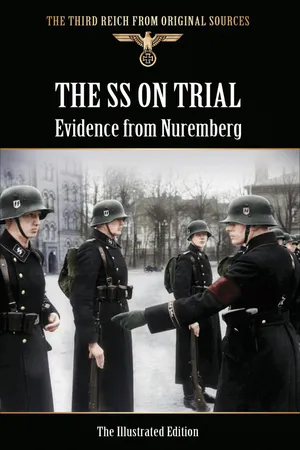
The SS on Trial presents the complete testimony from the hearings, including the original indictment, the criminal case put forward for the SS, the closing speeches by the prosecution and defense, and the final judgment. Former SS members often wondered why they were charged as war criminals when they merely performed their "normal" duty. The Military Tribunal at Nuremberg attempted to answer that question.
The witnesses called include Friedrich Karl von Eberstein, an early member of the Nazi Party, the SA, and the SS; Paul Hausser, one of the most eminent leaders of the Waffen-SS who vehemently defended their military role in the war; Georg Konrad Morgen, a former SS judge; and Wolfram Sievers, the Reich manager of the Ahnenerbe.
Featuring forty photographs and charts, this indispensable volume explores how the actions of Nazi soldiers challenged humanity's notions of criminality and global justice.
- 432 pages
- English
- ePUB (mobile friendly)
- Available on iOS & Android
eBook - ePub
About this book
Information
The Case for the SS
SATURDAY, 3RD AUGUST, 1946
THE PRESIDENT: I call on Dr. Pelckmann, counsel for the SS.
Now you may call your witnesses.
DR. PELCKMANN: I call the witness Freiherr von Eberstein.
(FRIEDRICH KARL VON EBERSTEIN, a witness, took the stand and testified as follows):
BY THE PRESIDENT:
Q. Will you state your full name?
A. Friedrich Karl Freiherr von Eberstein.
Q. Will you repeat this oath after me:
I swear by God, the Almighty and Omniscient, that I will speak the pure truth and will withhold and add nothing.
(The witness repeated the oath.)
THE PRESIDENT: You may sit down. Proceed.
DR. PELCKMANN: I will be very grateful to your Lordship if the interpretation could be organized in such a way that technical terms and the definitions of service offices and personnel could be rendered, as much as possible, in the original text, the German text, because mistakes could frequently arise in the interpretation. In the SS organization there are so many special definitions which it is difficult to keep apart in an interpretation.
THE PRESIDENT: Well, the Tribunal thinks that it would be convenient to them if both the German denomination and the English were given - if both were given.
DIRECT EXAMINATION BY DR. PELCKMANN:
Q. Witness, were you before and after 1933 a member of the general SS?
A. Yes.
Q. Had you already entered the so-called general SS in 1928?
A. Yes.
Q. Witness, I should like to ask you to pause after each question, just as I am going to try to pause after each answer. In 1928, did the SS have a commander of its own, or was it under the commander of the SA?
A. In 1928 the SS was under the Supreme SA Leadership. The Chief of Staff at that time was a Captain von Pfeffer. Himmler was not yet Reich Leader of the SS. The SS was led by a certain Heid under the Chief of Staff.
Q. In spite of this did the SS already form a special organization?
A. Yes, it was included with the SA under the Supreme SA Leadership.
Q. Did you belong to the general SS only in an honorary capacity, that is to say, in addition to your own profession, or were you a regular member?
A. I belonged to the SS outside my regular profession. I had been a civil servant since 1934.
Q. Well, did you have any salary as an SS leader?
A. No, I had no salary. I lived on my own fortune, and later I received the salary and in addition was reimbursed for my travelling expenses and got an additional expense allowance of 150 marks a month.
Q. If I understood you correctly, you received your salary as a civil servant?
A. As a civil servant, yes, indeed.
Q. And only a certain allowance extra for the expenses you had in the SS service?
A. Yes.
Q. What were the reasons for your joining the SS?
A. At the time, in 1928-1929, I was asked to join the SS because I had already been in the Party for some years, and they considered my services valuable because I had been an officer. I joined the SS very willingly.
Q. Were you in the World War?
A. Yes, I took part in the World War as an officer.
Q. What rank did you hold in the SS in 1930
A. In 1930 I was Sturmfuehrer and Standarten-Adjutant.
Q. What rank did you hold in 1933?
A. In 1933 I was SS Gruppenfuehrer.
Q. Through your activities, did you acquire a good insight into the aims and activities of the SS before and after 1933?
A. Yes.
Q. You are a member of the German nobility, witness?
A. Yes.
Q. Even in democratic countries, it is generally assumed that the nobility belongs to the respectable classes of the population. How does it happen that you became a member of an organization which, according to the allegation of the prosecution, is considered to have been criminal?
A. I was at all times active on behalf of Germany, in keeping with the tradition of my family; and so when I became a member of the Party and of the SS, I felt that I was fulfilling a patriotic duty. Moreover, before 1933 a great number of aristocrats and members of German princely houses joined the SS, such as, for example, the Prince von Waldeck the Prince von Mecklenburg, etc.
Q. After 1933, was this movement even stronger?
A. Yes, after 1933 the Prince of Hohenzollern-Sigmaringen became a member, as well as the Archbishop of Brunswick, Prince Lippe-Biesterfeld, General Graf von Schulenburg and many others.
Q. Do you know that Archbishop Groeber of Freiburg became a sponsoring member of the SS?
A. Yes, I know that.
DR. PELCKMANN: I refer the Tribunal to Document 5, which I shall hand in later.
Q. Do you believe on the basis of your experience at that time that the membership of such prominent personages made an impression on members of all classes in Germany?
A. On the bourgeois classes of our population, most certainly.
Q. I mean, made an impression in the sense that people said, “If such good human material belongs to the SS and works for its aims, then the aims governing the organization must be really good and legal.” Do you mean that in this sense?
A. Yes. In any case I am of the opinion, and it was also the opinion of my comrades, that at no particular time could we assume that the organization was following criminal aims.
Q. But did not the SS commit many acts of violence just before 1933, and were not these among its aims?
A. No. As its very name says, “Protection Detachment” (“Schutzstaffel”), this branch of the Party was set up in order to protect the leading personalities. Moreover, I might point out that as early as 1930 Hitler, in the trial of the Reichswehr officers, swore that his revolution would be an intellectual one, and he planned to win supreme power in Germany by legal means. And, indeed, that came about through the elections, and so he became Chancellor of the German Reich.
Q. Please describe the activities of the SS, for instance in the year 1930, when you were in Thuringia; their numbers, the increase in membership and other such details.
A. As I have already said, the SS was set up in 1928 and 1929 in Thuringia. Up to about the time of the Reich Party Rally in 1929, we had in all Thuringia approximately forty-five or fifty SS men. At the Reichsparteitag there were SS men from all Germany, approximately seven hundred men. In 1930 there were election fights in Thuringia, which necessitated a commitment of a larger number of SS men in order to protect the speakers. There can be no question of any other service besides that of protecting the speakers. There were some roll-calls at which they announced which speakers each SS man had to accompany. This protection was made necessary by the extraordinarily bitter political battle, and one was glad if only the men returned to their quarters in the evening without having been wounded.
Q. How large was the SS in comparison with the other Party organizations at that time? Please speak more slowly. I notice that the interpreters are having trouble in keeping up with you.
A. I beg your pardon. The SS was by far the smallest formation of the Party. According to an order of the Supreme SA Leadership, it could never have more than ten per cent of the numerical strength of the SA.
Q. Where were you in 1933?
A. In 1933 I was in Weimar, Thuringia.
Q. And in what position?
A. As leader of SS Oberabschnitt Mitte, the biggest Oberabschnitt of the SS.
Q. How many SS men were under you at the time?
A. After the seizure of power there were ten or fifteen thousand.
Q. What area did this number cover?
A. The Free State of Saxony, the Free State of Thuringia and the Prussian province of Saxony.
Q. How is the growth of the SS at this time to be explained?
A. The increase can be explained, first, by the fact that the National Socialist Government had come to power; and a large number of people wanted to show their loyalty to the new State. Secondly, after the Party in May, 1933, ordered that no more members would be taken, many wanted to become members of the semi-military formations (Gliederungen), such as the SS and SA, and through them to become members of the Party later. But then again there were also others who sought the pleasures of sport and the comradeship of young men and were less politically interested. The reasons were very diverse.
Q. But after this period of sudden growth, were the members carefully investigated, and were the old entrance requirements, namely, completely irreproachable conduct, clean way of life, high professional efficiency, made even stricter?
A. Yes, indeed. From about February or March, 1934, Himmler ordered an investigation of all those SS members who had joined in 1933, a thorough reinvestigation which lasted until 1935, and at that time about fifty to sixty thousand members throughout the entire Reich were released from the SS.
Q. Was it necessary to be a Party member in order to be admitted to the general SS?
A. No. Not at all. I already mentioned that before.
Q. But if Party membership was not necessary, can it then be correct that the SS, as the prosecution maintains, was the heart of the Nazi regime, an ideologically conspiratorial group, so that one can conclude from this that the strictest Nazi conditions, Nazi standards, were imposed upon admittance?
A. The heart of the regime, was the political party as such, and this, indeed, lay in the hands of the Hoheitstrager. The leadership of the people was conferred upon the Hoheitstrager by Hitler as a privilege which they had and which they maintained until the end. That was the heart of the regime, In the SS, to be sure, certain standards of selection were adhered to.
Q. But what did this selection refer to?
A. The selection standards required a certificate of good conduct from the police. It was required that people be able to prove that they led a decent life and performed their duty in their profession. No unemployed persons or people who were unwilling to work were accepted. In this respect, a careful selection was always required.
Q. But were not these principles of selection also extended to so-ca...
Table of contents
- Front Cover
- Title Page
- Copyright Page
- Contents
- FOREWORD
- STATEMENT OF CRIMINALITY OF GROUPS AND ORGANISATIONS
- THE INDICTMENT
- THE CASE FOR THE SS
- SUBMISSION OF DOCUMENTS
- CONCLUDING SPEECH FROM THE DEFENSE
- CONCLUDING SPEECH FROM THE PROSECUTION
- THE JUDGMENT
Trusted by 375,005 students
Access to over 1.5 million titles for a fair monthly price.
Study more efficiently using our study tools.
Frequently asked questions
Yes, you can cancel anytime from the Subscription tab in your account settings on the Perlego website. Your subscription will stay active until the end of your current billing period. Learn how to cancel your subscription
No, books cannot be downloaded as external files, such as PDFs, for use outside of Perlego. However, you can download books within the Perlego app for offline reading on mobile or tablet. Learn how to download books offline
Perlego offers two plans: Essential and Complete
- Essential is ideal for learners and professionals who enjoy exploring a wide range of subjects. Access the Essential Library with 800,000+ trusted titles and best-sellers across business, personal growth, and the humanities. Includes unlimited reading time and Standard Read Aloud voice.
- Complete: Perfect for advanced learners and researchers needing full, unrestricted access. Unlock 1.5M+ books across hundreds of subjects, including academic and specialized titles. The Complete Plan also includes advanced features like Premium Read Aloud and Research Assistant.
We are an online textbook subscription service, where you can get access to an entire online library for less than the price of a single book per month. With over 1.5 million books across 990+ topics, we’ve got you covered! Learn about our mission
Look out for the read-aloud symbol on your next book to see if you can listen to it. The read-aloud tool reads text aloud for you, highlighting the text as it is being read. You can pause it, speed it up and slow it down. Learn more about Read Aloud
Yes! You can use the Perlego app on both iOS and Android devices to read anytime, anywhere — even offline. Perfect for commutes or when you’re on the go.
Please note we cannot support devices running on iOS 13 and Android 7 or earlier. Learn more about using the app
Please note we cannot support devices running on iOS 13 and Android 7 or earlier. Learn more about using the app
Yes, you can access The SS on Trial by Bob Carruthers in PDF and/or ePUB format, as well as other popular books in History & World War II. We have over 1.5 million books available in our catalogue for you to explore.