A fascinating overview of the Allies' post-WWII program to gain access to advanced Nazi war machines and the technology they ultimately recovered.
Prior to the Allied D-Day assault on Normandy, France, rumors had already been circulating that high-tech Nazi super-weapons (
wunderwaffe) had reached or were near completion. At the war's end, a mad scramble ensued to discover the enemy's secrets, fueled in large part by a US desire to regain its technological edge and to keep these weapons out of Soviet hands. Operation Lusty (LUftwaffe Secret TechnologY) was in full swing.
In
Operation Lusty, aviation historian Graham M. Simons delivers a comprehensive and detailed history of the program while cataloging the advanced war equipment that was ultimately discovered—from U-boats, carriers, and battleships to radar equipment and operating systems, to fighters, bombers, rockets, and other V-weapons. With access to previously unreleased documentation and wide-ranging archival materials, Simons distinguishes what was fact in the Nazi arsenal from what was pure fantasy, dreamed up by Joseph Goebbels's powerful propaganda machine.
Operation Lusty sheds new light on the furious race for postwar technological superiority, and offers an insider's look at the full spectrum of military spoils that were gained.
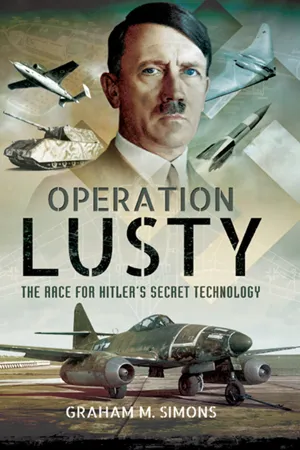
- 272 pages
- English
- ePUB (mobile friendly)
- Available on iOS & Android
eBook - ePub
About this book
Information
Chapter One
Wunderwaffen
Wunderwaffen is German for ‘wonder-weapons’ and was a term assigned by the Third Reich propaganda ministry to a number of revolutionary ‘superweapons’.
The Reichsministerium für Volksaufklärung und Propaganda - RMVP or Propagandaministerium - known as the Reichs Ministry of Public Enlightenment and Propaganda - was a Nazi government agency to enforce Nazism ideology.
Founded upon the 1933 Machtergreifung - or seizing of power - by Adolf Hitler’s National Socialist government, it was headed by Reich Minister Joseph Goebbels and was responsible for controlling the German news media, literature, visual arts, filmmaking, theatre, music, and broadcasting. As the central office of Nazi propaganda, it supervised and regulated the culture and mass media of Nazi Germany.
The English-language propaganda radio programme Germany Calling was broadcast to audiences in the UK on the medium wave station Reichssender Hamburg and by shortwave to the USA. The programme started on 18 September 1939 and continued until 30 April 1945, when Hamburg was finally overrun by the British Army.
Through such broadcasts, the RMVP attempted to discourage and demoralize British, Canadian, Australian and American troops and the British population within radio listening range, to suppress the effectiveness of the Allied war effort through propaganda, and to motivate the Allies to agree to peace terms leaving the Nazi regime intact and in power. Among the techniques used, the Nazi broadcasts reported on the shooting down of Allied aircraft and the sinking of Allied ships, presenting discouraging reports of high losses and casualties among Allied forces at the same time constantly broadcasting the scientific achievements of their scientists and technicians to create a soon-to-be-launched threat of the new German wonder weapons.
With the benefit of hindsight most of these weapons remained just feasible prototypes, or reached the combat theatre too late and in too insignificant numbers to have any great military effect. At the time however, those in power on the Allied side did not know that – nor could they take the risk of letting such super-weaponry fall into other hands.
This was particularly true of the USA, who not only did not trust their allies in the slightest, many of the political elite were harbouring ambitions of being the world’s only super-power at the cost of the British Empire!
With the passing of time it became increasingly difficult to decipher what was fact, what was fiction and what was pure fantasy in the context of the wunderwaffen. Instead of clarification coming from the removal of the Iron Curtain and declassification of secret documents, all that has happened is that the water has become increasingly muddied by conspiracy theorists and Unidentified Flying Object fantasists.
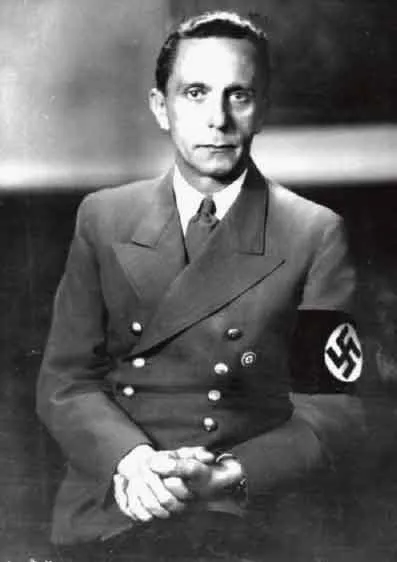
Paul Joseph Goebbels (b. 29 October 1897 – d. May 1945) was a German politician and Reich Minister of Propaganda in National Socialist Germany from 1933 to 1945.
That said, the list of known or alleged wunderwaffen was huge, and could be split into numerous sections, but please remember, this is just a partial list!
Naval vessels
Graf Zeppelin – a 33,550 ton aircraft carrier that was the lead ship in a class of four carriers ordered by the Kriegsmarine, planned in the mid-1930s by Grand Admiral Erich Raeder as part of the Plan Z rearmament programme after Germany and Great Britain signed the Anglo-German Naval Agreement. The carrier would have had a complement of forty two fighters and dive bombers.
A combination of political infighting between the Kriegsmarine and the Luftwaffe, disputes within the ranks of the Kriegsmarine itself and Adolf Hitler’s waning interest all conspired against the carriers. A shortage of workers and materials slowed construction still further and, in 1939, Raeder reduced the number of ships from four to two. Even so, the Luftwaffe trained its first unit of pilots for carrier service and readied it for flight operations. With the advent of the war, priorities shifted to U-boat construction; one carrier, Flugzeugträger B, said by some sources to have been named Peter Strasser, - the chief commander of German Imperial Navy Zeppelins during World War I - was broken up on the slipway while work on the other, Flugzeugträger A (christened Graf Zeppelin) was continued tentatively but suspended in 1940. The air unit scheduled for her was disbanded at that time.
German Aircraft Carrier I– This was a planned conversion of the transport ship Europa during World War Two. The loss of the battleship Bismarck and near torpedoing of her sistership Tirpitz in May 1941 and March 1942, respectively spurred the Kriegsmarine to acquire aircraft carriers. Europa was one of several vessels selected for conversion into auxiliary aircraft carriers. As designed, the ship would have had an air complement of 24 Bf.109T fighters and 18 Ju.87C Stuka dive-bombers.
Somewhat ironically, the Graf Zeppelin was captured by the Russians at the end of the war at Swinemünde and used as a Headquarters for the Commission analysing captured German equipment.
H-class battleship – a series of proposals for battleships surpassing both the US Navy’s Montana-class battleships and the Imperial Japanese Navy’s Yamato-class battleships in armament, culminating in the H-44, a 140,000 ton battleship with eight 20 inch guns. Two only laid down; both were scrapped on slipways.
U-boats
Rocket U-boat – a planned ballistic missile submarine; project abandoned.
Type XVIII U-boat – a U-boat designed to use air-independent propulsion; several were under construction when the war ended
Type XXI U-boat ‘Elektroboot’ (Electric boat) – the first U-boat designed to operate completely submerged. 118 were built

The German aircraft carrier Graf Zeppelin after its launch in December 1938.
Type XXIV U-boat – a planned U-boat designed to use air-independent propulsion
Type XXVI U-boat – designed to use air-independent propulsion.
Type XXII U-boat – designed to use air-independent propulsion.
Type XXIII U-boat (‘Elektroboot’) – a U-boat designed for coastal missions; 67 were built
Type XXV U-boat – a planned all-electric U-Boat designed for coastal missions
Type XI U-boat – designed to carry the Arado Ar 231 collapsible floatplane; four were laid down but cancelled at the outbreak of World War Two
Armoured vehicles
Flakpanzer ‘Kugelblitz’ (Ball Lightning) – a self-propelled anti-aircraft gun.
Sturer Emil – an experimental tank destroyer.
Landkreuzer P. 1000 ‘Ratte’ (Rat) – a planned super-heavy tank, weighing 1000 metric tons and armed with two 280mm cannons, 128mm anti-tank gun, eight 20mm flak guns and two 15mm heavy machine guns.
Landkreuzer P. 1500 ‘Monster’ – a proposed super-heavy self-propelled gun, weighing 1500 metric tons and armed with the 800mm Schwerer Gustav/Dora gun
Panzer VII ‘Löwe’ (Lion) – a planned super-heavy tank, weighing ...
Table of contents
- Cover
- Title Page
- Copyright
- Contents
- Acknowledgements
- Introduction
- Chapter One: Wunderwaffen
- Chapter Two: Making use of what arrived
- Chapter Three: The RAFwaffe
- Chapter Four: V-for-Vengence
- Chapter Five: The RAE Post War
- Chapter Six: Exploiting the Enemies Developments
- Chapter Seven: Operation Lusty and Other Missions
- Chapter Eight: BIOS, CIOS, FIAT And Other Acronyms
- Chapter Nine: Overcast and Paperclip
- Chapter Ten: Across the Channel
- Chapter Eleven: Japan
- Chapter Twelve: Flights of Fantasy
- Bibilography and Further Reading
Trusted by 375,005 students
Access to over 1.5 million titles for a fair monthly price.
Study more efficiently using our study tools.
Frequently asked questions
Yes, you can cancel anytime from the Subscription tab in your account settings on the Perlego website. Your subscription will stay active until the end of your current billing period. Learn how to cancel your subscription
No, books cannot be downloaded as external files, such as PDFs, for use outside of Perlego. However, you can download books within the Perlego app for offline reading on mobile or tablet. Learn how to download books offline
Perlego offers two plans: Essential and Complete
- Essential is ideal for learners and professionals who enjoy exploring a wide range of subjects. Access the Essential Library with 800,000+ trusted titles and best-sellers across business, personal growth, and the humanities. Includes unlimited reading time and Standard Read Aloud voice.
- Complete: Perfect for advanced learners and researchers needing full, unrestricted access. Unlock 1.5M+ books across hundreds of subjects, including academic and specialized titles. The Complete Plan also includes advanced features like Premium Read Aloud and Research Assistant.
We are an online textbook subscription service, where you can get access to an entire online library for less than the price of a single book per month. With over 1.5 million books across 990+ topics, we’ve got you covered! Learn about our mission
Look out for the read-aloud symbol on your next book to see if you can listen to it. The read-aloud tool reads text aloud for you, highlighting the text as it is being read. You can pause it, speed it up and slow it down. Learn more about Read Aloud
Yes! You can use the Perlego app on both iOS and Android devices to read anytime, anywhere — even offline. Perfect for commutes or when you’re on the go.
Please note we cannot support devices running on iOS 13 and Android 7 or earlier. Learn more about using the app
Please note we cannot support devices running on iOS 13 and Android 7 or earlier. Learn more about using the app
Yes, you can access Operation Lusty by Graham M. Simons in PDF and/or ePUB format, as well as other popular books in History & Military & Maritime History. We have over 1.5 million books available in our catalogue for you to explore.