This fascinating account of an unsung English monarch and military leader is "a pleasing and well-informed appraisal of the first Yorkist king" (Dr. Michael Jones, author of
Bosworth 1485: Psychology of a Battle).
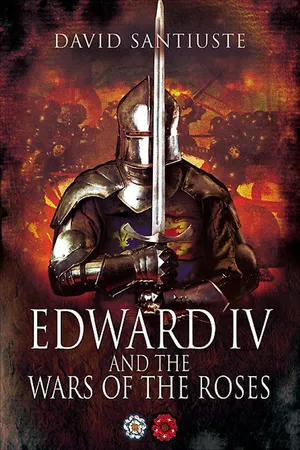
Indisputably the most effective general of the Wars of the Roses in fifteenth-century England, King Edward IV died in his bed, undefeated in battle. Yet he has never been accorded the martial reputation of other English warrior kings such as Henry V. It has been suggested that perhaps he lacked the personal discipline expected of a truly great army commander.
But, as the author shows in this perceptive and highly readable new study, Edward was a formidable military leader whose strengths and subtleties have never been fully recognized—perhaps because he fought most of his battles against his own people in a civil war.
This reassessment of Edward's military skill—and of the Wars of the Roses in which he played such a vital part—provides fascinating insight into Edward the man as well as the politician and battlefield commander. Based on contemporary sources and the latest scholarly research,
Edward IV and the Wars of the Roses stands as "a valuable and thought-provoking addition to the canon, which ought to become required reading for anyone interested in the reign of the first Yorkist monarch" (The Ricardian).
- 208 pages
- English
- ePUB (mobile friendly)
- Available on iOS & Android
eBook - ePub
Edward IV and the Wars of the Roses
About this book
Information
Chapter 1
Rouen, April 1442
Edward Plantagenet was born at Rouen, in Normandy, on 28 April 1442. His father was Richard Duke of York, the greatest English nobleman after the King. York was a ‘prince of the blood’, descended from King Edward III on both sides of his family. Edward’s mother, Duchess Cecily, was a member of the powerful Neville family, who had steadily increased their influence throughout the century. Cecily herself, traditionally known as ‘Proud Cis’ and ‘The Rose of Raby’, gained a reputation as a beautiful and formidable woman. The duke and duchess were rarely parted, and yet, as we shall see, rumours were later to emerge that Edward was not York’s son.1 Of course, it is now impossible to resolve the question of York’s paternity either way, although there is little evidence to suggest that Duke Richard treated Edward any differently from the rest of his children. An elder boy, Henry, died as an infant, so Edward became York’s heir. Over the next few years, more children would join Edward and his older sister, Anne, and the duke and duchess produced a large family; Edward had three brothers and four sisters. Edward’s three younger brothers – Edmund, George and Richard – will all feature prominently in our story.
At this time, the Duke of York was King Henry Vl’s lieutenant-general, responsible for the direction of England’s war with France. By 1442 the English and French had been at war, intermittently, for more than a hundred years.2 The war was reopened in earnest in 1413, by Henry V, who had recently attained the throne. Henry V, the victor of Agincourt, was a great military commander but he was aided by internal divisions within France. The ageing French King, Charles VI, suffered from mental illness (he sometimes believed himself to be made of glass). The French political community struggled to cope with the effects of their King’s incapacity; eventually this led to feuding between the highest nobility. The culmination, in 1419, was the murder of Duke John of Burgundy in the presence of the Dauphin, Prince Charles. This pushed Duke John’s young son, Duke Philip, into an alliance with the English. By 1420 Henry had conquered much of Northern France. He must have appeared invincible, and so the French came to terms. Henry married Charles VI’s daughter, Katherine. The Treaty of Troyes disinherited the Dauphin, making Henry heir to the French throne in his stead. But in 1422 Henry contracted dysentery. The King died on 31 August, only thirty-five years old, at the height of his powers. Henry’s son, Henry VI, succeeded to the English throne unchallenged but he was still an infant. All Henry V’s achievements were therefore placed in jeopardy, although the English cause in France continued to prosper. Effective leadership was provided by Henry V’s brother, John Duke of Bedford. But then, in 1429, everything changed. A small French force, ostensibly under the command of the remarkable Joan of Arc, broke the English siege of Orléans. Later that year, the Dauphin was crowned King Charles VII at Rheims, while Joan looked on in rapture.3 Joan’s ‘ministry’ was shortlived though: she was captured by the Burgundians the following year, and the English burned her alive as a witch. In 1431, Henry VI, although still a small child, was in turn crowned King of France at Paris. Yet Joan’s intervention had turned the tide of the war. In 1435 the English received a crushing blow when Duke Philip formally repudiated the Anglo-Burgundian alliance.4
By the early 1440s, therefore, the English were very much on the defensive. Charles VII surprised his subjects (and perhaps himself) by proving to be an effective king,5 and France’s superior resources now began to tell. But the English resisted bitterly, and there were some victories in these years. The Duke of York himself led a particularly successful expedition in 1441, the year before Edward’s birth. York’s main purpose was to relieve the town of Pontoise, which had been besieged by Charles VII’s army.6 During this campaign York exhibited dynamic leadership, and his audacious conduct – including night marches and surprise river crossings – so discomfited the French that every time the English appeared ‘they ran hard in the other direction’. On one occasion York almost captured Charles, finding the King’s bed still warm. Such successes were rare though, and much of York’s time in France was spent in a grim struggle to hold the line. Moreover, it was also clear by now that Henry VI was unlikely to follow in his father’s illustrious footsteps. Henry had achieved his majority in 1437, but he left most affairs in the hands of his chief minister, the Duke of Suffolk. Henry showed no inclination to lead an army in person. Insofar as he was interested in the war at all, he was inclined towards peace.
Suffolk also wanted peace, although perhaps on more pragmatic grounds. In 1445 Henry married Margaret, the daughter of Count René of Anjou, and this was the price of a truce. Henry’s government also ceded the territory of Maine. This was done in the teeth of ‘hawks’ such as the Duke of Gloucester, who was now Henry V’s only surviving brother. In the years after Henry V’s death Gloucester had played a prominent role, although by this time he was effectively marginalised. Gloucester’s downfall was completed in February 1447, when he was arrested and charged with treason. He was never tried, but died shortly afterwards in mysterious circumstances. Suffolk’s major rival had been removed, although his dominance would soon come to an end. A series of diplomatic blunders, which culminated in the English sack of Fougères, gave Charles a pretext to reopen the war.7 York had been succeeded as lieutenant by another kinsman of King Henry, Edmund Beaufort Duke of Somerset. Somerset had a distinguished war record but proved a disaster as lieutenant. In October 1449 Somerset was compelled to surrender Rouen; English Normandy was overrun. The loss of Normandy was a national disgrace, for which Suffolk paid the price. He was impeached by Parliament, although the death sentence that was sought was commuted to banishment. But Suffolk’s ship was intercepted – it remains unclear on whose orders – and Suffolk was brutally put to death. Worse was to follow for King Henry when the commons of the south-east rose in rebellion under an Irish soldier, Jack Cade. The revolt was eventually suppressed with great cruelty, although not until some of Henry’s ministers had been captured and murdered.
Thus it was a troubled kingdom to which Richard Duke of York returned in September 1450. Following the end of his tenure in France he had been appointed Lieutenant of Ireland, where he had enjoyed some success. But he now considered his presence in England to be essential. First, because he was enraged by the conduct of Somerset. York was vexed by a matter of honour: he believed that Somerset’s actions in France had breached the chivalric code.8 Nevertheless, Somerset remained in favour at court. He had replaced Suffolk as Henry’s principal counsellor, notwithstanding his miserable failure in France. Second, York wished to disassociate himself from Cade’s revolt, because the rebels had called for him to be given a greater place in government. Suspicions of York were particularly aroused at court because Cade, posing as a kinsman of the Duke, referred to himself as ‘John Mortimer’. In order to understand the significance of Cade’s claims we need to go back to 1399, when Richard II was deposed by his cousin Henry Bolingbroke. Bolingbroke, who was Henry VI’s grandfather, took the throne as King Henry IV. But a claim to the throne on behalf of Edmund Mortimer, the young Earl of March, which was arguably stronger than Henry’s, had been passed over.9 The House of Mortimer and their descendants therefore acted as a magnet for anyone with a grievance against the Lancastrian kings. York was now the Mortimers’ heir.10 York’s father had been executed for his part in a rebellion against Henry V, but Duke Richard himself had been conspicuously loyal. Gloucester’s death had brought the Duke of York a step closer to the throne, although it is unlikely that he could have contemplated the removal of Henry at this stage.11 York’s motives remain opaque, although he was now to devote the rest of his life to high politics in England.
But there were no simple remedies. Late medieval England was a mature political society.12 Its institutions, including Parliament, were of long standing. It was, moreover, a complex society, which combined political, cultural, religious and economic factors within a continued state of flux. However, the position of the monarchy was unchallenged: even the most radical political thinkers of the time could not conceive of a state which had no king. The King’s role was complex and multi-faceted. He was administrator, war leader and judge – the ‘chief executive’ of the realm – although this does no justice to the awesome majesty of kingship as it was perceived by medieval people. A medieval ruler was rex et sacerdus, king and priest. He ruled through hereditary right, but also because he was thought to be ordained by God. The King’s link with the divine did not mean, though, that his powers were completely unchecked. In his coronation oath the King swore to rule for the benefit of his subjects. It was also crucial that a king maintained good relations with his magnates, who expected the right to offer counsel and that their advice would be duly considered. Indeed, much of the political power in the country rested with the aristocracy – the peers, lords and gentry – the few hundred families, whose authority was derived from ownership of land and hereditary right.13 Yet if the King was considered to be divinely ordained, then how could he be compelled to act in the best interests of his realm?
It is clear that the political system depended heavily on the personal attributes of the King. One of the most difficult dilemmas that faced the political community during the later Middle Ages, therefore, was how to proceed when the King was unable, or unwilling, to provide effective leadership. Deposition, the ultimate solution, was never taken lightly, although it was now accepted that a king who ruled as a tyrant could be justifiably removed. Two medieval English kings had been deposed: Edward II, in 1327, and Richard II, in 1399, as we have seen. Henry VI’s minority – another hazard of medieval politics – had been navigated without the system breaking down, but as an adult king, at least until 1453, Henry posed a different set of problems. Henry was not actively malign, but he largely abdicated responsibility, first to Suffolk, and then to Somerset. Why he did so remains a matter of debate.14 Many contemporary writers believed Henry to be a good, simple and pious man: according to his chaplain, John Blacman, he was ‘like a second Job’. These are not necessarily negative qualities, of course, but the implication was that Henry was better suited to life in a monastery than to kingship. More seriously, however, Henry was also thought to be naïve and lacking in judgement. Abbot Whethamstede of St Albans, for example (albeit writing with hindsight), described him as ‘a mild-spoken, pious king, but halfwitted in affairs of state’.
The Duke of York launched an energetic campaign aimed at removing the Duke of Somerset from power. But he made little progress – and obviously the King would not act against Somerset in person – so he retired to his castle of Ludlow, in the Welsh Marches. York held lands throughout England, Ireland and, until 1449 of course, in France, but his greatest power lay in the Marches, the Mortimers’ patrimony. The duke’s marcher lordships brought him great wealth and here, like other marcher lords, he enjoyed quasi-regal powers. Ludlow, then a large and impressive castle, was the Duke of York’s principal seat. We may assume that York was reunited with his young son, Edward, because it was here, rather than in the household of another great noble, that Edward was destined to grow up. Edward would never forget his youth at Ludlow, nor the town’s long-standing loyalty to the House of York.15 The Duke of York’s power in the Marches brought him little comfort though. His sense of frustration grew, and York’s self-imposed exile from court gave his enemies the chance to brief against him. In February 1452 York, supported by the Earl of Devon and Lord Cobham, resorted to arms for the first time. By the end of the month York, denied entry to London, had taken up a strongly fortified position at Dartford, in north-west Kent. Here, he awaited the arrival of the King’s forces. This was not a course to be taken lightly. Theoretically, only the sovereign had the right to levy war, and to defy the King openly was treason. Nevertheless, on this occasion both sides were reluctant to engage in bloodshed. A series of noble emissaries, including York’s kinsmen, the Nevilles, were sent to persuade York to disarm. Eventually, York agreed to disband his army on the understanding that the King would hear his petition against Somerset; this was agreed. However, after presenting his case to the King, York was taken into custody. He was compelled to renew his oath of allegiance publicly, and also to swear that he would eschew ‘the way of feat’ [arms] thereafter.16 Further reprisals against York may have been planned, although it was now that Edward made his debut on the public stage, and thereby saved his father from further humiliation. It was said that Edward, now Earl of March, had raised an army, although he was still only ten years old, and was coming to York’s aid.17
During the next year it must be said that Henry’s government was energetic, particularly in the field of law and order, although the King’s own role is unclear. Henry’s councillors also turned their attention to the war in France. An expeditionary force was despatched to Aquitaine, under the redoubtable John Talbot, Earl of Shrewsbury. The English enjoyed initial success but Charles VII reacted swiftly and despatched a powerful force. On 17 July 1453, Talbot, aggressive as usual, attacked the French at Castillon, near Bordeaux, where they had fortified their encampment. The French were well supplied with artillery, which was expertly deployed, and the English attackers were blown to pieces; Talbot himself was slain. The Battle of Castillon has traditionally been regarded as the end of the Hundred Years’ War, and the English ‘Empire’ in France would henceforth be limited to the Calais Pale. The disaster at Castillon had further repercussions. Up to this point, Henry had given no indication that he wanted to follow his father’s martial example, but he had shown no clear signs of mental illness. But the news of Shrewsbury’s death had a catastrophic effect. When word of the English defeat was brought to Henry at Clarendon he suffered a breakdown.18 Henry was completely incapacitated. Even when Queen Margaret bore Henry a son, Edward, their first and only child, he remained oblivious.
At Dartford York had been left isolated by a lack of support from the nobility, but now he forged a valuable alliance with the Nevilles. The family included Richard Earl of Salisbury, his brother – the veteran William Lord Fauconberg – and Salisbury’s brood of able sons. The eldest of Salisbury’s sons, also named Richard, held the title Earl of Warwick through his marriage to Anne Beauchamp. Warwick’s brothers included John, who was destined to become a great warrior, and George, who was destined for a career in the Church. The Nevilles were motivated purely by self-interest: they needed support to help them in their feud with the Percys, who held much influence at court. Acrimony between the two great northern families was long-standing, dating back to the late fourteenth century, but their quarrel had become increasingly bitter as Henry VI’s reign progressed. Matters came to a head in August 1453. The wedding party of Salisbury’s other son, Thomas, traversing Heworth Moor, was attacked by a Percy force under Lord Egremont.19 In these testing times York also won the support of other lords. An attempt by Queen Margaret to claim the regency was rebuffed, and on 27 March 1454 York was accepted as Lord Protector by his peers. Unsurprisingly, York’s supporters were rewarded and his enemies were excluded from government. Salisbury, for instance, became Chancellor, an office that was usually held by a churchman; Somerset was imprisoned in the Tower, although he was never brought to trial. However, having opposed government by a court clique for so long, York did not wish t...
Table of contents
- Cover
- Title
- Copyright
- Contents
- List of Illustrations
- Acknowledgements
- York & Lancaster: The English Royal Family in the Later Middle Ages
- Maps
- Introduction
- 1. Rouen, April 1442
- 2. Calais, November 1459
- 3. London, March 1461
- 4. York, March 1461
- 5. Reading, September 1464
- 6. Texel, The Netherlands, October 1470
- 7. London, April 1471
- 8. Epilogue
- Abbreviations
- Notes
- Bibliography
- Index
Trusted by 375,005 students
Access to over 1.5 million titles for a fair monthly price.
Study more efficiently using our study tools.
Frequently asked questions
Yes, you can cancel anytime from the Subscription tab in your account settings on the Perlego website. Your subscription will stay active until the end of your current billing period. Learn how to cancel your subscription
No, books cannot be downloaded as external files, such as PDFs, for use outside of Perlego. However, you can download books within the Perlego app for offline reading on mobile or tablet. Learn how to download books offline
Perlego offers two plans: Essential and Complete
- Essential is ideal for learners and professionals who enjoy exploring a wide range of subjects. Access the Essential Library with 800,000+ trusted titles and best-sellers across business, personal growth, and the humanities. Includes unlimited reading time and Standard Read Aloud voice.
- Complete: Perfect for advanced learners and researchers needing full, unrestricted access. Unlock 1.5M+ books across hundreds of subjects, including academic and specialized titles. The Complete Plan also includes advanced features like Premium Read Aloud and Research Assistant.
We are an online textbook subscription service, where you can get access to an entire online library for less than the price of a single book per month. With over 1.5 million books across 990+ topics, we’ve got you covered! Learn about our mission
Look out for the read-aloud symbol on your next book to see if you can listen to it. The read-aloud tool reads text aloud for you, highlighting the text as it is being read. You can pause it, speed it up and slow it down. Learn more about Read Aloud
Yes! You can use the Perlego app on both iOS and Android devices to read anytime, anywhere — even offline. Perfect for commutes or when you’re on the go.
Please note we cannot support devices running on iOS 13 and Android 7 or earlier. Learn more about using the app
Please note we cannot support devices running on iOS 13 and Android 7 or earlier. Learn more about using the app
Yes, you can access Edward IV and the Wars of the Roses by David Santiuste in PDF and/or ePUB format, as well as other popular books in History & Military & Maritime History. We have over 1.5 million books available in our catalogue for you to explore.