This "handsome volume" offers a "lavishly illustrated" journey back to the golden age of steam travel through first-hand accounts and images of the passengers (Bruce Peter, author of
Ship Style).
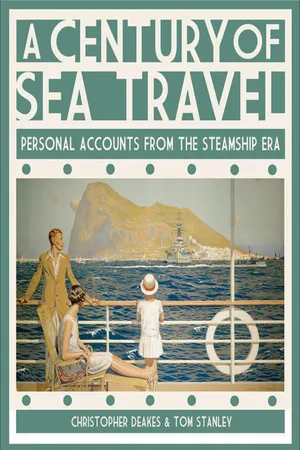
A Century of Sea Travel is an eye-opening voyage through the golden years of the passenger steamship, a voyage described by the very travelers who sailed on these magnificent engineering marvels. In memoirs and letters home, diaries and the backs of postcards, the recorded experiences of every aspect of steamship travel are here relived: from details of the ships, the crew, and fellow passengers; to the food and entertainment on board; to tales of romance, accidents, and disasters; and of being dreadfully sick during storms at sea. The writers were emigrants or colonial rulers, men of letters, young men seeking their fortune, wives on their way to new homes abroad; some were rich, many were poor and escaping the hardship of downtrodden lives. All had in common the experience of voyaging at sea.
Vividly brought to life by full-color and black-and-white postcards, travel posters, promotional brochures, fine art, photographs, maps, luggage labels, health inspection certificates, and itineraries, the authors have woven together word and image into a page-turning narrative that evocatively describes an age (1840–1950) now lost to time.
eBook - ePub
A Century of Sea Travel
Personal Accounts from the Steamship Era
- 192 pages
- English
- ePUB (mobile friendly)
- Available on iOS & Android
eBook - ePub
About this book
Information
SCENES ALONG THE WAY
A Flick of Sunshine on a Strange Shore

A somewhat flimsy mode of embarking or disembarking operated at West African ports: will it or won’t it tip them into the sea?


Sunrise at Singapore, the perfect stillness of which is for many the best time of day.
‘I soon found my fellow passengers and their behaviour in the different places we visited a far more absorbing study than the places themselves,’ wrote Evelyn Waugh, on his Mediterranean cruise in 1929 on the Stella Polaris. However, it was the places they stopped at en route to their destinations that intrigued most travellers, and those who wrote of their first impressions – either as they approached the port, or after they had just landed – recorded both their favourable and unfavourable thoughts.
Perhaps because they felt they could add nothing to what had been previously recorded, it seems that most writers of diaries and recollections concentrated on their experiences ashore rather than on their first thoughts when arriving at a new port. In addition, such thoughts on arrival at large, well-known places were often not expressed, and those who decided to record their first impressions focussed on the smaller ports of call which were so different from their homelands.
In Britain, Plymouth was on the schedules of a few important lines and was called at before the final destination – Southampton or London – was reached. It offered a typically English view to Alan Blascheck as he sailed home on the Ballaarat in 1889. ‘My only impression of Plymouth,’ he wrote, ‘being a few high wooded hills and plenty of rain which obscured the view.’ Outbound, ships scattered in different directions as they reached the ocean, towards North and South America, and to South Africa to round the Cape for those lines that did not route their ships past Gibraltar and into the Mediterranean. ‘A great fortress,’ declared P T Etherton, steaming towards it on the Orizaba in 1898. ‘As you approach it the Rock looks sullen and tremendous, even though the sky above it is clear and blue. It gives the impression of a lion guarding a great sea.’ But the Rock did not always evoke the respect due to it. Frederick Treves, in 1903, wrote that ‘On the morning of the next day the steamer came to Gibraltar. The first impression of this famous colony is one of aggrieved disappointment.’ Maurice Baring, in 1912, had so little to say about it – ‘Most people have been there. For those who haven’t:
“It looks
Exactly as it does in books.”’

An early start to the day for Catherine Morrison at Suez.

-that he was chastised by others for being flippant. It also ‘looks exactly like’ the ‘advertisements of the Prudential Life Insurance Company,’ according to E W Howe. Evelyn Waugh, however, wrote that while many travellers believed the Rock looked like a lion, he thought that it resembled nothing but ‘a great slab of cheese.’ Marseilles, Genoa and Naples were regularly called at by long distance steamers. Treves’s view of Marseilles was that, ‘The approach to Marseilles is picturesque, and the busy town looks well from the sea. It is indeed one of that great series of towns which appear at their best only at a distance.’ Bertram Hayes, when captain of the White Star liner Adriatic in 1912, recalled that ‘On one of our voyages to the Mediterranean I saw the most beautiful sight I think I have ever seen. We were approaching the anchorage off Monaco one morning as daylight was coming in. The sun rose right out of the sea and every window in Monte Carlo facing became a deep crimson for a few moments. This, with the white houses and the snow on the mountains in the background made an effect that was simply indescribable’ And the mariner’s oft made complaint; ‘And only one of our passengers was on deck to see it!’ Darmstadt, the ship Robert Roberts sailed on in 1897, called at Genoa on its way to Australia. ‘We had no idea Genoa was such a lovely place,’ he wrote, going ashore to confirm his first impressions. ‘The houses are built of lightly tinted stone – creamy and light green, with occasional faint pinks, and a highly ornate style of architecture. One or two streets were wholly occupied with palaces. The palaces did not stand off the street like English palaces, but fronted flush with the street like ordinary houses – only with more stately fronts. Peeping through the main entrance, you could see trim garden enclosures in ample courts behind. The grandeur inside instead of outside: English palaces seem arranged for public view, while these are for private comfort.’
‘Vesuvius looked rather pensive as we entered the Bay of Naples,’ wrote Caroline Kirkland in 1906, on her return from Africa. ‘We saw two glowing streams of lava… but nothing to indicate the catastrophe that was imminent… It remained for us to go through the most terrific Vesuvian eruption since 1631.’ Over 200 people died in what was to be the volcano’s worst eruption of the last century. Evelyn Waugh, on his cruise, remembered Naples for another reason. It was early on a Sunday morning when the Stella arrived in the bay, and as soon as he landed, a cheerful little fellow in a straw hat ran up to meet him.
‘“Hullo, yes, you sir. Good morning,” he cried. “You wanta one nice woman.”
‘I said no, not quite as early in the day as that.’
As to the expression ‘See Naples and die,’ Edgar Howe was told by the barber on the Burgermeister that it was properly ‘See Naples and Morreai’ (an island in the bay), but that ‘in a spirit of levity the English translated the saying’ somewhat differently.
Passengers often recorded warnings about the dangers of Naples without describing their first impressions of the city, but after they had sailed there were some memorable sights to be seen from the ship. Frederick Treves recorded one such: ‘A day passed and the vessel came upon Crete. It was about an hour after sunrise… and the view of it was delicate and wonderful. The cliffs that rose from the sea were lean and dim, but the mountains far inland were lit by the rising sun, so that every dome and pinnacle stood out in freshest outline. The whole range was covered with snow.’ A view late in the day struck Waugh as his ship entered Istanbul, and ‘just as the sun was on the horizon it broke through the clouds, and, in the most dramatic way possible, threw out a great splash of golden light over the minarets of St Sophia.’
These pleasant visions contrasted strongly with the reactions of passengers who stopped at Port Said, ‘where West meets East.’ No other port seems to have engendered as many responses as this town, and not all of them favourable. P T Etherton’s opinion: ‘Port Said – the highlight in vice and iniquity of a voyage to the East.’ He described it: ‘It is quite a small town; you could get the whole of it into a 5-acre field, a good deal of the available space being taken up with the dwellings of houris and harlots of every nationality… The moment you land at the quay you are assailed by men and boys who undertake to introduce you to fairies of every age, colour and hue.’ However, Frederick Treves saw something attractive about the place in 1903. ‘Port Said affords a display of the West at its worst and of the East spoiled. Yet at the time of sunset, a glory of the East can make even beautiful this mongrel city … At this time the squalid house-tops become turrets and battlements of gold. The sky is the colour of the yellow rose, the clouds are tinted with lilac, the shadows in the street are purple and long.’ When Caroline Kirkland passed through in 1905 on her way south, she felt that the town was ‘much improved since I was there in 1899, when it seemed the jumping off place for the West and the East’ – now it was ‘more law-abiding.’ She noticed particularly the ‘specimens of many of the strange tribes of Africa and Asia, draped in all colors of the rainbow and varying in skin tint from the pale chocolate of some inland Arabs to the luminous black of the Nubians.’ Lewis Upcott also commented on the people in 1913, though he did not much care for what they did: ‘Port Said is not very picturesque, but the people are – much hustled by sellers of expensive and mostly rubbishy trifles.’ They seemed to hustle more as the years passed. Genesta Hamilton, who called there on the Neuralia in 1922, gave an example of the sort of thing passengers could expect. ‘Reached Port Said this morning …Then a conjuror appeared. “Gully, gully, gully…You hold this, Lord Kitchener, Queen Mary, you take this two bob in your hand. You close him and turn him over. I not touch you, I stand right away over here. I take your two shillin’ from you without touch you. Then I keep him – so? Now you blow on your shut hand – you feel the florin? You sure got him? Yes? Now say ‘Go.’” The victim says “Go!” “Now look in your hand, you, Queen Mary.” Sure enough there are two lead weights there, and the man tips the two shillings off his fez! “Lord Kitchener, I think you got little chicken in your coat… ”’ A few years later, in 1929, Julian Huxley found things had not changed. ‘The touts in the street,’ he wrote, ‘are as unbearable as gadflies… The one redeeming feature of their pesterings is the names they bestow on the ladies of the party. If you will not buy what they offer you become Scotch: “All right, Mrs M’Gregor; yes, you come from Aberdeen?”’ If you stayed on board, you were to some degree protected, as Celia Davies found when the Tevere called there in 1931. ‘Port Said was my first introduction to the East. I was fascinated by all the tiny boats which swarmed around our ship, like flies round a honey-pot; with the evil-looking men who hawked their wares, arguing, haggling, bargaining and by the boys who came aboard and dived from fantastic heights for small coins tossed into the water.’ But, generally, the place received a bad press, and over sixty years – when James Kirkup passed through – had not changed much: ‘Port Said … impressions of filth, uncharm, roguery, poverty, disease, ignorance, nastiness, dirty postcards.’

A harbour in Monaco.

Naples, a port with a mixed reputation, always dominated by Vesuvius, portrayed by so many shipping company artists.

Istanbul was Constantinople. Now it’s Istanbul, not Constantinople.
Then there was the trip through the Suez Canal. This had been opened in 1869, but was ‘just a ditch, and an ugly one at that,’ according to Seymour Fortescue, who passed through it in 1876 on the new Bl ship Merkara (built with pens for 1 cow, 10 sheep and a fowl coop). It was clearly quite a shallow ditch, as ‘a ship, as not infrequently happens, sticks in the mud. We ourselves lost a whole day not far from Suez, because an English steamer had run aground and could not float again until she had partly unloaded.’ So wrote Ernst Haeckel in 1881, on his way to Ceylon on the Helios. The naturalist found some appealing aspects to the Canal. ‘Morning rose over Lake Menzaleh,’ he recalled, ‘refreshingly cool and bright, and the sandbanks in the lake were crowded with pelicans, flamingoes, herons and other water-birds.’ A few years later, William Bastard’s ship, the Orient, was also delayed, but the wildlife failed to be appreciated. ‘Yesterday we waited in a siding while 13 vessels passed us, 11 English, 1 Dutch and 1 French. We were kept waiting 2 hours because the French boat was supposed to be in the Canal, but turned out to be all the while lying in Ismailia, just like a silly Froggie. Captain very savage.’ The French were also involved when the German liner Darmstadt, on which Robert Roberts was a passenger in 1897, was obliged to stop in the Canal to repair its searchlight. ‘While we were moored,’ Roberts wrote, ‘a French steamboat that was following us, passed us and went ahead. At first, the French steamer did not know who we were, and was disposed to return our salutations; but when she presently found out that we were German, passengers and crew fairly howled at us. The French have never forgiven the terrible whipping they received at the hands of the Germans in 1870’ (the Franco-Prussian War). There was, nevertheless, some entertainment to be had during that transit. ‘A certain fledgling on board – with haughty airs, though somewhat of a simpleton – had managed to make himself odious to some of his fellow-passengers,’ Roberts related. ‘He expressed a wish, as the vessel was stopped, to land and walk to Suez and join the vessel there… They encouraged him in the project, and suggested various precautions which they represented to be needful in the risks he would run from the marauding Bedouin… revolvers… a supply of provisions. making a will. and a substantial meal before starting. He thought this also a good suggestion… The whole affair being thoroughly arranged, one of the party suggested ...
Table of contents
- Cover
- Title Page
- Copyright
- Contents
- Introduction
- There Go the Ships Departure
- Great Steamers White and Gold The Ship
- A Cabin to Dance In Accommodation
- The Minimum of Activity, and the Maximum of Gossip At Sea
- Not a Very Sober Crowd but Very Amusing The Passengers
- Tea and Boiled Boots The Food
- The Strain of Relentless Whimsy Entertainment
- Thinking, Feeling, Loving Waves of Romance
- A Flick of Sunshine on a Strange Shore Scenes along the Way
- The Howl of the Wind, the Tumult of the Sea Storms, Seasickness and Disasters
- A Pint of Beer a Day Troopships
- As Human as Ourselves The Crew
- Farewell, Monsieur Traveller Arrival
- Bibliography
- Picture Credits
- Acknowledgements
Trusted by 375,005 students
Access to over 1.5 million titles for a fair monthly price.
Study more efficiently using our study tools.
Frequently asked questions
Yes, you can cancel anytime from the Subscription tab in your account settings on the Perlego website. Your subscription will stay active until the end of your current billing period. Learn how to cancel your subscription
No, books cannot be downloaded as external files, such as PDFs, for use outside of Perlego. However, you can download books within the Perlego app for offline reading on mobile or tablet. Learn how to download books offline
Perlego offers two plans: Essential and Complete
- Essential is ideal for learners and professionals who enjoy exploring a wide range of subjects. Access the Essential Library with 800,000+ trusted titles and best-sellers across business, personal growth, and the humanities. Includes unlimited reading time and Standard Read Aloud voice.
- Complete: Perfect for advanced learners and researchers needing full, unrestricted access. Unlock 1.5M+ books across hundreds of subjects, including academic and specialized titles. The Complete Plan also includes advanced features like Premium Read Aloud and Research Assistant.
We are an online textbook subscription service, where you can get access to an entire online library for less than the price of a single book per month. With over 1.5 million books across 990+ topics, we’ve got you covered! Learn about our mission
Look out for the read-aloud symbol on your next book to see if you can listen to it. The read-aloud tool reads text aloud for you, highlighting the text as it is being read. You can pause it, speed it up and slow it down. Learn more about Read Aloud
Yes! You can use the Perlego app on both iOS and Android devices to read anytime, anywhere — even offline. Perfect for commutes or when you’re on the go.
Please note we cannot support devices running on iOS 13 and Android 7 or earlier. Learn more about using the app
Please note we cannot support devices running on iOS 13 and Android 7 or earlier. Learn more about using the app
Yes, you can access A Century of Sea Travel by Christopher Deakes,Tom Stanley in PDF and/or ePUB format, as well as other popular books in History & Military & Maritime History. We have over 1.5 million books available in our catalogue for you to explore.