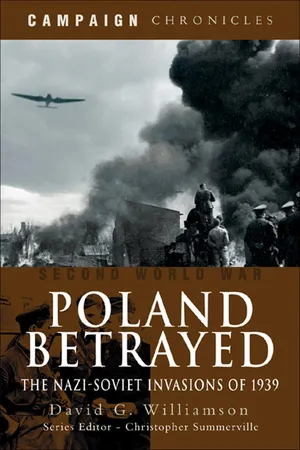
An in-depth history of the attack that began World War II, and one country's courageous fight against two unstoppable forces.
Hitler's military offensive against Poland on September 1, 1939 was the brutal act that triggered the start of World War II, wreaking six years of death and bloodshed around the world. But the campaign is often overshadowed by the momentous struggle that followed across the rest of Europe.
In this thought-provoking study, each stage of the battle is reconstructed in graphic detail. The author examines the precarious situation Poland was in, caught between Nazi Germany and the Soviet Union. He also reconsiders the pre-war policies of the other European powers—particularly France and Britain—and assesses the evolving scenario in a vivid, fast-moving narrative.
Included throughout are first-hand accounts of soldiers and civilians who were caught up in the war as well as the Polish capitulation and its tragic aftermath.
eBook - ePub
Poland Betrayed
The Nazi-Soviet Invasions of 1939
- 256 pages
- English
- ePUB (mobile friendly)
- Available on iOS & Android
eBook - ePub
About this book
Information
Campaign Chronicle

Preliminary Incidents
Britain and France had been concerned that the Germans would, through some incident on the frontier, provoke the Poles’ retaliation, which would then give Berlin an excellent excuse to declare war. In fact, Hitler had indeed given this top priority. On 5 August 1939 the head of the SD (the Security Service of the SS), Reinhard Heydrich, entrusted the 28-year-old Alfred Naujoks with the task of creating just such an incident. Heydrich observed:
There have been scores of irritating little incidents all along the frontier in the last few months […] nothing serious, just an odd shot here and there, the usual diplomatic complaints. But nothing big enough, nothing manufactured on a large scale. Nothing, in fact, to set off the powder barrel. [Source: G. Peis, p. 115.]
In order to ‘set off the powder barrel’, Heydrich outlined a complex plan for blowing up the German radio station at Gleiwitz (Gliwice). A team of six commandos were to be dressed up as Polish soldiers and seize the radio station, taking its occupants prisoner. Then, a specially picked announcer who could speak Polish was to make a provocative speech, boasting of Poland’s success in taking over the radio station. An engineer from Radio Berlin was to ensure that this was broadcast to the whole of Germany. To add a realistic detail to the operation, a Jewish concentration camp inmate was to be dressed up as a Polish soldier, shot dead, and left in front of the radio station.
On the night of 31 August the attack was successful, but the wireless expert panicked and could not find the correct landline switch, and thus was only able to broadcast on the local programme. Heydrich, however, was not bothered, as he had already leaked details of the incident to the Nazi paper, the Völkischer Beobachter. That night there were two other incidents. At 4 a.m. operation ‘Agathe’ was launched against a customs house in Hochlinden and a forester’s house in Pitschau, by a group of German SS men disguised as drunken Polish pillagers.
Gleiwitz, and to a much lesser extent the other two incidents, enabled Hitler to claim that Germany was only going to war in self-defence when he broadcast his declaration of war to the German Army at 5.40 a.m.:
The Polish state has refused the peaceful settlement of relations which I desired and has appealed to arms. Germans in Poland are persecuted with bloody terror and driven from their homes. A series of violations, intolerable to a great power, prove that Poland is no longer willing to respect the frontier of the Reich. In order to put an end to this lunacy I have no choice than to meet force with force; the German Army will fight for the honour and rights of a newborn Germany. [Source: N. Bethel, p. 2.]
31 August 1939: The Wehrmacht’s Orders
The Wehrmacht was fully deployed for Fall Weiss by midnight on 31 August, and action was scheduled to start at 04:45 hours. The orders issued were simple: German forces were to encircle and destroy the Polish Army at the earliest possible moment, so that troops could then be transferred westwards to deal with the threat of a French invasion. Army Group North’s aim was to move into the Polish Corridor and cut off Gdynia from the rest of Poland. Once the Corridor was occupied, the XIX Motorized and Panzer Corps would move east and, together with the Third Army, mount a southwards movement against Warsaw. In the south, the Tenth Army was to smash through the Polish border defences and advance rapidly on Warsaw, while the Fourteenth Army would shield its southern flank from the Polish Army Kraków and send Panzer and motorized forces deep into Poland to meet up with troops from Army Group North on the axis of Dęblin–Lublin–Chelm.
1–17 September: Fighting in Danzig, Westerplatte and the Coastal Regions
Within Danzig itself the bombardment by the old German battleship, the Schleswig-Holstein, of the arsenal at the Westerplatte, which was used as a transit base for munitions and other materials for the Polish Army, at 04:45 hours, signalled the start of attempts by the SS Heimwehr (Home Defence) Danzig Division, supported by naval commandos and some paramilitary units, to occupy the small Polish outposts and official enclaves in the city. The Polish customs and railway offices, the Polish school and the students’ hostel, as well the diplomatic mission, were all quickly occupied by SA and SS men. The Polish Post Office and the arsenal at Westerplatte, were, however, to cause the Germans considerable problems. The Post Office had originally been a German military hospital and in 1930 its structure had been considerably strengthened. All the personnel who worked in it were military reservists.
As soon as the first salvo of the Schleswig-Holstein was heard, armed police and SS men of the Heimwehr Danzig Division launched an attack against the Post Office, but it was easily beaten back. A second attack was attempted with the help of a police reconnaissance car but was again beaten back with heavy casualties. As Anton Winter, a member of the SS division, later recalled:
It was simply impossible without a great number of casualties to climb over the walls and iron gate and penetrate into the building. After the attack with the armed reconnaissance car failed, there was a short pause in the fighting. Even after a heavy army howitzer opened up fire, the defenders could still not be forced to surrender. The Poles defended the Post Office with exceptional bravery in the belief that they would be rescued by the Polish cavalry, who, as we all know would be in Berlin within seven days! [Source: R. Michaelis, p. 145 (translated by the author).]
Finally, late in the afternoon, a flame-thrower was brought up from Westerplatte and the Fire Brigade – protected by a barrage of fire – pumped petrol into the cellars and then set it on fire. This was successful and smoked out the thirty-eight defenders, who were later charged with war crimes, brought before a ‘war tribunal’ and shot.
A precondition of the German destruction of Polish land and naval forces in Gdynia and on the Hel Peninsula was the capture of the Westerplatte complex. The problem was that neither the commander of the German land forces in Danzig, Generalmajor Eberhardt, nor the captain of the battlecruiser, Schleswig-Holstein, Gustav Kleikamp, had an accurate picture of the defences of the arsenal. Optimistically it was assumed that after the Westerplatte had been softened up by a bombardment by the Schleswig-Holstein and by machine-gun fire from local police units, a naval commando force would successfully force it to surrender. In fact, the Germans faced a ring of fortified underground concrete bunkers and an elite force of 210 men under the command of Major Henryk Sucharski.
It was thus not surprising that the first German attack at 07:07 hours on 1 September was repulsed. A second attempt twelve hours later was again defeated, and the Germans had by now suffered eighty-two lost or wounded. The Poles, in contrast, lost only four men with a further four wounded, and were buoyed up with the feeling of having won their first skirmish. Kleikamp was consequently forced to rethink his tactics and reinforce his troops. Eberhardt was all for another assault as soon as possible but the news that the Poles had ‘at least’ twenty reinforced bunkers on the Westerplatte, persuaded him that caution was the better part of valour. The following day a battalion of sappers was sent by Army Group North and then between 18:05 and 18:45 hours the Westerplatte was bombarded by the Luftwaffe with devastating effect. Considerable damage was done and a further eight Poles were killed. Sucharski later conceded that if the Germans had followed this up quickly with a land attack, the Westerplatte would have fallen. The Germans, however, took their time and softened up the Westerplatte’s defences with heavy mortar fire. By the night of 5/6 September the garrison was under great pressure. Lieutenant Kregielski briefly summed up the situation:
the barracks after all the damage done to it are no longer recognizable. The soldiers […] are exhausted and the wounded lie on stretchers. The only light comes from a candle […] The hygienic situation is appalling and the air is terrible. [Source: B. Stjernfelt and K-R. Boehme, p. 113 (translated by the author).]
The soldiers were so exhausted that, in the words of Sergeant Gryczman, they were ‘shooting at shadows’ fearing that they were Germans. On the 7th, Sucharski decided to surrender. The news was received with disbelief by his men, but when they heard that the Germans had already driven deep into Poland, they realized that they had no other option. Such was the respect that the Germans gave Sucharski, that he was allowed to wear his sword into captivity.
Once the German troops had occupied the Corridor, Polish coastal and naval forces were isolated. The Naval Air Detachment force, which consisted of twenty-five obsolete planes, was rapidly destroyed by air raids. Poland’s cruiser force had already sailed for Scotland, but left behind were the destroyer Wicher, the minelayer Gryf, a division of the ships of the Jaskółka class, which were capable of carrying out both minesweeping and minelaying operations, and a torpedo boat squadron. None survived the might of the Luftwaffe for long.
On 1 September the Wicher and Gryf, together with six minesweepers and two gunboats, left Gdynia to lay a minefield south-east of the tip of the Hel Peninsula. A reconnaissance aircraft spotted the Gryf and a force of thirty-three Junker Ju 87 (Stuka) dive-bombers took off within half an hour of hearing the news. They soon found not only the Gryf busy mine-laying, but the Wicher, six minesweepers and two gunboats sailing in a convoy. There followed then what Krzysztof Janowicz has called the first naval-air battle of the Second World War:
The Junkers’ pilots divided themselves into two groups and began the attack. Diving down they tried to locate precisely their bombs, but the ships were zigzagging and shooting massive fire at them. The sea was boiling with the explosions and machine-gun bursts, the skies were filled with streaks left by projectiles and with smoke. Polish ships concentrated in a loose group shooting at Stukas [Ju 87s] and forcing them to bomb from a higher altitude. [Source: K. Janowicz, Luftflotte I, p. 32.]
A German air attack killed the commanding officer of the Gryf, wounded twenty-nine of the crew, and severely damaged a minesweeper. The Gryf returned to Hel, but the Wicher continued on patrol. Unaware of the return to port of the Gryf, the Wicher’s captain let pass a unique opportunity of torpedoing a German convoy, as he was under strict orders not to risk the main mission of mine-laying. On 3 September, however, both ships, together with shore-based artillery, beat off a German attack on the Hel Peninsula, heavily damaging one of the German destroyers, but in the early afternoon the Polish vessels were sunk by yet another German air raid.
The shore batteries and coastal defence forces formed stubborn pockets of resistance. The Hel Peninsula was defended by about 2,800 troops, while there were a further 14,000 holding the defensive perimeter on the Oksywie Heights overlooking the Gulf of Danzig. These were composed of naval and artillery units as well as workers’ militias. To eliminate these pockets the Germans assembled a corps of about 26,000 troops. Only the German 207th Infantry Division was composed of fully trained troops, while the rest were made up of various frontier or paramilitary units. After the fall of Westerplatte a further 12,000 troops under General Eberhardt became available.
Once the Luftwaffe had secured domination of the skies over Poland by 6 September, it was able to employ small groups of hydroplanes, Stukas and Heinkels to bombard and machine-gun Polish positions several times a day on both the Hel Peninsula and the Oksywie Heights. Captain Michal Pikula later described the effectiveness of their attacks on troops on the Oksywie Perimeter:
In the afternoon of 15 September our battalion was moved to [a] forest west of Suchy Dwór. At 5 p.m. the commander […] organized a briefing in a country manor […] Night was falling when we heard a hum of a hydroplane. After a while a bomb exploded in the garden, 30 feet away from our room. The explosion destroyed all the windows and we all fell on the floor. Some bigger shrapnel made a hole in the wall two foot thick and killed a beautiful Bernadine dog that was lying there. Having regained my consciousness I got up from the floor covered with glass and debris […] From ten officers taking part in the briefing eight were more or less seriously wounded. [Source: Janowicz, p. 38.]
Two days later the remaining resistance on the Oksywie Heights was broken, and the Commander, Colonel Dabek killed himself rather than surrender. The Germans then turned their attention to the Hel Peninsula, which managed to hold out until 1 October (see pp. 131–2).
1–6 September: Rout of the Polish Air Force
The German Air Force in eastern Germany on the eve of war consisted of two air fleets. In the north, Luftflotte 1, under General Albert Kesselring, which had 1,105 aircraft, including 526 bombers; and in the south, Luftflotte 4, under General Alexander Löhr, which possessed 729 aircraft including 303 bombers. To defend themselves from this armada, the Poles had effectively only 397 combat aircraft, of which 154 were medium bombers.
The senior officers of the Luftwaffe were disciples of the doctrine of the Italian air strategist, Giulio Douhet, who insisted that ‘a decision in the air must precede a decision on the ground’. Consequently, the Luftwaffe was trained to destroy its enemies’ air forces with the greatest rapidity. In a lecture on the Polish Campaign to the Military Attachés in Berlin on 24 November 1939, a German Air Force officer, Captain Kleb, observed that
The essential task of [the] Luftflotten was in the shortest possible time to gain mastery in the air over Polish territory, so that they might be free to support the advance of the Army at full strength. Three consecutive phrases can be clearly distinguished:
• Achievement of mastery in the air.
• Support of the Army, which culminated in the attack on military objectives in Warsaw.
[Source: NA AIR 40/1208.]
In fact it was not as clear cut as this. Luftflotten 1 and 4 during the first week pursued all three objectives concurrently. From the very beginning of the war the Luftwaffe worked in close cooperation with the troops on the ground.
On 1 September German plans to launch a massive attack against the PAF were upset by low cloud and fog. Consequently the planned attack disintegrated into a series of individual actions. Operation Wasserkante, the mass bombing of Warsaw, had to be cancelled. Luftflotte 1 was only able to carry out seven separate raids in the morning, five of which involved airfields. Only in the afternoon, when the clouds cleared, was Kesselring able to commit all his Luftwaffe units. In the south, where weather conditions were more favourable, most of the attacks were launched on time. The main attacks were directed against the airfields at Kraków, Częstochowa, Katowice, Krosno, Moderovka, Łódź, Kielce and Radom, but, repeatedly during the day, ground-attack sorties were made against troop concentrations.
The results achieved against ground targets were very effective and led to the disintegration of entire Polish units as the troops fled in panic. The Germans had not, however, yet succeeded in achieving their aim of destroying the Polish Air Force, even though they undoubtedly enjoyed air superiority. The Poles had been able to move their aircraft to emergency airstrips. The airfields that were attacked had been evacuated and only training aircraft were...
Table of contents
- Cover
- Title
- Copyright
- Contents
- Maps and Illustrations
- Acknowledgements
- Background
- Campaign Chronicle
- Aftermath
- Appendix I: Chronology of Major Events
- Appendix II: Biographies of Key Figures
- Appendix III: Glossary and Abbreviations
- Appendix IV: Orders of Battle
- Appendix V: Survivors’ Reminiscences
- Sources
- Index
Trusted by 375,005 students
Access to over 1.5 million titles for a fair monthly price.
Study more efficiently using our study tools.
Frequently asked questions
Yes, you can cancel anytime from the Subscription tab in your account settings on the Perlego website. Your subscription will stay active until the end of your current billing period. Learn how to cancel your subscription
No, books cannot be downloaded as external files, such as PDFs, for use outside of Perlego. However, you can download books within the Perlego app for offline reading on mobile or tablet. Learn how to download books offline
Perlego offers two plans: Essential and Complete
- Essential is ideal for learners and professionals who enjoy exploring a wide range of subjects. Access the Essential Library with 800,000+ trusted titles and best-sellers across business, personal growth, and the humanities. Includes unlimited reading time and Standard Read Aloud voice.
- Complete: Perfect for advanced learners and researchers needing full, unrestricted access. Unlock 1.5M+ books across hundreds of subjects, including academic and specialized titles. The Complete Plan also includes advanced features like Premium Read Aloud and Research Assistant.
We are an online textbook subscription service, where you can get access to an entire online library for less than the price of a single book per month. With over 1.5 million books across 990+ topics, we’ve got you covered! Learn about our mission
Look out for the read-aloud symbol on your next book to see if you can listen to it. The read-aloud tool reads text aloud for you, highlighting the text as it is being read. You can pause it, speed it up and slow it down. Learn more about Read Aloud
Yes! You can use the Perlego app on both iOS and Android devices to read anytime, anywhere — even offline. Perfect for commutes or when you’re on the go.
Please note we cannot support devices running on iOS 13 and Android 7 or earlier. Learn more about using the app
Please note we cannot support devices running on iOS 13 and Android 7 or earlier. Learn more about using the app
Yes, you can access Poland Betrayed by David G. Williamson, Christopher Summerville in PDF and/or ePUB format, as well as other popular books in History & Russian History. We have over 1.5 million books available in our catalogue for you to explore.