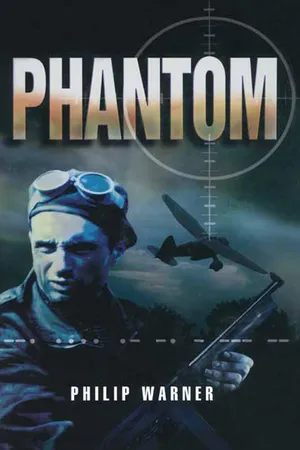
The story of the shadowy special reconnaissance unit whose intelligence helped the Allies win World War II.
It operated in Italy, Sicily, Austria, France, Belgium, Holland, and Germany. It was at Dieppe with the Commandos, in France with the SAS, at Arnhem with Airborne, and in Germany until the surrender.
Phantom—aka GHQ Liaison Regiment—was one of the most secret and most effective of the wartime special regiments. It was formed in 1939 with the mission of finding out exactly where all the Allied forward positions were—a task which required linguistic ability, unlimited tact, and radio expertise. After Dunkirk, its squadrons at first kept an eye on all invasion points, before deploying to Greece and to the Middle East.
An indispensable direct communication link between the forward patrols and command headquarters, its members were as varied and colorful as its tasks. Among them were a Cambridge college postgraduate, three professors, a famous actor-playwright, a film star, a famous sculptor, a steward of the Jockey Club, a commissioner of the Metropolitan Police, and numerous authors and journalists. This fascinating history goes beyond Phantom's aura of mystery and shows how it was so successful in its role of tracking both allied and enemy movements and relaying vital information direct to commanders.
eBook - ePub
Phantom
About this book
Information
Topic
HistoireContents
Acknowledgements | |
PART ONE | |
| 1 | Origins |
| 2 | Phantom Wins its Spurs |
| 3 | Phantom Regroups |
| 4 | Phantom Reborn |
| 5 | Phantom Gathers Experience |
| 6 | Europe Again |
| 7 | D Day and After |
| 8 | A Deceptive Calm |
| 9 | The Final Stages |
| 10 | End of Message |
PART TWO | |
| 11 | Personal Viewpoints |
| 12 | The Recollections of Light and Thompson |
| 13 | The Scene on Many Fronts |
| 14 | Working with the SAS |
| 15 | The Experiences of Denys Brook-Hart 1938–1945 |
Epilogue | |
Further Reading | |
Appendix I: Phantom Officers | |
Appendix II: Phantom Messages during the Battle of Arnhem | |
Index |
List of Maps
Greece and its Neighbours
The Western Desert and Eastern Mediterranean
Sicily and Italy
The D-Day Landings
France
Torgau
Acknowledgements
This account of Phantom is in two parts. The first part is a narrative of events as they occurred, in chronological sequence whenever possible. This part enables the reader to appreciate the detail given in the second part which consists entirely of personal experiences and recollections.
It will be obvious that I have had magnificently generous help from many people to enable me to write this book. I interviewed as many people as I could, and all were unreservedly helpful. I have no doubts that those members of the regiment whom I did not manage to see would have been just as cooperative.
My thanks are especially due to Lady Wallinger who kindly lent me photographs and gave me permission to quote from the late Christopher Cadogan’s diary and to the librarians of the Staff College, Camberley and the Royal Military Academy Sandhurst. As always, the staff at the Public Record Office at Kew were extremely helpful.
In thanking the following members of the regiment I am well aware that I may have omitted some names which should be on it. To them I offer my apologies for any unintended discourtesy. There are many other names which I would have liked to have been able to put on it but it seemed to me that fifty would give an adequate sample of views and experiences. In the event I wished I had had time to make it a hundred as I found almost everyone I interviewed recommended someone else.
W. Adam, Esq.; Dr J. P. Astbury, Major the Hon Sir John Astor, MBE, DL; I. Balfour-Paul, Esq., MC; G. F. K. Bell, Esq.; G. Brain, Esq., T.D.; Lord Bridge of Harwich, P.C., D. Brook-Hart, Esq., MC; Major A. Crawley-Boevey, MBE; Lord Cullen of Ashbourne, MBE; F. M. Cumberledge, Esq.; F. A. de Marwicz, Esq.; Colonel J. P. Fane, MC; Colonel B. Franks, MC; M. Felgate-Catt, Esq.; J. B. L. Fitzwilliam, Esq.; The Right Hon Sir Hugh Fraser, PC, MBE, MP; Colonel J. D. Hignett; P. Hincks, Esq.; B. E. Hutton-Williams, Esq. MBE; H. L. Light, Esq.; The Right Hon Maurice Macmillan, PC, MP; Lord Mayhew, PC; A. A. Maclaren, Esq.; John Morgan, Esq.; C. R. Moore, Esq. MC; David Niven, Esq.; P. S. Newall, Esq.; Professor M. J. Oakeshott, FBA; E. F. Oliver, Esq.; P. D. Pattrick, Esq. MBE; G. H. Pinckney, Esq.; R. J. H. Pogucki, Esq.; G. O’B. Power, Esq.; N. Radcliffe, Esq.; J. H. Randall, Esq.; G. F. N. Reddaway, Esq., CBE; Major Miles Reid; K. V. Rose, Esq.; D. L. Russell, Esq.; Milton Schulman, Esq.; A. R. M. Sedgwick, Esq.; Professor B. Simon; P. L. Stileman, Esq.; V. A. Stump, Esq.; Major J. A. Warre, MC; J. B. Watney, Esq.; L. Whistler, Esq.; Colonel B. R. Wood, MBE, TD; W. H. Woodward, Esq.; P. G. Worsthorne, Esq.; Sir John Wrightson, Bt, TD, DL.
Part One
CHAPTER ONE
Origins
Phantom was an unorthodox, secret, highly successful regiment which was created in 1939 and ceased to exist in 1945.* Its official title was GHQ Liaison Regiment, but official titles of secret regiments do not give much away to the curious and it would not have been an easy task to discover exactly what Phantom was up to – unless, of course, you were entitled to know. ‘Phantom’, as we see later, was originally a code-name but soon became adopted as an appropriate designation for this regiment which would suddenly manifest itself and then disappear as mysteriously as it had come. Although Phantom was active in many different theatres its existence was not widely known, and it is not surprising that since 1945 it seems to have almost disappeared from memory. But the survivors of Phantom, an enthusiastic but inevitably dwindling band, hold annual reunions, and an even more enduring tribute to the regiment is the fact that many lessons derived from its wartime experiences have proved, and still prove, of great value to the British Army.
Unorthodox, secret regiments are usually a great adventure for those belonging to them, even though the casualty Tate may be high and the fate of members, if captured, is likely to be unpleasant. Such regiments are usually regarded with extreme disfavour by the commanders of more orthodox formations who, naturally enough, resent losing some of their best officers, NCOs and men to what appear to them to be hare-brained, wasteful and ill-disciplined units. Almost invariably the men volunteering are the most enterprising, energetic and least dispensable. A regiment that has just lost, say, two first-class NCOs is not likely to be persuaded that their talents are now being more usefully employed elsewhere but generally any crumb of consolation is denied by its being almost certain that the unorthodox unit is not allowed to disclose to anyone what its achievements or failures may have been.
World War II produced a number of unorthodox formations of varying quality. At one end of the scale were units that quickly proved their worth and then went on to enhance their reputations.
Most notable among these was the Special Air Service which began in the Western Desert by destroying enemy aircraft on the ground and continued by attacking behind-the-lines targets in Italy, France, Holland, Belgium and Germany. The SAS was disbanded in 1945 but was recreated to deal with the problems of the Malayan emergency. Recently it has received considerable publicity through its televised success in anti-terrorist operations. However, the SAS insists that it is merely a regiment of the British Army with a specialist rôle.
Other wartime creations that earned many distinctions were the Commandos, whose tradition has been continued in the Royal Marines, and the Parachute Regiment, which has cheerfully accepted many routine infantry tasks. One of the most successful, though least publicized, formations was the Long Range Desert Group, which achieved miracles in intelligence work and surveillance over vast tracts of desert. Popski’s Private Army, Merrill’s Marauders, and the Long Range Penetration Group all performed well against the enemy but there were also many other units which played a very useful part. Jock Columns, Camouflage teams, Deception units, the service, and the ‘J’ service all had a brief but valuable existence.
A feature common to most of these units was that they owed their initial creation and impetus to the vision and driving force of one man, or sometimes a small group of men. Thus Stirling, Mayne and Lewes were the architects of the SAS, Haycock, Durnford-Slater and Young of the Commandos, Lord Lovat of Lovat’s Scouts, Dudley Clarke of the Deception units, and so on.
Phantom had two guiding geniuses, neither of whom, unfortunately, survived the war. They were Fairweather of the Royal Air Force and Hopkinson of the Army.
The regiment originated as an RAF unit, named No. 3 British Air Mission,* in November 1939. Commanded by Wing Commander J. M. Fairweather, DFC, its task was liaison with the Belgian General Staff. With the development of tactical air forces it had been realised, not least by those at ground level, that it was vitally important to keep the Allied Air Forces accurately informed of the exact position of troops in forward areas. In past wars the term ‘front line’ had given a reasonably accurate picture of troop disposition, although in close tactical support it was by no means unknown for the artillery to range on to their own troops by accident. But if it was difficult for the Gunners, with forward observation officers, always to know precisely where everyone was, it was nearly impossible for airmen, unless some satisfactory method of transmitting up-to-date information was involved. It is bad enough to be bombed and shelled by the enemy but intolerable to be subjected to the same treatment by one’s own comrades in arms. Unfortunately it happens – occasionally. Equally unfortunately friendly planes have been shot down by our own guns in moment of stress and confusion.
To avoid such disasters Fairweather was allowed seven officers and twenty-two other ranks to assist him in the task of discovering from the Belgian General Staff just where the forward British and Belgian troops were. (The term ‘front line’ was soon found to be no longer applicable for troops might be widely dispersed and the term ‘Forward Defended Localities’ – FDLs – was used instead.) The task was for the unit to ascertain from the Belgians where Allied troops were deployed and then transmit the information direct to the commander of the British Air Forces in France who was, at the time, Air Marshal Sir Arthur Barratt. From this information a ‘defensive bomb line’ could be made.
Clearly such a liaison unit demanded a very high degree of competence. Liaison with the Belgians was through fluent linguists, not all of whom were officers. Intelligence officers assessed the information, which was enciphered and transmitted by long-range radio sets. There was no room for failure. If the liaison officers were unable to get on with their Belgian counterparts sufficiently well to obtain all the latest information easily the mission would have little to do. Linguistic ability needed to embrace a knowledge of idiomatic French and Flemish.
In its simplest form, enciphering messages means substituting a figure, or different letter, for each letter of the original. However, as simple ciphers are easily broken by the enemy, much more complicated ones are used, perhaps using a series of numbers for each letter. The possibilities for error and thus baffling one’s own friends as much as the enemy are considerable. A single error may make the entire have to be checked and re-transmitted. The error is most likely to message incomprehensible. If an error occurs, the whole message may occur when the message is being sent over radio. A figure or a group may be lost from interference by weather, instrument failure, human error, or enemy action. A unit entrusted with the task of transmitting vital information must therefore not only be skilled at the art of obtaining it but also one hundred per cent reliable in passing it on. Patience, persistence and almost superhuman conscientiousness are essential.
Fairweather’s unit established itself at Valenciennes in the French, not the British zone, where it reviewed its duties and began training for them. Not least of its problems was the fact that the Belgians did not wish to co-operate with the Allies or do anything which might provoke the Germans to attack them. In mid-November 1939 Phantom was joined by Lieutenant-Colonel G. F. Hopkinson, mc, (North Staffordshire Regiment). Hopkinson had up till then been a part of the Howard-Vyse mission, a formation commanded by Major-General Sir Richard Howard-Vyse whose task was to liaise with General Gamelin in Paris. (Liaising with General Gamelin was said to be somewhat frustrating for the General spoke French very rapidly and almost inaudibly.) In any event the assignment was not one to suit the redoubtable ‘Hoppy’.
Hoppy and Fairy got on very well. Both agreed that all the required information coul...
Table of contents
- Cover
- Halftitle
- ABOUT THE AUTHOR
- Full Title
- Copyright Page
- Contents
Trusted by 375,005 students
Access to over 1.5 million titles for a fair monthly price.
Study more efficiently using our study tools.
Frequently asked questions
Yes, you can cancel anytime from the Subscription tab in your account settings on the Perlego website. Your subscription will stay active until the end of your current billing period. Learn how to cancel your subscription
No, books cannot be downloaded as external files, such as PDFs, for use outside of Perlego. However, you can download books within the Perlego app for offline reading on mobile or tablet. Learn how to download books offline
Perlego offers two plans: Essential and Complete
- Essential is ideal for learners and professionals who enjoy exploring a wide range of subjects. Access the Essential Library with 800,000+ trusted titles and best-sellers across business, personal growth, and the humanities. Includes unlimited reading time and Standard Read Aloud voice.
- Complete: Perfect for advanced learners and researchers needing full, unrestricted access. Unlock 1.5M+ books across hundreds of subjects, including academic and specialized titles. The Complete Plan also includes advanced features like Premium Read Aloud and Research Assistant.
We are an online textbook subscription service, where you can get access to an entire online library for less than the price of a single book per month. With over 1.5 million books across 990+ topics, we’ve got you covered! Learn about our mission
Look out for the read-aloud symbol on your next book to see if you can listen to it. The read-aloud tool reads text aloud for you, highlighting the text as it is being read. You can pause it, speed it up and slow it down. Learn more about Read Aloud
Yes! You can use the Perlego app on both iOS and Android devices to read anytime, anywhere — even offline. Perfect for commutes or when you’re on the go.
Please note we cannot support devices running on iOS 13 and Android 7 or earlier. Learn more about using the app
Please note we cannot support devices running on iOS 13 and Android 7 or earlier. Learn more about using the app
Yes, you can access Phantom by Philip Warner in PDF and/or ePUB format, as well as other popular books in Histoire & Histoire de l'armée et de la marine. We have over 1.5 million books available in our catalogue for you to explore.