A "fascinating" look at hardship, heroism, and civilian life in England during the Great War (
World War One Illustrated).
The truth about the sacrifice and suffering among British civilians during World War I is rarely discussed. In this book, people who were there speak about experiences and events that have remained buried for decades.
Their testimony shows the same candor and courage we have become accustomed to hearing from military veterans of this war. Those interviewed include a survivor of a Zeppelin raid in 1915; a Welsh munitions worker recruited as a girl; and a woman rescued from a bombed school after five days. There are also accounts of rural famine, bereavement, and the effects on families back home—and even the story of a woman who planned to kill her family to save them further suffering.
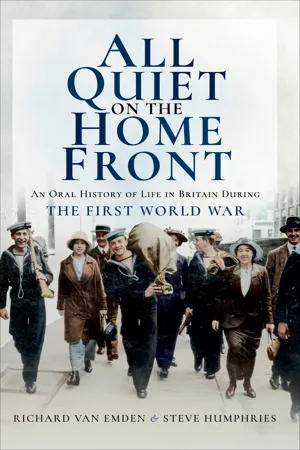
eBook - ePub
All Quiet on the Home Front
An Oral History of Life in Britain During the First World War
- 224 pages
- English
- ePUB (mobile friendly)
- Available on iOS & Android
eBook - ePub
All Quiet on the Home Front
An Oral History of Life in Britain During the First World War
About this book
Information
–CHAPTER ONE–
A Nation in Arms

YEARS BEFORE A SHOT WAS EVER FIRED ON THE Western Front, the British people were already fighting the Germans – at least in their imagination. Since its foundation in 1871, Germany as a nation had gone from strength to strength; indeed, its rise economically and militarily had been meteoric. By the turn of the new century, it could compete with Britain on almost every level. Germany was helped, in no small measure, by a dramatic increase in its population from 41 million to 65.3 million in just forty years. This rise ensured that by 1914 Germany was numerically the largest nation west of Russia, and was more than a third as big again as Great Britain.
For the British, still clinging to world pre-eminence, there was no greater threat, and books and articles speculating about German intentions flooded the market, picturing Teutonic invasions and warning Britain against complacency. Books such as Erskine Childers’s Riddle of the Sands predicted an assault by hordes of enemy soldiers, while spies abounded throughout the island. Such fear was not restricted to the adult world but passed down to the younger generation in magazines and comics, including Pearson’s Weekly, which ran a notably rip-roaring serial that had Germans invading Kent only to be foiled by gallant Boy Scouts.
Then there were the public shows for the whole family to enjoy, such as the floodlit display performed in the grounds of London’s Crystal Palace. In 1907 Vic Cole, a ten-year-old working-class boy from south London, accompanied his family to watch the spectacle. He noted later:
“The Invasion”, as it was called, featured a life-size English village complete with church and pub. Village folk walked slowly from the former and others drank beer outside the latter. Into this peaceful rural scene suddenly a German aeroplane swooped (it ran down a wire) and dropped some bombs which exploded with appropriate noise and a great deal of smoke. When the air cleared, it was seen that German soldiers occupied the village. All ended happily when the Territorials arrived and routed the enemy.’
Ruth Armstrong, the daughter of an agricultural labourer, was not even five when she began hearing about war. She grew up in Wiltshire, in the village of Tilshead, where some of her earliest recollections were of talk between her parents. ‘My mother and father kept on about this Kaiser and I couldn’t think what it was all about and they kept on, “Oh, we’re going to war, we’re going to war.” I didn’t know what war meant, but the memory has stuck in my mind as well as the question, “Who is this Kaiser?” ’
Emily Galbraith, the daughter of a Methodist minister, was born in 1895 in Fenton, a small town in the Potteries. Now aged nearly 108, she recalls with remarkable clarity the pervading acceptance that war would come between Britain and Germany.
‘In 1901, I was at a good fee-paying school in London. In class we had dual desks and I sat next to a German girl and she used to tell me that her king was coming over here to fight my king and her king was going to win. And we sat in these desks and I used to have a ruler and poke her and say my king would win and she used to poke me until we both got sore. Then, after school, on the way home, I took the train from Fenchurch Street Station. Now on this train you went into a cabin before stepping into the main carriage. Boys used to congregate in these cabins and as the train went along, we would pass over fog signals. As the train passed each signal it made a very loud noise, a hefty bang, and the boys used to shout into the carriage, “The Germans are here! The Germans are here!” It was just a bit of fun. But you see, we knew that that war was coming, we knew long before it happened.’
Many boys found the prospect of war exciting, brought up as they were on ripping yarns of empire and the thin red line. Even military disasters and defeats could be ‘spun’ into heroic deeds, from the stand made by Gordon at Khartoum to the later crisis in South Africa during the Boer War. Adult patriotism, along with the threat of a potential enemy, was commonly passed down to children, who accepted the ideas automatically and largely without question. For boys especially, who would one day defend the empire, there were other weekly papers such as The Magnet and The Boys’ Herald, which regaled hundreds of thousands of impressionable young lads with stories of derring-do; there was never any question of who would finally win.
Team spirit, personal sacrifice, dedication to the cause were extolled, teaching those who read such magazines that their country came first, over and above the self. It was a persuasive argument, fostered by the establishment not in a blatant desire to make soldiers of these boys but as a form of social control, to inculcate the notion of duty to a higher national cause.
To become a man entailed accepting a whole raft of ideals, in particular the teaching of what is often known as ‘Muscular Christianity’, which was vigorously taught in public schools. It was in essence a way of living suited to defending Britain and her empire. Boys were meant to be Christian, ready to enforce what was good and true, ‘to fight the good fight’ if necessary. Yet what was good and true was, almost invariably, synonymous with the country’s self-interest. To this end, sports were advocated, as good health was seen as almost a religious and social duty. To achieve this, boys were taught that physical health and fitness were integral to mental strength and fortitude, from which would flow integrity and honesty; no surprise then that The Boys’ Herald was subtitled ‘A Healthy Paper For Manly Boys’.
Boxing, rugby, football and cricket would instil discipline, teamwork and duty, and would set boys on the right path for life. As a by-product, such training would be of immense help should the boys be needed to play the ‘greater game’ against an enemy. Sport, in and out of school hours, built character, as Richard Hawkins, born into an upper-middle-class family, recalls: ‘My father and I used to do a lot of boxing when I was a boy. He used to kneel down so as to get to my level and then we would spar. On one occasion my parents had to call in the doctor because was a bit swollen round the glands; they thought I’d got mumps. Well, I hadn’t; my father had let fly perhaps a little bit too much.’
When war broke out ten years later, the then nineteen-year-old enlisted straight away, without question. ‘It was our duty, nothing out of the ordinary, it was obvious, to protect our country. We were the best country in the world. Oh, I don’t think we gave anyone else a thought, there was no need to. We had to go and defend the country against all invaders and to give, if necessary, our lives to do it.’
The ideals of Muscular Christianity percolated through to the lower-middle and working classes through youth organisations such as the Church Lads’ Brigade, the Boys’ Brigade, the Scouts and the Sea Scouts. Yet, before ever joining, the raw material, the boys themselves, had to be taught notions of obedience and conformity. This was first taught at home, then reinforced in school with cast-iron authority, as Londoner Vic Cole recalled.
‘The discipline at school was to be marvelled at. At the first few strokes of the assembly bell, kids would drop all games and snap into their class formation like guardsmen. There were several teachers who could rap out words of command like sergeant majors. The children would spring smartly to attention at the order, right or left turn as one man and march into their respective classrooms.’
A respect for discipline was maintained even out of school:
‘Although somewhat given to violent combat as a means of settling disputes, they were on the whole a pretty good lot of youngsters at school. Fights, though frequent, were kept clean and proper by mutual observance of the so-called “fair-play” code of those days, which laid down the various conditions under which blows could or could not be exchanged. To strike a boy smaller than oneself was definitely not done. This would bring forth cries of “coward” and “bully” or “hit one yer own size!” ’
While Vic’s schooling was rough and tumble, there were many other children in the poorest areas whose education was far more confrontational. In many schools, notions of obedience and discipline were frequently contested by older, increasingly marginalised pupils, who had little interest or belief in such codes of conduct.
It has been estimated that approximately 40 per cent of boys joined one or other of the formal youth organisations, drawn into a world in which patriotism, teamwork and mutual help were extolled as manly virtues. It is self-evident that there was another 60 per cent who were not attracted to such organisations. These were children primarily from the poorest families, boys who frequently felt little connection to the nation’s prevailling hopes and objectives. These children were suspicious of the Scouts and the Boys’ Brigade, seeing them as an attempt to exercise authoritarian control over their lives. The fact that ‘subs’ were charged to take part hardly improved matters, for it was money that the poorest families could ill afford. It is not surprising that many continued their disorganised lives, preferring unfettered fun in the back street to controlled games in the Scout hut.
The boys who did join, while attracted from many walks of life, were generally those who were ‘better behaved’. Boys’ organisations were in action everywhere. There were exhibitions at Earls Court and the Crystal Palace, where Boys’ Cavalry Brigades drilled and paraded, sponsored by some of the big daily newspapers, particularly those that led the way in reporting the ‘German threat’, such as the Daily Mail. It did not require a great leap of imagination to see these Boy Scouts, with their badges, bands and banners, making the transition to the army when the time required. These organisations had been designed to give boys experience of the adventurous life most craved. Nevertheless, when war broke out, when thousands of young men flocked to join up, those who had learnt some semblance of drill or musketry in the Scouts or Boys’ Brigades were at a distinct advantage, as one officer commissioned into Kitchener’s volunteer army saw. ‘You had four platoon sergeants which you had to choose from your men,’ recalled Richard Hawkins, ‘and by Jove if one had been in the Boy Scouts, well, he was a corporal straight away. Otherwise we had no previous experience of soldiering.’
In the days before war broke out, it would appear that only the politicians were undecided as to whether Britain should be plunged into a general European conflict. The Prime Minister, Asquith, noted in his diary for 31 July:
We had cabinet at 11 and a very interesting discussion, especially about the neutrality of Belgium . . . are we to go in or stand aside? Of course everybody longs to stand aside, but I need not say that France is pressing strongly for a reassuring declaration. We are under no obligation [to France so] that we could give no pledges and that our actions must depend upon the course of events . . . and the direction of public opinion here.
If Asquith was worried about public opinion, then he only had to look out of his window or drive around in his car for reassurance. Of course there were dissenting voices. The veteran politician and former Labour Party leader, Keir Hardie, made an impassioned speech against the war on 2 August, and later a small anti-war rally took place in Trafalgar Square. But these demonstrations quickly fell away once war was a reality. The pretext for going to war, according to a vocal and vociferous press, was an invasion of Belgian soil by Germany, and the public was seemingly in almost full support. When Germany did indeed invade Belgium, on 3 August, the country at large was hardly surprised when Britain declared war the next day. That afternoon, as Asquith’s car left Parliament, the Prime Minister noted, ‘It is curious how going to and from the House we are now always escorted and surrounded by cheering crowds of loafers and holidaymakers.’
That weekend there had been a bank holiday, which meant that at the precise moment Britain plunged into war, an unusually large number of people were in the capital. The Times had reported the excited mood:
A great majority of these holidaymakers had been attracted to London by a desire to be present in the capital in this moment of grave crisis. They were eager for news and impatient to learn what part England was to play. Miniature Union Jacks and tricolors were sold in the streets, and quickly bought . . . In the evening thousands of people gathered in Trafalgar Square and the Mall and outside Buckingham Palace. Up and down the Mall, processions, carrying Union Jacks and the French tricolor, marched continually, cheering and singing . . . The demonstration of patriotism and loyalty became almost ecstatic until at last the enormous crowd eventually dispersed in processions which flooded the streets of the West End.
Vic Cole was just one of the many thousands of people who witnessed events that day.
‘The evening newspapers were all pretty certain that before many hours Britain would be at war with Germany. In the afternoon I went up town and wandered about in front of Buckingham Palace and down the Mall. There was a great crowd of people outside the Palace and other crowds were congregating in Whitehall and towards Westminster. Later on that night, just before midnight, the word went around that, the ultimatum having expired, we were now at war with Germany. I was terribly excited; the thing that people had been talking about for years had at last come about and at any moment (I thought) the invasion of England would begin. I conjured up brave visions of myself lying behind a hedge, rifle in hand, firing round after round at hordes of Germans advancing through the fields of Kent on their way to besiege London. I wanted to be in the army with a gun in hand like the boys I had so often read about in books and magazines. Little did I realise in those days how well I had been brainwashed.’
Broadly speaking, the British public had little doubt that the Germans were responsible for the war, that Britain’s hand had been forced. As one patriot, a young girl who was to work in nursing, munitions and the Land Army, wrote, ‘I believe we’re fighting for an ethical truth, and that the war is a struggle between civilisation, and all it stands for, on one side, against Germany’s barbarism, which seems the result of their extraordinary rapid and material progress of the last forty years, which isn’t based on a solid civilisation.’ Her words were determined and sure, a mood reflected by most who associated themselves with the views of ‘middle England’. Yet behind such words of courage there was anxiety and fear, particularly among those old enough to know better.
Florence Nield, a working-class girl from Swansea, was at home when war broke out.
‘The newsboy was outside calling out that England had declared war on Germany. I was not quite fifteen years old at the time and I was quite pleased, being a youngster, I thought it was like two people sparring up to each other. My mother and father were on the doorstep and I said, “Oh lovely, we’re going to have a fight, you know,” and I was surprised when my mother gave me a quick slap.’
No one wanted to contemplate a war lasting beyond Christmas time, and there was a deep-seated desire to see it won convincingly and quickly. There was an inherent public belief in the capabilities of the British army when called to action; although in truth most military commanders, Lord Kitchener among them, saw that the war would be anything but short. Britain’s small, highly trained regular army was no match in terms of numbers for the huge German forces which, within a week of mobilisation, had 3.8 million men under arms. Kitchener foresaw that a new citizens’ army would be required, made up of volunteers.
In times of war, the government had envisaged that the regular and Territorial armies would simply grow organically, taking on new recruits and expanding as required. Lord Kitchener, who had little enough faith in the prowess of the new Territorial Force formed in 1908 with part-time soldiers, originally meant for home defence), decided to discard the idea and, as the new Secretary of State for War, create an entirely New Army of 100,000 men. However, such was the apparent enthusiasm to fight that some 300,000 civilians enlisted in August, before word ever got out that this New Amy was needed. Then, when Kitchener launched his famous appeal, epitomised by the poster ‘Your Country Needs You’, there came a second, spontaneous response, hundreds of thousands of men besieging recruiting stations set up right across the country.
One of the first to enlist, even before the appeal, was farmer’s son George Whitehead, the eldest brother of seven-year-old Len, who recalls:
‘Everybody was terribly excited, and there was nobody more excited than my elder brother George. He was going, he said, “first thing tomorrow morning”. We were having a bit of leg pulling and we sang him the song:
No more will I work in the harvest to reap the golden corn
But I’m going to join the army and I’m off tomorrow morn.
Hurrah for the scarlet and blue
See the helmets glitter in the sun
See the bayonets flash like lightning
To the beating of the old militia drum.
‘Dad didn’t want him to enlist, he tried to persuade him against going so soon – stop to see the harvest in. But George was keen to go and here was his chance, and he went into my mother’s bedroom – she was not very well at the time – and he picked up a stick which she used to rap on the floor if she wanted anything. “This is how I shall strut about the London parks,” he said, jokingly of course. It was the glamour of it all, nobody sort of gave it a second thought that they might never come back.
‘In the early part of the war, small squads of soldiers used to march through the villages – it was part of the recruiting drive, you see, and they sang a song, “You ought to join Kitchener’s Army. Seven bob a week, plenty of grub to eat, great big boots make blisters on your feet, you ought to join.” Of course we used to run alongside these soldiers; they had a drum and a fife band, or a bugle. I think we used to poke fun at them. It wasn’t military music but enough perhaps to stir some young men to want to join up.’
One of those eager to go was Jack Davis, then nineteen years old and working at the National Liberal Club in London’s Whitehall Place. He had not seen the popular hysteria on the streets as he had been working, but that did not matter and he went along to enlist on 3 September, during the first week of Kitchener’s appeal. Of all those men who enlisted, Jack, now aged 108, is possibly the very last surviving ...
Table of contents
- Cover
- Title
- Copyright
- Contents
- ACKNOWLEDGEMENTS
- Introduction
- Chapter One A Nation in Arms
- Chapter Two East Coast Bombardment
- Chapter Three The Enemy Within
- Chapter Four ‘It is my painful duty . . .’
- Chapter Five Caring for the Wounded
- Chapter Six The First Blitz
- Chapter Seven The Year of Hunger
- Chapter Eight Toil and Trouble
- Chapter Nine The darkness before the Dawn
- Chapter Ten Bittersweet Victory
- Select Bibliography
- Plate section
Trusted by 375,005 students
Access to over 1.5 million titles for a fair monthly price.
Study more efficiently using our study tools.
Frequently asked questions
Yes, you can cancel anytime from the Subscription tab in your account settings on the Perlego website. Your subscription will stay active until the end of your current billing period. Learn how to cancel your subscription
No, books cannot be downloaded as external files, such as PDFs, for use outside of Perlego. However, you can download books within the Perlego app for offline reading on mobile or tablet. Learn how to download books offline
Perlego offers two plans: Essential and Complete
- Essential is ideal for learners and professionals who enjoy exploring a wide range of subjects. Access the Essential Library with 800,000+ trusted titles and best-sellers across business, personal growth, and the humanities. Includes unlimited reading time and Standard Read Aloud voice.
- Complete: Perfect for advanced learners and researchers needing full, unrestricted access. Unlock 1.5M+ books across hundreds of subjects, including academic and specialized titles. The Complete Plan also includes advanced features like Premium Read Aloud and Research Assistant.
We are an online textbook subscription service, where you can get access to an entire online library for less than the price of a single book per month. With over 1.5 million books across 990+ topics, we’ve got you covered! Learn about our mission
Look out for the read-aloud symbol on your next book to see if you can listen to it. The read-aloud tool reads text aloud for you, highlighting the text as it is being read. You can pause it, speed it up and slow it down. Learn more about Read Aloud
Yes! You can use the Perlego app on both iOS and Android devices to read anytime, anywhere — even offline. Perfect for commutes or when you’re on the go.
Please note we cannot support devices running on iOS 13 and Android 7 or earlier. Learn more about using the app
Please note we cannot support devices running on iOS 13 and Android 7 or earlier. Learn more about using the app
Yes, you can access All Quiet on the Home Front by Richard van Emden,Steve Humphries in PDF and/or ePUB format, as well as other popular books in History & British History. We have over 1.5 million books available in our catalogue for you to explore.