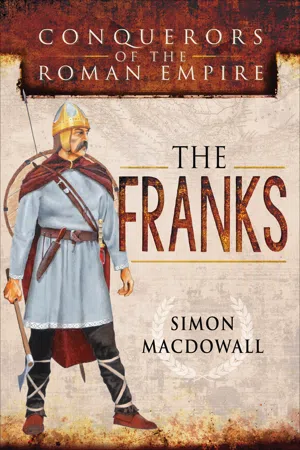
How a relatively small group of Germans came to be overlords of all of the former Roman province of Gaul—giving their name to France in the process.
Simon MacDowall studies the Frankish way of warfare and assesses its effectiveness, from their earliest incursions into the Empire, down to the Battle of Casilinum (554), their last battle against Romans, The size and composition of their armies, their weapons (including the characteristic Francisca axe), equipment, and tactics are discussed.
In this tumultuous period, the Franks had a complex relationship with the Romans, being by turns invaders, recruits to the legions, and independent allies. Accordingly, this book also covers the Franks' role in defending the Rhine frontier against subsequent invasions by the Vandals, Alans, Suebi, and the Huns. Their success in defending their new homeland against all comers allowed them, under the leadership of the Merovingian dynasty of Clovis, to establish the Frankish kingdom as one of the most enduring of the "barbarian" successors to the power of Rome.
- 216 pages
- English
- ePUB (mobile friendly)
- Available on iOS & Android
eBook - ePub
The Franks
About this book
Information
Chapter 1
The Rhine Tribes
Theodomer, king of the Franks, son of Richimer, and Ascyla his mother, were once upon a time slain by the sword. They say also that Chlogio, a man of ability and high rank among his people, was king of the Franks then, and he dwelt at the stronghold of Dispargum which is within the borders of the Thuringians. And these parts, that is, towards the south, the Romans dwelt as far as the Loire. But beyond the Loire the Goths were in control; the Burgundians also, who belonged to the sect of the Arians, dwelt across the Rhône in the district which is adjacent to the city of Lyons.
This passage, from Gregory, Bishop of Tours, is a sixth century take on the situation several decades earlier as the Franks were poised to take over most of the country we now call France – taking its name from this Germanic people who came to rule it.
Scope and Sources
The previous two books in this series told the stories of the Vandals and Goths – two East Germanic tribes that migrated thousands of miles to carve kingdoms for themselves out of the carcass of the West Roman Empire in the fifth century AD. In the process of their long migrations both peoples sacked Rome – the Goths in 410 and the Vandals in 455.
The Franks too were a Germanic people but their story is quite different. Unlike the Vandals or Goths, the Franks expanded gradually from their homes on the east bank of the Rhine to take over Roman Gaul and give their name to modern France.
Technically the Franks were not actually conquerors of Rome. They did not sack the city and, although they did invade Italy, theirs is a story of gradual expansion and absorption rather than long migration or the outright conquest of swathes of Roman territory. Indeed, their greatest conquests were against the other Germanic peoples who had previously moved into the Roman provinces of Gaul.
This book will tell the story of how the Franks emerged from the banks of the Rhine to become the rulers of France as the West Roman Empire collapsed. In doing so the tale of the other peoples absorbed by the Franks will also be told, including the Burgundians, Armorican Britons, and the Alamanni. Many of these peoples had much in common with the early Franks, rising to prominence at the same time and in similar circumstances. While the Franks gave their name to modern France, the Alamanni (also Alemanni, Alamans or Alemannen) gave theirs to the modern Germany which in French is called Allemagne. The Burgundians gave their name to modern Burgundy and the Britons to Brittany.
This is primarily a military history, examining how the Franks fought both for and against the Romans and how they managed to achieve supremacy in late Roman Gaul (roughly modern France, Belgium and that part of modern Germany to the west of the Rhine). All of this will be placed in the political, economic and social context of the times. The story of the Franks does not end when they first established their rule over France. As this series is concerned with the Germanic conquests of the Roman Empire, however, I have chosen to end their story in the mid sixth century after the last conflict between the Franks and Romans in Italy. This book does not cover the later years of the Frankish Merovingian dynasty beyond the mid sixth century.
The narrative is aimed at the general reader with an interest in the military aspects of the barbarian conquests of Rome rather than the academic specialist. In recent years there have been a number of excellent books about the end of the Roman Empire in the West and the barbarian invasions which helped to bring it about. Many of these I have found very useful in placing the story of the Franks in a wider context. I have listed the most helpful ones in the Bibliography.
Gregory, the Bishop of Tours (538–594), tells the story of the Franks from his point of view. His History of the Franks was written when Frankish kings had established their hegemony over Roman Gaul after having defeated the Alamanni, Burgundians and Visigoths. He is, however, more interested in political and ecclesiastical matters than military or social developments. As he himself says in his introduction he was interested in: ‘The struggles of kings with the heathen enemy, of martyrs with pagans, of churches with heretics.’ He does describe some military actions but these tend to be relatively small encounters focusing on the deeds of notable individuals. The larger engagements, such as the critical victory of the Franks over the Visigoths in 507, are only given a few lines with an unfortunate paucity of informative detail. The lives of the ordinary Franks and Romans are ignored.
All other contemporary accounts come from Roman sources. Of these, the writings of Ammianus Marcellinus, Procopius and Agathias are the most interesting and complete. The first was a Roman military officer turned historian who wrote a history of the Roman Empire at the end of the fourth century. He describes in detail the campaigns of the Emperor Julian against Franks and Alamanni in the 350s. As a soldier himself, he had first-hand knowledge of what ancient battle was like and he lived through the events he described. Procopius, secretary to the East Roman general, Belisarius, gives similar near first-hand information at the other end of our story. Writing in the mid sixth century he tells of the first Frankish invasions of Italy in the 550s and gives some background of their earlier years. His account is supplemented by Agathias who deals with the later Frankish involvement in Italy and also describes the fighting methods of the Franks in the sixth century from a Greco-Roman perspective.
We have very little information about the Franks before the fourth century apart from tantalizing snippets in various panegyrics to Roman Emperors and a few lines in other Roman histories. Tacitus, who wrote a detailed description of the German peoples in the first century AD, does not mention the Franks – probably because they were a later coalition of some of the tribes he described under different names. Tacitus does, however, provide quite a lot of detail about the fighting methods of the earlier Germans. He would have heard much of this from Roman officers who fought them, other aspects he probably made up to make a moral point. How much of this would still have been applicable to the Franks remains a matter of conjecture.
Naturally we know more about the Romans at the time of the initial Frankish expansion. One source which gives great detail about the structure and organization of later Roman armies is the Notitia Dignitatum. This a list of offices and army units from the end of the fourth century in the east and early fifth century in the west. This tells us the official orders of battle of the Roman army at the time the Franks were beginning to flex their muscles in Gaul. While the Notitia needs to be treated with a fair degree of caution it is invaluable in building a picture of the Roman army and political structures in the late fourth-early fifth centuries. Appendices I and II replicate the list of Roman army units in Gaul and Italy in the early fifth century. At this time the Empire was divided in two. The Western Empire was ruled from Ravenna. Rome was still the most important city in the West but it had ceased to be the seat of power during the third century. The Eastern Empire was ruled from Constantinople and it continued to survive for another millennium after the fall of the West.
Helpfully the Franks and other western Germans buried their dead with weapons and accoutrements from the fourth century onwards. This has left us with good archeological evidence to supplement the literary sources.
The Ancestors of the Franks
The Franks (or Franci) are first mentioned in late third century Roman sources. It is likely that at this time a number of smaller Germanic tribes living on the north-eastern banks of the Lower Rhine began to coalesce into a larger, loose federation. They were not the only ones. At the same time other Germanic tribes to the south moved into the Agri Decumates (the Upper Rhine Valley of modern Baden in Germany) which had been abandoned by the Romans. This triangle, bound by the Rhine, Danube, Black Forest and the Alps, was never really properly Romanized. In the first century AD Tacitus described it as a place where ‘all the most despicable characters in Gaul, all the penniless adventurers, seized on a territory that was a kind of no-man’s-land’. The southern Germanic tribes which moved into the Agri Decumates became known as the Alamanni or Alemannen (literally ‘all men’).
Those first century tribes mentioned by Tacitus which coalesced into the Franks probably included the Chatti, Chamavi, Chauci, Bructeri, Chasuari, Angrivarii, Tubantes, Tencteri and Frisii. The Frisii (Frisians) retained a separate identity into modern times so their association with the other Frankish tribes may have been more tenuous. Tacitus assessed some of the customs and military capabilities of many of these early ancestors of the Franks in some detail:
The Chatti are distinguished by hardy bodies, well-knit limbs, fierce countenances and unusual mental vigour. They have plenty of discernment measured by German standards. They appoint picked men to lead them and then obey them. They know how to keep rank and how to recognise an opportunity or else postpone their attack. They can map out the duties of the day and make sure the defences of the night… All their strength lies in their infantry, which in addition to their arms, are burdened with entrenching tools and provisions. Other tribes may be seen going forth into battle – the Chatti come out for a campaign. They seldom engage in swift rushes or in casual fighting – tactics which properly belong to cavalry with their quick successes and quick retreats.
He adds that young Chatti men were not allowed to shave their beards until they had shown bravery in battle. Our traditional view of Germanic barbarians is that they were bearded while Romans were clean-shaven. In the latter years of the West Roman Empire the opposite was true. Most Romans sported short, trimmed beards with short hair while Germans tended to wear their hair long and shaved their beards, sometimes leaving a moustache. More detail of the appearance of the Franks is given in Chapter 5.
Tacitus says that the Tencteri, who occupied the east bank of the Middle Rhine in his day, ‘excelled in horsemanship’. The degree to which the later Franks took to mounted warfare will be discussed more fully later on. Germanic tribes did not have clear delineations between cavalry or infantry as the Romans did, nor as we now understand the terms. To own a horse was a mark of wealth and prestige. If a man had a horse he would ride it for strategic mobility or to chase down scattered bands of enemies and then might dismount to fight on foot in a formal battle line. A warrior was a warrior not a cavalryman or an infantryman. He would fight on foot or on horseback according to his means and the tactical situation. Tacitus tells us that amongst the Tencteri: ‘Horses pass by inheritance along with slaves, homestead and rights of succession. The horses go to a son not necessarily, like the rest of the property to the eldest, but to the one who is the keenest and ablest soldier.’
It is quite probable that the Chamavi (also Hamavi) was the core tribe around which others coalesced to form the Franks in the third century. An inscription on a first century Roman map (the Tabula Peutingeriana) located the Chamavi on the north bank of the Rhine in the modern Netherlands with the inscription Hamavi qui et Franci – Hamavi (or Chamavi) who are called Franks.
Tacitus says that the Chamavi and Angrivarii moved into the territory of the Bructeri and nearly wiped them out. ‘We were even permitted to witness the battle. More than 60,000 were killed – not by Roman swords or javelins but (more splendid still) as a spectacle before our delighted eyes. Long, I pray, may foreign nations persist if not in loving us then at least in hating one another.’
Of some of the other tribes which may eventually have become Franks, Tacitus has only this to say: ‘The Angrivarii and Chamavi have a common frontier with the Dulgubinii, Chasuarii and other tribes of no special fame. To the northwest they are succeeded by the Frisii… They have the Rhine as their common frontier right down to the ocean. Their settlements extend around vast lagoons which have been sailed by Roman fleets.’
The Alamanni
To the south of those tribes who eventually made up the Franks, the Suebi held sway. They have given their name to modern Swabia in Baden-Württemberg (south-west Germany). Tacitus seems to lump together all the Germanic tribes as Suebi, except for those on the Lower Rhine.
They (the Suebi) occupy more than half Germany and are divided into a number of separate tribes under different names, though all are called by the generic title of ‘Suebi’. It is a special characteristic of this nation to comb their hair sideways and tie it in a knot. This distinguishes the Suebi from the rest of the Germans… Their elaborate coiffure is intended to give them greater height as to look more terrifying to their foes when they are about to go into battle.
Given that he includes the east Germanic tribes (such as the Lombards and Goths) amongst the Suebi, we can only assume that Tacitus really did not really know much about them. Those eastern tribes had little in common with those of the Upper Rhine and Danube. He claimed that the Semnones were the most powerful of the Suebic tribes but does not say where they lived. Modern historians tend to think that they may have occupied the Middle Rhine in Tacitus’ day, eventually moving further south to become part of the Alamannic confederacy. A third century Roman inscription from Augsburg equates the Semnones with the later Juthungi who lived to the east of the Alamannic heartland and who appear to have maintained a separate identity from the Alamanni.
The Hermunduri were another notable first century tribe who lived along the Upper Danube. They were broken up in the tribal movements which sparked off the Marcomannic War (see Chapter 2). Some may have been absorbed into the later Thuringians and others helped to found the Alamanni. Tacitus has this to say of them:
Nearer to us… are our faithful allies the Hermunduri. Because they are so loyal they are the only Germans who trade with us, not merely on the banks of the river, but far within our borders, and in the most flourishing colony of the province of Raetia (roughly modern Switzerland). Everywhere they are allowed to pass without a guard. While to the other tribes we display only our arms and our camps, to them we have thrown open our houses and country-seats, which they do not covet.
The Alamannic confederacy is first mentioned by the Roman author Cassius Dio describing a campaign by the Emperor Caracalla (Severus Antoninus) in the early years of the third century. ‘Antoninus made a campaign against the Alamanni and whenever he saw a spot suitable for habitation, he would order a fort to be erected or a city to be built. He gave these places names relating to himself.’
By the mid third century the Alamanni were a force to be reckoned with. Made up from fragments of earlier tribes, who then disappeared from history, they moved into the Agri Decumates which had been abandoned by the Romans. Some of them were from the Suebic tribes mentioned by Tacitus but other Suebi maintained a separate identity. In 406 some Suebi joined the Vandals and Alans when they crossed the Rhine, eventually ending up in Spain. Others remained behind in Germany to the east of the Alamanni.
Even today there is some c...
Table of contents
- Cover
- Dedication
- Title
- Copyright
- Contents
- List of Illustrations
- Maps
- Chapter 1: The Rhine Tribes
- Chapter 2: Gaul on the Brink
- Chapter 3: Rome’s Last Grasp
- Chapter 4: Defending the Rhine
- Chapter 5: Aetius and Attila
- Chapter 6: The End of Roman Gaul
- Chapter 7: From Gaul to Francia
- Chapter 8: The War in Italy
- Chapter 9: The Frankish Way of War
- Chapter 10: The Legacy of the Franks
- Appendix I: The Fifth Century Roman Army of Gaul
- Appendix II: The Fifth Century Roman Army of Italy
- Chronology
- Notable Frankish, Alamannic and Burgundian Leaders
- The Later Roman Emperors
- Glossary
- Select Bibliography
- Plate section
Trusted by 375,005 students
Access to over 1.5 million titles for a fair monthly price.
Study more efficiently using our study tools.
Frequently asked questions
Yes, you can cancel anytime from the Subscription tab in your account settings on the Perlego website. Your subscription will stay active until the end of your current billing period. Learn how to cancel your subscription
No, books cannot be downloaded as external files, such as PDFs, for use outside of Perlego. However, you can download books within the Perlego app for offline reading on mobile or tablet. Learn how to download books offline
Perlego offers two plans: Essential and Complete
- Essential is ideal for learners and professionals who enjoy exploring a wide range of subjects. Access the Essential Library with 800,000+ trusted titles and best-sellers across business, personal growth, and the humanities. Includes unlimited reading time and Standard Read Aloud voice.
- Complete: Perfect for advanced learners and researchers needing full, unrestricted access. Unlock 1.5M+ books across hundreds of subjects, including academic and specialized titles. The Complete Plan also includes advanced features like Premium Read Aloud and Research Assistant.
We are an online textbook subscription service, where you can get access to an entire online library for less than the price of a single book per month. With over 1.5 million books across 990+ topics, we’ve got you covered! Learn about our mission
Look out for the read-aloud symbol on your next book to see if you can listen to it. The read-aloud tool reads text aloud for you, highlighting the text as it is being read. You can pause it, speed it up and slow it down. Learn more about Read Aloud
Yes! You can use the Perlego app on both iOS and Android devices to read anytime, anywhere — even offline. Perfect for commutes or when you’re on the go.
Please note we cannot support devices running on iOS 13 and Android 7 or earlier. Learn more about using the app
Please note we cannot support devices running on iOS 13 and Android 7 or earlier. Learn more about using the app
Yes, you can access The Franks by Simon MacDowall in PDF and/or ePUB format, as well as other popular books in History & Military & Maritime History. We have over 1.5 million books available in our catalogue for you to explore.