An all-encompassing account of the dawn of the Edwardian era from the international bestselling author of
The Mums' Book and
Life Below Stairs.
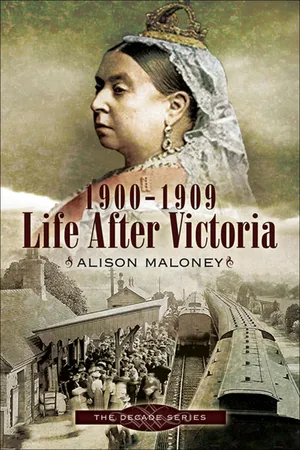
A heavily illustrated journey through the first decade of the twentieth century, the first in a series of ten books outlining the key events of the century by bestselling author Alison Maloney. Focusing on the aftereffects of Victoria's death, the riots after Edward VII's canceled Coronation, and the glories of the Edwardian era, the book will appeal to all ages with its fact boxes, clear-cut copy and period pictures, including vintage advertising. Perfect for learning more about the events that shaped the world.
- 224 pages
- English
- ePUB (mobile friendly)
- Available on iOS & Android
eBook - ePub
Life After Victoria, 1900–1909
About this book
Information
Chapter Seven
1906
Politics
EMERGING WORLD POWER
ENCOURAGED by their impressive military and naval success against Russia in the conflict over Korea and Manchuria, Japan announced plans to almost double the size of its navy by 1908. Shortly after this proud and bold claim by the emerging global power, the British government declared that its Navy budget would be £1.5m, lower than 1905.
LANDSLIDE VICTORY FOR LIBERALS
On February 7, the Liberals were formally confirmed in power after a landslide General Election victory. They had 399 MPs in the new Parliament, with the Tories trailing with 156.
One of the main reasons why they won so decisively is that voters feared there would be dearer food if the Tories were re-elected, as they gave preferential tariffs to trade from the Empire.
A strong working-class, anti-Tory movement saw the Liberals form a pact with the newly affiliated Labour Party – formerly the Labour Representation Committee – led by James Keir Hardie.
COLLAPSE OF RUSSIA’S NEW PARLIAMENT
Russia’s first elected Parliament, the Duma, soon clashed with Tsar Nicholas II when it called for amnesty for political prisoners.
It was estimated that 1,000 political prisoners a day were being sent to exile in Siberia. On November 2, workers’ leader Leon Trotsky was amongst those exiled to Siberia for life.
After further clashes, the Duma was dissolved by new Prime Minister Peter Stolypin, on July 21, and martial law declared.
BIRTHS
April 9 – British Labour Party leader Hugh Gaitskell.
December 19 – Soviet leader Leonid Brezhnev.
Royalty
ROYAL WEDDING ALMOST ENDS IN TRAGEDY
King Alphonso of Spain married Scottish-born Princess Victoria Eugenie of Battenberg – a grandaughter of Queen Victoria and niece of King Edward VII – on May 13.
The glittering ceremony at the Royal Monastery of San Geronimo in Madrid almost ended in tragedy as the King and his new bride, now called Queen Victoria, made their way back to the Royal Palace in an open carriage.
From his vantage point on a balcony overlooking the road the anarchist Mateu Morrall threw a bomb which was concealed inside a bouquet. The royal couple escaped injury as the bomb rolled it killed 18 people and injured 30 others.
DEATHS
January 29 – King Christian IX of Denmark.
Historical Events
ZULU UPRISING
A Zulu uprising against British rule met with a swift and brutal response when troops killed 60 of the rebels in March. The following month, the government sent a further 7,000 troops to South Africa, where they killed over 1,000 Zulus in fierce clashes.
MOUNT VESUVIUS ERUPTS
The intermittent eruptions from the Italian volcano Mount Vesuvius caused some concern among people living under its shadow.
The air of foreboding was shattered by a huge eruption on April 7. More than 100 people died and many more were injured from the molten lava and tremors which caused buildings to collapse.
SAN FRANCISCO DESTROYED BY EARTHQUAKE
Another devastating natural disaster occurred on April 18 when a major earthquake in San Francisco destroyed much of the city, killing at least 1,000 people.
Raging fires burnt buildings to the ground, claiming lives and causing horrific injuries. The water mains were also damaged, which meant that the city fire department had few resources with which to fight the fires.
Looters took advantage of the situation but they were ruthlessly dealt with. Soldiers, assisting police, were given orders to shoot to kill and it is estimated that as many as 500 people were shot dead in the city.
Thousands of citizens spent the night sleeping in parks or in tents on the outskirts of the city. Thousands more fled in ferries and trains as the fires continued to rage for four days.
Social Change
SCHOOL DINNERS
The new Liberal government was committed to reform to help the poorest members of society and especially to improve the health and welfare of children. One idea, the provision of meals at school, was not, however, met with universal approval: in April a headmaster told the Commons Select Committee that he thought the practice was unnecessary.
Bradford MP Fred Jowett, whose constituency had already started providing food illegally, made school meals the subject of his maiden speech. He convinced MPs that hungry children did not learn easily, and Parliament passed the Provision of School Meals Act. However, it was not compulsory and, 30 years later, only half of local authorities provided school dinners.
CADBURY FINDS LIFE IS NOT SO SWEET
Edward Cadbury and others carried out a study on wages of working class men and women in the Birmingham area. The authors found low pay and terrible working conditions in a number of industries, including the metal industry and the garment trade. They also found a vast inequality between the pay of men and women.
In the metal industry, for example, they found that, where women replaced men, they would get ‘from one third to half the wages of a man’.
The same year, Mary MacArthur attempted to redress the balance by forming the National Federation of Women Workers, and the following year she founded the monthly newspaper Women Worker.
A LONG ROAD AHEAD
The new government still had a long way to go to improve the lives of the poor – and the population was growing. A study conducted by the University of London found that birth rates among the upper classes were dropping while poorer families had a higher birth rate.
David Lloyd George declared that sixty per cent of poverty in the UK was caused by drinking and gambling. ‘Britain is the richest country under the sun yet it has 10 million workmen living in conditions of chronic destitution,’ he told the Society for Social Service of North Wales Wesleyans’ in September.
‘Drink is the most urgent problem of the hour for our rulers to grapple with. Next year the government will wrestle with it in earnest and tackle the potent forces that profit from this degradation.’
Unemployment was a huge problem, especially outside of London. In February, a group of jobless men marched on London from the Midlands to highlight the problem.
Things were looking up, though, for those at the end of their working life, with Parliament approving the principle of an old age pension which would be paid for with taxes.
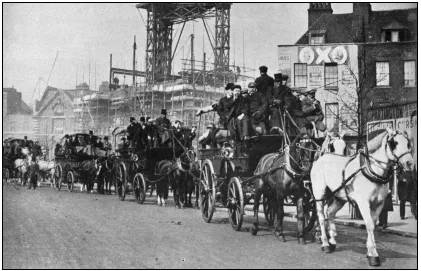
Workers taking a day out in London, whilst others marched from the Midlands in protest at high unemployment in an age before the Welfare State. In the background, new buildings are being erected and the Edwardian era was an unprecedented age for building, although there were still not enough jobs to go round.
Fashion
THE PRICE OF GLAMOUR
Ready to wear fashion was becoming increasingly popular amongst the middle classes as it was both stylish and affordable. But the glamorous outfits came at a high human cost, with most being produced in sweatshops.
Workers in the ‘sweated industries’ often worked 13 to 14 hours a day in appalling conditions, many cramped workshops providing accommodation at night. Workers’ pay was disproportionately small for the price of the garment. An intricate silk blouse, for example, might retail at around 18s but the worker would receive around 10d.
In an attempt to highlight the problem, journalist Richard Mudie Smith organised the Daily News ‘Anti-Sweating Exhibition’, supported by the paper’s owners, the philanthropic Cadbury Brothers. Opened by Princess Henry of Battenburg on May 2, the exhibition ran for six weeks and attracted 30,000 visitors to London’s Queen’s Hall.
Detailed brochures were printed and 20,000 sold. The event put the issue of sweated labour firmly on the political agenda and led to the formation of the Anti-Sweating League, which aimed to establish a minimum wage in the UK.
SCHOOLGIRL FASH...
Table of contents
- Front Cover
- Title Page
- Copyright Page
- Dedication
- Contents
- Introduction
- 1900
- 1901
- 1902
- 1903
- 1904
- 1905
- 1906
- 1907
- 1908
- 1909
- Conclusion
- Reference Works
Trusted by 375,005 students
Access to over 1.5 million titles for a fair monthly price.
Study more efficiently using our study tools.
Frequently asked questions
Yes, you can cancel anytime from the Subscription tab in your account settings on the Perlego website. Your subscription will stay active until the end of your current billing period. Learn how to cancel your subscription
No, books cannot be downloaded as external files, such as PDFs, for use outside of Perlego. However, you can download books within the Perlego app for offline reading on mobile or tablet. Learn how to download books offline
Perlego offers two plans: Essential and Complete
- Essential is ideal for learners and professionals who enjoy exploring a wide range of subjects. Access the Essential Library with 800,000+ trusted titles and best-sellers across business, personal growth, and the humanities. Includes unlimited reading time and Standard Read Aloud voice.
- Complete: Perfect for advanced learners and researchers needing full, unrestricted access. Unlock 1.5M+ books across hundreds of subjects, including academic and specialized titles. The Complete Plan also includes advanced features like Premium Read Aloud and Research Assistant.
We are an online textbook subscription service, where you can get access to an entire online library for less than the price of a single book per month. With over 1.5 million books across 990+ topics, we’ve got you covered! Learn about our mission
Look out for the read-aloud symbol on your next book to see if you can listen to it. The read-aloud tool reads text aloud for you, highlighting the text as it is being read. You can pause it, speed it up and slow it down. Learn more about Read Aloud
Yes! You can use the Perlego app on both iOS and Android devices to read anytime, anywhere — even offline. Perfect for commutes or when you’re on the go.
Please note we cannot support devices running on iOS 13 and Android 7 or earlier. Learn more about using the app
Please note we cannot support devices running on iOS 13 and Android 7 or earlier. Learn more about using the app
Yes, you can access Life After Victoria, 1900–1909 by Alison Maloney in PDF and/or ePUB format, as well as other popular books in History & 20th Century History. We have over 1.5 million books available in our catalogue for you to explore.