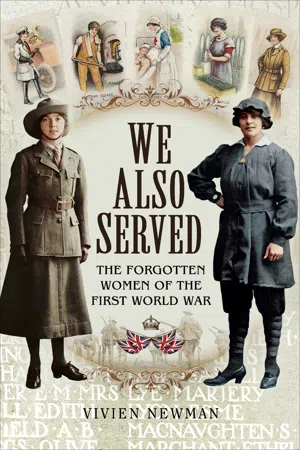
A social history of British women's brave yet forgotten service during WWI from a historian of female wartime experiences—includes photos.
At the outbreak of World War I, women looking to contribute to the Allied effort were told by the war office to "go home and sit still." Thankfully, hundreds of thousands of women from all corners of society ignored that advice and lent their collective strength to the cause. In
We Also Served, Vivien Newman digs beneath the myths surrounding women's war efforts to reveal stories of determination and heroism.
Becoming nurses, munitions workers, members of the Land Army, ambulance drivers, and surgeons, women stepped readily into a world normally occupied by men. Some served with the Armed Forces, others funded and managed their own hospitals within sight and sound of the guns. At least one British woman bore arms, and over a thousand women lost their lives as a direct result of their involvement with the war. This profoundly important history by an expert in female wartime experiences lets these all but forgotten voices finally be heard.
"A short book rich in facts and personal testimonies." —
Historical Novel Society
- 224 pages
- English
- ePUB (mobile friendly)
- Available on iOS & Android
eBook - ePub
About this book
Information
CHAPTER 1
Recruiting Women:
Sending the Boys, Knitting for the Boys, Writing for the Boys
Sending the Boys, Knitting for the Boys, Writing for the Boys
‘We answer not the call to Arms, we answer the call to…’
(Mrs Peel)
On a late July evening in 1914, Nursing Sister Violetta Thurstan attended a military tattoo on Salisbury Plain. It was, she wrote at the time, ‘one of those breathless evenings in July when the peace of Europe was trembling in the balance, and when most of us had a heartache in case England, at this time of international crisis, did not rise to the supreme sacrifice.’. The evening of military displays, riding demonstrations and massed bands drew to its close, ‘The Last Post followed,’ and, as the notes rose into the sky, this was the moment when, ‘I think somehow we all knew’.
Hilda Sebastian wrote home on 26 July 1914 from her boarding-school, Wycombe Abbey, in Buckinghamshire, ‘the soldiers all came to church this morning.’ Reflecting decades later, she believed that with the pending school holidays, ‘The appearance of the soldiers held little significance for me then,’ although her 3 August diary entry reads, ‘No one talks of anything but the war. What is England going to do?’
Sixteen-year-old Clare Leighton was unaware of ‘what was happening in the world’ beyond Suffolk; the war only impinged on her consciousness when her 18-year-old brother Roland ‘became a Second Lieutenant and disappeared to a camp.’ In Buxton, Roland Leighton’s contemporary and friend, Vera Brittain, was recording events in her diary. On 3 August she states that if England remains neutral, ‘we should be guilty of the grossest treachery’; the following day she concludes, ‘this war is a matter of life and death to us.’
Twenty-four hours earlier, near Westroosebeke, Belgium, Martha Cnockaert’s father had, ‘burst into the kitchen of our old farmhouse. “The Germans have invaded Belgium,” he breathed.’ Left to the mercy of the Germans by the retreating Belgian Army, Martha’s home was set alight by the invaders, ‘We stared fascinated [at the conflagration] till my mother gave a moan like an animal in pain, then we slowly walked into Westroosebecke.’
With Belgium invaded, many in Britain wondered, ‘When are we going in?’ During the evening of 4 August 1914, the answer came. Many of the thousands of citizens who gathered around Buckingham Palace to cheer the King and Queen felt, like 17-year-old subsequent Voluntary Aid Detachment (VAD) nurse Angela Trotter, ‘frightfully excited’, ‘thinking it was splendid that we were going into the war.’
May Cannan, Quartermaster in the Oxfordshire VAD, realised that for women this was ‘our war too’. In the north of England, 16-year-old farm worker Olive Taylor remained oblivious to what was happening, ‘England had been at war three months before I knew. I was in domestic service on a farm near the River Humber and one day as I was attending to the ducklings a shell whizzed over my head from the direction of the river.’ This was the first she knew about a war in which she would be closely involved.
Britain’s last European War had ended in 1815, 99 years ago. Popular opinion – if not Lord Kitchener’s – was that this one would be ‘over by Christmas’. As the 120,000 men of the Regular Army which formed the British Expeditionary Force (BEF) mobilised, swiftly followed by the Territorial Army, one army wife knew she would ‘never forget the almost unending roar of troop trains on the way to Southampton. My husband was one of the first to go.’ Another woman sat at a station, ‘watching trains full of soldiers go past. Suddenly I felt the tears come… all those men… those boys’. A young girl living close to where one Division was camping and who had friends in the regiment ‘got a telephone message to say that they were off that night… There was no time for more than the most hurried farewell’. However, most citizens with no obvious connection to the Army knew little about how, or even when, the Army would arrive in the field; heavily censored newspapers were not enlightening.
On 18 August The Times finally lifted the veil of secrecy which had surrounded the BEF’s movements, announcing, ‘BRITISH ARMY IN THE FIELD’. Hints of the desperate situation developing across the Channel emerged when, on 25 August, news broke of 2,000 casualties already sustained. The Sunday Times’ 30 August headline was stark, ‘MORE MEN NEEDED’. By the end of the first three weeks of war, the Press Bureau announced losses of 5,000 to 6,000 men. On 3 September, Vera Brittain noted a ‘call for 500,000 men to arms’. Yet, after the initial rush to the recruiting stations, by mid-September volunteer numbers began to dwindle. Nonetheless, casualties had to be quickly replaced.
‘One Word From YOU and He’ll Go’
In a nation with no history of conscription and a small Regular Army suffering devastating casualties and rapidly falling enlistment rates, the women of the British Empire would also be conscripted, not into the Army, but into encouraging, coercing, and indeed even humiliating men into enlisting.
As early as 30 August 1914 Admiral Charles Penrose Fitzgerald organised 30 women in Folkestone to distribute white feathers to men not in uniform. As members of the Order of the White Feathers their mission was to shame men into enlisting or fear being branded a coward. The Daily Mail enthusiastically reported their activities, hoping, like Fitzgerald, that the gesture would ‘shame every young slacker’ into enlisting. The generally female white feather distributors achieved much notoriety by frequently misjudging their targets: stories of men on leave, wounded, or in reserved occupations being handed these odious symbols abound.
How many women were actively involved in the Order of the White Feather is impossible to establish, but the numbers are almost certainly lower than popular history leads people to believe. Although in Three Guineas Virginia Woolf argues that the numbers were infinitesimal, the Imperial War Museum (IWM) Collections indicate that, whilst not widespread, there were more than Woolf’s supposed ‘fifty or sixty’. White feathers continued to feature in stories in popular women’s magazines long after the introduction of conscription, which should have laid the campaign to rest; the IWM has records of a few being distributed even in 1918. Knowledge of the White Feather Campaign remains alive and well in the collective imagination, even in the twenty-first century. The popular television series Downton Abbey featured white feather women in an episode relating to World War One.
On 4 September 1914, Baroness Orczy, author of The Scarlet Pimpernel, addressed an appeal ‘To the Women of England’, telling them that if any of them were wondering, ‘What can I do?’ the answer was simple, ‘Give your sons and sweethearts’. Orczy made it plain:
I want your men, your sweethearts, your brothers, your sons, your friends. Will you use your influence that they should respond one and all… to my crying need? … [Mothers] your sons cannot stand aside any longer… you his mother will be ashamed to look all the brave English men and women in the face.
Would-be adherents had to complete a form, and, if they included 2d in stamps, they would receive a badge and their name placed on the Active Service League’s ‘Roll of Honour’. Women had to pledge to ‘persuade every man I know to offer his services to his country and never to be seen in public with… any man who has refused to respond to his country’s call.’ The response was relatively unenthusiastic: only about 20,000 women, as opposed to the 100,000 Orczy wanted, subscribed within the first week.
Newspapers also encouraged women to undertake the recruiting sergeants’ work – frequently publishing material by contributors who felt that a man’s duty was to don khaki. A 29 August 1914 letter to The Times reminded every ‘English Girl’ that she would ‘give good help to her country by shunning a man, be he ‘lover, brother, friend’ who did not ‘take up arms’. In December 1914, the Contemporary Review advised girls to ‘cut the acquaintance’ of any sweetheart not in khaki. On 8 July 1915 ‘Ethel M’ informed ‘Jack G’, via a letter to The Times, that ‘if you are not in khaki by the 20th I shall cut you dead.’ Although we cannot know if ‘Ethel M’ really existed, it was sufficient that contemporary readers believed that she did.
The press did not depend solely on letter-writers to swell the ranks. The Daily Mail initiated its own campaigns; one which achieved notoriety used music halls, popular long before the War and renowned for the singing of patriotic songs. It commissioned prolific lyricist and composer Paul Ruben to write a women’s recruiting song to be sung nightly in ‘Music Halls, cinemas and theatres in the West End’. The resulting ‘Your King and Country Want You’ first appeared in print on 12 September 1914, having been successfully sung in Bournemouth the previous week. Profits from its 1s 1d sale (equivalent to about £2.50 in 2013) were donated to the Queen’s Work for Women Fund and by November it had run into a fifth edition. According to the commissioning newspaper, there was hardly a home in the country without a copy and, ‘all those who have heard it believe it will act as a powerful aid to recruitment.’ The newspaper patriotically waived its performance fee.
From mid-September a list of venues where it would be sung and the relevant artistes appeared in the paper – arguably this alerted the White Feather distributors, as the performance ended with those who did not show themselves ready to enlist being handed a feather, frequently by children. Social commentator Mrs Peel noted in How We Lived Then, ‘It seems strange that a call to a man perhaps to give his life, in any event to face almost unbelievable horror, did not incite words of more dignity.’ Judging by the song’s appeal, many disagreed with her.
Although sung by female artistes, other stridently pro-enlistment songs were also written by men. Arthur Wimperis and Herman Finck’s ‘I’ll Make A Man of You’ was widely sung in music halls, both to drive up recruitment numbers and raise funds. Vesta Tilley, one of the biggest stars of the day, was closely associated with such songs; she frequently strode on to the stage dressed as a Tommy wishing, ‘Jolly good luck to the girl who loves a soldier,’ and drumming up recruits.
In this context, the story of mill worker Kitty Morter (sic Eckersley, IWM Sound Recordings 4089) is simply told. A recently married young couple, Kitty and Percy Morter went to their local music hall. Army officers were also on stage. To Kitty’s distress, when Vesta Tilley marched up and down the auditorium, encouraging men to enlist, Percy was one of many who fell in behind. She remembered, ‘When we got home that night I was terribly upset.’ To no avail. Lance Corporal Percy Morter was killed on 7 July 1916, leaving Kitty pregnant with their first child. In Vesta’s defence, she became closely involved with morale-boosting concerts, performed for soldiers in military hospitals and raised thousands of pounds through her appearances in charity shows for hospital and rehabilitation funds.
Mothers were also directly targeted in songs: F.V. St Clair’s 1914 ‘Follow the Drum’, subtitled ‘Every Mother’s Son is Ready to Carry the Gun’ (with profits mounting apparently to over £1,000 given to various ‘Relief Funds’), combines ‘Mother England’ and England’s mothers whose patriotic sons will, in the words of the chorus, ‘be ready to carry a gun’. A number of mothers felt that their sons should indeed carry a gun and the question of whether an individual should enlist could divide neighbours and families.
In Buxton on 9 August 1914, Vera Brittain reports how their neighbour Mrs Ellinger was, ‘quite rude to Mother… Maurice [her son] intended signing on for 3 years.’ On 3 September, Vera noted her father’s reluctance for his son [Edward] to enlist. Mr Brittain was subjected to considerable pressure from Edward, ‘Mother and I [who] tried to make him see it from the point of view of honour.’ Mrs Brittain wrote to one of her husband’s business partners ‘asking him to use his influence over Daddy’. This conflict was a major preoccupation for the Brittain family: ‘we all discussed again Daddy’s refusal’, and the debate stretched beyond the four walls of the Brittains’ home. ‘We saw Mrs Ellinger later & she seems very strongly to disapprove of Daddy.’ Further pressure is put on Mr Brittain during a discussion of a letter in The Times ‘of a mother who said to her hesitating son, “My boy I don’t want you to go, but if I were you I should”.’ Eventually, bowing to female pressure, Mr Brittain relented, ‘Edward may enlist although he wishes it to be known that this is “in direct opposition to my wishes”.’
The subtext of Mrs Ellinger’s disdain was undoubtedly the idea that Maurice was protecting the Brittain family – something that posters and pamphlets soon conveyed to women, especially mothers. In wartime, mothers willing to offer their sons to the nation in her time of need can be portrayed as selfless and patriotic; those who ‘expect other Mothers’ sons’ to defend her and hers are condemned as unpatriotic and selfish. One early pamphlet exhorted mothers to ‘Give Your Sons’, thereby proving that they were the ‘right sort of Mother for Old England’.
A 1915 recruiting leaflet blends ideas of civic and maternal responsibilities, ‘One word from YOU and he will go.’ Others, such as the leaflet asking the ‘Women of London’, ‘Is your “Best Boy” wearing Khaki? If not, don’t YOU THINK he should be?’ implied that a man who ‘neglects his duty to his King and Country,’ might well ‘NEGLECT YOU’.
Posters directly addressing mothers’ psychological power over men soon entered the fray. According to social commentator Caroline Playne in Society at War, recruiting messages were ‘proclaimed on all available wall spaces’ in the ‘most soul-convincing way.’ One that has achieved a measure of notoriety is the Essex Recruiting Committee poster, ‘Go! It’s Your Duty, Lad, Join Today.’ The mother’s pointed arm makes it plain to her seemingly reluctant son where his duty lies. Inevitably, not all mothers were convinced. In Essex, Alexandra Grantham saw war as ‘depriving the mother of ownership in what so essentially belongs to her, the children to whom she has given birth.’ Although her published writings make her own views clear, she may have concealed these from her sons, one an officer in the Essex Regiment, the other in the Hussars.
Another widely reproduced Parliamentary Recruiting Committee poster, E.V. Kealey’s ‘Women of Britain “Say Go”,’ appeared in May 1915 when recruitment numbers were dwindling. Its sentimental image of a mother gazing out of the window as soldiers march by, whilst clutching her two children, is amongst the war’s most famous and also ambiguous posters. There is a wistful resignation on the woman’s face; she may accept the need for the men to go, yet there is little obvious enthusiasm or jingoism, more an acceptance of the necessity. Women who, embarrassingly, had no sons to give could nevertheless do their duty, as another 1915 poster addressed ‘To the Women of Britain’ makes plain: ‘You can prove your love for your country by persuading them to go.’
During the first two years, just under three million men volunteered to serve in the British Armed Forces. Such numbers joining of their own free will represented a considerable achievement. Whilst the majority enlisted out of a sense of duty and patriotism, some admitted to being ‘shamed’ into volunteering – and were resentful of those who had coerced them. Nevertheless, the numbers of volunteers remained insufficient. On 28 December 1915, according to Caroline Playne, the ‘long drawn-out controversy, round which all the emotionalism that could be spared from actual war measures… drew to its close.’ On this historic day, ‘statesmen whittl[ed] away [one of England’s] three greatest institutions, free military service.’ The Cabinet had decided to ‘introduce a measure of compulsion for military service.’
This opened the way for the January 1916 Military Service Act and the conscription, initially of single men aged between 18 and 41, and married men soon after. Writing on 9 January 1916, Kate Courtney felt that ‘the outlook seemed very black – a bitter contest against conscription added to the fierce war, perhaps a beginning of social strife which we fear will follow this war.’
In the Dominions, the need for more men was also urgent and governments considered their options. After intensive campaigning, in August 1917, the Canadian Government voted in favour of the introduction of conscription – a move that deeply divided the broadly pro-English and anti-French-speaking Canadians. Meanwhile, in Australia, full conscription was attempted twice via plebiscites. The first in October 1916 was narrowly defeated: 51 per cent of Australians voted ‘No’. A second plebiscite was scheduled in December 1917.
Inevitably both sides used posters and leaflets to gain support. Constructed to prey on the Australian males’ sense of masculinity, one striking leaflet reminded readers how the [British] Women’s Auxiliary Army Corps were ‘doing work in the shell-swept zone,’ in order to release soldiers for ‘the grim work of the trenches’. The message from the Australian Government to both women and men was clear, they should give ‘An Overwhelming Yes’ in the forthcoming plebiscite. A slightly increased majority of Australians disagreed; this time just under 54 per cent of the population remained opposed. Australian soldiers would finish the War as they had begun, as proud volunteer members of the Australian Imperial Force. Although it would continue for Australian women, by early 1916, British women’s task as recruiters was done.
‘It’s not a sock she’s knitting it’s a web of love for him’
Lord Kitchener’s pointing finger telling men, ‘Your Country Needs You’, has become one of the iconic images of the War. Women who wished to contribute their services to the war effort being advised to ‘Go home and knit socks’ has similarly entered into popular imagination. Less well known is how, requiring 300,000 pairs of socks by November 1914, Lord Kitchener and Queen Mary called upon the women of the British Empire to knit them – and Kitchener gave his name to a stitch which ensured that toes and heels we...
Table of contents
- Cover
- Dedication
- Title Page
- Copyright
- Contents
- Acknowledgements
- Introduction
- Chapter 1: Recruiting Women: Sending the Boys, Knitting for the Boys, Writing for the Boys
- Chapter 2: ‘Thank God We Have The Sisters’: Nursing Personnel at the Front
- Chapter 3: Making the Munitions of War: Guns, Shells and Food
- Chapter 4: Defiant to the End: Aristocrats, Doctors and Spies
- Chapter 5: ‘We Too Wore Khaki’: Service women on the Home and War Fronts
- Chapter 6: ‘Their graves are scattered and their names are clean forgotten’: Women who Died
- Chapter 7: Giving Sorrows Words: ‘His Name Liveth For Evermore’
- Conclusion: ‘I was very proud of my service’
- Select Bibliography
Trusted by 375,005 students
Access to over 1.5 million titles for a fair monthly price.
Study more efficiently using our study tools.
Frequently asked questions
Yes, you can cancel anytime from the Subscription tab in your account settings on the Perlego website. Your subscription will stay active until the end of your current billing period. Learn how to cancel your subscription
No, books cannot be downloaded as external files, such as PDFs, for use outside of Perlego. However, you can download books within the Perlego app for offline reading on mobile or tablet. Learn how to download books offline
Perlego offers two plans: Essential and Complete
- Essential is ideal for learners and professionals who enjoy exploring a wide range of subjects. Access the Essential Library with 800,000+ trusted titles and best-sellers across business, personal growth, and the humanities. Includes unlimited reading time and Standard Read Aloud voice.
- Complete: Perfect for advanced learners and researchers needing full, unrestricted access. Unlock 1.5M+ books across hundreds of subjects, including academic and specialized titles. The Complete Plan also includes advanced features like Premium Read Aloud and Research Assistant.
We are an online textbook subscription service, where you can get access to an entire online library for less than the price of a single book per month. With over 1.5 million books across 990+ topics, we’ve got you covered! Learn about our mission
Look out for the read-aloud symbol on your next book to see if you can listen to it. The read-aloud tool reads text aloud for you, highlighting the text as it is being read. You can pause it, speed it up and slow it down. Learn more about Read Aloud
Yes! You can use the Perlego app on both iOS and Android devices to read anytime, anywhere — even offline. Perfect for commutes or when you’re on the go.
Please note we cannot support devices running on iOS 13 and Android 7 or earlier. Learn more about using the app
Please note we cannot support devices running on iOS 13 and Android 7 or earlier. Learn more about using the app
Yes, you can access We Also Served by Vivien Newman in PDF and/or ePUB format, as well as other popular books in History & Women in History. We have over 1.5 million books available in our catalogue for you to explore.