From the author of
The Audit of War comes "a valuable read for those interested in leadership" through the 19th and early 20th centuries (StrategyPage).
Throughout history, there have been those who become leaders through effort, fate, violence, or simple luck. They are leaders of men, of armies, and of nations. Some strive for the best of humanity, while others spread death and destruction. But all change history.
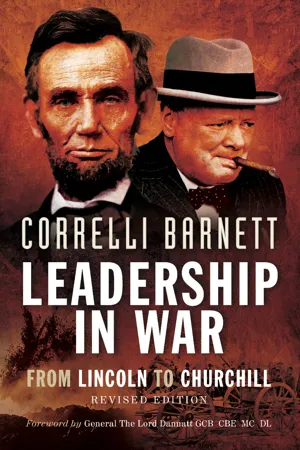
In this controversial study, Correlli Barnett examines the strengths and weaknesses of twenty wartime leaders in the nineteenth and early twentieth centuries. He considers the extraordinary difficulties they faced, and analyses how they performed and what they achieved. Were they successful, or were they beaten down by the burden of their roles? His book focuses on men from different backgrounds, from three continents in conflicts ranging from the American Civil War to the Second World War.
They include statesmen such as Abraham Lincoln, Adolf Hitler, and Winston Churchill; generals like Ulysses S. Grant, Douglas Haig, Erwin Rommel, Georgy Zhukov, and Dwight D. Eisenhower; and admirals like Isoroku Yamamoto and Bertram Ramsay. These leaders demonstrated fascinating contrasts of personal character, styles of leadership, and aptitude for command as they grappled with the daunting professional problems that confronted them.
Here, the author demolishes hallowed reputations, rehabilitates the unjustly scapegoated, and shines an unfiltered light on those who have shaped our world.
- 320 pages
- English
- ePUB (mobile friendly)
- Available on iOS & Android
eBook - ePub
About this book
Information
PART I:
The Nineteenth Century
PROLOGUE
The Romantic Ideal of Leadership
The career and character of Napoleon Bonaparte, the self-crowned ‘Emperor Napoleon’, supply the essential prelude to the studies of leadership in war in this book. Throughout the nineteenth and twentieth centuries, Bonaparte was to be celebrated by the romantically-minded as the very incarnation of martial genius. He was to be admired by those military historians (such as Basil Liddell Hart and David Chandler) who treat campaigns and battles as if they were games of skill played for their own sakes; and who discuss the performance of military commanders as one might discuss the stroke-play of cricketers or tennis-players.
Yet these approaches are fundamentally wrong-headed. War is not a romantic stage-play in which to play the hero; nor is it a game or a duel. And nor is it, as some western liberal thinkers would have it, a violent and meaningless breakdown in a natural order of ‘peace’. War is simply an available political instrument, as Clausewitz acutely pointed out in his book On War, and Lenin and Mao Tse Tung well understood.
War may serve as a last resort when all attempts at resolving a political dispute by negotiation and compromise have failed – no matter whether the dispute is between sovereign states or within a state, as in the run-up to the American Civil War. It may be willingly chosen as the instrument of policy of a sovereign state seeking either territorial expansion or control over foreign markets and sources of raw materials. Or it may serve the purpose of a revolutionary movement seeking to overturn an existing political and social order. And it may even supply the bloodied cutting edge of religious zeal, as in Europe during the sixteenth and seventeenth centuries or with Islamist militancy today.
Nonetheless, it is war regarded as an instrument of state policy that has constituted the norm in western society for more than four centuries. The utility of this instrument in any particular case can only be measured by the war’s political and economic consequences. The wisdom of a national leader in resorting to this instrument can only be judged in the light of his own prior assessment of what those consequences are likely to be.
The consequences of Napoleon Bonaparte’s wars, entirely unforeseen by him, are easily stated: the destruction of his self-build empire, and the lasting reduction of France from the superpower of Europe to a country in long-term decline, while he himself ended his career not as emperor of the French but as a prisoner of England on St Helena, a remote island in the South Atlantic.
How could all this be, given that (as myth would have it) he was a political and military genius? His admirers have done their best to explain the paradox. They say that there was a ‘turning-point’ in his career after which his political and military judgement deteriorated, although opinions differ as to exactly when this supposed turning-point occurred. Medical explanations have proved popular too: it is alleged that had it not been for painful piles in the anus or incipient cancer, Bonaparte must certainly have won the Battle of Waterloo. Then also it is argued that he was again and again let down by his subordinates. For example, it is alleged that it was all Marshal Ney’s fault that the day of Quatre-Bras and Ligny in 1815 did not end in the total destruction of the Prussian army under Blücher; and Ney’s and Marshal Grouchy’s joint fault that Bonaparte lost the climactic battle of his career at Waterloo two days later.
But there is a simpler explanation as to why Bonaparte’s career ended in such utter ruin. It is this: he was not a political and military genius at all, but an overconfident gambler pursuing from start to finish a fundamentally unsound system of war and statecraft.
It must always be remembered that Bonaparte was no mere soldier obediently implementing decisions already made by politicians in government. Even before his first campaign in 1796 as commander-in-chief in Italy, he had been closely involved in policy-making and strategic planning by the revolutionary régime in Paris. After he became ‘First Consul’ in 1799, he was the government, and remained so for the next fifteen years. So he alone was the author of his ultimate ruin.
The calamitous process of launching France into military adventures that were against her true long-term interest began with Bonaparte’s renowned Italian campaign of 1796–97. By 1795 France was bankrupt after six years of revolutionary turmoil and war against much of Europe. Her plight really demanded a compromise peace, whereby the existing régime, the so-called Directory, gave up its annexationist demand for the ‘natural frontier’ of the Rhine from Basle to the sea. Such a peace could have made possible much-needed retrenchment and reconstruction at home; and perhaps even opened the way to a deal with the exiled King Louis XVIII in order to heal the deep rift in French society since the revolution.
But the loss of prestige entailed by a compromise peace would spell political doom for the Directory. And so, on the advice of General Bonaparte, the Directory instead decided to gamble on being able to dictate ‘a glorious peace’ to their principal enemy, Austria. The gamble would involve, firstly, the conquest of northern Italy, and thereafter the invasion of Austria itself via the Tyrol. The pillage of Italy en route would not only pay for the campaign and supply the army, but also rescue the French state from bankruptcy.
So just like a modern capitalist seeking to avert a cash-flow crisis by stripping and selling assets, the Directory and its general set out on their ambitious march.
* * *
It is this Italian campaign of 1796–97 which above all others has been praised ever since by Bonaparte’s admirers as a marvel of strategic invention, daring and leadership. Bonaparte, so the legend goes, threw off the shackles of eighteenth-century warfare, with its elaborate supply trains and consequently slow advances, and its preoccupation with besieging fortresses. Instead he inaugurated a new era of warfare – fast-moving manoeuvre leading to decisive battles with all forces united, to victory and a triumphant peace. But in reality the Italian campaign displays a different model; and one which was to recur in every campaign Bonaparte fought.
In the first place, Bonaparte’s method of providing cash-flow and supplies for his army by stripping the assets of Italian states soon led to unexpected and potentially disastrous results, for the outraged population rose in widespread revolt, so forcing Bonaparte to disperse much of his strength in protecting his own communications and putting down the insurrections with fire and sword. The Bonapartian shortcut solution to the problem of supply in fact led him straight into a morass of political and social complication, and just at the time when he was desperately fending off Austrian counter-offensives. Far from Bonaparte going effortlessly from success to success in 1796, he was writing in November: ‘Perhaps we are on the verge of losing Italy.’1 And the pattern was to repeat itself in Egypt in 1798, in southern Italy in 1806, in Spain in 1808, in Russia in 1812 and finally in Germany in 1813. In each case the forcible extortion of money and goods, coupled with his high-handed interference with local institutions, led to popular uprisings, with all their serious political and military consequences. In Spain, a country so large and so barren but inhabited by a uniquely proud and ferocious people, Bonaparte’s favourite methods of repression – shootings and burnings of villages – failed for the first time to quell the trouble. Hence his system of supply by pillage failed to work; and the Duke of Wellington and the Spanish guerrilleros between them brought the French armies to ultimate disaster.
A second basic flaw in Bonapartian warfare also manifested itself in that inaugural campaign in Italy. Because Bonaparte advanced without adequate supplies or transport, it was absolutely vital that he won a quick decisive victory. To an army living from hand to mouth by pillage, any unexpected hold-up, any unexpectedly prolonged march, carried with it the danger of starvation and the collapse of the campaign. Within a week or so of Bonaparte’s first celebrated victory at Montenotte over the Piedmontese, the dearth of food, forage and ammunition was such that retreat seemed inevitable.
Since every one of Bonaparte’s campaigns was similarly an immense gamble on inadequate logistic margins, he again and again was to face supply crises threatening him with imminent catastrophe. In 1799 when Bonaparte’s march across the Sinai from Egypt into Palestine was blocked by an unforeseen Turkish fort at El Arish, he wrote that the army was ‘in a situation where the least delay could become disastrous for it’.2 In 1800 when during his crossing of the Great St Bernard Pass into Italy he was blocked by the Austrian-held fort of Bard, he wrote to his chief commissary that the army was ‘exposed to dying of starvation’; and he signalled his chief-of-staff that ‘the destiny of Italy, and perhaps of the Republic, depends on the taking of Fort Bard!!’3
The march in 1805 from the invasion camp at Boulogne to the Danube in order to surround the Austrians at Ulm is often cited as one of Bonaparte’s most brilliant exploits. In fact, so inadequate proved the Bonapartian system of subsisting off the country, so ramshackle his supply arrangements, that only the ineptitude of the enemy saved him from disaster. As Bonaparte himself acknowledged at the time, ‘had the army suffered some reverse, the lack of magazines would have led us into the greatest difficulties’.4 And, striking an already familiar note, he told his intendant-general that delay in sending up supplies ‘could have the most disastrous effects on the army and the Empire’.
Even when, in the poverty-stricken countryside of East Prussia and Poland in 1806–07, Bonaparte did revert to the eighteenth-century system of supply depots and wagon trains to bring the supplies up to the troops, he could not bring himself to tailor his strategy to his limited logistic resources. As a consequence, his army once again faced the near prospect of destruction by hunger. Bonaparte wrote to his intendant-general that ‘It is the penury of victuals which shackles all operations’, and to a minister that ‘Today the destiny of Europe and the grandest calculations depend on supply’.5
Yet this campaign, like all his previous ones except the invasion of Palestine, ended in a victory. How was it that so far none of these repeated supply crises had actually brought him to disaster? The answer lies in the mistaken strategies of his enemies. They had almost always been kind enough to come forward to meet him in battle, often in ill-conceived offensives of their own, thus offering him the gift of that early decisive encounter upon which his gambler’s system so much depended. And when they lost that initial battle, they gave up the fight and made peace overtures – often thanks to a ‘peace party’ at court, as was the case with Piedmont in 1796 after the Battle of Montenotte. His enemies failed to adopt the one strategy necessarily fatal to a commander like Bonaparte working on the slenderest of financial and logistic margins – a war of evasion; protracted war.
It was the Russians in 1812 who stumbled on this strategy by accident. In planning his invasion of Russia, Bonaparte certainly recognised that his Grande Armée of 450,000 men and thousands of beasts could not live off so poor a country as Russia, and he therefore made the most elaborate plans – on paper – for stocking depots along the route of advance, and wagon trains to shift supplies forward to the troops. But the reality fell far short of Bonaparte’s grandly optimistic orders, while the scarce and mud-bound Russian roads could not in any case carry the necessary volume of traffic.
Within two weeks of the start of the invasion, the Grande Armée was reduced to marching on an empty stomach in true Bonapartian style. As a consequence, Bonaparte himself, again true to form, hungered ever more desperately for the deliverance of a decisive battle. However, squabbles within the Russian high command prevented them from offering this battle. Thus fortunately spared a Bonapartian onslaught, the Russians retreated ever deeper into their vast country, while Bonaparte vainly pursued them. Every mile of road saw his supply crisis sharpen and his army melt away. At Vitebsk he was down to 230,000 men; at Smolensk to 156,000. Nevertheless, in the most dangerous gamble of his career, he still pressed on in search of victory. When he at last entered Moscow the Grande Armée was reduced to only 100,000 men.
He now found himself in a familiar enough situation, though this time on the grand scale: outwardly a picture of successful conquest, but actually one of growing weakness and peril. In all his previous Continental campaigns his enemies had got him off the hook by rashly attacking him or asking for an armistice. The Russians did neither. The weeks passed; the Russian winter approached. At last Bonaparte faced the fact that he had no alternative but to retreat, and on 14 October 1812 issued the preparatory orders.
So finally it had come to pass – that total collapse of his strategy, that destruction of his army, which had very nearly occurred so many times before.
And other nations would learn from the Russian experience. Never again would Bonaparte enjoy the essential prerequisite of his earlier successes – opponents who conveniently played into his hands.
It had taken him sixteen years to rise from command of the army of Italy to the supreme height of imperial power he enjoyed on the eve of the Russian adventure. But after his return from that adventure, sixteen months sufficed for him to lose it all. It was not, as some have argued, that his military talents and energies had decayed. His performance as a strategist and commander in the field in 1813–14 was neither better nor worse than in, say 1796–97. His vigour (measured by volume of correspondence and strenuousness of activity) was even greater. However, he failed to perceive that he was now operating in a fundamentally altered political and military environment, and hence he failed to adapt accordingly. Instead he went on stubbornly clinging to his old formula of seeking a great victory in battle and then dictating a peace. He was like a gambler sticking to a favourite system even when the game has swung persistently against him.
It was not Bonaparte who had changed in the years 1812–15, but his enemies: the Austrians, the Russians and the Prussians. In the German campaign of 1813, they refused to be discouraged by his initial successes at Lützen and Bautzen; and in the second phase of the campaign adopted a strategy of evasion which wore out Bonaparte’s troops in ineffective marches and counter-marches. After gradually netting him from north, east and south, they destroyed his tired and outnumbered army in the three-day Battle of Leipzig.
Next year, Bonaparte’s attempted defence of France against invasion saw this pattern repeated: delusory initial successes, an army worn out by forced marching, and enemy columns closing relentlessly back towards Paris despite all Bonaparte’s frantic thrusts this way and that.
And even if in 1815 Bonaparte had managed to win the Battle of Waterloo itself, the allies would have followed the same strategy of wearing him down into defeat by superior numbers and protracted campaigning.
* * *
Yet what of Bonaparte as a fighting commander? What was the secret of that run of victories in battle from Montenotte in 1796 to Ligny in 1815? He has been presented as the inventor of a wonderfully flexible ‘Napoleonic’ system whereby army corps marched separately from each other but came swiftly together at the decisive moment. He was, so his admirers believe, a master of concentration of all forces on the battlefield. Yet time and again Bonaparte is found waiting for a subordinate corps commander to arrive on the field with desperately-needed reinforcements – Desaix at Marengo in 1800, Davout at Austerlitz in 1805, Davout and Ney at Eylau in 1807, Ney at Bautzen in 1813 and at Ligny in 1815, and Grouchy at Waterloo. Lack of orders or muddled orders could lead to major formations failing to take part in a battle at all. This was the case with Bernadotte’s corps at Jena and Auerstädt in 1806 and again at Eylau in 1807; the case with Bertrand’s corps at Lützen and Souham’s at Leipzig in 1813; and d’Erlon’s corps on the day of Quatre-Bras and Ligny.
On the morning of the Battle of Waterloo on 18 June 1815, Wellington and Blücher, the Prussian commander, lay near enough for cooperation in a joint battle. Bonaparte, however, had divided his own army by despatching Marshal Grouchy with 20,000 men to pursue the Prussians in retreat after the Battle of Ligny the previous day, but in the wrong direction: eastwards instead of northwards. This mistake landed Bonaparte with the task of fighting against an ever-heavier superiority of numbers as the day of Waterloo wore on.
In fa...
Table of contents
- Cover
- Title Page
- Copyright
- Contents
- Dedication
- List of Plates
- Foreword
- Preface
- Introduction
- PART I: The Nineteenth Century
- PART II: The Great War 1914–18
- PART III: The Second World War 1939–45
- Maps
- Acknowledgements
- Bibliography
- Index
Trusted by 375,005 students
Access to over 1.5 million titles for a fair monthly price.
Study more efficiently using our study tools.
Frequently asked questions
Yes, you can cancel anytime from the Subscription tab in your account settings on the Perlego website. Your subscription will stay active until the end of your current billing period. Learn how to cancel your subscription
No, books cannot be downloaded as external files, such as PDFs, for use outside of Perlego. However, you can download books within the Perlego app for offline reading on mobile or tablet. Learn how to download books offline
Perlego offers two plans: Essential and Complete
- Essential is ideal for learners and professionals who enjoy exploring a wide range of subjects. Access the Essential Library with 800,000+ trusted titles and best-sellers across business, personal growth, and the humanities. Includes unlimited reading time and Standard Read Aloud voice.
- Complete: Perfect for advanced learners and researchers needing full, unrestricted access. Unlock 1.5M+ books across hundreds of subjects, including academic and specialized titles. The Complete Plan also includes advanced features like Premium Read Aloud and Research Assistant.
We are an online textbook subscription service, where you can get access to an entire online library for less than the price of a single book per month. With over 1.5 million books across 990+ topics, we’ve got you covered! Learn about our mission
Look out for the read-aloud symbol on your next book to see if you can listen to it. The read-aloud tool reads text aloud for you, highlighting the text as it is being read. You can pause it, speed it up and slow it down. Learn more about Read Aloud
Yes! You can use the Perlego app on both iOS and Android devices to read anytime, anywhere — even offline. Perfect for commutes or when you’re on the go.
Please note we cannot support devices running on iOS 13 and Android 7 or earlier. Learn more about using the app
Please note we cannot support devices running on iOS 13 and Android 7 or earlier. Learn more about using the app
Yes, you can access Leadership in War by Correlli Barnett in PDF and/or ePUB format, as well as other popular books in History & Military & Maritime History. We have over 1.5 million books available in our catalogue for you to explore.