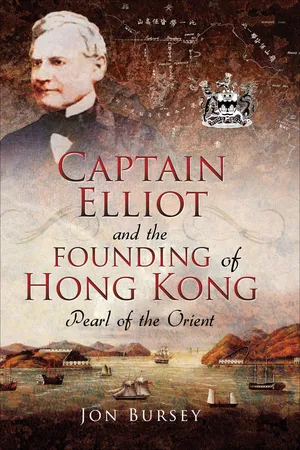
An in-depth look at the life of Captain Charles Elliot—from his Royal Navy career to his controversial role in establishing Hong Kong as a British colony.
On January 26, 1841, the British took possession of the island of Hong Kong. The Convention of Chuenpi was immediately repudiated by both the British and Chinese governments and their respective negotiators recalled. For the British this was Capt. Charles Elliot, whose actions in China became mired in controversy for years to come.
Who was Captain Elliot, and how did he find himself at the center of this debate? This book traces Elliot's career from his early life through his years in the Royal Navy before focusing on his role in the First Anglo-Chinese War and the founding of what became the Crown Colony of Hong Kong. Elliot has been demonized by China and for the most part poorly regarded by historians. This book shows him to have been a man ahead of his time whose views on slavery, armed conflict, the role of women and racial equality often placed him at variance with contemporary attitudes. Twenty years after the return of Hong Kong to China, his legacy is still with us.
- 296 pages
- English
- ePUB (mobile friendly)
- Available on iOS & Android
eBook - ePub
About this book
Information
Topic
StoriaSubtopic
Biografie in ambito storicoPART ONE
Chapter One
Forbears, Father and Family
When Charles Elliot was born on 15 August 1801, his father Hugh was 49, well over half way through a career in which he distinguished himself as a soldier and a diplomat. The Elliot clan was well-known in the Scottish Borders and in the upper echelons of British society and had already produced a number of accomplished lawyers, statesmen, diplomats, sailors, and poets.
In earlier, more turbulent, times the Elliots had become prominent for rather different reasons. A late nineteenth century chronicler of the clan’s beginnings in the border country says that it was at the start of the sixteenth century that they began to feature with increasing frequency, ‘chiefly at first in the criminal records, and later in the letters of the English border officers … Like their neighbours the Armstrongs, they were not only one of the most powerful, but also one of the most lawless and unruly of the Border clans’.1
The first Sir Gilbert Elliot (c. 1650–1718), great-grandfather of Hugh) made his money in the law, having established a substantial practice as an advocate by the time he was knighted in 1692. His wealth enabled him to purchase three Border estates in 1696 and 1697, and in 1703 he bought Minto, mid-way between modern day Jedburgh and Hawick, which he made his principal seat.2 It remained the family home of the Minto Elliots almost continuously for the next nearly three hundred years.3 Sir Gilbert had in 1700 become a baronet; the title passed on his death to his elder son (c.1693–1766), also named Gilbert and also an advocate. Like his father, the second baronet adopted the judicial title Lord Minto, served for a time as Member of Parliament (MP) for Roxburghshire, and became a senior figure in the Scottish legal system. He and his wife Helen Steuart had nine children, including Gilbert (1722–77), who in due course became the third baronet. This was Charles Elliot’s grandfather, a prominent politician and scholar who served as an MP for twenty-four years4 and, among other offices, as a Lord of the Admiralty and Treasurer of the navy.
Hugh Elliot was the second of Sir Gilbert’s sons. Of his siblings, five brothers and two sisters, Hugh was closest to his elder brother, Gilbert. The two boys were tutored at home until 1764 when on advice given by their father’s friend, the philosopher David Hume, they travelled to Paris to attend the Pension Militaire at Fontainebleau. After two years there the brothers returned to Britain, attending the Universities of Edinburgh and Oxford. Their ways then parted. Gilbert embarked on further study at Lincoln’s Inn, while in 1770 Hugh went back to France, to the Military Academy at Metz, in anticipation of the military career to which he had provisionally been committed as a boy.5
Many years later Hugh Elliot’s granddaughter Emma (Nina), Countess of Minto, wrote a biography of him.6 An admirer of Charles Elliot, Sir Henry Taylor, commented to Charles that
In talking to N[ina] three weeks ago of your father as he appears in her book, she said to me what I had been saying once and again to others, that you were the person in whom he seemed to be reproduced, and that the resemblance was constantly coming out.7,8
Nina was born just six years before Hugh Elliot’s death and her view of him, and hence of the likeness between him and her uncle Charles, will have been based largely on the perceptions of others (though it may be nonetheless valid for that) and on the record of what he did; Taylor on the other hand had almost certainly been at least acquainted with him and was a close friend of Charles. In Hugh Elliot’s personal and professional life can be seen indications of the characteristics that would be passed on to his children and particularly – if Nina and Taylor are to be believed – to his son Charles.
The first setback in Hugh Elliot’s career came early. The practice of purchasing military commissions had since the late seventeenth century become a widespread method of officer entry to the army, and during the eighteenth century it became commonplace also for commissions to be bought for children. Hugh had been granted a commission in the Guards when he was ten, but notwithstanding his military education, it was not confirmed.9 There were however other options. Military experience of a full and direct kind could be had not by merely enlisting in an army but by joining a war. Hugh Elliot accordingly launched himself straightaway into active service by signing on as a volunteer with the Russian forces in their 1768–74 conflict with the Turks. Though his time as a soldier was brief, Elliot by all accounts distinguished himself in the 1773 campaign, earning praise from the Russian commander, General P.A. Rumyantsev, for displaying ‘a truly British courage’.10
Military experience, even if short as in Elliot’s case, was often a precursor for a diplomatic career, and at what may seem the very early age of 22 Hugh Elliot was given his first diplomatic appointment, as Envoy-Extraordinary to the Elector of Bavaria in Munich. There was no requirement for aspiring diplomats to receive any special training, and willingness to serve abroad was seen as an important attribute.11 Except for two years (1790–92) in which he worked unofficially as a special agent (see below), Hugh Elliot undertook formal diplomatic assignments for a total of thirty-two years, from 1774 to 1806. From Munich he was posted to Berlin (1777–82), Copenhagen (1783–89), Dresden (1792– 1802), and Naples (1803–06).
The Berlin appointment, Envoy-Extraordinary to the Prussian King Frederick the Great, was an important one in the light of Prussia’s role as a major European power. During his tenure, however, Elliot was reprimanded by the British government for encouraging the theft of papers from visiting American agents, an incident which would prove to be one of several blots on his copybook in his diplomatic career. It was symptomatic of an impulsive, maverick streak, a characteristic which, according to his granddaughter, his brother-in-law William Eden described as ‘a predominancy of Hotspur vivacity’.12 He could nevertheless also be calculating and charming; the French General Comte Roger de Damas, who knew Elliot in Naples, wrote
I often saw Elliot, the English Minister, an extremely pleasant and attractive man, with an active but ill-regulated mind, and always with two aims in view: the service of his government, and his own advancement. If there be two ways of attaining his desire he will always choose the one with the more conspicuous effects. He is keenly imaginative, insincere, unscrupulous and unprincipled: in short he is as dangerous in public affairs as he is amusing in society. Every man in office should fear him, and deal cautiously with him; while a man who takes an interest in affairs and is free for the moment but may be employed for the future should conciliate him, distrust him, and study him – but will certainly enjoy meeting him.13
Despite his inclination to the unorthodox, or perhaps because of it, Hugh Elliot achieved some notable successes as a diplomat. The negatives continued to build, however. In 1779 he had married, after eloping with her, the young Prussian heiress Charlotte von Kraut, but the marriage was soon in trouble. She did not go with her husband to Copenhagen; reports reached Elliot there of her continuing infidelity, and in 1783 he divorced her. That was an unusual thing to do at that time, but not as startling as his earlier challenging of a suspected lover – a cousin of Charlotte – to a duel. Elliot was not seriously wounded, but the incident was much talked about in diplomatic circles and is likely to have done significant damage to his reputation. There was one child of the marriage, a daughter, Isabella, born in 1781.
It was probably during his time in Denmark that Hugh Elliot married again. We know little about Margaret Lewis Jones, Charles Elliot’s mother.14 In her biography of Hugh, Nina mentions her in describing a visit to Dresden in 1799 by his brother Gilbert, now the first Earl of Minto: ‘Some years had passed since the brothers had met, and in the interval Hugh Elliot had married a beautiful girl of humble birth, but whose personal qualities justified his choice’.15 Lord Minto himself, writing to his wife, was more effusive: ‘She is very handsome – her face and head remarkably pretty, in so much that the celebrated Virgin of Raphael in the gallery, one of the finest pictures I ever saw, is her exact portrait….’16 As well as being beautiful Margaret was to prove a loyal wife. She died in 1819, aged 49, having borne nine children.
Following his time in Copenhagen Hugh Elliot had three years to wait before his next posting, but the interval was constructively spent. Then as now governments made use of unofficial agents to influence, cajole and persuade in circumstances in which the formalities of diplomatic exchange would have been disadvantageous or otherwise inappropriate. In the constitutional uncertainty of immediate post-revolution France no decision-making machinery had yet been established for authority to take the country to war; the matter became urgent in 1790 when conflict threatened to break out between Britain and Spain over Nootka Sound, a disputed trading post off Vancouver Island, and Spain called on France to commit itself in support. British attempts to prevent such a commitment were made through formal diplomatic channels, but they were not considered sufficient. Two men, William Miles and then Hugh Elliot, were sent to France to make unofficial contact with members of the new National Constituent Assembly, who included Elliot’s old friend and fellow student, the Comte de Mirabeau. Their work was successful. Importantly, the British Ambassador to France was fully aware and supportive of what was being done. Perhaps with examples of Hugh Elliot’s past unpredictability in mind, the Prime Minister, Pitt, had cautioned him specifically that,
whatever confidential communications may take place with the Diplomatic Committee [of the Assembly] for the sake of bringing them to promote our views, no ostensible intercourse can be admitted but through the medium of accredited Ministers or the Secretary of State for Foreign Affairs, and that in the name of the King.17
Elliot will have found his mission to France temperamentally more to his liking than his years in Copenhagen. He was subject there to bouts of gloom and despondency; like other diplomats posted to northern Europe, he found the climate and environment depressing, writing to Pitt in 1788 of ‘this dismal abode’ and of ‘…a chilling Danish fog, when the distinction between air and water seems to be lost and I only acknowledge my own existence by the intenseness of rheumatic complaints’.18,19 British diplomats abroad were also inclined to complain about their salaries, which were often found to be inadequate; Hugh Elliot had himself accumulated a critical level of debt while he was at Munich, prompting him to take a period of leave in Switzerland in 1775.
Not all Elliot’s communications to his political masters were about pay and conditions; he wrote on several occasions of various aspects of current procedure and practice in the diplomatic world which he found unsatisfactory. These included the engagement of locals or other foreigners as staff in key support roles, and a lack of awareness in Britain of the potential impact abroad of ‘invective against foreign princes…. In England where that species of writing is as usual to us as our daily bread it is scarcely remarked, here the shoe pinches and a tight shoe upon a gouty foot is apt to raise ill humour.’20 Highly pertinent observations such as this were evidence of a broad approach to his work, of his not confining himself to issues of the moment, but they were also indicative of a willingness to speak out as forcefully and as frequently as he thought necessary.
The ten years spent in Dresden were Hugh Elliot’s longest assignment. He was Envoy-Extraordinary to the court of the Elector of Saxony, but this was not a key appointment and was to signal the plateauing of his career in diplomacy (though not of service to the crown). Uneventful though the decade was for him professionally, family life was full, five (possibly six) of his children with Margaret being born during these years.21
Of his siblings, Charles Elliot became closest to his sister Emma (1794–1866), who, on 30 October 1823, married Lieutenant General Sir Thomas Hislop, thirty years her senior. In the same church on the same day in London the eldest of Hugh and Margaret Elliot’s sons, Captain (later Lieutenant Colonel) Henry Elliot, Royal Engineers, was also married, to the heiress Margaret Masterton; the officiating priest was their brother, the Rev. Gilbert Elliot (1800–91). Charles’s other elder brother, Edward (Ned) (1796–1866), who was to meet up with him unexpectedly many years later, joined the Indian Civil Service. Dates of birth and death are incomplete for Charles’s sisters Harriet (died 1845) and Caroline (Carrie). His two younger brothers were (Hugh) Maximilian (1802–26), who died after only one year of marriage, and Sir (Thomas) Frederick (1808–80), a distinguished civil servant who played a key role in managing the process of emigration to the colonies. For Hugh Elliot the rapid expansion of his family was yet another strain on his finances, about which he had many times sought assistance both from the government and from his bank (Coutts). Writing to his brother the first earl in 1802 he complained,
Had I enjoyed for only three years out of the thirty I have served, the same advantages which have been conferred upon many of my juniors, I should at present have been free from encumbrance. As it ...
Table of contents
- Cover
- Title
- Copyright
- Contents
- Acknowledgements
- Author’s Note
- Northern British Guiana
- List of Illustrations
- Prologue
- Part One
- Part Two
- Part Three
- Epilogue
- Appendix 1: Genealogies
- Appendix 2: Timeline
- Appendix 3: Ships
- Notes and References
- Bibliography
- Plate section
Trusted by 375,005 students
Access to over 1.5 million titles for a fair monthly price.
Study more efficiently using our study tools.
Frequently asked questions
Yes, you can cancel anytime from the Subscription tab in your account settings on the Perlego website. Your subscription will stay active until the end of your current billing period. Learn how to cancel your subscription
No, books cannot be downloaded as external files, such as PDFs, for use outside of Perlego. However, you can download books within the Perlego app for offline reading on mobile or tablet. Learn how to download books offline
Perlego offers two plans: Essential and Complete
- Essential is ideal for learners and professionals who enjoy exploring a wide range of subjects. Access the Essential Library with 800,000+ trusted titles and best-sellers across business, personal growth, and the humanities. Includes unlimited reading time and Standard Read Aloud voice.
- Complete: Perfect for advanced learners and researchers needing full, unrestricted access. Unlock 1.5M+ books across hundreds of subjects, including academic and specialized titles. The Complete Plan also includes advanced features like Premium Read Aloud and Research Assistant.
We are an online textbook subscription service, where you can get access to an entire online library for less than the price of a single book per month. With over 1.5 million books across 990+ topics, we’ve got you covered! Learn about our mission
Look out for the read-aloud symbol on your next book to see if you can listen to it. The read-aloud tool reads text aloud for you, highlighting the text as it is being read. You can pause it, speed it up and slow it down. Learn more about Read Aloud
Yes! You can use the Perlego app on both iOS and Android devices to read anytime, anywhere — even offline. Perfect for commutes or when you’re on the go.
Please note we cannot support devices running on iOS 13 and Android 7 or earlier. Learn more about using the app
Please note we cannot support devices running on iOS 13 and Android 7 or earlier. Learn more about using the app
Yes, you can access Captain Elliot and the Founding of Hong Kong by Jon Bursey in PDF and/or ePUB format, as well as other popular books in Storia & Biografie in ambito storico. We have over 1.5 million books available in our catalogue for you to explore.