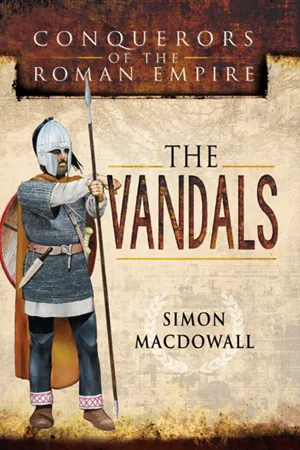
An up-close look at the Germanic people who sacked Rome in the fifth century AD.
On 31 December AD 406, a group of German tribes crossed the Rhine, pierced the Roman defensive lines, and began a rampage across Roman Gaul, sacking cities such as Metz, Arras, and Strasbourg. Foremost amongst them were the Vandals, and their search for a new homeland took them on the most remarkable odyssey. The Romans were unable to stop them and their closest allies, the Alans, marching the breadth of Gaul, crossing the Pyrenees, and making themselves masters of Spain.
However, this kingdom of the Vandals and Alans soon came under intense pressure from Rome's Visigothic allies. In 429, under their new king, Gaiseric, they crossed the straits of Gibraltar to North Africa. They quickly overran this rich Roman province and established a stable kingdom. Taking to the seas, they soon dominated the Western Mediterranean and raided Italy, famously sacking Rome itself in 455. Eventually, however, they were utterly conquered by Belisarius in 533 and vanished from history. Simon MacDowall narrates and analyzes these events, with particular focus on the evolution of Vandal armies and warfare.
- 208 pages
- English
- ePUB (mobile friendly)
- Available on iOS & Android
eBook - ePub
The Vandals
About this book
Information
Chapter 1
Germania
The Vandals
The very name conjures up violent images of wanton destruction. It is the label given to those that deliberately destroy or damage property and it is the lasting epithet of the ancient Germanic tribe that carved a kingdom out of Roman Africa in the fifth century AD.
Of all the conquerors of the Roman Empire the Vandals surely have had the worst press. The Greeks and Romans called anyone living beyond the bounds of their Mediterranean civilization a ‘barbarian’. This pejorative term has also found its way into modern usage implying, as it did in ancient times, someone who is uncouth, uneducated and uncivilized. A ‘vandal’ seems to be one step further beyond the pale.
Who then were these people whose name has been preserved for nearly 1,700 years as the epitome of barbaric savagery? Do they deserve their reputation or is there more to their story?
The original Vandals sacked Rome in 455 but they were not the first to do so. Alaric’s Goths captured the eternal city forty years earlier, spending three days looting, pillaging and plundering. St Augustine was living in Hippo Regius as the Vandals were besieging that city, which they later sacked. For many early Christians the horrors of barbarian invasion was seen as God’s righteous wrath and punishment for their sins. The Vandals, although Christians themselves by this time, followed the teachings of the Bishop Arius and vigorously persecuted the Romans who believed that the Arian version of Christianity was heresy. All of this added up to an impression that the Vandals were bent on the destruction of all that was good and civilized.
As far as it is possible to tell, the term ‘vandalism’ first came to be equated with wanton destruction in the eighteenth century. In 1794, Henri Grégoire, the bishop of Blois, described the destruction of artwork in the French Revolution as ‘vandalisme’. The term stuck, even if the original Vandals were perhaps no more or less destructive than any of the other conquerors of ancient Rome. The Vandals are credited with defacing Roman monuments but in truth, much of the destruction of classical architecture was carried out by local inhabitants re-using building materials along with pious Christians taking offence at nudity and pagan symbolism.
Despite the real horrors of invasion by a foreign people who then become unsympathetic overlords, there is indeed much more to the narrative of the Vandals. Their story is actually quite remarkable. After very little contact with the Greco-Roman world, they emerged from the forests of central Europe in the early fifth century. They crossed the Rhine in midwinter, ravaged Gaul (modern France and Belgium) then passed through the Pyrenees. They briefly ruled over parts of Spain but in 429 they were on the move again. They crossed from Spain into Africa and took the Roman province for themselves.
It may be that the name of the Vandals comes from the same root as the modern German ‘wandeln’ (in German the letter ‘w’ is pronounced as the English ‘v’). From this we get the English word ‘wanderer’. If so it is an apt name. The Vandals were indeed wanderers, moving from Scandinavia to central Europe, then down to the Danube before crossing the Rhine, passing through France into Spain, and finally ending up in Africa.
Once established in Africa, these people from the land-locked forests of central Europe ruled the Mediterranean with their fleets, defying both the West and East Roman Empires. From a small insignificant tribe amongst many, they had emerged as one of the most powerful kingdoms of the fifth century. Their moment in the African sun was, however, very short lived. In 533 the East Romans, under the inspired leadership of Belisarius, crushed the Vandals and wiped out all traces of their kingdom except for the memory of their name as destroyers of civilization.
This book will examine how the Vandals managed to achieve such stunning success and then lose it all in a brief campaign. It will focus on the military aspects: how their armies were formed, their tactics, equipment and how they compared with their opponents. As a consequence the book will concentrate primarily on the great migration that led to the foundation of their African kingdom and its reconquest by Justinian’s East Romans. All of this will be placed in the political, religious and social context of the times.
Our Sources
The Vandals left very little archeological record. Therefore in reconstructing their story we have to rely primarily on literary sources. Unfortunately, unlike many of the other conquerors of the Roman Empire such as the Goths, Franks, Lombards and Saxons, the Vandals had no one to write their history from their point of view. The only contemporary records that we have, were written by their Roman enemies.
The end of the Vandal kingdom is very well documented by Procopius, secretary to the Roman general Belisarius who led the campaign which defeated the Vandals. Procopius was actually present at many of the incidents he recounted and took an active part in the campaign. As a result we have detailed accounts of the battles and skirmishes that took place between the Roman invasion of Africa in 533 and the end of the last free Vandals in 546. Although obviously biased, Procopius’s history is reasonably balanced. His descriptions of the battles, the numbers of troops involved and the various political machinations are both realistic and reliable.
The same cannot be said about any of the sources prior to this. Before their crossing of the Rhine in the early-fifth century, the Vandals were a relatively minor Germanic people and are only mentioned in passing by various Roman authors. Once they moved into Roman territory their story is recounted in horror by several chroniclers, all of whom were churchmen who took great exception to the Vandals’ heretical beliefs.
After crossing the Rhine on the last day of 406, the Vandals spent three years ravaging France. Yet the sum total of what contemporary chroniclers have to say about this amounts to no more than a few hundred words. Other than listing the cities that fell to the Vandals and some hints of other actions, Saint Jerome, Prosper of Aquitaine and others do not tell us how they did it, what sort of defence the Romans conducted nor any detail of the many skirmishes, sieges and battles that must have taken place between 406 and 409.
Once the Vandals crossed into Spain, the Spanish Bishop Hydatius gives us a little more detail. Hydatius lived through the Vandal occupation of Spain and spent several months as a prisoner of the Suevi who had accompanied the Vandals from Germany into Spain. Even though Hydatius tells us something about the events that took place in his country between 409 and 429, he is terribly short on detail. For example he says: ‘the barbarians ran wild through the Spanish provinces’, but does not say anything about how they managed to take most of the peninsular for themselves.
The story of the Vandals’ early years in Africa suffers from the same problem. Several bishops, Victor of Vita being the most notable, wrote about the suffering of Roman orthodox Christians at the hands of the Vandals. We hear how the Vandals ‘set to work on (Africa) with their wicked forces, laying it waste by devastation and bringing everything to ruin with fire and murders.’ Once again we do not learn how they did it, nor how they managed to defeat the Roman armies sent against them.
Therefore, in telling the Vandals’ fascinating story, I have had to frequently fall back on conjecture. I have tried to piece together the frustratingly sparse contemporary evidence, match it with other original sources that tell us something about the politics and military actions of the age and come up with conclusions that seem right, even if we are unlikely to ever know for certain. In this regard there are a couple of other invaluable contemporary sources. The first of these is the history of Ammianus Marcellinus – a fourth century Roman officer turned historian. Although his history ends a couple of decades before the Vandals crossed the Rhine, he does give first hand accounts of late Roman and barbarian warfare as well as observations on many of the peoples who played into the Vandal story. The second is the Notitia Dignitatum, a list of offices and army units from the end of fourth and early-fifth centuries. This tells us the official orders of battle of the Roman Army at the time of the Vandal invasion. While it needs to be treated with a fair degree of caution it is invaluable in building a picture of the Roman Army at the time of the Vandals. The histories and letters of Zosimus, Priscus, Saint Augustine, Olympiodorus, Jordanes, Sidonius Apollinaris and other chroniclers help to fill in some of the blanks.
I have quite deliberately relied on contemporary accounts rather than more recent histories or interpretations. In fact there are very few modern accounts of the Vandal story. The definitive modern study of the Vandals was written by Christian Courtois in 1955 and since then there have only been a couple of new books about them. There have, of course, been many new investigations of the fall of the West Roman Empire and late Roman warfare. Many of these have been very helpful in placing the story of the Vandals in a wider political, military and economic context. I have listed the most useful ones in the bibliography.
The Origins of the Vandals
The Vandals were an east Germanic people who crossed the Rhine in the early fifth century and ended up in Africa. This much is certain. Tracing back their origins and forming any idea of what their ancestors were like is much less so.
Tacitus, in his first century work Germania, recounts oral German tradition in which three groups of tribes – the Ingaevones; the Hermiones and the Istaevones were descended from the son of the earth-born god Tuisto. He then goes on to say:
‘Some authorities, with the freedom of conjecture permitted by remote antiquity, assert that Tuisto had more numerous descendants and mention more tribal groups such as Marsi, Gambrivii, Suevi and Vandillii – names which they affirm to be both genuine and ancient.’
It would seem that Tacitus is sceptical of this claim, even though he is quite tactful in the way he expresses his doubt. Unfortunately, after this brief introduction, Tactius does not mention the Vandals again. When he goes through his descriptions of each of the Germanic tribes he says nothing about the Vandals or Vandillii.
Pliny the Elder also mentions the Vandilii in his Natural History, written in AD 77. He lists them as one of the five most important German tribes alongside the Burgundians, Goths, Varini and Charini. Interestingly, Pliny adds that the Burgundians were a part of the Vandal people. Close cooperation between the later Siling Vandals and Burgundians may lend some credence to this claim.
Norse and Germanic legends recount stories of migrations from Scandinavia into central Europe in which the Germanic peoples displaced or absorbed the earlier Celtic inhabitants. This is certainly the Gothic tradition and it is backed up with some archeological and etymological evidence. The same may be true of the Vandals. However, Tacitus’ story and Jordanes, history of the Goths may indicate that the Vandals were already living in central Europe when the Goths and others moved south.
Jordanes wrote in the sixth century for a Gothic audience. As such he glorifies the deeds of that people at the expense of others. In the fifth century the Goths and Vandals were bitter enemies. Jordanes traces this enmity back in the mists of time when the Goths first moved from Scandinavia to Germany, ‘subdued their neighbours, the Vandals, and thus added to their victories.’ By the third century the Goths were settled north of the Black Sea ‘holding undisputed sway over great stretches of country, many arms of the sea and many river courses. By their strong right arm the Vandals were often laid low.’
We have to take Jordanes’ stories with a grain of salt. A bit like Geoffrey of Monmouth rewriting Arthurian legends for the benefit of King Stephen, he re-interprets ancient histories for his Gothic readers to give them legitimacy. The Vandals are always cast in a bad light while the deeds of the Goths are glorified.
The seventh century Origin of the Lombard People recounts a legend in which the Lombards also defeated the Vandals early in their history:
‘There is an island that is called Scadanan… where many people dwell. Among these there was a small people that was called the Vinniles. And with them was a woman, Gambara by name, and she had two sons. Ybor and Agio. They, with their mother, Gambara, held the sovereignty over the Vinniles.
‘Then the leaders of the Vandals, that is, Ambri and Assi, moved with their army, and said to the Vinniles: “Either pay us tribute or prepare yourselves for battle and fight with us.”
‘Then answered Ybor and Agio, with their mother Gambara: “It is better for us to make ready the battle than to pay tributes to the Vandals.”
‘Then Ambri and Assi, that is, the leaders of the Vandals, asked Wodan that he should give them the victory over the Vinniles. Wodan answered, saying: “Whom I shall first see at sunrise, to them will I give the victory.”
‘At that time Gambara with her two sons… appealed to Frea, the wife of Wodan, to help the Vinniles. Frea gave counsel that at sunrise the Vinniles should come, and that their women, with their hair let down around the face in the likeness of a beard, should also come with their husbands. Then when it became bright, while the sun was rising, Frea, the wife of Wodan, turned around the bed where her husband was lying and put his face towards the east and awakened him. And he, looking at them, saw the Vinniles and their women having their hair let down around their faces. And he says, “Who are these Long-beards?” And Frea said to Wodan, “As you have given them a name, give them also the victory.” And he gave them the victory, so that they should defend themselves according to his counsel and obtain the victory. From that time the Vinniles were called Langobards (long-beards).’
It is possible that the Vandals were previous migrants who had to defend their territories from new arrivals such as the Goths and Lombards, although the Lombard history places their conflict with the Vandals in Scandinavia. There are links with the Vandal name to Scandinavia. Vendel in Sweden, called Vaendil in old Swedish, may indicate an original homeland of the Vandals. The northern tip of the Jutland peninsular of Denmark is called Vendsyssel, which may also have a Vandal connection. ‘Syssel’ is an ancient administrative area similar to the English ‘shire’, and ancient Danish names for the area include Wendila and Wændil. The ancestors of the Vandals may have migrated from northern Denmark in the second century BC. The archeological record shows that the Jutland peninsular was heavily settled at that time and then shortly afterwards was largely abandoned.
It is probable that the ancestors of the Vandals were living in modern Silesia, which is now part of Poland, at the time that Tacitus wrote his Germania. The archeological record shows a common culture over a wide but sparsely-populated area of small settlements where the dead were mostly cremated but notable warriors were interred together with horse gear and spurs.
Unfortunately the links between the literary and archeological records for the early Vandals are tenuous at best. After the brief mention of the Vandals in his introduction, Tacitus says that a confederation of tribes called the Lugi were living in the region where the Vandals are presumed to have settled. The Lugi are also located by other Greek and Roman writers as settled between the Oder and Vistula rivers but their name drops out of the historical record by the second century as that of the Vandals comes into greater prominence. Some historians have concluded that the Lugi and Vandals were one and the same, others think that the Vandals may have absorbed the Lugi in the second century and still others believe that there is no link at all. We will never really know for certain.
Ancient Germanic tribes were not like modern nation-states nor were they necessarily people who shared a common ancestry and heritage. The Vandals who moved into Africa in the fifth century included Alans, a Sarmatian people, and many others who were not descended from the original Vandals of central Europe. Ethnicity amongst the ancient German tribes was more about shared attitudes than ancestry or race. You were a Vandal if you were bound by oaths of loyalty to a Vandal leader and followed the norms and customs of Vandal society. Therefore the early Vandals could be thought of as a constantly shifting community, with various groups joining and leaving over the centuries before the crossing into Africa. This makes tracing their early history a very difficult proposition indeed.
First Contact with Rome
By the second century the story of the Vandals starts to become a little clearer. There are two main groupings: the Asdings (also variously written as Hasdings or Astings) and the Silings. T...
Table of contents
- Cover
- Title Page
- Copyright
- Contents
- List of Plates
- List of Maps
- Chapter 1: Germania
- Chapter 2: In the Bleak Midwinter
- Chapter 3: A Spanish Interlude
- Chapter 4: Into Africa
- Chapter 5: Mare Nostrum
- Chapter 6: The Next Generation
- Chapter 7: The Empire Strikes Back
- Chapter 8: Moors and Mutineers
- Chronology
- The Vandal and Alan Kings
- The Later Roman Emperors
- Glossary
- Select Bibliography
Trusted by 375,005 students
Access to over 1.5 million titles for a fair monthly price.
Study more efficiently using our study tools.
Frequently asked questions
Yes, you can cancel anytime from the Subscription tab in your account settings on the Perlego website. Your subscription will stay active until the end of your current billing period. Learn how to cancel your subscription
No, books cannot be downloaded as external files, such as PDFs, for use outside of Perlego. However, you can download books within the Perlego app for offline reading on mobile or tablet. Learn how to download books offline
Perlego offers two plans: Essential and Complete
- Essential is ideal for learners and professionals who enjoy exploring a wide range of subjects. Access the Essential Library with 800,000+ trusted titles and best-sellers across business, personal growth, and the humanities. Includes unlimited reading time and Standard Read Aloud voice.
- Complete: Perfect for advanced learners and researchers needing full, unrestricted access. Unlock 1.5M+ books across hundreds of subjects, including academic and specialized titles. The Complete Plan also includes advanced features like Premium Read Aloud and Research Assistant.
We are an online textbook subscription service, where you can get access to an entire online library for less than the price of a single book per month. With over 1.5 million books across 990+ topics, we’ve got you covered! Learn about our mission
Look out for the read-aloud symbol on your next book to see if you can listen to it. The read-aloud tool reads text aloud for you, highlighting the text as it is being read. You can pause it, speed it up and slow it down. Learn more about Read Aloud
Yes! You can use the Perlego app on both iOS and Android devices to read anytime, anywhere — even offline. Perfect for commutes or when you’re on the go.
Please note we cannot support devices running on iOS 13 and Android 7 or earlier. Learn more about using the app
Please note we cannot support devices running on iOS 13 and Android 7 or earlier. Learn more about using the app
Yes, you can access The Vandals by Simon MacDowall in PDF and/or ePUB format, as well as other popular books in History & Military & Maritime History. We have over 1.5 million books available in our catalogue for you to explore.