A portrait of the doomed queen's image and influence that provides "a detailed look at real life in Tudor England" (
Manhattan Book Review).
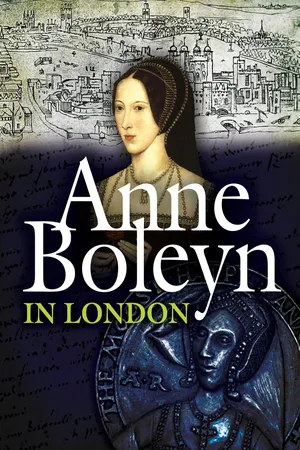
Romantic victim? Ruthless other woman? Innocent pawn? Religious reformer? Fool, flirt, and adulteress? Politician? Witch? During her life, Anne Boleyn, Henry VIII's ill-fated second queen, was internationally famous—or notorious. Today, she still attracts passionate adherents and furious detractors.
It was in London that most of the drama of Anne Boleyn's life and death was played out, most famously in the Tower of London, the scene of her coronation celebrations, her trial, and her execution, and the place where her body lies buried. In her few years as a public figure, Anne Boleyn was influential as a patron of the arts and of French taste, as the center of a religious and intellectual circle, and for her purchasing power, both directly and as a leader of fashion. It was primarily to London, beyond the immediate circle of the court, that her carefully spun image as queen was directed during the public celebrations surrounding her coronation.
In the centuries since Anne Boleyn's death, her reputation has expanded to give her an almost mythical status in London, inspiring everything from pub names to music hall songs and novels—not to mention merchandise including pincushions with removable heads. Over fifty Twitter accounts use some version of her name. This book looks at both the effect London and its people had on the course of Anne Boleyn's life and death—and the effects she had, and continues to have, on them.
- 224 pages
- English
- ePUB (mobile friendly)
- Available on iOS & Android
eBook - ePub
Anne Boleyn in London
About this book
Information
Chapter 1
A Walk Through London: 1522
The London Anne Boleyn returned to as a young woman would be virtually unrecognisable to a visitor from the twenty-first century. Not even the River Thames looked the same – it was wider in those days before the Embankment, shallower and crossed by only one bridge. The Tower of London was there, in a neighbourhood of warehouses, the moat full of water and the area within the walls full of unfamiliar buildings, with Tower Hill a more obvious landmark than it is today. The Tower would probably do, however, to help the time traveller to find her way. And it would soon be obvious that Tudor London was tiny in comparison to what it has become. Estimates vary as to how many people lived there in the 1520s – perhaps 70,000.1 There were, as yet, no census returns: even parish registers were not to be required until the 1530s. There was some development to the south of the river at Southwark, to the east in Stepney and Bethnal Green, and to the north in Clerkenwell. Kensington and Islington, however, were still rural villages. Hackney, a 3-mile walk away and a favoured country retreat, was famous for its market gardens, excellent turnips and healthy air. There was a farm at Tottenham Court, and marshes around the Tyburn and Westbourne streams, by then getting silted up and fetid because so much water was being diverted to London for its civilians to drink. Knightsbridge was best avoided, as it was a hotspot for footpads, and at Mayfair there were only a few cottages to mark a place that came alive on its market days. London would have seemed not only small, but probably provincial to someone who was used to Paris, which at that time was the largest city in the world, with a population of perhaps 300,000.
The river was not only wider and shallower, but smellier, as it served as the capital’s main sewer. It was also busy to the point of congestion, as it was the main transport route. Rich Londoners had their own barges; the rest made do with calling a waterman – the Tudor version of a black cab. The bridge was about 30 metres from the present-day London Bridge – the north end of it is marked by a plaque near the church of St Magnus the Martyr. It had been rebuilt after the murder of Thomas a Becket, and by the 1520s it was crowded with up to 200 shops, private houses and warehouses, which virtually joined together overhead, leaving a space only about 12 feet wide for people, carts and animals to find their way through. The roof of the gatehouse at the southern end of the bridge featured spikes topped with the tarred and boiled heads of traitors – a macabre welcome to visitors. Rivers long culverted in the present day still flowed, trickled or meandered their way into the Thames. The bridge also made the navigation of the river highly dangerous, as the buttress supports took up five sixths of the width of the river, leaving the water to rush ferociously through the gaps. At some stages of the tide the levels of the water would be up to 6 feet higher on one side than on the other. Prudent travellers would disembark to leave the boatman to find his way through, and get back on board once he had done so.
Once in the city, the street layout was very similar to that of the twenty-first century. However, the streets themselves, cobbled at best, were more often surfaced simply with trodden earth, muddy, icy or dusty according to weather and season. Gravel would be put down in preparation for important events. The streets were mostly narrow and dark, as the wooden-framed houses had upper storeys that projected over the lower ones, meaning that there was little space between the top floors. There were also dozens of house signs over pedestrians’ head – these, resembling modern pub signs, were used to identify locations in the days before street numbering. An address might be, for example ‘At the sign of the Lock, near St Mary’s Church in Bow Lane’. No sensible citizen would venture out unaccompanied at night – people of high status would have their own servants to go with them. Shops had wooden shutters that were raised so that goods could be displayed in opening hours; most shopkeepers lived on the premises, giving over the front room to trade, the back premises as a kitchen or as a workshop, and the rooms above to domestic life. At ground-floor level, windows were placed high up and, at the front of the house, usually kept shuttered. Doors had stout locks and bolts and, very often, a security grille so the people inside could inspect their potential visitor before committing themselves by opening the door. No one expected city streets to be safe.
Inside, even the houses of the prosperous were dark and sparsely furnished. The darkness was because windows were small. Glass was expensive, thick and did not let all the light through. Inside the rooms, most finishes were wooden – but it was only the Victorians who decided the past was brown. The Tudors liked bright colours, and so the panelling that lined many walls was generally painted, and the tapestries fashionable among those who could afford them were usually in bright colours, as were the painted cloths of the less affluent. Floors on the ground level of poorer houses were still often of rammed earth, covered with rushes. The better off had floorboards. Those few who could afford carpets usually used them as table coverings – Cardinal Wolsey had just negotiated the import of sixty Damascene carpets via Venice, and seems to have been the first person in England to use them to walk on. For most, furniture was sturdy, simple and largely made of oak. The main room of a middleclass house might contain a table, a couple of benches, perhaps a chair or two for the master and mistress of the house, a few jointed stools and a cupboard for the household’s silver or best pewter. A bedroom would contain little more than beds (few people slept alone) and clothes chests. Only the main rooms would have a fireplace, fuelled with wood or the more expensive sea coal.
Some privileged households had piped water. This was available in limited areas from private water companies, including one enterprise that pumped water from a chalybeate spring in Hackney, to Aldgate. But most people had to make do with pumps, wells, and the conduits that were set up in many London streets including Cheapside and Fleet Street. It is easy to understand why few people drank water which was known to be a source of illness, but which was needed for washing. Although bathrooms only existed in Royal palaces, the same was not true of baths, which were generally slipper shaped, wooden and lined with sheets before use. They had to be filled by hand with water, drawn and then heated over the fire. The dirty water was then removed and disposed of – having a bath was onerous and time consuming. This does not mean, however, that Londoners did not make great efforts to keep clean, but usually washed themselves from a hand basin (there are many recipes for homemade soap and scented washes). The same applied to washing clothes, in particular the linen shirts and smocks that men and women almost universally wore next to the skin. Those who could afford to, would change these very frequently.
Clothes were extremely expensive and expected to last a lifetime, and good ones were often left in wills. Tudor Londoners expected to be able to work out the social status of anyone they met, just by looking them up and down. It did not always work like that, but for another century efforts would be made to enforce the sumptuary laws that sought to dictate in great detail who could wear what. The regulations applied to both men and women, and covered everything from kinds and qualities of fabric, to colours and jewellery to furs.2 The legislation included threats of confiscation and fines for anyone who disobeyed. At the top of the social scale, purple silk was reserved to the King and his immediate family; Earls could wear cloth of gold and sable, while lords and knights had to content themselves with imported wool, and the colours crimson and blue. Serving men were not allowed to have long gowns using more than 3 yards of fabric, while servants, shepherds and labourers might not pay more than two shillings for the cloth for their outer clothes. The fact that these laws were reissued so often suggests that they were broken with great frequency, and it is notable that those of high status could wear virtually anything they pleased. Churchmen were supposed to dress simply and modestly, and, if they rode, they were to do so on a mule in emulation of Christ. Cardinal Wolsey, the King’s chief minister and Archbishop of York, kept the mule, but gave his a harness of red and gold leather. When he rode out, he was preceded by servants carrying two huge silver crosses and calling out ‘Make way for my lord’s Grace’. He was generally dressed in red, as befitted a Cardinal, but favoured silk and velvet, with ermine linings for winter – he lived in a grander style than the King.
References to imported wool suggest that one of the motivations for the lawmakers was to support the wool industry, by far England’s most lucrative trade. Wool cloth could be anything from exquisitely fine ‘nun’s veiling’, through to smooth but durable broadcloth and on to coarse, plain frieze cloth. Scarlet was a quality of cloth as well as a colour, but it appears that red was very popular for both men and women. This was long before the clothes of most male Londoners became virtually monochrome. The limiting factor as to colour was that of the dyes that were available and at what price. The brightest reds were made with cochineal, and were very expensive. A true black, too, was expensive to produce and was, therefore, usually seen on people of high status. The cheapest dyes were those that could be produced from plant sources such as woad, for blue, and weld, for yellow. Cheapest of all was to leave wool in its natural colour. Most, but not all, underclothing was made of linen – cotton, although it was known, was uncommon, and its use was largely confined to upholstery. New clothes were a major undertaking, involving choosing the fabric and fittings with a tailor – in the following decade, Lady Lisle, living in Calais, sent frequent shopping lists to her factor, John Husee, in London. Just one consignment of fabric included £5 4s 11d worth of worsted, buckram, damask, velvet, camlet and satin.3
Our time traveller, looking at Tudor Londoners, would immediately notice that everyone, including small children, was wearing a hat of some kind. For men this was generally a round, brimmed cap. Some older men wore a coif underneath. Most London women wore their hair entirely covered, sometimes with several layers of coifs of different shapes. Some women wore a hood over this – in the 1520s this was a gable-shaped hood with long flaps reaching down to the shoulders. Apart from small girls, only brides and queens wore their hair loose in public. Indeed, when the French hood came into fashion, probably popularised at court, although not introduced, by Anne Boleyn, it was considered very daring because the front few inches of the wearer’s hair were displayed. No decent person, either, would have shown their arms uncovered, even on the hottest day. A kirtle with its removable sleeves pinned up and turned back to show the wearer’s smock, would be considered distinctly risqué. Working from the skin outwards, a woman’s clothing consisted of a smock, the only undergarment, usually linen, with a kirtle over it, and possibly a gown worn over that. There were few, if any, corsets worn by Englishwomen until the end of the century – support was provided by a well-fitted kirtle with an interfaced bodice. Men had a linen shirt, with a doublet, upper hose (tight breeches), nether hose (stockings) and a gown as an outer garment. Shoes took the form of soft leather sandals for both sexes – men had boots for riding, but these do not appear to have been worn at other times.
Although London had spilled out of the confines of the city walls, those walls and their gates were still an important feature of 1520’s life. The walls were still largely the ones that had been built by the Romans; in the sixteenth century they were still viable as a defence, and were patrolled as such. The gates were the way into London – their names and locations still live on as Ludgate, Billingsgate, Moorgate and the rest. They were locked for the night for curfew by 9pm in summer, dusk in winter; after those times no one was supposed to enter or leave; the rule was that shops and taverns should close up for the night and everyone go home. All through the night until 4am, watchmen patrolled, calling the time and a reassurance that all was well – they were instructed to rouse a neighbourhood in the case of fire or crime. The Great Fire of 1666 was only the last, and most catastrophic, of the fires that broke out quite frequently, threatening London’s overwhelmingly timber buildings. Attempts were made to include stone fire walls in new houses, but these were piecemeal and inadequate. Inside, most people seem to have gone to bed early – candles were expensive, and most people could not afford to burn enough to work by. Tudor days were inclined to begin and end early.
For those who had the money, the wharves between the Bridge and the Tower were the place to find almost anything from almost anywhere in the known world. You needed the contacts as well as the funds, as some things were risky to deal in. Fabric and clothing were one thing – a mercer with the right connections could bypass import restrictions and demarcation between guilds; but something really controversial called for more circumspection. Most of the business of the Customs House, south west of All Hallows by the Tower, was concerned with weighing the vast quantities of English wool being exported and collecting the dues on it – a useful source of income for the Crown. Officials could, in theory, search any incoming ship. When Anne Boleyn came to London, it was only five years since Martin Luther had nailed his challenge to a church door. His ideas soon did the sixteenth century equivalent of ‘going viral’ – pamphlets were printed in each town, distributed and passed on to the next printer. The first copies were only just getting to England, brought in quietly by returning diplomats and traders. The authorities were scarcely aware of them yet, but there were already ‘known men’ – people of reformist sympathies – in London. Lollards had been in existence for a century, and when a young priest called William Tyndale arrived in London to ask the Bishop to help with his project to translate the whole of the New Testament into English, he was only the latest in a long tradition.
It is impossible to over emphasise the importance of religion to Londoners of Anne Boleyn’s generation. All aspects of life were undertaken and perceived in terms of faith, and every Londoner belonged to the same church. Despite the early signs of a tidal movement towards reform, the structures belonging to nearly a millennium of an all-powerful church hierarchy were so ubiquitous that it is highly unlikely that most people would have questioned them. In terms of actual religious practice, not only did almost everyone attend church regularly for Mass, but it was taken for granted that individuals would also pray in private. Wills and inventories show that very many people possessed rosaries, and that it was very common for homes to contain crucifixes and images of saints. One farming book of the time begins with an exhortation to the reader to begin each day by making the sign of the cross and saying several prayers.4 Neither was there much distinction between religious and secular life. Most organisation was done by the parish, and meetings and decisions happened in and around the church. It was at church where you were most likely to see your neighbours and catch up with news. This was especially necessary at a time when it is likely that less than half of Londoners could read. Even the well to do could often not sign their own names – making the literate parish priest an even more useful and important person. For anyone with property to leave, it was usual to make a will beginning with a prayer and funeral arrangements – often with some money left for masses for the testator’s soul.
Perhaps the one element about early Tudor London that is most difficult to imagine is that of the omnipresence of the Church, and of churches. It has been estimated that one quarter of the city was Church property. Of the most impressive buildings in the capital, the Tower of London and the Guildhall were secular – the rest were mostly churches or parts of monasteries and nunneries – there were over 100 churches within the city walls. Names such as Covent Garden, the Minories and Whitefriars and Blackfriars recall the religious houses – Tudor Londoners lived with the reality, and each monastic house owned several acres of land. For example, when Blackfriars came to be dissolved, there was room for an entire exclusive housing development in its precincts. And, near what is now the Bank of England, the Austin Friars had enough land to spare to lease several plots out, so that Thomas Cromwell was able to live in a gated community. The church also held extensive additional property, as wealthy people made bequests for the good of their souls – very often the rent from a house would pay for a chantry chapel with a full-time priest to pray for the souls of several generations of a family.
The St Paul’s Cathedral of the 1520s was utterly different from the one the time traveller knows today, although it was on the same site. Old St Paul’s was a vast, gothic structure – it consisted of nave, choir, transepts and spire; parts of it were nearly a thousand years old. To Londoners, it was infinitely familiar. Famously, its nave was a walkway and short cut, with traders occupying recognised stalls along its length; they hired and paid rent for these, and goods and services of all kinds were offered. Outside, there were small shops built up against the cathedral walls – the rents were a useful source of extra income for the church. Given the level of population, it seems unlikely that there were enough potential members of the congregation to go round the 100 other churches – but this was hardly the point, not least because services for the local population were far from being the only, and often not the most important, use for a church. They also operated as family chapels, meeting places, shops, places of burial, pubs, storage spaces and courts. The church door was the place to post information, and was also the location for weddings. A number of churches also had connections with livery companies, and might also house a chapel for the use of guild members.
London was also a centre of education, even though it was to be some three centuries before it acquired its own university. There were, however, a great many schools. To the north of St Paul’s Cathedral, our time traveller may see the extensive and still new buildings of Dean Colet’s school. Colet, an intellectual, son of a Lord Mayor of London and the friend of Erasmus and More as well as a university contemporary of Cardinal Wolsey, died in 1519, leaving his school generously endowed and with a carefully planned governing document ensuring that its future course would be steered by like-minded people – and not by priests. John Colet, although he was Dean of St Paul’s, went on record as believing ‘there is no heresy more dangerous to the church than the vicious lives of its priests. A reformation is needed, beginning with the bishops, and extended to the priests …’. His views brought him into conflict with More and the bishops – but Colet was too well connected and too clever for them.5 All round London, on a smaller scale, there were schools in private houses and in rooms over church porches. Most of these charged modest fees. There were also dame schools, where a woman taught perhaps half a dozen children in her own home. Thomas More reckoned that sixty per cent of English adults could read and write.6 It should, however, be remembered that at this time reading and writing were taught separately, and many people who were signing their names with an ‘x’ could read. This may have been especially true of girls, who were less likely to be sent to school, but who were often taught to read at home by their mothers. The sophisticated education given to Royal ladies, and to Thomas More’s own three daughters, was unusual but not unprecedented.
The pe...
Table of contents
- Cover
- Title
- Copyright
- Contents
- Chapter 1 A Walk Through London: 1522
- Chapter 2 ‘Your very humble obedient daughter’ 1501–22
- Chapter 3 Queen in Waiting: 1522–33
- Chapter 4 The White Falcon Crowned: 1533
- Chapter 5 Earthly Powers: London
- Chapter 6 Earthly Powers: Court
- Chapter 7 Anne the Queen: 1533–36
- Chapter 8 Fall: 1536
- Chapter 9 Ever After
- Appendix: Tudor Money and Prices
- Notes
- Plate section
Trusted by 375,005 students
Access to over 1.5 million titles for a fair monthly price.
Study more efficiently using our study tools.
Frequently asked questions
Yes, you can cancel anytime from the Subscription tab in your account settings on the Perlego website. Your subscription will stay active until the end of your current billing period. Learn how to cancel your subscription
No, books cannot be downloaded as external files, such as PDFs, for use outside of Perlego. However, you can download books within the Perlego app for offline reading on mobile or tablet. Learn how to download books offline
Perlego offers two plans: Essential and Complete
- Essential is ideal for learners and professionals who enjoy exploring a wide range of subjects. Access the Essential Library with 800,000+ trusted titles and best-sellers across business, personal growth, and the humanities. Includes unlimited reading time and Standard Read Aloud voice.
- Complete: Perfect for advanced learners and researchers needing full, unrestricted access. Unlock 1.5M+ books across hundreds of subjects, including academic and specialized titles. The Complete Plan also includes advanced features like Premium Read Aloud and Research Assistant.
We are an online textbook subscription service, where you can get access to an entire online library for less than the price of a single book per month. With over 1.5 million books across 990+ topics, we’ve got you covered! Learn about our mission
Look out for the read-aloud symbol on your next book to see if you can listen to it. The read-aloud tool reads text aloud for you, highlighting the text as it is being read. You can pause it, speed it up and slow it down. Learn more about Read Aloud
Yes! You can use the Perlego app on both iOS and Android devices to read anytime, anywhere — even offline. Perfect for commutes or when you’re on the go.
Please note we cannot support devices running on iOS 13 and Android 7 or earlier. Learn more about using the app
Please note we cannot support devices running on iOS 13 and Android 7 or earlier. Learn more about using the app
Yes, you can access Anne Boleyn in London by Lissa Chapman in PDF and/or ePUB format, as well as other popular books in History & Historical Biographies. We have over 1.5 million books available in our catalogue for you to explore.