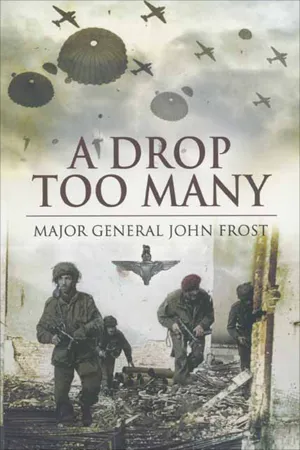
One of the British Army's first paratroopers recounts in vivid detail his service in the 2nd Parachute Battalion during the Battle of Arnhem and beyond . . .
No one who has read of Arnhem can fail to be inspired by gallantry of the 2nd Parachute Regiment, which held the north end of the key road bridge over the Rhine—the "Bridge Too Far"—not for twenty-four hours for which it was equipped, but for three days and four nights. Commanded by the then Lieutenant-Colonel Frost, they beat off repeated armored and infantry assaults by far greater numbers, until forced out of the ruined and burning positions by losses, lack of ammunition, and the failure of the whole Arnhem operation. Their sacrifice stands as one of the most heroic defenses of all time.
General Frost's story is, in effect, that of the battalion. His tale starts with the Iraq Levies and goes on the major airborne operations in which he took part—Bruneval, Tunisia, Sicily, Italy, Arnhem—and continues with his experiences as a prisoner and the reconstruction of the battalion after the German surrender.
Though written with modesty and humor, the book is shot through with the fire and determination of the fighting solider, and throws important new light on many controversies, not only those of Arnhem.
- 288 pages
- English
- ePUB (mobile friendly)
- Available on iOS & Android
eBook - ePub
A Drop Too Many
About this book
Information
Contents
| Preface | |
| 1 | Iraq |
| 2 | Home Again |
| 3 | The Bruneval Raid |
| 4 | Aftermath |
| 5 | Maison Carrée |
| 6 | Oudna |
| 7 | Retreat From Oudna |
| 8 | Oudna Aftermath |
| 9 | Happy Valley |
| 10 | Battle of Tamera: Phase One |
| 11 | Battle of Tamera: Phase Two |
| 12 | Sicily |
| 13 | Italy |
| 14 | U.K. Interlude |
| 15 | Arnhem |
| 16 | Prisoner |
| 17 | Rehabilitation |
| 18 | Representation |
| 19 | Last Thoughts |
| Index |
Preface
I began to write this book while I was a prisoner-of-war and the memory of the battle of Arnhem was fresh in my mind. I kept the original draft under my bedclothes when we were visited by the Gestapo, so I feel that it must have some authentic value. I made several attempts to finish it, but so much intervened that I was discouraged from going further. However, since the publication of A Bridge Too Far by Cornelius Ryan, and the production of the film of the same title, I have been urged by so many people to tell my own story that I have now succumbed. With the active encouragement of my wife, Jeannie, I have written an account of my war service which will, I hope, interest and amuse people and yet provide some lessons for my peers and happy recollections for our old soldiers.
The story starts with my service with the Iraq Levies, when I commanded No. 2 Assyrian Company, a body of men whose watchword was ‘Perfection’. They set a standard which I have never seen exceeded. Whether they could have withstood the hard pounding that British troops habitually do I cannot say, but they were the direct descendants of the Assyrians of old whose ‘cohorts were gleaming in purple and gold’, and as such I shall always remember them.
After a short sojourn with my old regiment, the Cameronians (Scottish Rifles), always outstanding for dour, dogged slogging matches in every campaign and whose soldiers were as hardy and enduring as any in the world, I ventured into something quite new – the Airborne Forces.
I hope that I have said enough in the following chapters to convey just what stuff the paratroops were made of. They were men of whom you could never ask too much. Wherever there was a Red Beret, there was a way.
Although some of the actions have been described before, especially Arnhem, Bruneval and Sicily, I am so glad to be able to narrate the part played by the 1st Parachute Brigade when, after completing their initial airborne operations in the Tunisian compaign, they remained to fight as infantry almost to the end. We were not meant to be so employed (indeed, Winston Churchill was adamant that we should not), but the generals on the spot were so hard-pressed that we had to be. The snag was that both the Prime Minister and the public at home had to be hoodwinked, and so the Press were debarred from our part of the front and all our fighting was attributed to other units and formations. We did not know of this at the time for we seldom saw newspapers from home, but it did hurt when letters from relatives implied that we must be having a nice easy life lying about under the Mediterranean sun. When one had been swopping punches with the German Parachute Regiment, Sturmregiment Koch, the Witzig Regiment and the 10th Panzer, one felt entitled to credit for having opposed crack German army units.
Much has been said and written about the battle of Arnhem, that great venture which could have changed the course of history had it been pursued with the vigour it deserved, but as I am so often asked: ‘What went wrong at Arnhem?’ it is perhaps appropriate that I should take this opportunity of saying what I think.
The unwillingness of the air forces to fly more than one sortie in the day was one of the chief factors that militated against success. The transport aircraft could have been loaded before dawn on D-day, taken off at dawn, completed their mission and returned in time to have embarked their second lifts by noon. This would have allowed the bulk of the first lifts to make straight for the main objectives and dispensed with the time-consuming commitment to secure the D.Z.s for lifts on following days, when the weather might, and did, cause further delay.
Then again, the air force planners who insisted that the farmland between the rivers was unsuitable for landing gliders and that the enemy flak was too formidable to allow D.Z.s near the objectives, exerted a fatal handicap on the airborne troops. The exact locations of all the guns had been made known by the Dutch underground, and with the degree of air superiority available, it is unduly pessimistic to maintain that these could not have been destroyed or neutralized.
The presence north of Arnhem of 2nd S.S. Panzer Corps was known to H.Q.s Army Group, Army and Airborne Corps, yet this vital information was withheld from H.Q.s XXX Corps and 1st British Airborne Division. Perhaps it was feared that the troops involved would jib at going if they knew, but it had the effect of making the leading brigade of 1st Airborne adopt the wrong plan and deprived it of the opportunity of increasing its anti-tank capability. The 1st Parachute Brigade advanced on a broad front, which is quickest when the opposition is thought to be light, but the worst course to take when it is otherwise. Thus, when one of the battalions succeeded in reaching the bridge, the others had become too involved to be readily switched on to the going route.
Failure by both the Army and the Air Force to make full use of the Dutch underground meant that a most effective means of producing and confirming information was discarded. It was known that the underground had been partially penetrated, but it was still highly organized and consisted of people of great courage and integrity. Perhaps it was wise not to give warning of the impending operation, but once the landing had taken place, every chance should have been taken of using their services, for they had much to give.
However, by far the worst mistake was the lack of priority given to the capture of Nijmegen Bridge. The whole essence of the plan was to lay an airborne carpet across the obstacles in southern Holland so that the Army could motor through, yet the capture of this, perhaps the biggest and most vital bridge in that its destruction would have sounded the death-knell of the troops committed at Arnhem, was not accorded priority. The capture of this bridge would have been a walk-over on D-day, yet the American 82nd Airborne Division could spare only one battalion as they must at all costs secure a feature called the Groesbeek Heights, where, incidentally, the H.Q. of Airborne Corps was to be sited. It was thought that the retention of this feature would prevent the debouchment of German armour from the Reichwald in Germany. This armour was there by courtesy of rumour only and its presence was not confirmed by the underground. In fact, as a feature it is by no means dominating and its retention or otherwise had absolutely no bearing on what happened at Nijmegen Bridge.
The very presence of the Airborne Corps H.Q. was nothing more than a nuisance. Airlift that could have been used to fly in another combat unit was squandered and the commander would have been far more effective if he had remained with the air commander in the U.K., whence he could have directed resupply and the movement of reinforcements and reserves. The failure of communications at all levels within the Airborne Corps was phenomenal, but a commander with all the resources of the Air Forces in the U.K., near at hand, would have had many options open. Incidentally, whereas the communications within the infantry and signals were so abysmal, the Royal Artillery net was excellent throughout.
Finally, when it was decided that Nijmegen Bridge ought to be taken, the Germans had been able to strengthen their hold to such an extent that the American parachute troops had to paddle across the river in British canvas assault boats, with which they were totally unfamiliar. This most unpleasant task was carried out in daylight in the teeth of well-established opposition and really must rank as one of the bravest feats of all time. This Division was inspired by General James Gavin, and it was a pity that so little credit was given to it by the allies, either then or since. At the time censorship within the British chain of command precluded the appearance of accounts in the Press.
The German generalship was vigorous and inspired. Field Marshal Model, the German C.-in-C., who had his Sunday lunch party rudely interrupted by the arrival of British troops in Oosterbeek, near Arnhem, drove around the German positions like a devil possessed. He was able to telephone direct to Hitler’s H.Q. asking for reinforcements and to galvanize his subordinates with formidable threats. On the right flank of the advancing British Army was the highly experienced old parachutist, General Student. Considerably helped by the capture of a map which showed in detail all his opponents’ plans and strengths, he continually urged his men to break through the thin British corridor leading past him northwards, and this greatly inhibited our own efforts to reach the objectives. On our left flank, German troops were moved across water obstacles in broad daylight, apparently unimpeded by our air forces, and these were brought to bear against the westerly positions of our beleaguered Airborne in due course.
At the time, the Prime Minister and the C.I.G.S. were away in Canada at the Quebec Conference, so perhaps all concerned on our side breathed a little easier and tended to take things a bit more quietly. Whether this is the case or not, there does seem to have been a lack of drive all the way through the British chain of command. In Field Marshal Montgomery’s memoirs there is no mention of his visiting and urging anyone to greater exertions. General Horrocks, XXX Corps Commander, was not once visited by General Dempsey, the 2nd Army Commander, during the whole nine days of battle. Indeed, on one occasion, Horrocks, this most gallant of all generals, had to turn part of his spearhead about so as to open the corridor behind him. General O’Connor, XIII Corps Commander on the right flank, was not even told about the operation until the day before it was due and then his orders were merely to sidestep and take over the XXX Corps front. Yet this was the Corps which would have been able to fend off all the efforts of General Student to cut the XXX Corps corridor.
So maybe some of our generals were having an off-day, or several off-days for that matter. Certainly there seemed to be a lack of urgency. Even after the Nijmegen Bridge had been captured undamaged on Wednesday the 20th, and while we of the 1st Airborne Division were still holding out by the skin of our teeth at Arnhem Bridge, it was several hours before a very tentative effort was made by the Guards Armoured Division to reach us, and after four tanks had been knocked out the whole thing came to a grinding halt. Several more hours were to elapse before a thoroughly plodding infantry formation was produced to continue on another axis.
Perhaps the casualty lists speak for themselves. During the nine days, while the British 1st Airborne Division was virtually written off with over eight thousand casualties, the two American Airborne Divisions suffered three thousand five hundred, but the British 2nd Army, consisting of nine divisions, suffered to the tune of three thousand seven hundred only. These figures hardly suggest resolute, continuous, determined fighting, by day and night, to achieve an Olympian victory. This was not the time to count the cost: the Germans had practically no reserves left and most of the population would have then welcomed the end of the war. The Russian armies were still back in Poland. All this was before the dreadful conference at Yalta that conceded so much. If we had won, Europe and the world would be very different today.
On 17 December 1977, those fine Dutch people who suffered so much with us during and after the battle did us the most signal honour by renaming their famous old bridge:
JOHN FROSTBRUG
J.D.F
Northend Farm, 1980, 1982
Northend Farm, 1980, 1982
Preface to the Second Edition
After the publication of the first edition of A Drop Too Many, in October 1980, several people intimated that my ending was too abrupt, and suggested that I add further information about what happened to me thereafter. So, besides some necessary revisions, I have added three more chapters.
JOHN FROST
June 1982
1
Iraq
I was in the Syrian Desert when the war began. I had been seconded from my regiment, The Cameronians, to the Iraq Levies, a force of Assyrian, Kurdish and Arab tribesmen, organized into infantry rifle companies, with a small support weapons and signals element. The main base was the R.A.F. Station at Habbaniya, some eighty miles northwest of Baghdad on the river Euphrates. The Levies’ role was to guard the R.A.F. airfields and installations and, in emergency, keep open the lines of communication with Jordan.
When it was considered that our bases in Egypt might be threatened, the training establis...
Table of contents
- Cover
- Half Title
- Full Title
- Copyright Page
- Dedication
- Contents
Trusted by 375,005 students
Access to over 1.5 million titles for a fair monthly price.
Study more efficiently using our study tools.
Frequently asked questions
Yes, you can cancel anytime from the Subscription tab in your account settings on the Perlego website. Your subscription will stay active until the end of your current billing period. Learn how to cancel your subscription
No, books cannot be downloaded as external files, such as PDFs, for use outside of Perlego. However, you can download books within the Perlego app for offline reading on mobile or tablet. Learn how to download books offline
Perlego offers two plans: Essential and Complete
- Essential is ideal for learners and professionals who enjoy exploring a wide range of subjects. Access the Essential Library with 800,000+ trusted titles and best-sellers across business, personal growth, and the humanities. Includes unlimited reading time and Standard Read Aloud voice.
- Complete: Perfect for advanced learners and researchers needing full, unrestricted access. Unlock 1.5M+ books across hundreds of subjects, including academic and specialized titles. The Complete Plan also includes advanced features like Premium Read Aloud and Research Assistant.
We are an online textbook subscription service, where you can get access to an entire online library for less than the price of a single book per month. With over 1.5 million books across 990+ topics, we’ve got you covered! Learn about our mission
Look out for the read-aloud symbol on your next book to see if you can listen to it. The read-aloud tool reads text aloud for you, highlighting the text as it is being read. You can pause it, speed it up and slow it down. Learn more about Read Aloud
Yes! You can use the Perlego app on both iOS and Android devices to read anytime, anywhere — even offline. Perfect for commutes or when you’re on the go.
Please note we cannot support devices running on iOS 13 and Android 7 or earlier. Learn more about using the app
Please note we cannot support devices running on iOS 13 and Android 7 or earlier. Learn more about using the app
Yes, you can access A Drop Too Many by John Frost in PDF and/or ePUB format, as well as other popular books in History & Military & Maritime History. We have over 1.5 million books available in our catalogue for you to explore.