A "crisply written, well researched . . . superb piece of scholarship about one of the most dramatic and decisive battles in the ancient world" (
Journal of Military History).
At Zama (in what is now Tunisia) in 202 BC, the armies of two great empires clashed: the Romans under Scipio Africanus and Carthaginians, led by Hannibal. Scipio's forces would win a decisive, bloody victory that forever shifted the balance of power in the ancient world.
Thereafter, Rome became the dominant civilization of the Mediterranean.
Here, Brian Todd Carey recounts that battle and the grueling war that led up to it. He offers fascinating insight into the Carthaginian and Roman methods of waging war, their military organizations, equipment, and the tactics the armies employed. He also delivers an in-depth critical assessment of the contrasting qualities and leadership styles of Hannibal and Scipio, the two most celebrated commanders of their age.
With vivid prose and detailed maps of the terrains of the time,
Hannibal's Last Battle is an essential text for fans of military history and students of the classical period.
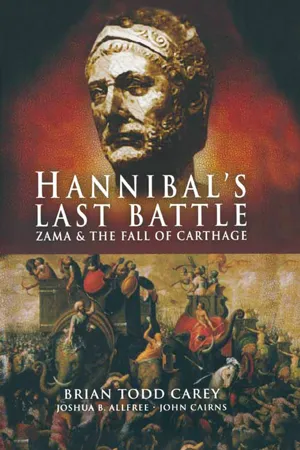
eBook - ePub
Hannibal's Last Battle
Zama & The Fall of Carthage
- 232 pages
- English
- ePUB (mobile friendly)
- Available on iOS & Android
eBook - ePub
About this book
Information
Topic
GeschichteSubtopic
Zweiter WeltkriegContents
| Preface and Acknowledgements | |
| List of Maps | |
| Key to Maps | |
| List of Illustrations | |
| Chronology of the Punic Wars | |
| Introduction: | Clash of Civilizations |
The Battle of Zama as Turning Point | |
Phoenicia’s Heir: The Rise of Carthage | |
Rome: From City-State to Master of Italy | |
| Chapter 1 | The First Punic War (264–241 BCE) |
The Organization and Tactics of the Carthaginian Army | |
The Organization and Tactics of the Roman Army | |
The First Punic War: The War at Sea and On Land | |
An Unequal Peace and the Mercenary War | |
| Chapter 2 | The Early Campaigns of Hannibal |
Hannibal’s Early Life and the Origins of the Second Punic War (218–202 BCE) | |
The Second Punic War: Initial Strategies | |
Dangerous Journey: Hannibal Crosses the Alps | |
Seizing the Initiative: Early Punic Victories at the Ticinus and the Trebia (218 BCE) | |
Ambush at Lake Trasimene and Rome’s ‘Fabian’ Strategy (217 BCE) | |
Cannae: Hannibal’s ‘Killing Field’ (216 BCE) | |
After Cannae | |
| Chapter 3 | The Early Campaigns of Scipio |
Scipio’s Early Life and Building a New Army | |
Rome Resurgent and the Elder Scipios in Spain | |
Scipio the Younger and the Capture of New Carthage | |
The Roman Conquest of Spain (208–207 BCE) | |
Hasdrubal Defeated: The Battle of Metaurus River (207 BCE) | |
Scipio’s Masterpiece: Ilipa (206 BCE) | |
Scipio Returns to Rome and Builds an Army (205-204 BCE) | |
| Chapter 4 | The African Landings and the Battle of Zama |
The African Landings (204 BCE) | |
The Battle of the Great Plains (203 BCE) | |
Armistice and Hannibal Recalled | |
Parley on the Plain and Locating the Battlefield | |
The Battle of Zama (202 BCE) | |
Scipio Africanus: ‘Greater than Hannibal’? | |
The End of the Second Punic War | |
| Chapter 5 | In Zama’s Wake: The Growth of Roman Imperialism and the Third Punic War |
Hannibal After Zama (201–183 BCE) | |
Scipio After Zama (201–184 BCE) | |
Rome Expands in the Mediterranean (201–149 BCE) | |
The Third Punic War | |
The Siege Perfected and the Fall of Carthage (147–146 BCE) | |
Rome Transformed: The Legacy of the Punic Wars | |
| Notes | |
| Glossary of Important Personalities | |
| Glossary of Military Terms | |
| Glossary of Roman and Carthaginian Government Terms | |
| Select Bibliography | |
| Index | |
Preface and Acknowledgements
Few historical figures in western civilization have commanded as much attention from historians, generals and military theorists as Hannibal Barca. Born into a well-placed Carthaginian military dynasty, Hannibal and his brothers Hasdrubal and Mago, followed in their father Hamilcar’s footsteps and dedicated their lives to battling the Romans in Spain, Italy and North Africa. Hannibal’s epic journey across the Alps and numerous victories over Roman armies during the Second Punic War have been studied for millennia, while his destruction of the Roman host at Cannae in a double-envelopment has often been considered the perfect engagement. Nearly always fighting at a disadvantage in manpower and resources, Hannibal rose to the ranks of legend within his own lifetime, becoming the most feared man in the Mediterranean. It is even said his reputation was so fierce that Roman parents merely had to utter ‘Hannibal ad portas’ (‘Hannibal is at the gates’) when their children misbehaved.
In the twentieth century more attention has been paid to the generalship and campaigns of Hannibal’s arch-enemy and eventual nemesis, Publius Cornelius Scipio ‘Africanus’. This scrutiny has given rise to a new appreciation of this Roman commander, with many historians proclaiming Scipio to be ‘greater than Hannibal’ as either tactician, strategist, or both. Like Hannibal, Scipio was from a well-established noble family, but, unlike his Punic adversary, Scipio had the advantage of fighting for a civilization with extraordinary resources and a growing desire for imperium. The struggle between these two giants of their age is emblematic of conflicts between antagonists and civilizations in any age, which is probably why historians have spent so much effort studying these two extraordinary generals.
As the title of this study suggests, this monograph concentrates on the campaigns of Hannibal and Scipio Africanus during the Second Punic War, emphasizing the events leading up to the Battle of Zama in 202 BCE. In order to put this campaign in perspective, time is spent exploring the origins, course and outcome of the First Punic War and the events leading to the eventual destruction of Carthage in the Third Punic War. It is hoped that this work will serve as a brief introduction to the Punic wars and to the personalities and campaigns of two of military history’s most compelling figures.
When I began research on this book, Joshua B. Allfree and John Cairns, my illustrators for Warfare in the Ancient World and Warfare in the Medieval World, came on board again and provided outstanding tactical and regional map illustrations. Their efforts give this book its uniqueness. We could not have completed this project without the collaboration and support of a few notable people. We would like to first and foremost thank Pen and Sword Books, especially our managing editor Rupert Harding. Mr Harding’s wisdom and guidance throughout the process of publishing three books in three years has proved invaluable, as has the adroit copy editing of Philip Sidnell, whose knowledge of, and passion for, ancient military history is evident in his support of this project. Without these gentlemen’s generous assistance this book would simply not have been possible. Special thanks is also extended to Dr Jon Carleton, Chair of History and Military Studies at the American Public University System, for his encouragement while writing this book. Finally, we would like to thank our family and friends whose unwavering support over the process of creating these three books has been instrumental to our success.
Brian Todd Carey
Loveland, Colorado
Loveland, Colorado
List of Maps
The Carthaginian Empire, circa 264 BCE
Rome During the Middle Republic, c. 218 BCE
Sicily and North Africa During the First Punic War
The Battle of Mylae, 260 BCE (phases I–III)
The Battle of Ecnomus, 256 BCE (phases I–V)
The Battle of Tunis, 255 BCE (phases I–IV)
The Battle of Drepana, 249 BCE (phases I–III)
The Battle of Aegates Islands, 241 BCE (phases I–III)
Carthaginian Possessions in Spain, 218 BCE
Hannibal’s Route Across the Alps, 218 BCE
The Battle of the Ticinus, 218 BCE (phases I–V)
The Battle of the Trebia, 218 BCE (phases I–VIII)
The Battle of Lake Trasimene, 217 BCE (phases I–V)
The Battle of Cannae, 216 BCE (phases I–V)
Italy During the Second Punic War
Spain During the Second Punic War
The Siege of New Carthage, 209 BCE (phases I–VI)
The Battle of Baecula, 208 BCE (phases I–IV)
The Battle of Metaurus River, 207 BCE (phases I–VI)
The Battle of Ilipa, 206 BCE (phases I–VI)
The North African Campaign, ...
Table of contents
- Cover
- Half Title
- Full Title
- Copyright Page
- Contents
Trusted by 375,005 students
Access to over 1.5 million titles for a fair monthly price.
Study more efficiently using our study tools.
Frequently asked questions
Yes, you can cancel anytime from the Subscription tab in your account settings on the Perlego website. Your subscription will stay active until the end of your current billing period. Learn how to cancel your subscription
No, books cannot be downloaded as external files, such as PDFs, for use outside of Perlego. However, you can download books within the Perlego app for offline reading on mobile or tablet. Learn how to download books offline
Perlego offers two plans: Essential and Complete
- Essential is ideal for learners and professionals who enjoy exploring a wide range of subjects. Access the Essential Library with 800,000+ trusted titles and best-sellers across business, personal growth, and the humanities. Includes unlimited reading time and Standard Read Aloud voice.
- Complete: Perfect for advanced learners and researchers needing full, unrestricted access. Unlock 1.5M+ books across hundreds of subjects, including academic and specialized titles. The Complete Plan also includes advanced features like Premium Read Aloud and Research Assistant.
We are an online textbook subscription service, where you can get access to an entire online library for less than the price of a single book per month. With over 1.5 million books across 990+ topics, we’ve got you covered! Learn about our mission
Look out for the read-aloud symbol on your next book to see if you can listen to it. The read-aloud tool reads text aloud for you, highlighting the text as it is being read. You can pause it, speed it up and slow it down. Learn more about Read Aloud
Yes! You can use the Perlego app on both iOS and Android devices to read anytime, anywhere — even offline. Perfect for commutes or when you’re on the go.
Please note we cannot support devices running on iOS 13 and Android 7 or earlier. Learn more about using the app
Please note we cannot support devices running on iOS 13 and Android 7 or earlier. Learn more about using the app
Yes, you can access Hannibal's Last Battle by Brian Todd Carey,Joshua B. Allfree,John Cairns in PDF and/or ePUB format, as well as other popular books in Geschichte & Zweiter Weltkrieg. We have over 1.5 million books available in our catalogue for you to explore.