"A compelling, dramatic account of the Royal Navy's last great sea battle." —Robert K. Massie, Pulitzer Prize–winning and
New York Times–bestselling author of
Dreadnought
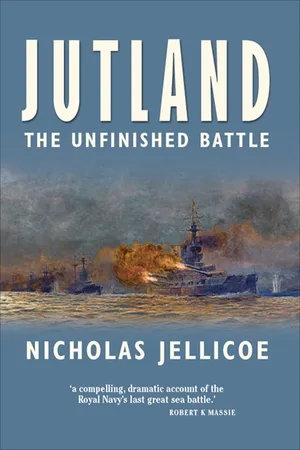
More than a century later, historians still argue about this controversial and misunderstood World War I naval battle off the coast of Denmark. It was the twentieth century's first engagement of dreadnoughts—and while it left Britain in control of the North Sea, both sides claimed victory and decades of disputes followed, revolving around senior commanders Admiral Sir John Jellicoe and Vice Admiral Sir David Beatty.
This book not only retells the story of the battle from both a British and German perspective based on the latest research, but also helps clarify the context of Germany's inevitable naval clash and the aftermath after the smoke had cleared.
- 428 pages
- English
- ePUB (mobile friendly)
- Available on iOS & Android
eBook - ePub
About this book
Information
THE BATTLE

6
Prelude to Action
The British and German fleets finally met at the Jutland Bank, eighty miles west of the northern coast of Denmark. The meeting came about through a curious series of events. To start with, each admiral planned to lure the other into the same trap on the same day. It was the culmination of a pattern that had begun earlier in the year.
On 22 February 1916 the terminally ill and ageing commander of the German High Seas Fleet, Hugo Pohl, died. On 18 January the frail commander had been replaced by a new man, Reinhard Scheer. Until that point Scheer had been commanding the 3rd Squadron, consisting of the High Seas Fleet’s most modern ships. An eager anticipation was in the air. His views were known. He wanted to get out and bring the fight to the British. During Pohl’s command the fleet had sortied eight times only and never more than 130 miles north of Heligoland. Scheer was known for his orientation towards action and an immediate shift in German naval policy was up for discussion.
Life at Anchor: Scapa, Rosyth and Kiel
The morale of sailors at anchor was a critical factor in their performance at sea. Conditions for the officers and men of the ships – great and small – of the two navies could not have been more different.
For both sides life quickly became dull. The much hoped-for ‘Entscheidungstag’ that the Germans had been waiting for drifted out of sight and imagination. ‘Es wird mächtig langweilig. Man stellte sich den Krieg immer so vor, also er nach der Kriegerklärung, gleich Hurrah käme, Angriff und dann Schluß … ein Feind finds nichts su zehen.’1 (Rough translation: ‘It was unbelievably boring. One imagined that with the declaration of war there would be cheers, battle and then an end … but we can’t even find the enemy.)
One officer, Knobloch, even started to question why Germany had built a navy: ‘Wozu eigentlich haben wir die dicken Schiffe?’2 (Rough translation: ‘By the way, why on earth do we even need these big, fat ships?’)
There was utter joy felt by the German sailors when the British were spotted. They had been champing at the bit for this day. As the commander of Seaman Richard Stumpf’s ship, SMS Helgoland, Korvettenkapitän Walter Zaeschmarr described it: ‘Es herrschte bei uns am Bord aufrichtige Freude, also die erstenfeindlichen Mastzeichen über der Kimm auftauchten’.3 (Rough translation: ‘When the first characteristically shaped enemy mast was seen over the horizon, all on board had a real sense of joy.’) Stumpf himself spoke of the mix of feelings: ‘Ich müßte lügen, wenn ich sagen würde, daß ich Angst gehabt habe. Nein, es war ein undefinierbares Gemisch von Freude, Angst, Neugierde, Gleichgültigkeit und noch etwas, das mit dem Worte Tatendrang vielleicht nicht ganz richtig ausgedrückt ist’.4 (Rough translation: ‘I’d be lying if I said that I was afraid. No, it was an indefinable mix of joy, fear, inquisitiveness, indifference and something which I can’t adequately put into words.’)
For the German navy, technology, ship design and armaments had all strongly advanced. But its very heart, the ship’s crew, was to become the source of the navy’s destruction. The social divisions were more extreme than on British ships where, at least, the back-breaking ritual of coaling brought officer and rating together. The food in the German navy was already of low quality and significantly declined as the war continued, while in the British Navy this was never a cause for conflict or resentment.
Life in Scapa Flow – a place that is hauntingly beautiful in the late spring and the summer months – was dismal in the winter, when it became a grey, cold and windy prison for the sailors. As inventive as the officers and men were in entertaining themselves with sports, crafts, theatre, opera and the like, it became numbingly boring. What made it worse was that the Grand Fleet crews knew that the battle-cruiser life was so much better in Rosyth, with all that near-by Edinburgh could offer.
See Malcolm Brown and Patricia Meehan, Scapa Flow: The Reminiscences of Men and Women who Served in Scapa Flow in the Two World Wars (Allen Lane, 1968).
Up to the early spring of 1916, German strategy had been to tie up the Royal Navy, holding back resources that could have been released elsewhere. Scheers decision was to upset the balance of naval power with the combined weight of his scouting forces and his dreadnoughts, the High Seas Fleet. As we have seen, Scheer believed he had contrived the perfect trap for the British Navy. ‘The fatal flaw in Scheers reasoning,’ Eric Grove writes, ‘was that surprising the Grand Fleet was much more difficult than he thought. Thanks to the feats of the cryptanalysts in Room 40 at the Admiralty, the British had prior warning of many of Scheers intentions.’5
In April 1916 Scheer had put his strategy into play with the attacks on Lowestoft and Yarmouth. The image of the Royal Navy, for which the public had been asked to spend today’s equivalent of billions of pounds over a decade, was badly tarnished. Scheers major lesson from the raids was that he would be better off moving the scouting group target just far enough north to tempt Beatty out of Rosyth, but not so far that it would make it easy for Jellicoe’s forces, coming from the far northern Orkney base in Scapa Flow, to get there in time as effective support.
Scheers third attempt was to coincide with the Irish Easter Rising; he was looking for a point of maximum political and military distraction for the British. His top priority was to keep his ‘fleet in being’, posing a significant enough threat to the British that they constantly had to guard against any German action, resulting in the tying up of significant British resources in men and materiel. He was not looking for any major naval action, but rather one in which he could lure out a small group of British ships and safely overpower them. Scheer was a great believer in integrated naval operations and prepared a number of strategically located submarine traps. These were deployed to critical points where ships could be torpedoed by U-boats.
Scheer had ordered two boats, U.34 and U.44, to lie in wait for Jellicoe’s forces to sortie from the Pentland Firth separating Caithness and the Orkneys; eight U-boats were to wait for Beatty in the Firth of Forth to the south. On 20 May U.27 was sent to the latter to head in as far as the Isle of May. Three U-boats were to lay mines. On 13 May U.72 was to lie off the Firth of Forth, on 23 May U.74 off the Moray Firth and, the next day, U.75 off the Orkneys; another was off Peterhead. U.21 and U.22 were off the Humber, as British warships had been (incorrectly, as it turned out) reported there and two more, U.46 and U.47, were west of the island of Terschelling off the Dutch coast, to guard against a possible intervention by Commodore Tyrwhitt’s Harwich Force. The submarines could be operational until 31 May.6 Scheer had ordered ten to be deployed to the North Sea, with orders to patrol from 17–22 May.7 The British picked up on this and responded with increased patrols. Three U-boats turned back.8
Scheers planning ran into more difficulties: he had to postpone his operation because of machinery problems in the 3rd Squadron, then because of news that repairs to Seydlitz would take another week. This delayed the operation from the 17th to the 23rd, and finally until the 30th. Scheer had also planned extensive reconnaissance by Zeppelins but the date chosen, 29 May, turned out to be too windy. As a result of reconnaissance not going ahead, Scheer dropped his targeting of Sunderland, replacing it with a sortie to the Skagerrak, the stretch of water between the southern end of Norway and the northwestern tip of Denmark. With that decision, the fleet was informed by the coded signal ‘31 May GG 2490’. U.66 and U.32 alone received it.
Jellicoe had his own plans for the High Seas Fleet. He would send a squadron of British battleships and eight light cruisers to appear off the Danish coast, at Skagen, on 2 June and move into the Kattegat. He banked on the news getting to Scheer – with Scheer undoubtedly then sending units to try to cut them off. Jellicoe held the Grand Fleet south, at the Horns Reef, shallows about ten miles off the westernmost point of Denmark, and used the planes of Engadine, the Grand Fleet’s sole carrier, to deter Zeppelins and so keep Scheer in the dark about its presence. Jellicoe deployed British submarines north for his particular trap.
Fleet composition
The fleet that Jellicoe took to sea was numerically very strong. He had twenty-four dreadnoughts in the line, with varying degrees of hitting power. Two had 15in guns, one had 14in, eleven, including Iron Duke, had 13.5in and ten had 12in. But the fleet also had its weaknesses: Jellicoe had decided to keep with the current formation two squadrons of obsolete, pre-dreadnought, armoured cruisers.*
Jellicoe was missing the added punch of the thirty-five destroyers from Tyrwhitt’s Harwich Force. Rear Admiral Henry Oliver, chief of staff, was convinced that real danger lay in the Germans feinting and rushing the Straits of Dover. According to Correlli Barnett, ‘this is where [Jellicoe’s] … superiority was at its narrowest’.9 Tyrwhitt had actually set sail at 17:10 on his own initiative, only to be pulled back by terse instructions from the Admiralty: ‘Return to base at once and await orders’. They never came.
Fleet Composition August 1914
Ship Type | Royal Navy | Imperial Navy |
Battleships in commission | 22 | 15 |
Battleships under construction | 13 | 5 |
Battle-cruisers in commission | 9 | 5 |
Battle-cruisers under construction | 1 | 3 |
Pre-dreadnought battleships | 40 | 22 |
Old armoured cruisers | 40 | 7 |
Small/light cruisers | 20 | 16 |
Torpedo boats/destroyers | 330 | 205 |
U-boats/submarines | 73 | 31 |
Source: Wolz, Imperial Splendour, p17. Missing are the seaplane carriers.
Comparative Fleet Composition at Jutland
Ship Type | British (151) | German (99) |
Dreadnought battleships | 28 | 16 |
Pre-dreadnought battleships | 0 | 6 |
Battle-cruisers | 9 | 5 |
Armoured cruisers | 8 | 0 |
Light cruisers | 26 | 11 |
Destroyers | 79 | 61 |
Seaplane carriers | 1* | 0 |
*HMS Campania should also have sailed with the battle fleet but did not receive her initial sailing orders and was ordered back to port by Jellicoe, who would not spare destroyers for a separate escort. She would have added ten aircraft.
On the German side, Scheer made errors of composition similar to Jellicoe’s, including in the 2nd Battle Squadron the six famously slow Deutschland-dass pre-dreadnoughts under pressure from his old friend, Rear Admiral Franz Mauve. Steaming at a maximum speed of 17 knots, these old models were known as the Fünf-Minuten-Schiffe (five-minute ships), their effect being seriously to reduce the German fleet’s overall speed – and there was not a single super-dreadnought in it when it sailed. The new 15in SMS Bayern would not be completed until a month after Jutland a...
Table of contents
- Cover
- Dedication
- Title Page
- Copyright
- Contents
- Illustrations
- Maps
- Foreword
- Preface
- Acknowledgements
- Abbreviations
- Introduction
- The Context
- The Battle
- The Aftermath
- Notes
- Sources
Trusted by 375,005 students
Access to over 1.5 million titles for a fair monthly price.
Study more efficiently using our study tools.
Frequently asked questions
Yes, you can cancel anytime from the Subscription tab in your account settings on the Perlego website. Your subscription will stay active until the end of your current billing period. Learn how to cancel your subscription
No, books cannot be downloaded as external files, such as PDFs, for use outside of Perlego. However, you can download books within the Perlego app for offline reading on mobile or tablet. Learn how to download books offline
Perlego offers two plans: Essential and Complete
- Essential is ideal for learners and professionals who enjoy exploring a wide range of subjects. Access the Essential Library with 800,000+ trusted titles and best-sellers across business, personal growth, and the humanities. Includes unlimited reading time and Standard Read Aloud voice.
- Complete: Perfect for advanced learners and researchers needing full, unrestricted access. Unlock 1.5M+ books across hundreds of subjects, including academic and specialized titles. The Complete Plan also includes advanced features like Premium Read Aloud and Research Assistant.
We are an online textbook subscription service, where you can get access to an entire online library for less than the price of a single book per month. With over 1.5 million books across 990+ topics, we’ve got you covered! Learn about our mission
Look out for the read-aloud symbol on your next book to see if you can listen to it. The read-aloud tool reads text aloud for you, highlighting the text as it is being read. You can pause it, speed it up and slow it down. Learn more about Read Aloud
Yes! You can use the Perlego app on both iOS and Android devices to read anytime, anywhere — even offline. Perfect for commutes or when you’re on the go.
Please note we cannot support devices running on iOS 13 and Android 7 or earlier. Learn more about using the app
Please note we cannot support devices running on iOS 13 and Android 7 or earlier. Learn more about using the app
Yes, you can access Jutland by Nicholas Jellicoe in PDF and/or ePUB format, as well as other popular books in History & Military & Maritime History. We have over 1.5 million books available in our catalogue for you to explore.