A gripping true account of warfare in the skies over Korea, when American bombers and North Korean jet fighters would change the course of air combat.
On October 23, 1951, an hour and a half before sunrise, nine B-29s of the 307th Bombardment Wing took off from Kadena Air Force Base in Okinawa, Japan, on a bombing mission against Namsi—a North Korean airfield under construction in the heart of the shooting gallery known as MiG Alley.
In under six hours, they would engage in a battle that would forever change the conduct of strategic aerial bombardment. Six of the nine aircrafts were shot down; the highest percentage of US bombers ever lost on a major mission. Unfortunately, this event that many experts consider the epic air battle of the Korean War—and perhaps the greatest jet engagement in the history of aerial warfare—has become another forgotten fight in a forgotten war.
Here, Earl J. Hill presents the facts and circumstances of the mission from first briefing to final landing using historical documents, firsthand accounts of aircrew members and ground personnel from both sides, and photographs of the mission and its aftermath.
This is the story of those who clashed in the skies above Namsi, the events leading up to it, and Black Tuesday's historical impact on the aerial warfare tactics.
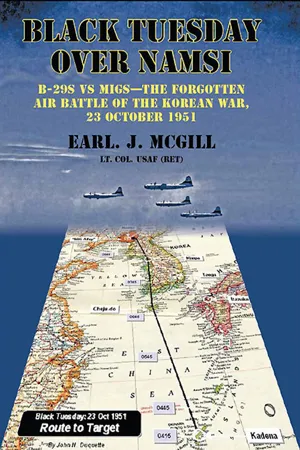
eBook - ePub
Black Tuesday Over Namsi
B-29s vs MIGs—The Forgotten Air Battle of the Korean War, 23 October 1951
- 224 pages
- English
- ePUB (mobile friendly)
- Available on iOS & Android
eBook - ePub
Black Tuesday Over Namsi
B-29s vs MIGs—The Forgotten Air Battle of the Korean War, 23 October 1951
About this book
Information
1
The Mission
My crew and I were crouched around a fifty-caliber ammunition crate, playing poker in our hut overlooking the Kadena flight line. We were trying to push the war out of our minds. Autumn, which had started out as a milk run, had turned sour. On October 2 we had survived The Outlaw crashing on takeoff. Ten days later, Typhoon Ruth provoked a full-scale evacuation of our Okinawa-based B-29s to Japan, and knocked our tin hut off its foundation. To take a leak in the elevated toilet we had to stand on a chair, but this was the least of our worries. The day before, up north, MiG-15s had jumped our group’s twelve-ship formation and shot down one B-29. Now we were sweating out news of our sister unit, the 307th Bombardment Wing. Rumor was they’d run into big trouble. When word came they were inbound, we folded our hands, piled into a Jeep, and headed for the flight line. Minutes later, we saw a lone bomber silhouetted against the tranquil Pacific sky. One B-29 out of nine – with a hole in the tail fin we could see the sky through.

For the 307th crews, the mission had begun with a 1900 briefing the night before. Lt. Nick Kourafas, lead bombardier, and his navigator, Lt. Fred Meier, had worked all afternoon, planning and making computations. Namsi Airfield was less than fifty miles southeast of Antung and its politically protected jet fighter bases in China. The nine aircraft formation would be attacking a target within easy range of more than a hundred MiG-15s stationed there. As a veteran of 44 missions, Nick knew what that could mean.
On May 3, Kourafas and Meier had received spot promotions to first lieutenant. They would fly their entire tour together and lose their promotions when their tour ended in November 1951. Meier remembers that the crew’s first radio operator, a Texan, found religion while flying the B-29 and always read The Bible on their way to the target. The crew’s original Central Fire Controller (CFC) had also been replaced by a younger and shorter Fred Spivey. Their left gunner, Rolland Miller, had flown his first combat mission when he was 18. This mission to Namsi would be his 45th and make him a seasoned combat veteran at 19. Meier called their crew aircraft commander, Captain Clarence Fogler, “the lucky one.” ‘Fog’ had survived the brutal low-level Ploesti raids of WWII. He had also brought his crew home from the deadly April 12 mission against the bridges at Sinuiju. With luck he would also bring them home from Namsi.
Meier wrote in his diary, “I hope I’m wrong but I think the MiGs will be in the area.”
Major William Griner, acting squadron operations officer for the 372nd, took over as commander on aircraft #44-27347, substituting for Capt. Brisey who was unable to fly because he’d sprained his wrist.
Wake up was at 0100; take off at 0415.
At 0230, Cpl. Dewell Turner, on loan from the 301st Bomb Wing and assigned TDY as a spare gunner with the 307th, was woken by the charge of quarters and told he would be flying with Major Griner in place of a gunner who had been grounded. Turner’s late assignment precluded him being in on the pre-flight duties, except for the last minute prior to boarding. He noted in retrospect that the short notice was probably a good thing because it didn’t give him time to contemplate the gravity of the mission. Major Griner and his CFC interviewed Turner briefly before take off and placed him in the left gunner’s seat.
Another 301st substitute gunner who had accompanied Turner from Barksdale, Cpl. Paul Stainbrook, had been temporarily assigned to Captain Shields’ crew. After a year in the Navy and a short intermission between military services, Stainbrook had joined the Air Force and wound up as a B-29 gunner. On his 21st birthday he boarded a DC-4 destined for the Far East and was ultimately assigned to the 307th Bomb Wing.
Stainbrook hoped to be permanently assigned to Shields’ crew.
For reasons that are not fully understood, a ranking officer was assigned to fly as an observer on each of the three flight lead aircraft. Colonel Henry Ledbetter joined Fogler’s crew as the designated airborne commander; Colonel John Carroll would fly with Reeter, and Lieutenant Colonel Julius O’Neal, slated to be the new 370th squadron commander, climbed aboard Shields’ ill-fated B-29. For most of the mission, all three observers would perch on the forward compartment “aisle stand,” a box with a seat belt that was situated between and slightly behind the pilots. In spite of the potential for heavy flak and MiG attack, all but one of the nine aircraft would have extra personnel aboard.
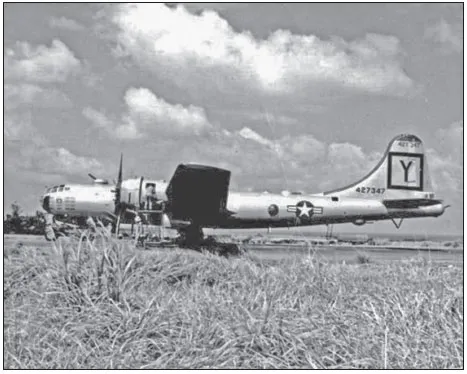
B-29 # 44-27347, Baker Three on Black Tuesday, being preflighted before a mission
(Robert Adams Photo, Courtesy of Frank Farrell)
(Robert Adams Photo, Courtesy of Frank Farrell)
Rolland Miller, left gunner on Able Lead (Courtesy of Rolland Miller)
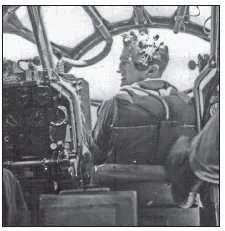
Nick Kourafas, Able Lead bombardier (Courtesy of Rolland Miller et al.)
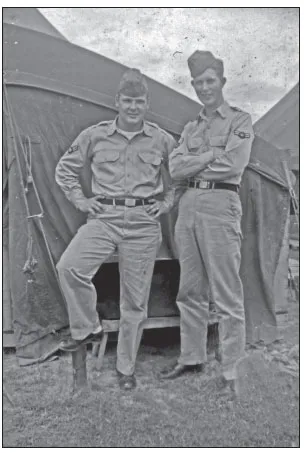
Paul Stainbrook (l) and Dewell Turner (r) (Courtesy of Dewell Turner)
Capt. James “Archie” Foulks and his crew would be flying their 44th mission. For his co-pilot (officially listed as “pilot” on a B-29 crew), 1st Lt. Fred Beissner Jr. and several others on the crew, Archie Foulks would be their third aircraft commander. Before Foulks took over, they’d flown with their squadron operations officer, a West Pointer, and another pilot, Major Martin L. Jones.
Flying only his second combat mission, Sgt. Edward Moore was assigned to fly as Major Field’s radio operator in place of Dick Chamness, who had managed a job swap that put him in a crew that would soon rotate back to the states. Moore, who had joined the Marine Reserves when he was sixteen, had already flown with the crew, once as a sub on the Typhoon Ruth evacuation to Yokota and again on a combat mission that was inserted into their return to Kadena.
Although Paul Stainbrook’s assigned position on Shields’ crew was tail gunner, Sgt. Carl Webb the regular left gunner asked Stainbrook to trade places. Because of the crammed nature of their compartment, tail gunners usually wore chest pack harnesses. About the size and shape of a large breadbox, the chest chute, was kept separate and clipped to the harness only in an actual emergency. Left gunners wore backpacks. Nevertheless, Stainbrook said it was OK with him, a decision that may have saved his life.
Preflight inspections were carried out with the aid of flashlights, and it was still dark when the ten B-29s started their engines, pulled out of their revetments, taxied, and lined up for takeoff. Although four 370th squadron aircraft were scheduled to take off, one of them had an excessive rpm drop during engine run-up, and the spare took its place. Rolland Miller’s gunnery school chum, Gene Woods, was on a 370th aircraft that aborted and later, the gunners who flew the mission kidded Gene about putting straight pins in the spark plug leads during the engine pressure check to cause the excessive rpm drop.
Griner’s aircraft was number six in line with Shields directly behind. Although only nine aircraft would bomb Namsi, it was standard procedure on missions involving several aircraft to have a spare B-29 ready to launch. On Black Tuesday, the spare, commanded by Major Don Field, himself a volunteer, filled-in for the aircraft that aborted because of engine trouble.
The huge Box Y on its vertical stabilizer identified a B-29 as belonging to the 307th Bombardment Group, and the foot-wide color band at the tip designated which squadron it was assigned to. Green identified a 370th B-29, yellow the 371st, and the 372nd was painted red. Like all B-29 aircraft, each bomb symbol on the nose denoted a combat mission. Unlike other units, the 307th had no nose art.
In turn, each bomber lined up on the runway, throttling all four engines for a full power check before brake release and the agonizingly slow acceleration that would often gobble up the entire available runway before lift off. With landing gear and flaps coming up, the B-29 was flown level and often appeared, to the ground observer, to be settling back to earth as it gathered speed, usually to 190 mph, calibrated airspeed, before resuming its climb to 5000 - 9000 feet.
After leveling off, the bomber crews were in for a boring two and a half hour grind over the open East China Sea that gave them too much time to think about what lay ahead. Cpl. Rolland Miller and his crewmates on Able Lead occupied some of their time by having an in-flight lunch, “C” or “K” rations packed inside a 2”x 6”x 8” brown cardboard box with the contents printed on the outside. The several choices included small cans of pork and applesauce or beef stew, packages of crackers, cans of peaches or fruit cocktail and chocolate bars. There was also a napkin, which could be used for toilet paper, and a tiny folding “P-38” can opener, which almost everyone who had anything to do with rations attached to his dog tag chain. Crew members in the aft compartment heated cans of meat on the Aldis signal lamps or the radar operator’s equipment inverter. Some rations contained meat in double-walled cans. Holes could be punched in the top of the outer can and water added. Chemical reaction heated the inner can. Miller remembers the meal “because it was always the same,” adding, “We usually tried to eat before formation assembly so in case something happened and we went down we would have a partially filled stomach.”
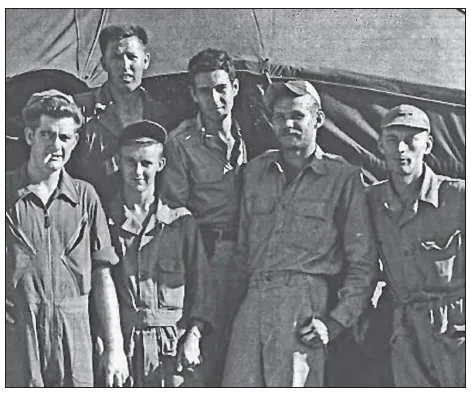
Baker Three enlisted crew members in 307BW tent area (Courtesy of Paul Dickerson)
Fred Meier recalls, “The flight lunches were WWII vintage leftovers, sometimes rotten and inedible.”
Toward the end of their flight over the East China Sea, the bombers climbed to their formation altitude. “I couldn’t believe they sent us with no altitude equipment,” Meier recollects. A drop of water on the deck turned to ice instantly, and he was forced to sit on his feet to keep them from freezing.
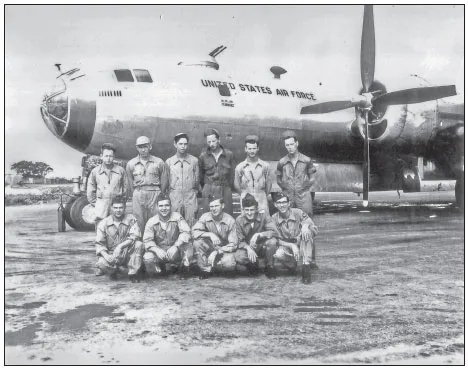
Photo of Able Lead Crew taken before Capt. Clarence Fogler took over as aircraft commander. Back Row, L. to R: TSgt. Ralph Dees, Engineer; Cpl. Fred Spivy, L. Gunner; Cpl. Rolland Miller, R. Gunner; TSgt. Jack King (?), CFC; Cpl. Francis “Dippy” Fields, Tail Gunner; TSgt. Bernie Blumonthol, Radio Operator. Front Row, L to R: Capt. Joe Denson; Aircraft Commander; Lt. Stan Pyfrom, Pilot; Lt. Fred Meier, Navigator; Lt. Nick Kourafas, Bombardier; Lt. James “Bill” Chapman, Radar. Fred Meier wrote, “Acft. #045 had 4 Ford engines. Our Crew Chief worked hard to get them matched.” (Courtesy of Fred Meier)
First light streaked the horizon fifteen minutes before they reached the assembly point, but sunup was still twelve minutes away, at 0657 local time. Headwinds had been stronger than predicted, necessitating the aircraft speed up in order to arrive at the assembly and fighter rendezvous points on time. This required more power; therefore more fuel. The climb to 19-21,000 feet was begun to arrive at altitude over the orbit/assembly point, Cheju-do, a volcanic island in the southwest sea of the Korean peninsula.
Cheju-do is large and oval-shaped, with Halla, an extinct volcano, situated almost dead center. The 6,400’ cone presented a perfect radar return, therefore an ideal coast-in point for northbound B-29s. To the people in the region, Cheju-do has always been a place of mystery, and the constant parade of bombers circling and massing far overhead only added to that mystery.
Time limited the orbit to one big circle before proceeding north as three separate three-ship formations. In Able Flight, Capt. James Lewis flew Fogler’s right wing, while Capt. Robert Krumm held position on the left. Behind them Lt. William Reeter, accompanied by the 372nd Squadron C. O, headed up Baker Flight with Capt. James Foulks on the right and Major William Griner flying left wing. Capt. Thomas Shields led Charlie Flight. Major Donald Field flew on his right and Lt. Peter Dempsey on the left.
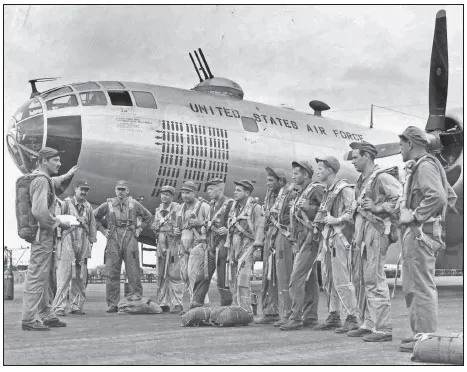
Baker Lead crew receives a last minute b...
Table of contents
- Cover
- Title Page
- Copyright
- Dedication
- Contents
- List of Illustrations, Maps and Diagrams
- Preface
- Acknowledgments
- Abbreviations
- Introduction
- 1. The Mission
- 2. The Korean Air War
- 3. The Combatants
- 4. The Machinery of War
- 5. Prelude to Disaster
- 6. Target: Namsi Airfeld
- 7. Black Tuesday, October 23, 1951
- 8. Aftermath
- 9. Analysis, Conclusions and Refections
- Appendix I American B29 Crew Rosters
- Appendix II Casualty Lists
- Appendix III Soviet Crew Rosters
- Appendix IV Biographical Sketches of Selected Combatants
- Notes and References
- Bibliography
- eBooks Published by Helion & Company
Trusted by 375,005 students
Access to over 1.5 million titles for a fair monthly price.
Study more efficiently using our study tools.
Frequently asked questions
Yes, you can cancel anytime from the Subscription tab in your account settings on the Perlego website. Your subscription will stay active until the end of your current billing period. Learn how to cancel your subscription
No, books cannot be downloaded as external files, such as PDFs, for use outside of Perlego. However, you can download books within the Perlego app for offline reading on mobile or tablet. Learn how to download books offline
Perlego offers two plans: Essential and Complete
- Essential is ideal for learners and professionals who enjoy exploring a wide range of subjects. Access the Essential Library with 800,000+ trusted titles and best-sellers across business, personal growth, and the humanities. Includes unlimited reading time and Standard Read Aloud voice.
- Complete: Perfect for advanced learners and researchers needing full, unrestricted access. Unlock 1.5M+ books across hundreds of subjects, including academic and specialized titles. The Complete Plan also includes advanced features like Premium Read Aloud and Research Assistant.
We are an online textbook subscription service, where you can get access to an entire online library for less than the price of a single book per month. With over 1.5 million books across 990+ topics, we’ve got you covered! Learn about our mission
Look out for the read-aloud symbol on your next book to see if you can listen to it. The read-aloud tool reads text aloud for you, highlighting the text as it is being read. You can pause it, speed it up and slow it down. Learn more about Read Aloud
Yes! You can use the Perlego app on both iOS and Android devices to read anytime, anywhere — even offline. Perfect for commutes or when you’re on the go.
Please note we cannot support devices running on iOS 13 and Android 7 or earlier. Learn more about using the app
Please note we cannot support devices running on iOS 13 and Android 7 or earlier. Learn more about using the app
Yes, you can access Black Tuesday Over Namsi by Earl. J. McGill in PDF and/or ePUB format, as well as other popular books in History & Military & Maritime History. We have over 1.5 million books available in our catalogue for you to explore.