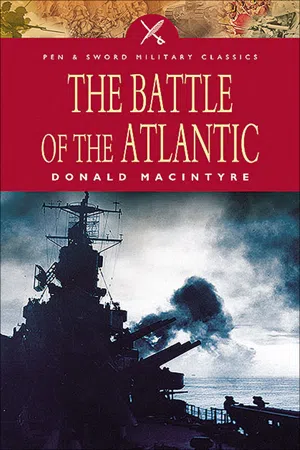
An eyewitness account of the fight for supremacy at sea during World War II, as told by a man who was in the thick of combat against Nazi Germany.
The Battle of the Atlantic was an unremitting assault by enemy boats and aircraft against Allied merchant ships that were the lifeline of Great Britain—and the vigilant defense against them made by the Royal Navy and other allied forces.
Captain Donald Macintyre—a winner of the Distinguished Service Cross who participated in the fighting, escorting over 1,100 ships and losing only two—tells the story with immediacy and clarity. He describes the measures employed to defeat the amazingly successful 'wolf-pack' tactics of the U-boats, the convoy system and individual convoys, never shirking from how desperately close to defeat the Allies were at times.
Not only does he analyze the strategic issues of the day, he also describes the battle from the viewpoint of the participants themselves. The long, drawn-out duels between escort and U-boat are made vivid by quotations from the log-books of some of the ablest escort-commanders as well as combat reports of the German U-boat captains.
Featuring dozens of rare wartime photographs drawn from both German and British sources, this account of the sacrifice and savagery of war makes the courage and endurance of those who fought in the Atlantic all the more palpable.
- 208 pages
- English
- ePUB (mobile friendly)
- Available on iOS & Android
eBook - ePub
The Battle of the Atlantic
About this book
Information
Chapter One
The Background
As, in the late sixteenth century, Spanish adventurers opened up Central and South America to conquest and colonization, their nation was locked in dispute with England. Religious differences were responsible for a continuous state of quasi-war, hostilities financed and sustained through the wealth that flowed back in the holds of the periodic flota and the individual great ships coming up from the Isthmus.
Elizabeth I of England was resourceful, but presided over an impoverished Treasury. To prey on Spanish trade offered the chance of both striking at Spain's ability to fight and the prospect of national (and personal) enrichment.
Of the fighting ships with which the Queen faced the enemy, less than twenty per cent were the property of the Crown. The remainder were owned and equipped by merchant adventurers, patriotic but with an eye to profitable return. Their inducement was the Letter of Marque, issued by the Crown to its captains to legitimize their activities. As they sailed private ships, they became known as ‘privateers’.
Letters of Marque were no new device, having been issued as far back as 1243 ‘for the annoyance of the King's enemies’. Ships taken by privateers had, by international law, to be taken to the nearest port at which they could be condemned by a Prize Court, valued and sold off. The income would be split in agreed proportion between Crown and privateer captain, the welfare of crew and passengers of the prize having been observed.
In reality, unfortunately, it was risky and time-consuming to bring a prize to port. Far simpler for her to ‘disappear’ with all hands. In short, there was always incentive for privateering to degenerate into something akin to common piracy, being frequently rewarded accordingly and summarily at the end of a convenient yardarm.
Usually profitable, occasionally hugely so, privateering was exceedingly widespread. Even as Elizabeth issued her own licences, for instance, others of her honest seafarers were being persecuted in the near seas by men of like persuasion from the provinces of Holland and Zeeland, under the pretext that English merchants ‘were assisting Dunkerque, Spain and Antwerp’.
As west-European maritime powers founded and extended their empires, trade increased and, with it, rivalries that led often to war. To the detriment of recruitment to the regular services – English, French or Dutch – the best and most enterprising seamen were immediately drawn by the undoubted glamour and potential of privateering.
By the eighteenth century, the Royal Navy operated scores of minor warships in an effort to counter the activities of privateers. Sloops, brigs, cutters and, later, schooners, they offered superb experience for their commanders and lieutenants-in-command. While many enjoyed individual success however, their overall activities were not well directed.
In the course of the unnecessary ‘War of 1812’ British trade endured some very enterprising American privateering. Over five hundred American Letters of Marque were authorized, these taking some 1,300 British merchantmen. This effort would not, of itself, have won a war against a major maritime power, but each capture aided the enemy and racked up insurance rates a further notch.
The so-called Crimean War was terminated by plenipotentiaries who, gathering in Paris in 1856, also made a declaration outlawing the practice of privateering. Powers including Great Britain, France, Russia, Austria and Prussia, later joined by others, agreed the following fundamental points:
- That privateering was abolished.
- That a neutral flag protects an enemy's goods, excepting contraband.
- That an enemy flag protects a neutral's goods, again excepting contraband.
- That blockades, to be legal, must be effective.
Probably the last gasp of privateering on any scale was from the United States where, during the Civil War, some eighty licenced Confederates took a similar number of Union vessels. Following the 1856 agreement, however, most neutral ports were now closed to prizes and, with the near-disappearance of the profit element, private operators turned to blockade running. From now on, war against trade would be conducted by regular navies, either with warships or auxiliary cruisers, operating under naval control and ensign.
The nineteenth century had been a period of great upheaval for the major fleets, not least the Royal Navy. Technological advance had seen lines of battle, little-changed in centuries, displaced by steam power, metal hulls and the leap-frogging competition between ever larger guns, their explosive projectiles and the protection with which to withstand them. Varying opinion on how best to combine these elements had resulted in an eclectic force of warships, many with considerable ‘presence’ but few with appreciable fighting power.
Despite its shortcomings, the Victorian navy was still the standard against which others were measured. With the passing of the Naval Defence Act of 1889 and the adoption of the Two Power Standard the Royal Navy began to receive coherent classes of modern warship in something like predictable numbers.
The rising costs of Britain's armed forces depended for funding much upon popular support, but the government's more radical wing was already challenging expenditure through the undoubted need to invest in improved social programmes. Britain's naval rivals were experiencing much the same problem, that of providing a credible response to overwhelming strength with only a limited budget.
Predictably, it was the French who arrived at what appeared to be the answer, in the philosophy of the Navy Minister, Admiral Théophile Aube.
Whitehead's self-propelled torpedo had been used successfully during 1878–80 by both the Russians and the Peruvians. Known, from the youth of its followers, as the Jeune École, Aube's beliefs included using large numbers of inexpensive ‘torpedo boats’ to render armoured ‘battleships’ (as they were becoming known) impotent. While an enemy's fleet was thus contained, cruisers – large, fast and unarmoured – would prey on his commerce. Aube saw that the key to success was ruthlessness, writing ‘War is the negation of law . . . the recourse to force . . . Everything is therefore not only permissible but legitimate against the enemy.’
British response to Aube was predictable, maintaining numerical superiority in capital ships and cruisers while out-building the French in torpedo boats. Countermeasures, such as rapid-firing medium-calibre guns, electric searchlights and torpedo nets, disproved the supposition that the day of the battleship was over. Torpedo gunboats admittedly had proved too slow for their intended role but, by 1893, the first torpedo boat destroyer had appeared.
Although large, coal-hungry ‘commerce destroyers’ continued to be built by major navies, Aube's theories were looking discredited. In 1885, however, the Swedish innovator Nordenfelt had successfully married the Whitehead torpedo with a practical submersible. This combination was promptly adopted by the French as a substitute for the obsolescent torpedo boat concept. By the turn of the century, they were the acknowledged leaders in this new technology and, at a time when battleships practiced gunnery at 4,000 yards, the torpedo could already reach 3,000 and was being rapidly improved.
As with all new developments, the Royal Navy's attitude to submarines was to keep an unobtrusive watch while taking no action that would unnecessarily make any part of its own armoury obsolescent. This policy had been expressed nicely by the First Lord, St Vincent when, long before, the Prime Minister, Pitt, had shown interest in Fulton's experiments: ‘Pitt was the greatest fool that ever existed, to encourage a mode of war which they who commanded the seas did not want and which, if successful, would deprive them of it.’
Only when the Admiralty learned that the French had approved funds sufficient to build 150 torpedo boats and submarines did it start its own programme. In 1901 Vickers began building to the American Holland's design.
The French vote had been part of the Fleet Law of 1900, a plan for general naval expansion which began to produce results just as the nation finally reached rapprochement with Great Britain. With the Entente of 1904 the two states agreed to solve conclusively all the petty differences that had, so often in the past, led to hostilities. Both now needed to recognize the fact that Germany posed the greatest common threat.
Following unification, Germany maintained a small fleet headed, significantly, by the army. It was viewed as a force to be used to safeguard the military's seaward flank or as a means to project military power onto a foreign shore. Coastal defence was a major role and Aube's theories accorded well with general plans.
In 1888, however, the young Wilhelm II acceded as emperor. Ambitious, he was steeped in the ideas, not of Aube, but of Mahan. He wanted a battle fleet the equivalent of the Prussian army. With it, he would gain for Germany some of the world stature enjoyed by his grandmother, Queen Victoria.
It was, nonetheless, 1897 before Wilhelm appointed Rear Admiral Alfred Tirpitz to head the Navy Office. Although a torpedo specialist, Tirpitz was another Mahanian disciple. Entrusted by his patron with the creation of a battle fleet, he proved to be both single-minded and a consummate politician, persuading a reluctant Reichstag that Germany's future ‘place in the sun’ depended upon credible maritime strength. The result was the successful passage of the 1898 Navy Bill.
Tirpitz did not stop here. Exploiting a wave of popular anti-British sentiment over the Boer War, he returned to parliament and had it pass a second bill, that of 1900. This effectively doubled the capital ship element to thirty-four hulls, with an agreed automatic replacement following twenty-five years of service.
Nothing deflected Tirpitz' plans, and those espousing Aube's ideas on cruiser or submarine/torpedo boat warfare received short shrift. His strategy was based on so-called ‘risk theory’, the battle fleet not being numerically superior to that of the ‘greatest sea power’ but, being concentrated in the North Sea, would be too powerful to be brought to decisive action except at the price of unacceptable loss. Wilhelm's fleet would be both threat and deterrent.
Only in April 1904 was Tirpitz finally moved to order a first U-boat. In light of later events, his tardiness was much criticized but he defended himself as ‘[refusing] to throw away money on submarines so long as they could only cruise in home waters . . . as soon as sea-going boats were built, however . . . I went as far as the limits of our technical production would permit’.
Six months after Tirpitz placed the fateful order that launched the German submarine service, Admiral Sir John (‘Jacky’) Fisher was appointed First Sea Lord, a post that he was to hold for sixty-three months. A small, volatile man of prodigious energies, Fisher was a dedicated reformer. To him, war with Germany was inevitable and his response was decisive and controversial. He formed and chaired an expert committee that would inaugurate the ‘Dreadnought revolution’. He reorganized the dockyards and scrapped 154 obsolete warships. Alliances formed with France and Japan allowed considerable naval strength to be withdrawn from the Mediterranean and the Far East. By also revising or closing distant foreign stations, Fisher moved even more ships into home waters, going far to offset Tirpitz' ambitions.
Importantly, Fisher appreciated the potential of the submarine. During his tenure as C.-in-C. Portsmouth, his responsibilities included the Navy's submarine base and he could learn at first hand. At a time when service opinion was still sharply divided, Fisher was enthused, believing that submarines and aircraft would eventually revolutionize war at sea.
The Navy's major tasks were to prevent invasion and to protect trade. For deep sea operations, Fisher envisaged a battle fleet headed by fast, heavily-armed but lightly armoured battle cruisers. Against invasion, the narrow seas would be made untenable for big ships by swarms of submarines and torpedo boats, organized in every port in what was t...
Table of contents
- Cover Page
- Title Page
- Copyright
- Contents
- Introduction
- Chapter One: The Background
- Chapter Two: The Line-up
- Chapter Three: Bitter Tide (September 1939 – December 1941)
- Chapter Four: Drumroll. The Dark before the Dawn (1942)
- Chapter Five: Climax in the Atlantic (January – July 1943)
- Chapter Six: The Battle Won (August – December 1943)
- Chapter Seven: Cleansing the Stable (January 1944 – May 1945)
- Chapter Eight: Retribution
- Index
Trusted by 375,005 students
Access to over 1.5 million titles for a fair monthly price.
Study more efficiently using our study tools.
Frequently asked questions
Yes, you can cancel anytime from the Subscription tab in your account settings on the Perlego website. Your subscription will stay active until the end of your current billing period. Learn how to cancel your subscription
No, books cannot be downloaded as external files, such as PDFs, for use outside of Perlego. However, you can download books within the Perlego app for offline reading on mobile or tablet. Learn how to download books offline
Perlego offers two plans: Essential and Complete
- Essential is ideal for learners and professionals who enjoy exploring a wide range of subjects. Access the Essential Library with 800,000+ trusted titles and best-sellers across business, personal growth, and the humanities. Includes unlimited reading time and Standard Read Aloud voice.
- Complete: Perfect for advanced learners and researchers needing full, unrestricted access. Unlock 1.5M+ books across hundreds of subjects, including academic and specialized titles. The Complete Plan also includes advanced features like Premium Read Aloud and Research Assistant.
We are an online textbook subscription service, where you can get access to an entire online library for less than the price of a single book per month. With over 1.5 million books across 990+ topics, we’ve got you covered! Learn about our mission
Look out for the read-aloud symbol on your next book to see if you can listen to it. The read-aloud tool reads text aloud for you, highlighting the text as it is being read. You can pause it, speed it up and slow it down. Learn more about Read Aloud
Yes! You can use the Perlego app on both iOS and Android devices to read anytime, anywhere — even offline. Perfect for commutes or when you’re on the go.
Please note we cannot support devices running on iOS 13 and Android 7 or earlier. Learn more about using the app
Please note we cannot support devices running on iOS 13 and Android 7 or earlier. Learn more about using the app
Yes, you can access The Battle of the Atlantic by Donald Macintyre in PDF and/or ePUB format, as well as other popular books in History & Military & Maritime History. We have over 1.5 million books available in our catalogue for you to explore.