"Comprehensive scholarship and convincing reasoning, enhanced by an excellent translation, place this work on a level with the best of David Glantz" (Dennis Showalter, award-winning author of
Patton and Rommel).
This groundbreaking book examines the battle of Kursk between the Red Army and
Wehrmacht, with a particular emphasis on its beginning on July 12, as the author works to clarify the relative size of the contending forces, the actual area of this battle, and the costs suffered by both sides.
Valeriy Zamulin's study of the crucible of combat during the titanic clash at Kursk—the fighting at Prokhorovka—is now available in English. A former staff member of the Prokhorovka Battlefield State Museum, Zamulin has dedicated years of his life to the study of the battle of Kursk, and especially the fighting on its southern flank involving the famous attack of the II SS Panzer Corps into the teeth of deeply echeloned Red Army defenses.
A product of five years of intense research into the once-secret Central Archives of the Russian Ministry of Defense, this book lays out in enormous detail the plans and tactics of both sides, culminating in the famous and controversial clash at Prokhorovka on July 12, 1943. Zamulin skillfully weaves reminiscences of Red Army and
Wehrmacht soldiers and officers into the narrative of the fighting, using in part files belonging to the Prokhorovka Battlefield State Museum. Zamulin has the advantage of living in Prokhorovka, so he has walked the ground of the battlefield many times and has an intimate knowledge of the terrain.
Examining the battle primarily from the Soviet side, Zamulin reveals the real costs and real achievements of the Red Army at Kursk, and especially Prokhorovka. He examines mistaken deployments and faulty decisions that hampered the Voronezh Front's efforts to contain the Fourth Panzer Army's assault, and the valiant, self-sacrificial fighting of the Red Army's soldiers and junior officers as they sought to slow the German advance and crush the II SS Panzer Corps with a heavy counterattack at Prokhorovka. Illustrated with numerous maps and photographs (including present-day views of the battlefield), and supplemented with extensive tables of data, Zamulin's book is an outstanding contribution to the growing literature on the battle of Kursk, and further demolishes many of the myths and legends that grew up around it.
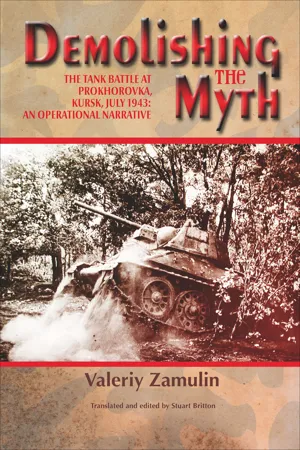
eBook - ePub
Demolishing the Myth
The Tank Battle at Prokhorovka, Kursk, July 1943: An Operational Narrative
- 646 pages
- English
- ePUB (mobile friendly)
- Available on iOS & Android
eBook - ePub
Demolishing the Myth
The Tank Battle at Prokhorovka, Kursk, July 1943: An Operational Narrative
About this book
Information
1
The Situation in the Kursk Sector as of July 1943
By the end of March 1943, the winter campaign was grinding to a halt. Forces of both sides had settled into defensive positions, and a rare cessation in operations along the Soviet-German front ensued. Both sides strove to use the lull in fighting to replace their losses in personnel and equipment.
In the course of the winter campaign, attacking Soviet forces had created a large, deep bulge in the enemy’s lines in the region of Kursk. The configuration of the front lines in this sector created an opportunity for the enemy to launch powerful flank attacks with major force groupings from the regions of Orel and Briansk in the north, and Belgorod and Khar’kov in the south, with a subsequent breakthrough into the Soviet rear areas. However, by the beginning of April 1943, the balance of forces between the two sides along the entire Soviet-German front had turned in the favor of the Soviets, who held a 1.1 to 1 superiority over the adversary in personnel, 1.4 to 1 superiority in tanks, 1.7 to 1 superiority in artillery, and had twice the number of combat aircraft.
Such superiority in strength could have been used to continue the offensive in one of several strategic directions. Some military leaders and front commanders proposed to forestall the enemy’s summer plans by launching a pre-emptive offensive to exploit the situation that had developed and destroy the flanking German forces on either side of the Kursk bulge. However, the Stavka VGK [Headquarters of the Supreme High Command], in light of the fatigue of the troops, the fact that many formations were not at full strength, and the difficulty of moving supplies and material during the spring muddy season, rejected an offensive. Doubtlessly, a factor in this decision was also the failure of the Khar’kov offensive in May 1942, when attacking forces of the Central and Voronezh Fronts had scored deep penetrations in the enemy’s defenses, but had wound up exposed to encirclement by the counterattacks of strong German formations on the flanks of the penetration.
On 12 April 1943, the Stavka adopted a preliminary decision to assume a prepared defense on the Kursk axis. Subsequent events at the front would show that this was the proper decision for the situation that it was facing by the spring of 1943.
Hitler’s headquarters also desired to take advantage of the favorable situation that had developed for its forces around the Kursk bulge in order to conduct a major offensive designed to seize the strategic initiative and to change the course of the war in its favor. The plan for a general offensive on the Eastern Front in 1943 traveled a long and winding path up and down the chain of command and through the Reich’s highest corridors of power. From its initial conceptions to the precisely formulated, laconically worded final order for the offensive, the operation became the Wehrmacht’s final strategic offensive on the Eastern Front.
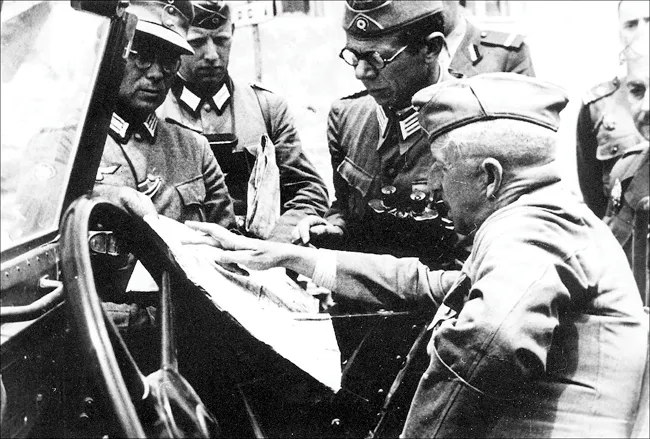
The commander of Army Group South, E. von Manstein, issues orders to one of his staff officers, July 1943. (RGAKFD, Russian State Archive of Film and Photo Documents)
It must be said that from the very moment the question arose in February 1943 about planning the Wehrmacht’s summer campaign in the East, right up to the latter half of June, Hitler simply could not decide upon the optimal plan for the offensive. More accurately speaking, he was unable to reconcile his boundless personal ambitions to the more limited possibilities of Germany and its armed forces. The spring of 1943 was marked by disagreements at Hitler’s headquarters over the further course of the war. At the same time, it was apparent that the acute pain of the Stalingrad catastrophe was fading among the top Nazi leaders, even as optimistic evaluations of Germany’s potential and a tendency to underestimate the Soviet Union’s possibilities were growing. In these arguments, the question of the usefulness of the Kursk offensive became fundamental.
Two groups, which had diametrically opposite points of view on the subject of the Kursk offensive, coalesced in Germany’s political and military leadership. The opponents of pursuing a large-scale offensive were primarily a number of high-ranking generals, including Colonel General H. Guderian; the commander of the Fourth Panzer Army Colonel General H. Hoth; and the operations chief of the Armed Forces High Command (Oberkommando des Wehrmacht, or OKW) Colonel General A. Jodl. By the end of spring, the commander of Army Group South Field Marshal E. von Manstein came to share this point of view as well. They believed that the Wehrmacht was not ready for large-scale offensive operations, including in the area of the Kursk bulge, against a battle-seasoned Red Army. In their opinion, such an offensive could lead to the exhaustion of Germany’s resources and drain the strength of its armed forces. Moreover, Jodl pointed to the danger that the British and Americans might open a second front in the West, and considered it inadvisable to use the limited reserves, which were being gathered with great difficulty, for an offensive. He proposed that the German forces on the Eastern Front instead adopt a defensive posture, straighten the lines wherever feasible, and transfer part of the forces thereby freed to the west, in order to strengthen the French and Mediterranean coastlines.
In the first days of April, fresh intelligence began to arrive, especially from aerial reconnaissance, which showed that the Soviet forces in the Kursk region were preparing a strong and deeply echeloned defense of the Kursk bulge, and that intensive work was underway precisely along the directions of the planned attacks. These preparations were obviously designed to reduce the pace of the German breakthrough efforts to a slow grind, and might eventually cause the complete failure of the offensive. However, Hitler just as before relied upon the shock strength of his panzer divisions, which had received new types of heavy tanks and assault guns, as well as upgraded models of the Panzer IV tank. The plans counted upon establishing overwhelming superiority over the defending Soviet forces in the designated breakthrough sectors, and rapidly destroying them before the arrival of reserves.
Hitler was still gripped by the experiences of 1941 and 1942, when Soviet defensive positions had collapsed under the concentrated blows of tanks and infantry, supported by the Luftwaffe. Moreover, the tasks of the main assault groups in this offensive were significantly more modest than in preceding operations. In addition, the political aspect of the future operation had a significant influence on the Führer’s views.
On 12 April, Hitler spread out a prepared map of the operation’s plan on a table before him. He had in fact just approved the plan earlier that same day. Within three days, on 15 April, the plan was put into motion by Operations Order 6, which laid out the goals and tasks of a summer campaign in the East, and spelled out the primary missions for both Army Group South and Army Group Center. The essence of the operation, which received the code name “Zitadelle [Citadel],” was by means of a concentric attack in the direction of Kursk from the region of Orel in the north and Belgorod in the south, to split the defenses of two Soviet fronts – Voronezh Front (commanded by General N. F. Vatutin1) and Central Front (commanded by General K. K. Rokossovsky) – and encircle their forces. The author of this scheme was General W. Model, commander of the German Ninth Army. The operation was planned as a simultaneous attack, designed to secure a rapid and decisive success, for which the attacking forces from the north and the south were given the mission to link up on the fourth day of the offensive east of the city of Kursk and thereby close a ring around the trapped Soviet forces. The eastern flank formations of the assault groupings had the task to create an outer shield for the pocket along the line of the Korocha River, Skorodnoe and Tim as quickly as possible, which would have in its rear the important lateral rail line running from Belgorod to Orel through Kursk. The plan also intended to use secondary forces of the assault groupings to guard the inner ring of the encirclement from breakout attempts, while at the same these covering units were to attack to reduce the enemy pocket. If the operation went smoothly, the plan envisioned a subsequent attack into the rear of the Southwestern Front. Here is an excerpt from this document:
I have decided, as soon as the weather permits, to conduct ‘Zitadelle,’ the first offensive of the year.
This attack is of the utmost importance. It must be executed quickly. It must seize the initiative for us in the spring and summer. Therefore, all preparations must be conducted with great circumspection and enterprise. The best formations, the best weapons, the best commanders, and great stocks of ammunition must be committed in the main efforts. Each commander and each man must be impressed with the decisive significance of this offensive. The victory at Kursk must be a signal to all of the world. I hereby order:
… 3. Army Group South sets out from the line Belgorod-Tomarovka with concentrated forces, passes through the line Prilepy-Oboian’, and makes contact with the attacking armies of Army Group Center east of and near Kursk. To cover the attack from the east, the line Nezhegol – Korocha sector – Skorodnoe – Tim is to be reached as soon as possible without threatening the concentration of forces on the main effort in the direction of Prilepy-Oboian’. Forces will be committed to protect the attack in the west; they will later be used to attack into the pocket.
4. Army Group Center launches a concentrated attack from the line Trosnanorth of Maloarkhangel’sk with the main effort on the eastern flank, passes through the line Fatezh-Vereitinovo, and establishes contact with the attacking army from Army Group South near and east of Kursk… The line Tim – east of Shchigry – Sosna sector is to be reached as soon as possible. To protect the attack in the east, however, the concentration of forces on the main effort is not to be disturbed. Secondary forces will be committed to cover [the attack] in the west.
At the beginning of the attack, Army Group Center forces operating west of Trosna to the boundary with Army Group South are to fix the enemy with local attacks of specially concentrated attack groups and then attack promptly into the forming pocket. Continuous ground reconnaissance and air observation is to insure that the enemy does not withdraw unnoticed. If this occurs, there is to be an immediate attack along the entire front.2
Of the twelve German armies and five operational groups present on the Eastern Front in the spring of 1943, the plan proposed to employ three armies (the Fourth Panzer Army, the Second Army, and the Ninth Army) and one operational group – Army Detachment Kempf – to implement Operation Citadel. The planned attacks were to strike rather narrow sectors, which comprised less than 14% of the entire length of the Soviet-German front.
Of the two assault groupings participating in the offensive, Army Group South was the primary one, and it was given the more complex and sizeable tasks. In order to reach the line where the two attacking groupings were to meet in the vicinity of Kursk, the forces of Field Marshal G. von Klüge’s Army Group Center had to advance approximately 75 kilometers, while those of E. von Manstein’s Army Group South would have to go much further, 125 kilometers. Accordingly, Army Group South had a somewhat more powerful strike force (nine panzer and motorized divisions) concentrated at its designated breakthrough sector in the Soviet defenses, while Army Group Center had only seven such divisions. Moreover, Army Group South was further strengthened on paper by receiving Brigade Decker (the 10th Panzer Brigade), which controlled two panzer battalions equipped with 200 of the new Panzer V Panther, 196 battle tanks and four recovery Bergepanthers.
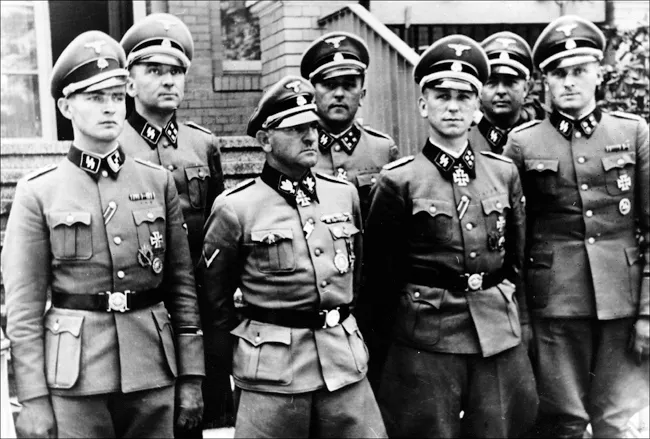
A group of officers of the SS Leibstandarte Adolf Hitler Panzergrenadier Division. In the front row, second from the left, is SS Obergruppenführer ‘Sepp’ Dietrich, who on 4 July 1943 turned over command of the division to SS Oberführer T. Wisch, who appears over Dietrich’s left shoulder. (RGAKFD)
Army Group South consisted of the Fourth Panzer Army, under the command of Colonel General H. Hoth, and Army Detachment Kempf, under the command of General W. Kempf.3 The two commands had a combined strength of eleven infantry and nine panzer and motorized divisions. By the end of April 1943, Hoth’s army had the following formations: the LII Army Corps (with the 57th 167th, 255th and 332nd Infantry Divisions), the II SS Panzer Corps (with the 1st SS Panzergrenadier Division Leibstandarte Adolf Hitler, the 2nd SS Panzergrenadier Division Das Reich, and the 3rd SS Panzergrenadier Division Totenkopf ) and the XXXXVIII Panzer Corps (with the Grossdeutschland Panzergrenadier D...
Table of contents
- Cover
- Title
- Copyright
- Contents
- List of Illustrations
- List of Maps
- List of Tables
- List of Abbreviations Used in Tables
- Publisher’s Note
- Introduction
- 1 The Situation in the Kursk Sector as of July 1943
- 2 Defensive Preparations of the Voronezh Front on the Southern Face of the Kursk Salient
- 3 The 5th Guards Tank Army and its Commander, P. A. Rotmistrov
- 4 Fighting on Voronezh Front’s Sector 5–9 July 1943
- 5 The II SS Panzer Corps Reaches the Prokhorovka Axis
- 6 The Advance of the Stavka’s Reserves to Prokhorovka
- 7 Combat Operations on 10 and 11 July – The Beginning of the Prokhorovka Engagement
- 8 Combat Actions on the Sector of 69th Army’s 35th Guards Rifle Corps, 9-11 July 1943
- 9 Preparations for Voronezh Front’s Counterstroke
- 10 Combat Operations on the Main Axis of Attack – The 5th Guards Tank Army
- 11 Combat Operations in the Sector of the 5th Guards Army in the Bend of the Psel River
- 12 Combat Operations of the 69th Army and Group Trufanov of the 5th Guards Tank Army on 12 July 1943
- 13 The 12 July Counterattack and its Results on Supporting Directions
- 14 Preparations for Combat Operations on the Prokhorovka Axis from 13 July to 16 July 1943
- 15 Combat Operations in the Psel River Bend and Southwest of Prokhorovka – 13 July
- 16 Combat Operations of the 69th Army in the Area of Rzhavets and Shakhovo 13-16 July
- 17 The Withdrawal of the 69th Army’s 48th Rifle Corps from Threatened Encirclement between the Lipovyi and Northern Donets Rivers, 15 July 1943
- 18 The Results of the Prokhorovka Engagement – Myths and Reality
- Appendices
- Notes
- Bibliography
- Map section
- Plate section
Trusted by 375,005 students
Access to over 1.5 million titles for a fair monthly price.
Study more efficiently using our study tools.
Frequently asked questions
Yes, you can cancel anytime from the Subscription tab in your account settings on the Perlego website. Your subscription will stay active until the end of your current billing period. Learn how to cancel your subscription
No, books cannot be downloaded as external files, such as PDFs, for use outside of Perlego. However, you can download books within the Perlego app for offline reading on mobile or tablet. Learn how to download books offline
Perlego offers two plans: Essential and Complete
- Essential is ideal for learners and professionals who enjoy exploring a wide range of subjects. Access the Essential Library with 800,000+ trusted titles and best-sellers across business, personal growth, and the humanities. Includes unlimited reading time and Standard Read Aloud voice.
- Complete: Perfect for advanced learners and researchers needing full, unrestricted access. Unlock 1.5M+ books across hundreds of subjects, including academic and specialized titles. The Complete Plan also includes advanced features like Premium Read Aloud and Research Assistant.
We are an online textbook subscription service, where you can get access to an entire online library for less than the price of a single book per month. With over 1.5 million books across 990+ topics, we’ve got you covered! Learn about our mission
Look out for the read-aloud symbol on your next book to see if you can listen to it. The read-aloud tool reads text aloud for you, highlighting the text as it is being read. You can pause it, speed it up and slow it down. Learn more about Read Aloud
Yes! You can use the Perlego app on both iOS and Android devices to read anytime, anywhere — even offline. Perfect for commutes or when you’re on the go.
Please note we cannot support devices running on iOS 13 and Android 7 or earlier. Learn more about using the app
Please note we cannot support devices running on iOS 13 and Android 7 or earlier. Learn more about using the app
Yes, you can access Demolishing the Myth by Valeriy Zamulin, Stuart Britton in PDF and/or ePUB format, as well as other popular books in History & Military & Maritime History. We have over 1.5 million books available in our catalogue for you to explore.