A rare, revealing, and chilling photographic history of Adolf Hitler—from mollycoddled child to vile propagandist to despotic madman.
One of the most intriguing mysteries about the rise of history's most despised dictator is just how utterly ordinary he once seemed. A chubby child, a mama's boy, an idle student, a failed artist, self-pitying outcast, and just another face in the crowd. The early images of Adolf Hitler give no hint of the demonic spirit bent on global domination. Only later in his tortured life came the metamorphosis, and the mask fell away to reveal a monster.
Adolf Hitler: Rare Photographs from Wartime Archives traces this dramatic process in photographs—some iconic, some rare and intimate. And they are all revealing in their gradually subtle and disturbing transformation, demonstrating the mesmerizing power that Hitler wielded not only over the German public but also statesmen, industrialists, and the global media. Many culled from the author's private collection, the photographs collected here provide unique insight into the mind of a megalomaniac and architect of the twentieth century's most unfathomable atrocity.
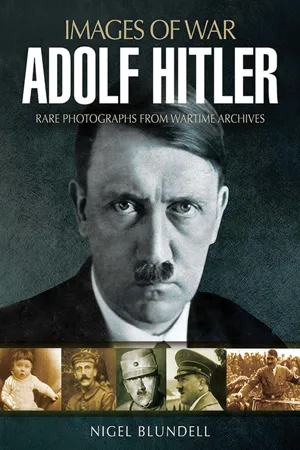
- 128 pages
- English
- ePUB (mobile friendly)
- Available on iOS & Android
eBook - ePub
Adolf Hitler
About this book
Information
The character of Adolf Hitler, as legend probably correctly has it, was built on the foundation of a harsh father and a doting mother. There is no reason to believe that the former, a stiff and formal civil servant, did not love his son. However, intensely proud of his rise to middle-class respectability, he demanded impeccable behaviour from his family, reinforced by violent punishments. Thus it was his mother whom the young Adolf revered. She gave him the affection that his father seemed unable to. In short, she loved her son too much. The result was that, ironically, the man who ended up a ranting tyrant spent his childhood as a bit of a ‘mummy’s boy’.
Adolf Hitler was born an Austrian citizen and a Roman Catholic at 6.30pm on 20 April 1889 at Braunau-am-Inn, close to the border with Bavaria. His mother, Klara, was the third wife of his father Alois, a customs official in the Austro-Hungarian Empire.
Contrary to the story that gained credence during the war, Hitler was not illegitimate. He did not carry his grandmother's name of Shicklgruber because, although his father Alois had been born out of wedlock, he subsequently had his birth legitimised by persuading the local priest to alter his birth documents to give him his father's name of Hitler. The confusion over Hitler senior's documents allowed later detractors to allege that Hitler's real maternal grandfather had in fact been a Jew named Frankenberger, who had been in the household where Alois's mother, Maria Anna Shicklgruber, was in service.
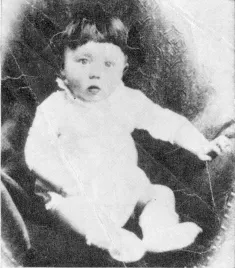
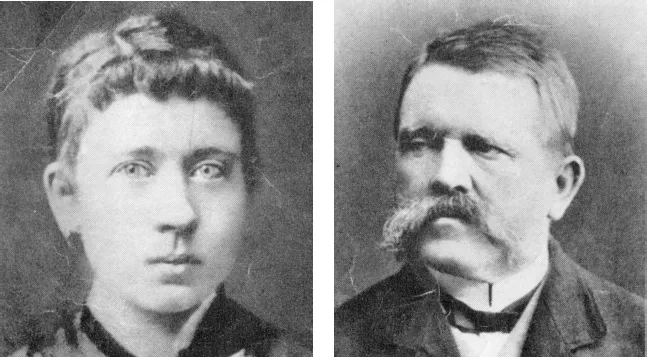
Baby Adolf (above) was doted on and spoiled by his mother Klara. His father Alois, however, was a strict disciplinarian.
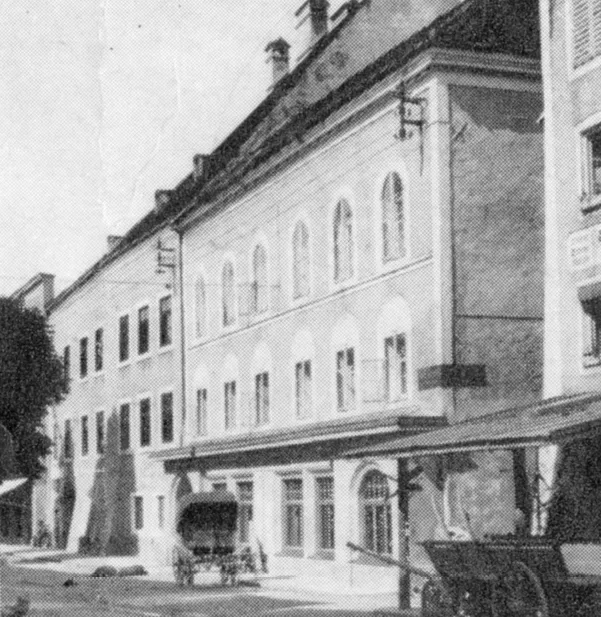
The birthplace of Adolf Hitler at Braunau-am-Inn, Austria, on 20 April 1889.
Yet there is no doubt that Alois Hitler’s private life was less than orthodox. When his first wife died in 1883 he married his mistress, who was pregnant with their second child. When she too died shortly afterwards he married his second cousin Klara Polzl, who was 23 years his junior and also carrying his child.
Adolf was the fourth of six children. Two older brothers and a sister died in infancy and a younger brother died of measles at the age of 11, reportedly affecting young Adolf deeply. This meant that his only surviving sibling was a younger sister, Paula. From his father's second marriage, there was also a half-brother Alois, who ran away from home at the age of 14, and a half-sister Angela, later to become the housekeeper at Hitler’s Bavarian retreat of Berchtesgaden.
Adolf’s actual place of birth was a room on the first floor of a three-storey house, the ground floor of which was an inn called Gasthof Zum Pommer. His parents rented a suite of rooms above the hostelry where Alois reputedly drank to excess in the saloon downstairs before staggering upstairs to abuse his timid wife.
The family continued to live in Braunau-am-Inn until 1892 when they moved to Passau, where the River Inn joins the Danube. Only recently has it emerged from old newspaper cuttings that a four-year-old child, believed to be Adolf, was rescued from drowning in the river in 1894. In Passau, the Austrian customs house lay on the German side of the border, so Adolf, then aged three, grew up speaking German with a Bavarian accent, rather than the more cultured tones of a Viennese.
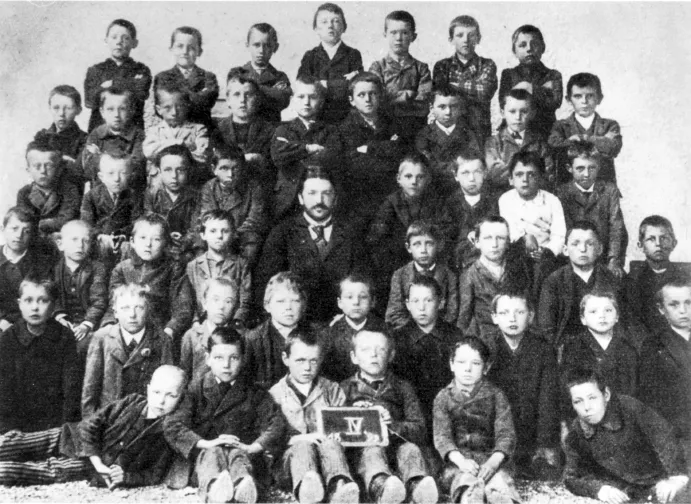
Ten-year-old Adolf, with arms folded, is centre of the top row in this photograph taken at his junior school in 1899.
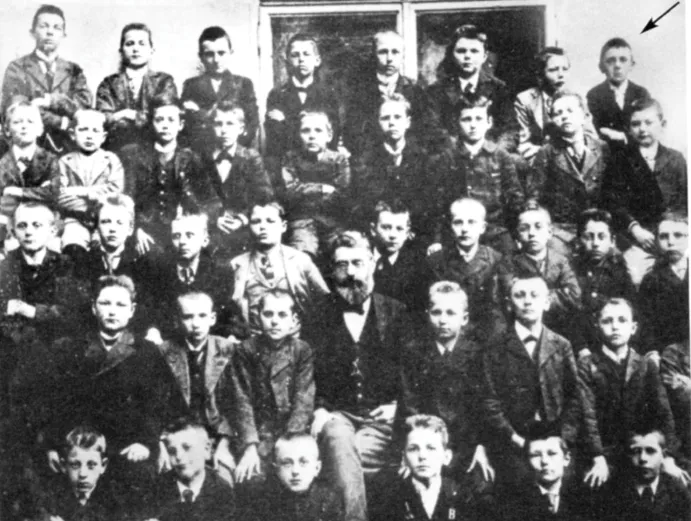
Another school photograph, taken perhaps a year later (Adolf arrowed).
Adolf was educated locally at village and monastery schools, until the age of 11 when his father paid for him to attend secondary school, with the intention that he would also become a civil servant. But by then the years of his mother’s mollycoddling – she had convinced herself that the boy was in poor health and needed constant attention – had made him a less than dedicated pupil.
At school he was a reasonably able pupil, although too shiftless to continue for long in any project. He failed exams and was refused promotion to the next grade. A teacher later recalled him as one who ‘reacted with ill-concealed hostility to advice or reproof, at the same time demanding of his fellow pupils their unqualified subservience, fancying himself in the role of leader’. According to the myth later perpetuated by Nazi propagandists, Hitler the schoolboy led all the playground games, being a natural leader and ‘understanding the meaning of history'. In reality, the young Adolf was a dreamer who made few friends.
On his retirement in 1895, Alois had moved his family to Leonding, near Austria’s third largest city Linz, which Adolf thereafter considered his ‘home town’. There, in 1903, his father walked to his favourite inn where he ordered a glass of wine but collapsed and died of a lung haemorrhage before it arrived.
Young Adolf, now 13, broke down and cried when he saw the body laid out. A local newspaper published an obituary that included the following telling description of the deceased: ‘The harsh words that sometimes fell from his lips could not belie the warm heart that beat under the rough exterior.’ But for Adolf, there would be no more harsh words and no more discipline from his domineering father, whose death had left the family with a healthy pension. The teenager abandoned all scholastic efforts to pursue his dream of becoming a great artist.
Thanks to his mother's generosity, he was able to live idly in and around Linz, where he was to be seen carefully dressed and sporting an ivory-tipped cane, attending the theatre or strolling the fashionable streets. Lacking any real occupation, he instead spent hours creating designs of a new and rebuilt Linz – youthful designs he was to turn to for comfort years later as Berlin was pounded to rubble in the final days of his life.
He bought a lottery ticket and dreamed of a future of artistic grace and leisure. When the number failed to come up, he denounced first the lottery organisation then the cheating government. He took piano lessons and then gave them up. Hitler succumbed to the grandiose music of Richard Wagner and was so stirred after a performance of his opera Rienzi that he walked with his sole boyhood friend, August Kubizek, and suddenly started to declaim about his future and that of his people. When he met Kubizek again 30 years later, he remarked: ‘It began with that hour.'
When his mother died in 1907, Hitler moved permanently to Vienna where he had already unsuccessfully applied to enter the Academy of Fine Arts. Despite the knockback, the wayward dreamer found a dazzling new world opening up to him in the city, still at the turn of the century a faded hub of empire. In Vienna he discovered nationalism as a prime force in a multi-ethnic city humming with intrigue as the old Austro-Hungarian system started to break up. In particular, the ruling Germans had become a minority as the empire stretched into Czechoslovakia and the Balkans. Racism was rife, and since the mid-19th Century had focussed itself in particular on Jews, whose emancipation in Austria had for years been encouraging streams of immigrants from Hungary and the East. Between 1850 and 1910, their presence in Vienna had risen from two percent of the population to almost nine percent.
In Mein Kampf (My Struggle), Hitler's credo and political life story, he wrote of an orphaned youth of 17 ‘forced to go far from home to earn his bread'. The reality is very different. Having lived quite comfortably off his widowed mother for several years, he was able to continue receiving his father's state pension by fraudulently claiming to be in full-time education.
In 1908 Hitler was joined by his old friend Kubizek, who was studying music at the Vienna Conservatory. The two shared an apartment, but while Kubizek worked hard at his studies, Hitler seemed content to continue his aimless course. He made plans to tear down and rebuild the Hofburg, he sketched castles and theatres, he developed a recipe for a non-alcoholic drink, he composed pamphlets attacking landlords, he tried to write an opera and a drama. He painted but was rejected a second time when he tried to enter the...
Table of contents
- Cover
- Title
- Copyright
- Introduction
- Chapter
- Principal Dates
Trusted by 375,005 students
Access to over 1.5 million titles for a fair monthly price.
Study more efficiently using our study tools.
Frequently asked questions
Yes, you can cancel anytime from the Subscription tab in your account settings on the Perlego website. Your subscription will stay active until the end of your current billing period. Learn how to cancel your subscription
No, books cannot be downloaded as external files, such as PDFs, for use outside of Perlego. However, you can download books within the Perlego app for offline reading on mobile or tablet. Learn how to download books offline
Perlego offers two plans: Essential and Complete
- Essential is ideal for learners and professionals who enjoy exploring a wide range of subjects. Access the Essential Library with 800,000+ trusted titles and best-sellers across business, personal growth, and the humanities. Includes unlimited reading time and Standard Read Aloud voice.
- Complete: Perfect for advanced learners and researchers needing full, unrestricted access. Unlock 1.5M+ books across hundreds of subjects, including academic and specialized titles. The Complete Plan also includes advanced features like Premium Read Aloud and Research Assistant.
We are an online textbook subscription service, where you can get access to an entire online library for less than the price of a single book per month. With over 1.5 million books across 990+ topics, we’ve got you covered! Learn about our mission
Look out for the read-aloud symbol on your next book to see if you can listen to it. The read-aloud tool reads text aloud for you, highlighting the text as it is being read. You can pause it, speed it up and slow it down. Learn more about Read Aloud
Yes! You can use the Perlego app on both iOS and Android devices to read anytime, anywhere — even offline. Perfect for commutes or when you’re on the go.
Please note we cannot support devices running on iOS 13 and Android 7 or earlier. Learn more about using the app
Please note we cannot support devices running on iOS 13 and Android 7 or earlier. Learn more about using the app
Yes, you can access Adolf Hitler by Nigel Blundell in PDF and/or ePUB format, as well as other popular books in History & Military Biographies. We have over 1.5 million books available in our catalogue for you to explore.