From the co-authors of the classic
Last Night a DJ Saved My Life: A fascinating oral history of record spinning told by the groundbreaking DJs themselves.
Acclaimed authors and music historians Bill Brewster and Frank Broughton have spent years traveling across the world to interview the revolutionary and outrageous DJs who shaped the last half-century of pop music.
The Record Players is the fun and revealing result—a collection of firsthand accounts from the obsessives, the playboys, and the eccentrics that dominated the music scene and contributed to the evolution of DJ culture.
In the sixties, radio tastemakers brought their sound to the masses, while early trendsetters birthed the role of the club DJ at temples of hip like the Peppermint Lounge. By the seventies, DJs were changing the course of popular music; and in the eighties, young innovators wore out their cross-faders developing techniques that turned their craft into its own form of music.
With discographies, favorite songs, and amazing photos of all the DJs as young firebrands,
The Record Players offers an unparalleled music education: from records to synthesizers, from disco to techno, and from influential cliques to arenas packed with thousands of dancing fans.
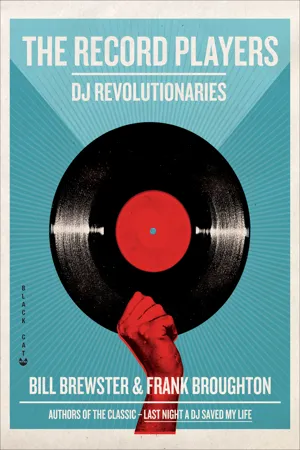
- 480 pages
- English
- ePUB (mobile friendly)
- Available on iOS & Android
eBook - ePub
About this book
Information
Subtopic
MusicIan Samwell
Nifty musician, top songwriter, record producer, all-round smoothie and the man who brought musical sophistication to Britain’s discotheques. As well as writing one of the very few credible British rock’n’roll records in ‘Move It’ by Cliff Richard & The Drifters, Ian Samwell helped transform our swirling post-war ballrooms, venues like the Lyceum in London and the Orchid in Purley, into havens for rhythm and blues music. Thanks to his deal with a New York publisher, Samwell had access to American records well before other people. He worked with The Small Faces, John Mayall, America and Hummingbird, and was the first British songwriter to have a song recorded by an American rhythm and blues act – ‘Say You Love Me Too’ by The Isley Brothers. Groundbreaking soul writer Dave Godin claimed that the Lyceum was the first proper disco in the UK. It was Ian Samwell who made it that way.
When and how did you start collecting music?
My parents owned a wind-up record player and a selection of pre-war records, so records were always a part of my life. Because I was obliged to do National Service I didn’t actually start collecting records until after I got out in the summer of ’58. I couldn’t afford it. Like everybody else, I listened to Radio Luxembourg and jukeboxes in coffee bars.
I joined the Drifters in April 1958 and Cliff [Richard] had a small record collection, mostly the songs we were performing on stage. I bought a portable battery powered record player with a built-in speaker. I didn’t think of myself as starting a collection, I just bought what sounded exciting to me – ‘Why Do Fools Fall In Love?’, ‘Whole Lotta Shakin’’, ‘Wake Up Little Susie’ etc. The Drifters also acquired a number of discards from a jukebox on an American air base. This led to us performing some very R&B material like ‘Get A Job’ by the Silhouettes and ‘Rock’n’Roll Shoes’ by Chuck Willis. We didn’t know they were race records, we just thought they were rock‘n’roll.
You were eventually edged out of the band, but you carried on writing songs for them.
Norrie Paramor [their producer] didn’t want The Drifters, he only wanted Cliff. He had a recording contract prepared but didn’t get Cliff to sign it until after we had recorded ‘Move It’ and ‘Schoolboy Crush’. It became obvious that Cliff was going to need a better guitarist than I was, so after we got back from Butlin’s Holiday Camp, Johnny Foster went to the 2I’s and found Hank Marvin. Hank agreed to join if he could bring along his mate Bruce Welch. I traded in my guitar for a bass and set off on tour with the Kalin Twins. On that tour was Jet Harris and he wanted to join and Cliff wanted him so I got fired.
The official story was that I had left to concentrate on songwriting and, in fact, I had been given a five-year contract with a retainer. We were all friends and I stayed around writing songs for a couple of years. I was also a temporary acting unpaid sort of manager-cum-publicist for the Drifters until the time came when they needed someone more experienced in ‘The Business’.
How did you get into playing records?
Gradually I ‘drifted’ away from the Drifters and began writing songs for other artists. I went to New York because I was under contract to a subsidiary of an American company, Hill & Range music. I bought or was given a lot of records, which I brought home to England with me.
Back in London I used to hang out in Denmark Street or ‘Tin Pan Alley’ and I continued to go to the clubs such as the 2i’s and The Scene. I was at the 2i’s when I first heard of Buddy Holly’s death. Times were changing, rock’n’roll was over and pop was the big thing. Most of it didn’t appeal much to me and I turned to rhythm and blues: Jackie Wilson, The Coasters, The Isley Brothers…
How did you get the gig at The Lyceum?
I don’t know how they found me, I just remember being invited down to The Lyceum one lunchtime. They were looking for someone to spin records for a lunch hour crowd. The house electrician had been playing the records until then. I had never played records as a DJ before. I was broke so I agreed to do it – money for nothin’ and chicks for free! I don’t know if it was every Tuesday but it might well have been.
Pretty soon it became very popular and I got booked to do Sunday nights as well. I played all the latest records with a few golden oldies thrown in. But I don’t remember playing oldies much. There was too much new stuff that I wanted to play. The Lyceum’s record collection was pretty pathetic so I started to bring my own records. I played a lot of stuff you couldn’t hear on the BBC – mostly rhythm and blues because it was hip and great to dance to.
What made you want to play records in the first place, since it was still a pretty unusual thing to do back then?
It was unusual, to say the least! I’d never heard of anything like it in England. In America they had record hops with DJs from local stations, and sock hops – usually held in gymnasiums. You had to take off your shoes so as not to damage the floor – hence ‘sock hops’. But there was nothing like that in England, so far as I knew.
When did you start there?
I think I started the Lyceum in 1962. Mecca made a life-size cut-out photo of me and billed me as ‘London’s No. 1 Dee-Jay’. Nonsense, of course, I wasn’t even on the radio!
What was your next step?
My next project was to run a ‘disco’ night at Greenwich Town Hall. I did this with Brian Mason, a part-time bouncer at The Lyceum. He took care of the business and I took care of the music. I bought two record players with built in speakers. I placed them next to each other on a table on the stage and placed a house mic in front of each one. The Town Hall had a Tannoy house system I think. The resultant echo spoiled the sound of the records but we had no other choice. People came from all around and packed the place. Eventually we started booking live acts. Some I remember were: The Animals, fresh down from Newcastle and without a record deal. Millie ‘My Boy Lollipop’ Small, and Sounds Incorporated. I also invited recording artists and gave away promo copies of their latest singles. Jet Harris, Kenny Lynch, Don Charles and Carol Dean were amongst those who graced the stage.
I was eventually given the job at The Orchid Ballroom at Purley which, like The Lyceum, also belonged to Mecca Ballrooms. Occasionally they would send me out of town to do a ‘special’ night at one of their other places. I gave it up after a while because it was too far to go for too little money. Mecca made a fortune though.
I also played the records at The Flamingo on Wardour Street in Soho. To me, that was the best gig because the audience were either very hip or West Indian and I played nothing but rhythm and blues or bluebeat, which became ska, which became skank, which became the reggae of today. I produced Georgie Fame’s first record there, an album called Rhythm And Blues at the Flamingo.
It was presumably a blacker soundtrack there. Do you remember specific discs?
The Flamingo was great for James Brown and the Bar-Kays. Stuff like that. Otis Redding, Sam and Dave, Wilson Pickett, Rufus Thomas, Maxine Brown etc, etc, etc. We also played bluebeat records: Prince Buster etc.
There were a lot of black American GIs there. Did they ever introduce you to records?
I don’t remember any GIs bringing me records to play. It seems very unlikely that they would be walking around London with a record in their hands.
Tell me about meeting Jeff Dexter?
I first met Jeff at The Lyceum. He was about 16 but looked 14. He was a very sharp dresser, ‘The Boy From New York City’, he wore mohair suits and button-down shirts from America. He was also the best twister and when he danced all the girls would gather round in a circle to watch him.
“There was a tiny basement that sold illegal imports; it was only open for two hours at lunch time. It was all very secretive and exciting.”
You were one of the first people to play ‘The Twist’. What kind of impact did it have?
The big record was ‘Let’s Twist Again’ by Chubby Checker. It was enormously influential in terms of introducing American-style dances to Britain. The only previous influence was jive, which was bought over by the Yanks during World War II. Other dances were the locomotion and the mashed potato.
Somebody told me that they heard you play Hank Ballard & the Midnighters’ version of ‘The Twist’ at the Lyceum, which came out earlier.
I don’t recall if I was playing Hank Ballard before Chubby Checker. The probability is that I was. Hank’s record was released on the B-side of ‘Teardrops On Your Letter’, which was a pretty big hit in the States. Chubby Checker’s ‘Twist’ came soon after.
Did you talk on the mic?
Yes, I talked on the mic at all the venues. Announcing records (but not before every record), and announcing other things like ‘dream time’, during which we spun the disco ball and played three slow records in a row.
Which clubs were most influential in terms of the music they played?
The key clubs of the early sixties were the Ad Lib, The Scotch of St James, The Cue Club, The Flamingo and, later on, The Speakeasy. There was also Middle Earth, The Scene, The Marquee and the 100 Club on Oxford Street. I’ve probably forgotten a couple, but those are the ones that come to mind.
Who was your favourite DJ?
I didn’t really have a favourite. All the Alan Freemans and the other guys were on the BBC – ‘’Nuff said’, ‘Not ’arf!’ I’ve never been a great fan of the in-your-face-type DJ who talks too much and too loudly. For me, it was always about the music and how to present new records and put them together in attractive danceable sequences. Jeff and I both knew how to pack the floor and keep it that way. And we did it without extended dance mixes too! We also had to walk 10 miles through the snow, up-hill, to get our records! These kids today…
You say you were making trips to New York as a songwriter. Where were you sourcing your records?
I used to go to New York at least once or twice a year. Probably five or six visits during my DJ years. I bought records from Sam Goody’s as well as the Colony record store. Once someone arranged for me to pick out some records at a One Stop wholesale store.
Do you remember any you brought back from these trips?
I do remember some of the records, notably: Barrett Strong’s ‘Money’ on the Anna label. Berry Gordy’s first attempt. Various Stax things, artists like Rufus and Carla Thomas and the first Supremes record ‘Baby Love’ and Len Barry’s ‘One, Two, Three’. Most of what I bought was eventually released in England, but I had them first. Oh, I just remembered – Jackie Ross’s ‘Selfish ...
Table of contents
- cover page
- Title Page
- Copyright Page
- Contents
- Introduction Listen to this!
- Jimmy Savile Dance hall disrupter
- Ian Samwell No.1 deejay
- Jeff Dexter The modfather
- John Peel Inspired everybody
- Terry Noel Original mixer
- Francis Grasso The groundbreaker
- ‘Farmer’ Carl Dene Treasure seeker
- Ian Levine Soul adventurer
- Kev Roberts Casino royal
- Ian Dewhirst A northern soul
- Steve D’Acquisto Disco’s radical
- David Mancuso Party messiah
- Tom Moulton Father of remixing
- Nicky Siano Wild man of disco
- Franñois Kevorkian Disco dubmaster
- Kool Herc Father of hip hop
- Grandmaster Flash Scientist of the mix
- Afrika Bambaataa Zulu king of the Bronx
- Arthur Baker Maestro electro
- Grand Mixer D.ST Turntable virtuoso
- DJ Shadow Vinyl resurrectionist
- Frankie Knuckles Godfather of house
- Chip E Chicago architect
- Marshall Jefferson Leader of the jack
- DJ Pierre Acid originator
- David Morales Hitmaker
- Louie Vega Master at work
- Juan Atkins Techno rebel
- Derrick May High-tech soul
- Jeff Mills Detroit wizard
- Alfredo Ibiza’s magician
- José Padilla Smooth operator
- Daniele Baldelli Cosmic voyager
- Froggy Soul Mafia hitman
- Danny Rampling Acid house evangelist
- Terry Farley Cultural hooligan
- Andrew Weatherall Electronic punk
- Mike Pickering Hañienda housemaster
- Paul Oakenfold Most successful
- Norman Cook Pop star
- Pete Tong Essential selector
- Sasha Son of God?
- Fabio Hardcore hero
- Shut Up And Dance Into the jungle
- Dreem Teem Garage mechanics
- Tiësto Stadium superstar
- Big thanks to…
- Thanks and photo credits
Trusted by 375,005 students
Access to over 1.5 million titles for a fair monthly price.
Study more efficiently using our study tools.
Frequently asked questions
Yes, you can cancel anytime from the Subscription tab in your account settings on the Perlego website. Your subscription will stay active until the end of your current billing period. Learn how to cancel your subscription
No, books cannot be downloaded as external files, such as PDFs, for use outside of Perlego. However, you can download books within the Perlego app for offline reading on mobile or tablet. Learn how to download books offline
We are an online textbook subscription service, where you can get access to an entire online library for less than the price of a single book per month. With over 1.5 million books across 990+ topics, we’ve got you covered! Learn about our mission
Look out for the read-aloud symbol on your next book to see if you can listen to it. The read-aloud tool reads text aloud for you, highlighting the text as it is being read. You can pause it, speed it up and slow it down. Learn more about Read Aloud
Yes! You can use the Perlego app on both iOS and Android devices to read anytime, anywhere — even offline. Perfect for commutes or when you’re on the go.
Please note we cannot support devices running on iOS 13 and Android 7 or earlier. Learn more about using the app
Please note we cannot support devices running on iOS 13 and Android 7 or earlier. Learn more about using the app
Yes, you can access The Record Players by Bill Brewster,Frank Broughton in PDF and/or ePUB format, as well as other popular books in Media & Performing Arts & Music. We have over 1.5 million books available in our catalogue for you to explore.