The teachings of the groundbreaking Buddhist Zen Master: "Should remain for years to come the standard source book for the Western student of Zen" (Douglas Harding,
The Middle Way).
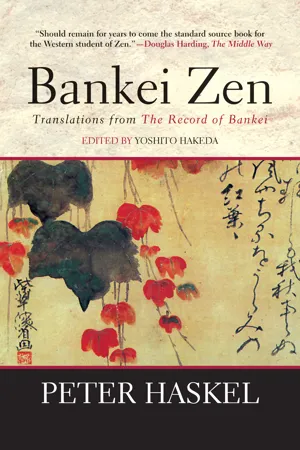
The eccentric Bankei (1622–1693) has long been an underground hero in the world of Zen. At a time when Zen was becoming overly formalized in Japan, he stressed its relevance to everyday life, insisting on the importance of naturalness and spontaneity. This volume presents his teachings—as refreshing and iconoclastic today as they were three hundred years ago—in a fluent translation by Peter Haskel, accompanied by a vivid account of Bankei's life and times, illustrations, and extensive notes for the scholar.
"Mr. Haskel has furnished us with an accurate and polished translation that fully captures the lively colloquial style of the original. The late Professor Hakeda has rendered invaluable assistance in resolving many linguistic problems and in furnishing important insights into the text itself." —Philip Yampolsky
"A splendid record of a dramatically different Zen master." —Huston Smith
"Bankei Zen has given us the essence of Bankei's unique teaching . . . one which seems particularly appropriate to our time." —Nancy Wilson Ross
- 196 pages
- English
- ePUB (mobile friendly)
- Available on iOS & Android
eBook - ePub
About this book
Information
Topic
Theology & ReligionSubtopic
Eastern PhilosophyPART I
Opening of the Sermons
When the Zen Master Bankei Butchi Kōsai,1 founder of the Ryōmonji2 at Aboshi in Banshū, was at the Great Training Period3 [held] at the Ryōmonji in the winter of the third year of Genroku,4 there were 1,683 monks listed in the temple register.5 Those who attended included not only Sōtō and Rinzai6 followers but members of the Ritsu, Shingon, Tendai, Pure Land, True Pure Land and Nichiren Schools,7 with laymen and monks mingled together, thronging round the lecture seat.8 One sensed the Master was truly the Teacher of Men and Devas9 for the present age.
At that time, the Master mounted the lecture seat and addressed the assembly of monks and laymen, saying: “We’ve got a big crowd of both monks and laymen here at this meeting, and I thought I’d tell you about how, when I was young, I struck on the realization that the mind is unborn. This part about ‘the mind,’ [though,] is something secondary. You monks, when you abide only in the Unborn, [will find that] in the Unborn, there’s nothing anyone needs to tell you, nothing you need to hear. Because the Buddha Mind is unborn and marvelously illuminating, it gets easily turned into whatever comes along. So, as long as I’m telling the lay people here not to change themselves into these different things that come their way and trade their Buddha Mind for thoughts, you monks may as well listen too!”
Listen carefully
The Master addressed the assembly: “Among all you people here today there’s not a single one who’s an unenlightened being. Everyone here is a buddha. So listen carefully! What you all have from your parents innately is the Unborn Buddha Mind alone. There’s nothing else you have innately. This Buddha Mind you have from your parents innately is truly unborn and marvelously illuminating. That which is unborn is the Buddha Mind; the Buddha Mind is unborn and marvelously illuminating, and, what’s more, with this Unborn, everything is perfectly managed. The actual proof of this Unborn which perfectly manages [everything] is that, as you’re all turned this way listening to me talk, if out back there’s the cawing of crows, the chirping of sparrows or the rustling of the wind, even though you’re not deliberately trying to hear each of these sounds, you recognize and distinguish each one. The voices of the crows and sparrows, the rustling of the wind—you hear them without making any mistake about them, and that’s what’s called hearing with the Unborn. In this way, all things are perfectly managed with the Unborn. This is the actual proof of the Unborn. Conclusively realize that what’s unborn and marvelously illuminating is truly the Buddha Mind, straightaway abiding in the Unborn Buddha Mind just as it is, and you’re a living tathagata10 from today forever after. Since, when you realize conclusively, you abide like this in the Buddha Mind from today on, my school is called the School of Buddha Mind.11
“Well, then, while you’re all turned this way listening to me talk, you don’t mistake the chirp of a sparrow out back for the caw of a crow, the sound of a gong for that of a drum, a man’s voice for a woman’s, an adult’s voice for a child’s—you clearly recognize and distinguish each sound you hear without making any mistake. That’s the marvelously illuminating dynamic function. It’s none other than the Buddha Mind, unborn and marvelously illuminating, the actual proof of the marvelously illuminating [nature of the Buddha Mind].
“I doubt there’s anyone among the people here now who’d say: ‘I heard [what I did] because I was deliberately trying to hear it.’ If anyone says he did, he’s a liar. Wondering, ‘What’s Bankei telling us?’ all of you are turned this way, intent only on hearing what I’m saying; no one’s deliberately trying to hear the various sounds coming from out back. That’s why, when all of a sudden these sounds appear and you recognize and distinguish them, hearing them without any mistake, you’re hearing with the Unborn Buddha Mind. Nobody here can claim he heard these sounds because he’d made up his mind beforehand to listen for them when they were made. So, in fact, you’re listening with the Unborn.
“Everyone who conclusively realizes that what is unborn and marvelously illuminating is truly the Buddha Mind, abiding in the Unborn Buddha Mind, is a living tathagata from today forever after. Even ‘buddha’ is just a name given to traces that have arisen,12 so, from the standpoint of the Unborn, it’s only a secondary matter, a peripheral concern. The man of the Unborn abides at the source of all buddhas. That which is unborn is the source of all things, the starting point of all things. There’s nothing more original than the Unborn, nothing prior to it. That’s why, when you abide in the Unborn, you abide at the source of all buddhas; so it’s something wonderfully precious. There’s no question of ‘perishing’ here, so when you abide in the Unborn, it’s superfluous to speak about the Imperishable13 too. That’s the reason I only talk about the Unborn and don’t mention the Imperishable. What isn’t created can’t be destroyed, so since it’s unborn, it’s obvious it’s imperishable without having to mention it. Isn’t that so?
“Of course, the expression ‘unborn and imperishable’14 has appeared here and there in the sutras and records from times of old—but not the actual proof of the Unborn. Everyone just learns the expression ‘unborn and imperishable’ and goes about repeating it; but when it comes to realizing conclusively and actually getting right to the heart of the matter, they haven’t any idea of what the Unborn is.
“When I was twenty-six, I first hit on the realization that all things are perfectly managed with the Unborn, and, in the forty years since, I’ve taught everyone with the actual proof of the Unborn: that what you have from your parents innately is the Unborn Buddha Mind—the Buddha Mind which is truly unborn and marvelously illuminating. I was the first to teach this. I’m sure that even among you monks in the assembly now, and everyone else too, nobody’s heard of anyone before me who taught people with the actual proof of the Unborn—that the Buddha Mind is truly Unborn and marvelously illuminating. I was the first to teach this. If anyone claims he’s heard of somebody before me who taught people with the actual proof of the Unborn, he’s a liar!
“When you abide in the Unborn, you’re abiding at the source of all things. What the buddhas of the past realized was the Unborn Buddha Mind; and what buddhas in the future will realize is the Unborn Buddha Mind too. We today are living in the Degenerate Age of Buddhism,15 yet when there’s even one man who abides in the Unborn, the true teaching16 has been restored to the world. All of you, isn’t it so? It certainly is! When you’ve conclusively realized this, then and there you’ll open the eye that sees into men’s minds, and that’s why my school is called the Clear-Eyed School.17 When the eye that sees into men is manifested, whenever it happens to be,18 that moment is the complete realization of the Dharma.19 I want you to know this. Whoever you may be, at that moment, you are my heir!”
Precepts
A certain master of the Precepts School20 asked: “Doesn’t your Reverence observe the precepts?”
The Master said: “Originally, what people call the precepts were all for wicked monks who broke the rules; for the man who abides in the Unborn Buddha Mind, there’s no need for precepts. The precepts were taught to help sentient beings—they weren’t taught to help buddhas! What everyone has from his parents innately is the Unborn Buddha Mind alone, so abide in the Unborn Buddha Mind. When you abide in the Unborn Buddha Mind, you’re a living buddha here today, and that living buddha certainly isn’t going to concoct anything like taking the precepts, so there aren’t any precepts for him to take. To concoct anything like taking the precepts is not what’s meant by the Unborn Buddha Mind. When you abide in the Unborn Buddha Mind, there’s no way you can violate the precepts. From the standpoint of the Unborn, the precepts too are secondary, peripheral concerns; in the place of the Unborn, there’s really no such thing as precepts. . . .”
The same old thing
“A certain teacher of Buddhism told me: ‘Instead of teaching the same old thing in your sermons day after day, you ought to throw in a few Buddhist miracle stories21 once in a while and give people a refreshing change of pace.’ Of course, he could be right. I may be thickheaded, but provided something is really helpful to people, then, thickheaded or not, I’m not beyond memorizing one or two old stories if I put my mind to it. However, teaching this sort of thing is like feeding poison to sentient beings. And feeding people poison is something I certainly can’t do!”
I don’t talk about Buddhism
The Master further said: “I don’t teach people by quoting from the words of the buddhas and patriarchs.22 Since I can manage simply by dealing with people’s own selves, there’s no need on top of that to quote the words of the buddhas and patriarchs too. I don’t talk about Buddhism, and I don’t talk about Zen. There’s really no need to talk about these things. Since I can manage perfectly just by dealing with people’s own selves as they are right here today, there’s no need for me to talk about Buddhism, or Zen either. . . .”

Meeting masters: Dōsha and Ingen
“Until the age of thirty, I continued to wear my jittoku23 robes without putting on a proper monk’s robe. When I was thirty, however, my teacher24 suggested I go to meet the Chinese Zen Master Dōsha Chōgen of Naninsan,25 who’d recently landed at Nagasaki. I decided to go, and my teacher told me: ‘Up to now you’ve been able to get by with your jittoku robes; but now that you’re going to call on a real Chinese monk, they won’t do. As it’s also for the sake of the Dharma, from here on you’d better wear a proper monk’s robe, so go put one on and call on Dōsha.’
“And that’s how, at the age of thirty, following my teacher’s advice, I put on a monk’s robe for the first time and went off to see Dōsha. I immediately presented my understanding. Dōsha sized me up at a glance and told me: ‘You have transcended birth and death!’
“Among the Zen teachers at that time, only Dōsha was able, to this modest extent, to confirm for me my experience of enlightenment; but, even so, I wasn’t fully satisfied. Now, looking back, today I wouldn’t even find Dōsha acceptable. If only Dōsha had gone on living till now, I might have made a better man of him. But he was an unlucky fellow and died young, to my great regret.”
“When I was a member of Dosha’s assembly, an invitation was sent to China to [the Zen Master] Ingen.26 I was among those who consulted on this, and, fortunately, Ingen arrived in Japan while I was with Dōsha, landing at the harbor in Nagasaki.27 I went along to welcome him, but the moment Ingen stepped ashore from the boat, I realized he wasn’t a man of the Unborn, and that’s why I never studied with him.”
I’m ready to be your witness!
“All of you right now are extremely fortunate. When I was young, either there were no enlightened teachers about, or else, if there were, I just wasn’t lucky enough to meet them, and being from youth exceedingly thickheaded, I suffered unimaginable hardships. How uselessly I struggled! I can’t forget those wasted efforts, which have left a deep impression on me. I had to learn the hard way, from experience. That’s why, in my desire to have all of you attain complete realization of the Dharma in perfect comfort, at your ease, and without any useless struggle, I do my best to come out like this every day and urge you on. All of you should consider yourselves fortunate. Where could you ever find this sort of opportunity!
“Although I didn’t intend to tell you about this—how when I was young I struggled uselessly thanks to my own thickheadedness—if among the young people here there’s anyone who struggles as I did, thinking it’s impossible to attain complete realization of the Dharma without doing so, why then I’ll be to blame. So, although I didn’t intend to tell you, you young p...
Table of contents
- Cover Page
- Title page
- Copyright Page
- Dedication
- Contents
- List of Illustrations
- Foreword
- Preface
- Introduction
- SERMONS
- Part I
- Part II
- HŌGO (Instruction)
- From The Gyōgō Ryakki
- Poems
- Letters
- “Words and Deeds” (Miscellaneous Materials)
- Notes
- Translator’s Notes
- Footnote
Trusted by 375,005 students
Access to over 1.5 million titles for a fair monthly price.
Study more efficiently using our study tools.
Frequently asked questions
Yes, you can cancel anytime from the Subscription tab in your account settings on the Perlego website. Your subscription will stay active until the end of your current billing period. Learn how to cancel your subscription
No, books cannot be downloaded as external files, such as PDFs, for use outside of Perlego. However, you can download books within the Perlego app for offline reading on mobile or tablet. Learn how to download books offline
Perlego offers two plans: Essential and Complete
- Essential is ideal for learners and professionals who enjoy exploring a wide range of subjects. Access the Essential Library with 800,000+ trusted titles and best-sellers across business, personal growth, and the humanities. Includes unlimited reading time and Standard Read Aloud voice.
- Complete: Perfect for advanced learners and researchers needing full, unrestricted access. Unlock 1.5M+ books across hundreds of subjects, including academic and specialized titles. The Complete Plan also includes advanced features like Premium Read Aloud and Research Assistant.
We are an online textbook subscription service, where you can get access to an entire online library for less than the price of a single book per month. With over 1.5 million books across 990+ topics, we’ve got you covered! Learn about our mission
Look out for the read-aloud symbol on your next book to see if you can listen to it. The read-aloud tool reads text aloud for you, highlighting the text as it is being read. You can pause it, speed it up and slow it down. Learn more about Read Aloud
Yes! You can use the Perlego app on both iOS and Android devices to read anytime, anywhere — even offline. Perfect for commutes or when you’re on the go.
Please note we cannot support devices running on iOS 13 and Android 7 or earlier. Learn more about using the app
Please note we cannot support devices running on iOS 13 and Android 7 or earlier. Learn more about using the app
Yes, you can access Bankei Zen by Yoshito Hakeda, Peter Haskel in PDF and/or ePUB format, as well as other popular books in Theology & Religion & Eastern Philosophy. We have over 1.5 million books available in our catalogue for you to explore.