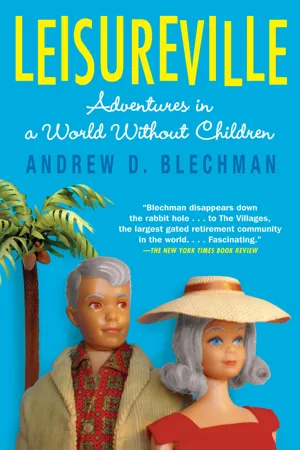
This revealing profile "disappears down the rabbit hole [into] the largest gated retirement community in the world" and what it discovers is "fascinating" (
The New York Times).
When his next-door neighbors pick up and move from New England to an age-restricted "active adult" development in Florida called The Villages, Andrew D. Blechman is astonished by their stories—and determined to investigate. Sprawling across two zip codes, with a golf course for every day of the month, two downtowns, its own newspaper, radio, and TV station, The Villages is a prefab paradise for retired Baby Boomers, where "not having children around seems to free [them] to act like adolescents" (
The New York Times).
In the critically acclaimed
Leisureville, Blechman delves into this senior utopia, offering a hilarious firsthand report on everything from ersatz nostalgia to the residents' surprisingly active sex life. Blechman also traces the history of this phenomenon, travelling to Arizona to find out what pioneering developments like Sun City and Youngtown have become after decades of segregation.
Blending incisive social commentary and colorful reportage, "Blechman describes this brave new world with determined good humor and considerable bemusement" (Katherine A. Powers,
The Boston Globe).
- 256 pages
- English
- ePUB (mobile friendly)
- Available on iOS & Android
eBook - ePub
About this book
Information
1
For Sale
IT WAS A TYPICALLY COLD, BLEAK FEBRUARY MORNING WHEN I LOOKED out the kitchen window and spotted a sign across the street on Dave and Betsy Anderson’s front lawn: “For Sale.” This came as a complete surprise; I had assumed the Andersons—cheerful acquaintances and active members of our small-town community—were neighborhood lifers. Hadn’t they just retired? Weren’t they still in Florida celebrating their new freedom with a snowbird vacation?
People like the Andersons don’t just pick up and leave, do they? And why would they want to go? We live in a small, traditional New England town, one that people pay good money to visit. Tourists travel from hours away to take in our bucolic vistas, marvel at our historic architecture, dine in our sophisticated restaurants, and partake in our enviable number of cultural offerings. It’s a charming place to live, like something out of a Norman Rockwell painting. In fact, Norman Rockwell once lived here.
Although we lived across the street from one another for about two years, the Andersons and I weren’t particularly close. We didn’t barbecue together in the summer, or sit around the fireplace in the winter sipping cocoa. In fact, I don’t think I ever invited them inside my home. But we were friendly. When I left town for a few weeks of family vacation the summer before, it was Dave who mowed my lawn, unsolicited. “I had the mower running anyway, so I figured what the heck,” he modestly explained.
Dave and I frequently toured each other’s yard, comparing notes about gardening and lawn care. His was immaculate, the lawn cut at a perfect ninety-degree angle to the house “to soften the edges” of his rectangular home. If a leaf fell, Dave was out there lickety-split with his leaf blower and preposterously large headphones. The shrubs were trimmed into perfect ovals, circles, and cones. Dave even tied a rope around his large pine tree and drew a tidy circle with it to mark the boundary between an acceptable accumulation of pine needles and a green lawn.
My yard, by comparison, was a far more haphazard work in progress. Dave started to take pity on me, stopping by to give occasional fatherly pep talks. “Been a rough year for crabgrass,” he remarked to me one summer day. “I’ve seen it all over town. Must be the hot weather.” Despite my best efforts, huge, gnarly clumps of it had thundered across my lawn. I found his words somewhat soothing (It’s not just me!) until I glanced across the street at his dense, verdant turf.
Over the course of these two summers, I also got to know Betsy. Whether Dave was methodically detailing his van or organizing his garage so that every tool had a proper perch, he moved with precision. But Betsy was a firecracker. She drove a candy-apple-red Mazda Miata, and waved energetically whenever our eyes met across the street. She was the one who loudly cheered me on as I shakily rode my new skateboard down our street. I appreciated her for that.
We were at different stages in our lives and seemingly had little in common. As the Andersons pondered retirement, my wife and I celebrated the birth of our first child. And the Andersons obsessively played one sport we had little interest in learning: golf. But this disparity of ages was one reason we had purchased a house in this particular neighborhood. The generational span seemed to add stability and was somehow endearing.
Besides, I just plain liked the Andersons. They were great neighbors: cheerful, low-maintenance, and reassuringly normal. That is why the sudden appearance of the “For Sale” sign threw me for a loop.
The Andersons didn’t return until early April, during another frosty spring. I ran into Dave a few days later, while I was out shoveling my driveway yet again. I asked him about the sign and he said something about moving to “sunny Florida.” Frankly, with my boots and mittens full of wet snow, I didn’t blame him, and I wished him the best of luck selling his house.
“But aren’t you a little sad to be going?” I asked.
Dave puffed on his pipe. His face was one big warm smile, childlike in its intensity. “Nope.”
Given the glut of houses on the market—three on our street alone—the Andersons’ didn’t sell right away, and so we spent another summer trading war stories about landscaping. One day Dave found me knee-deep in my shrubs, drenched in sweat, bugs swarming around my face, and my infant daughter perched on my back crying hysterically.
“How’s it going?” he asked.
I had spent the morning overseeding my lawn in an unpredictable wind, and most of the seed was now in the street. Then I stepped on the sprinkler and broke it.
“Oh, not bad,” I managed. “And you?” I got up and tried to shake his hand, but I was too busy swatting at bugs.
“You know, they make a product that you spread on your lawn that takes care of all these gnats and flies,” he suggested, offering me the use of his lawn spreader.
“What does the lawn have to do with all these bugs?” I asked, perplexed.
“Well, that’s where they come from, where they live. Haven’t you noticed?”
The conversation soon turned to Dave’s imminent move. I still felt a little let down by his decision to move away so abruptly. Didn’t he feel at least some regret? Weren’t he and Betsy going to miss strolling into town for dinner and waving to old friends along the way?
“We never intended to leave the neighborhood, Andrew,” he explained. “As you know, I’m not someone who makes rash decisions. But then we discovered The Villages. It’s not so much that we’re leaving here as we’re being drawn to another place. Our hearts are now in The Villages.”
The Villages? The name was so bland it didn’t even register. All I could picture was a collection of English hamlets in the Cotswolds bound together by narrow lanes and walking trails. But I thought Dave had said they were moving to Florida.
Over the course of the summer, Dave cleared up my confusion. At first, his descriptions of The Villages were so outrageous, so over the top, that I figured he must have been pulling my leg. Then he started bringing me clippings from The Villages’ own newspaper. As I sat and read them, I was filled with a sense of comic wonder mixed with a growing alarm.
The Andersons were moving to the largest gated retirement community in the world. It spanned three counties, two zip codes, and more than 20,000 acres. The Villages itself, Dave explained, was subdivided into dozens of separate gated communities, each its own distinct entity, yet fully integrated into a greater whole that shared two manufactured downtowns, a financial district, and several shopping centers, and all of it connected by nearly 100 miles of golf cart trails.
I had trouble imaging the enormousness of the place. I didn’t have any reference points with which to compare such a phenomenon. Was it a town, or a subdivision, or something like a college campus? And if it was as big as Dave described, then how could residents travel everywhere on golf carts? Dave described golf cart tunnels, golf cart bridges, and even golf cart tailgates. And these were no dinky caddie replacements. According to Dave, some of them cost upwards of $25,000 and were souped up to look like Hummers, Mercedes sedans, and hot rods.
The roads are especially designed for golf cart traffic, Dave told me, because residents drive the carts everywhere: to supermarkets, hardware stores, movie theaters, and even churches. With one charge, a resident can drive about forty miles, which, Dave explains to me, “is enough to go anywhere you’d want to go.”
According to the Andersons, The Villages provides its 75,000 residents (it is building homes for 35,000 more) with anything their hearts could possibly desire, mostly sealed inside gates: countless recreation centers staffed with full-time directors; dozens of pools; hundreds of hobby and affinity clubs; two spotless, crime-free village centers with friendly, affordable restaurants; and three dozen golf courses—one for each day of the month—with plans for many more.
More important, The Villages provides residents with something else they apparently crave—a world without children. An individual must be at least fifty-five years old to purchase a home in The Villages, and no one under nineteen may live there—period. Children may visit, but their stays are strictly limited to a total of thirty days a year, and the developer reserves the right to periodically request that residents verify their age. As a new father, I found this rule particularly perplexing, although I hesitated to say as much.
I asked Dave, a schoolteacher for thirty years, if he felt uncomfortable living in a community without children, and I was surprised when he answered that he was actually looking forward to it. “I was tired of trying to imagine what a thirteen-year-old girl in my classroom was going through,” Dave said. “I’m not thirteen, and I’m not a girl. I want to spend time with people who are retired like me.”
When I asked about diversity, Betsy said that she didn’t much care for it. Dave explained that diversity to him is more about interests and background than about age or racial demographics. “There are very few blacks—although I did play golf with a nice man—and I don’t think I’ve seen any Orientals, but there’s still so much stimulus there. Diversity exists if you want to find it. There are hundreds and hundreds of clubs to join, and if you don’t find one that suits your interests, they’ll help you start one.”
Orientals? I hadn’t heard that word since the 1970s, when chop suey was considered an exotic menu item. It never occurred to me how culturally out of sync I was with my neighbors. Although Dave and Betsy were young retirees (fifty-five and sixty-two, respectively), we were clearly of two different generations.
“Life in The Villages is really too much to describe,” Betsy added. “It’s simply unforgettable. For me, it was love at first sight.” She patted her heart for emphasis. “I can only equate it to the movie The Stepford Wives. Everyone had a smile on their face like it’s too good to be true. But it really is.”
“I was real worried about Elizabeth when it was time to go,” Dave said. “I was worried she would just crumble when we left to come back up here. The place really touched her heart.”
“There are a lot of people just like us,” Betsy continued. “I was very comfortable there. It’s where I want to be. It has everything I could possibly want.”
I was struck by how many of Dave’s newspaper clippings described the residents’ unusual leisure pursuits, including their fascination with gaining entry into the Guinness Book of World Records. In the eight months Dave had his house up for sale, his compatriots down south qualified for the big book twice: first for the world’s largest simultaneous electric slide (1,200 boogying seniors), and next for the world’s longest golf cart parade (nearly 3,500 low-speed vehicles).
As amusing as these descriptions of daily life in The Villages were, they left me feeling dismayed, even annoyed. Were the Andersons really going to drop out of our community, move to Florida, and sequester themselves in a gated geritopia? Dave and Betsy had volunteered on the EMS squad, and Betsy also volunteered at the senior center and our local hospice. By all accounts, they were solid citizens with many more years of significant community involvement ahead of them.
And frankly, our community needed the Andersons. There were whispers that the town intended to pave over our little neighborhood park with a 20,000-square-foot fire station. Other sites were being considered for the station, but because the town owned the property it would be cheaper to build it there. The Andersons were a known quantity around town. They were respected and presumably knew how to navigate town hall and the surprisingly acrimonious politics of small-town New England. And now they were leaving—running off to a planned community where such headaches in all probability didn’t exist. Rather than lead, they had chosen to secede.
As Betsy described The Villages’ accommodations for the terminally ill, it was clear that she had no intention of ever returning to our community. “The rooms overlook a golf course!” she said. “The Villages has even made dying a little more pleasant!”
After spending so much time discussing retirement living with the Andersons, I decided to take a peek at one of the few places in our town that I’d never bothered to visit: the senior center. I found it to be a rather glum-looking building, resembling an oversize ranch house, with small windows. One look at the activities offered, and it was plain to see that they paled by comparison with the hundreds of activities going on at The Villages: just a lunch “excursion” to a local Chinese restaurant, an art class, and a weekly bridge game. A flyer on the bulletin board advertised a free seniors’ seminar titled “I Don’t Want to Go to a Nursing Home!”
Money budgeted for seniors’ activities and services represented less than half of one percent of our town’s annual expenditures. Meanwhile our school system devoured fifty-five percent of the town budget, and residents had recently approved a $20 million bond issue to build two new schools.
This lopsided arrangement isn’t lost on Dave. “Pretty soon, Andrew, your daughter will be school-age and your greatest concern will be the school system,” he told me one day as I struggled to install a tree swing in my backyard. “You’ll want your tax dollars to go there. But our needs are different and we’re in competition for a finite amount of resources. It’s not a negative thing; it just exists. At The Villages, there’s not that same competition. It’s not a matter of funding a senior center or a preschool program, because at The Villages we spend our dollars on ourselves.”
By September, the little ranch house across the street had found a buyer. The Andersons spent the month packing up their belongings, while I planted crocuses in preparation for winter. The Andersons were positively ebullient on moving day. “The Villages puts everything we had here in a different light,” Dave told me, while waving good-bye to our mailman, Kevin. “Sure, we had a lovely home, a nice neighborhood, some status in the community, and some good friends. But none of that measured up to the two months we spent in The Villages.”
Betsy mechanically surveyed her empty home as if she were giving a hotel room a quick once-over before checking out. “It’s called ‘new beginnings,’” she said. Dave asked me if I wanted his winter boots. “I won’t be needing them anymore,” he said.
As the days grew shorter, the leaves turned fiery red and the sky a brilliant autumnal blue, I soldiered on in the garden while my wife pushed our daughter in her new tree swing. It would be several weeks before the new neighbors moved in, and I couldn’t help looking across the street at Dave’s leaf-strewn yard and empty house. It fell to me to organize the neighborhood against paving over our park, and I reluctantly accepted the challenge. I soon found myself flushed with purpose, sitting at the computer writing editorials and waiting outside our local co-op grocery store in a bitter wind for signatures on a petition.
A few months later, I received an e-mail from Dave. “The Villages’ mystique has not dimmed,” he wrote. “It was the right move at the right time for the right people. We’ve asked ourselves many times if we have any regrets. The answer is always the same, ‘No.’ He went on to invite me down to see the place for myself. “Maybe you’ll want to write a book about it.”
I’d already started taking notes, awkwardly following the Andersons around and writing down everything they said, like an ethnologist recording an oral history. Their move fascinated me—and kept me up at night. How could two bright individuals be drawn to something as seemingly ridiculous as The Villages? And by the looks of it, they were clearly not alone. Something was afoot; I could feel it. I suspected that the Andersons were in the vanguard of a significant cultural shift. I took Dave up on his offer.
As the day of my departure for Florida neared, it occurred to me that I had never visited a retirement community before, and so I had no idea what to pack. How does one dress for golf and bingo? I certainly didn’t want to cause the Andersons any embarrassment. With gritted teeth, I resolved to purchase a pair of casual loafers, argyle socks, and a sweater vest.
2
Where’s Beaver?
THE VILLAGES IS LOCATED ROUGHLY IN THE CENTER OF FLORIDA, about an hour north of Orlando International Airport, where I touch down feeling like a dork in my new argyle socks and loafers, and surrounded by giggling children running around in mouse ears. Given my travel budget, I rent an old beater, which is spray-painted black and is missing hubcaps, and whose odometer registers a quarter-million miles. The car shudders and misfires as I drive north along a relatively lonesome patch of the Florida Turnpike, which to my surprise cuts through rolling pastureland instead of swamps. This is Florida’s “high country,” home to the state’s cattle industry, which is slowly disappearing as ranchers sell their sprawling properties to housing developers and land speculators.
The sides of the road sprout billboards advertising retirement communities. Photos of seniors playing golf and relaxing in pools are plastered with slogans such as “Life is lovelier,” “On top of the world,” and “Live the life you’ve been waiting your whole life for!” Interspersed are signs advertising the central Florida of old: hot-boiled peanuts, deerskin moccasins, and ’gator meat.
I don’t see any advertisements for The Villages, but I do see state highway signs that guide me there via an off-ramp and a few small towns filled with vacant storefronts and roadside citrus vendors. I know I am getting close when the loamy soil and piney solitude segue into a construction site that stretches as far as the eye can see. A billboard displays a joyful phrase not often seen these days: “The Villages welcomes Wal-Mart!”
A short distance farther I spot the top of a beige water tower painted with The Villages’ omnipresent logo—its name written in a looping 1970s-era faux-Spanish script. The construction is soon replaced with lush fairways speckled with golfers. I turn on the radio and tune in to WVLG AM640, The Villages’ own radio station.
“It’s a beautiful day in The Villages,” the DJ announces. “Aren’t we lucky to live here? OK, folks, here is a favorite I know you’re going to love. The Candy Man Can. C’mon, let’s sing it together.” I listen in resigned silence to Sammy Davis Jr. and his effervescent lyrics about dew-sprinkled sunrises, feeling slightly claustrophobic and uneasy about living in a gated retirement community for the next month. Can someone under forty and as restless as I am sur...
Table of contents
- Cover Page
- Title Page
- Copyright Page
- Dedication
- Contents
- 1 For Sale
- 2 Where’s Beaver?
- 3 The Golden Years
- 4 Free Golf!
- 5 How Bananas Got Their Curve
- 6 The Chaz Incident
- 7 Mr. Midnight
- 8 Government, Inc.
- 9 Necropolis
- 10 Foreign Policy
- 11 Cluck Old Hen
- 12 Chasing the Elephant
- 13 An Idiot’s Farewell
- 14 Cat’s in the Cradle
- Epilogue
Trusted by 375,005 students
Access to over 1.5 million titles for a fair monthly price.
Study more efficiently using our study tools.
Frequently asked questions
Yes, you can cancel anytime from the Subscription tab in your account settings on the Perlego website. Your subscription will stay active until the end of your current billing period. Learn how to cancel your subscription
No, books cannot be downloaded as external files, such as PDFs, for use outside of Perlego. However, you can download books within the Perlego app for offline reading on mobile or tablet. Learn how to download books offline
Perlego offers two plans: Essential and Complete
- Essential is ideal for learners and professionals who enjoy exploring a wide range of subjects. Access the Essential Library with 800,000+ trusted titles and best-sellers across business, personal growth, and the humanities. Includes unlimited reading time and Standard Read Aloud voice.
- Complete: Perfect for advanced learners and researchers needing full, unrestricted access. Unlock 1.5M+ books across hundreds of subjects, including academic and specialized titles. The Complete Plan also includes advanced features like Premium Read Aloud and Research Assistant.
We are an online textbook subscription service, where you can get access to an entire online library for less than the price of a single book per month. With over 1.5 million books across 990+ topics, we’ve got you covered! Learn about our mission
Look out for the read-aloud symbol on your next book to see if you can listen to it. The read-aloud tool reads text aloud for you, highlighting the text as it is being read. You can pause it, speed it up and slow it down. Learn more about Read Aloud
Yes! You can use the Perlego app on both iOS and Android devices to read anytime, anywhere — even offline. Perfect for commutes or when you’re on the go.
Please note we cannot support devices running on iOS 13 and Android 7 or earlier. Learn more about using the app
Please note we cannot support devices running on iOS 13 and Android 7 or earlier. Learn more about using the app
Yes, you can access Leisureville by Andrew D. Blechman in PDF and/or ePUB format, as well as other popular books in Social Sciences & Gerontology. We have over 1.5 million books available in our catalogue for you to explore.